Couvent des Célestins in Vichy: Former Celestine Monastery
Site at a Glance
- Rating
- 4.5
- Popularity
- Medium
- Country
- France
- Primary era
- Medieval
- Eras represented
- Medieval
- Civilizations
- French
- Site type
- Domestic
- Remains
- House
On this page8 sections
History
The Couvent des Célestins is a former Celestine monastery in France, founded in the early fifteenth century on the initiative of Louis II, Duke of Bourbon. Construction of its church began in 1402, although the complex was still unfinished when Louis II died in 1410. The Celestines were a Catholic monastic congregation founded by Pietro da Morrone, later Pope Celestine V, as a reform movement within the Benedictine tradition.
Foundation and Bourbon Protection
The monastery benefited from the protection of the Bourbon dynasty and the royal family. Jeanne of Bourbon, Louis II’s sister and the wife of King Charles V, was particularly associated with its support. Louis II intended to spend his final years there, but he did not plan to be buried at the monastery.
In 1428, Louis II’s grandson Charles, Count of Clermont, considered establishing the monastery as the ducal necropolis, a burial place for members of a ruling dynasty, in place of Souvigny, the established Bourbon burial site. Charles was administering the duchy while his father was held prisoner by the English after the French defeat at the Battle of Agincourt in 1415. He later abandoned the proposal.
Destruction and Prosperity
Donations from the dukes of Bourbon and their associates quickly enlarged the monastery’s resources. During the Wars of Religion, the sixteenth-century conflicts between Catholics and Protestants in France, the community suffered repeated devastation. Protestant troops from Forez attacked it in 1568 before the Battle of Cognat. Forces led by the Prince of Condé and the German prince John Casimir damaged it again in 1576, followed by another destruction in 1590, at the beginning of King Henry IV’s reign.
The monastery recovered after these attacks and entered a prosperous period during the seventeenth and early eighteenth centuries. It held numerous estates, received exemptions from royal charges, and gained bequests from Bourbonnais aristocrats who wished to be buried in its church. This wealth supported a way of life that had moved away from the Celestines’ original principles.
Tradition and Suppression
Local tradition links the monastery with a Holy Thursday ceremony commemorating the Last Supper. The foundation was associated with Pierre de Bourbon, the first Count of Busset. Thirteen poor inhabitants represented the disciples, and one was selected by lot to play Judas. A crowd pursued him through the town until he reached the monastery’s refectory, where he was rewarded with a meal.
Louis XV suppressed the monastery in 1778. Its property passed to the Bishop of Clermont, who paid pensions to the six or seven monks who remained. During the Revolution, most of the monastic buildings were demolished and their materials sold. One lodging house survived because it was being used as the gardener’s residence. The surviving building was listed as a historic monument in 1927. The former convent was public property and had originally served as a monastery.
The convent’s name continues in Célestins park, the Célestins spring, and the Vichy Célestins mineral-water brand. The spring lies immediately below the former convent.
Remains
Terrace Setting and Monastic Site
The monastery stood on a terrace above the right bank of the Allier, south of the medieval town, in the area now known as Vieux Vichy and near the Castel franc. The surviving site lies in Célestins park between Vieux Vichy and the Albert Londres university campus. Its position at the edge of the terrace places the remaining building above the banks of the Allier.
Surviving Residence
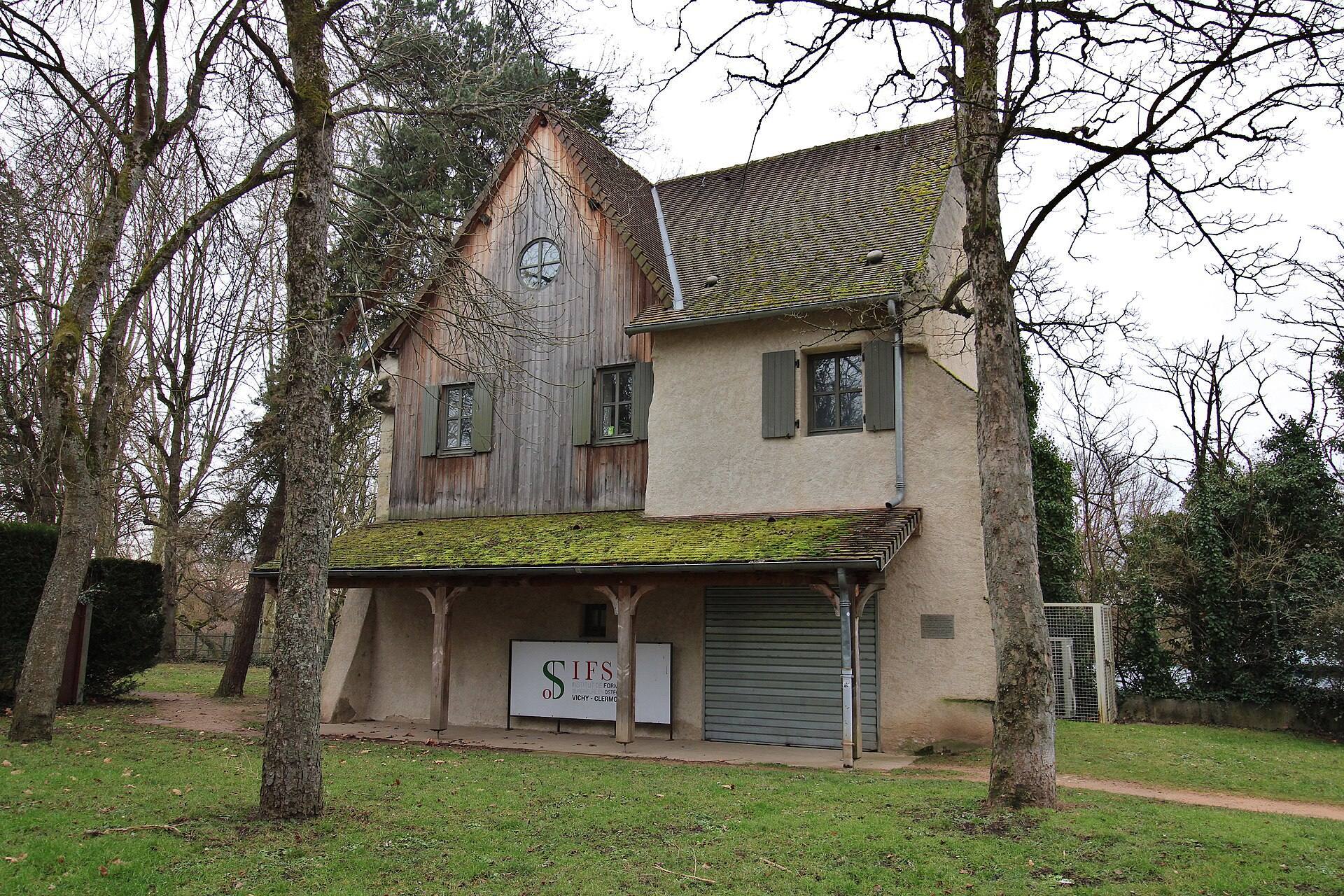
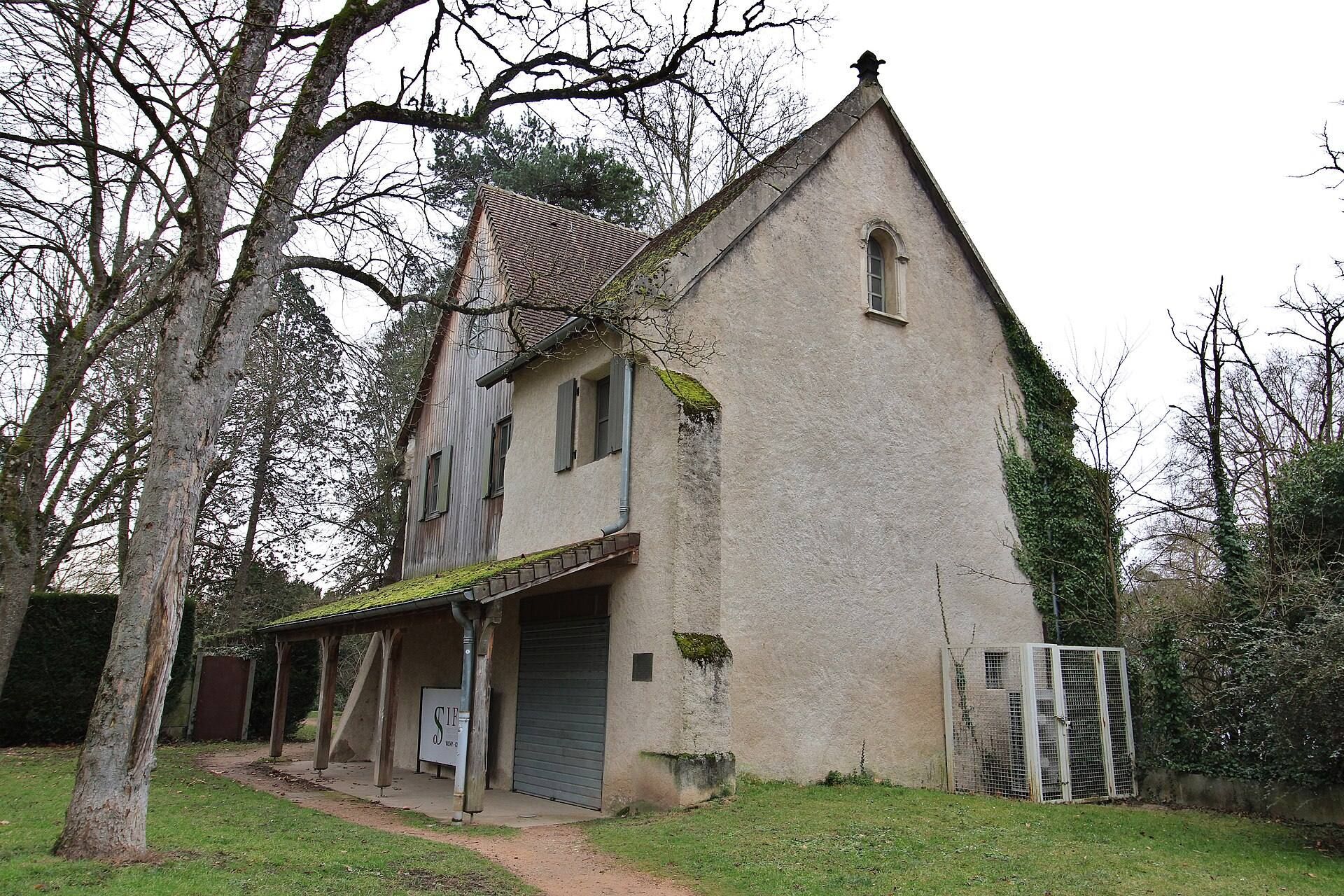
The remaining structure is a small rectangular residential building dating from the beginning of the fifteenth century. It has a very steeply pitched gabled roof, and its form is characteristic of Bourbonnais fortified houses, residences designed with defensive features on a smaller scale than castles. The building stood for a long period in a deteriorated condition before undergoing restoration.
Célestins Spring Structure
A separate structure at the foot of the terrace houses the Célestins spring. The spring is immediately below the former convent and remains physically associated with the site’s surviving landscape.