Corseul Roman City (Fanum Martis): Administrative and Religious Capital of the Coriosolites



Site at a Glance
- Rating
- 4.3
- Popularity
- Low
- Country
- France
- Primary era
- Classical
- Eras represented
- Iron Age, Classical
- Civilizations
- Roman
- Site type
- City
On this page14 sections
History
Corseul Roman City, known in antiquity as Fanum Martis, is a Roman city in France that developed as the administrative and religious capital of the Coriosolites. Its monumental architecture and road network were established mainly during the Augustan period, when Roman rule was reorganized after the conquest of Gaul. The settlement grew from prehistoric occupation into a major Gallo-Roman urban center.
Prehistoric and Iron Age origins
The area was occupied from the late Neolithic and early Bronze Age and expanded substantially during the late Iron Age. The Coriosolites, a Gallic people whose territory became a Roman civitas, or territorial and administrative district, are mentioned by Julius Caesar in 57 BC. Corseul is traditionally, or provisionally, regarded as their late Iron Age capital. Excavations conducted from 1961 through the early 1980s, however, did not uncover a substantial settlement demonstrating that it served as the political center of their civitas before the Roman conquest in 52 BC.
The creation of Fanum Martis
Under pressure from Emperor Augustus, the Coriosolites are thought to have established a new administrative and religious capital within their territory. The city was named Fanum Martis, a Latin name meaning “temple of Mars.” Mars was a major Roman god associated principally with warfare. Fanum Martis appears on the Peutinger Map, a medieval copy of an ancient Roman route map showing roads and settlements across the Roman world.
During the Early Roman Empire, the urban complex expanded to approximately 100 hectares, while the wider archaeological site covers about 110 hectares. Its planned streets, public and religious buildings, houses, and surrounding areas formed a substantial urban landscape. The city remained a major settlement through the Gallo-Roman period.
Late Roman transformation and medieval continuity
During the 3rd and 4th centuries, weakening Roman authority coincided with a change in the city’s name. Fanum Martis became known as Corseul, taking the name of the people whose capital it was. This period also saw renewed expression of local Gallic religious and ethnic identities in sculpture and dedicatory inscriptions.
The ancient settlement declined substantially at the beginning of the Christian era. Its later sequence included Gallo-Roman and Merovingian phases, with the Merovingian period belonging broadly to the early medieval era from the 5th to the 8th centuries. A major Roman road associated with the city continued in use into the Early Middle Ages.
Excavation and protection
The sanctuary now called the Temple of Mars at Haut-Bécherel was excavated in the early 19th century and designated a French historic monument in 1840. Archaeological exploration from the late 19th century onward revealed substantial urban remains. Extensive surveys and preventive archaeological investigations followed during the 1980s, while the ancient structures received historic-monument status in 1997.
Separate parts of the dispersed ancient city also received protection. The Haut-Bécherel Gallo-Roman site was designated in 1997, the Monterfil Gallo-Roman site was registered as a historic monument in 1995, and the Gallo-Roman remains at Clos-Mulon were classified in 2000. Archaeological work across the complex has brought to light funerary activity, domestic occupation, ceramics, Latin inscriptions, coin molds, and bronze ex-votos, or offerings dedicated to a deity as devotional gifts or in fulfillment of vows. Some of these offerings depict Harpocrates, the Greek form of the Egyptian child god Horus, whose image entered the Greco-Roman religious world and was often associated with silence.
Remains
The remains of ancient Corseul are distributed across several localities in the modern settlement, including Haut-Bécherel, Clos-Mulon, Monterfil, and the area beside the present church and town hall known as the site of the Jupiter Column. Together they represent a planned Roman city, its religious precincts, private houses, road system, and burial areas.
Sanctuary and religious monuments
Temple of Mars
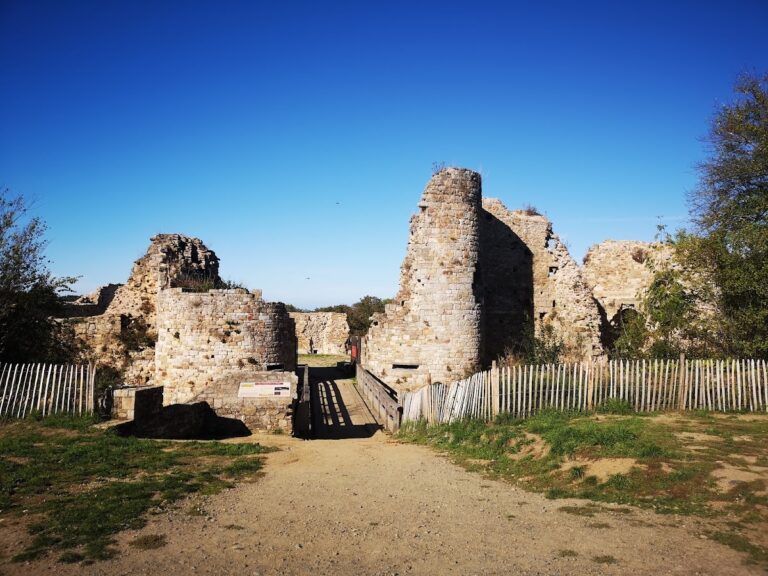
The Temple of Mars at Haut-Bécherel was built around the middle of the 1st century AD and remained in use until the end of the 3rd century. The sanctuary covered nearly one hectare. Three sections survive, with walls rising to about 10 metres. At its center was an octagonal cella, the enclosed central chamber of a Roman temple. The surviving masonry gives the sanctuary its principal physical form within the Haut-Bécherel archaeological area.
Jupiter Column
The Jupiter Column, also called the Column of the Garden of Antiquities, was found near the present church. One of the owners of Lessart Castle discovered it accidentally in a vegetable garden around the middle of the 19th century. The well-preserved granite monolith is 2.07 metres high and includes a base and capital. A small scrape marks one corner of its upper block.
The base has a rounded molding, a narrow band, and an inverted molding. Its central shaft is short and unusually thick, producing a massive, squat form, and its upper section carries a frieze with twisted motifs. The capital has three superimposed registers. The first uses truncated-conical collar forms, while the upper two combine to create a two-register upper block. Only three columns of this type dedicated to Jupiter have been recorded in Brittany. The other two are at Saint-Méloir-des-Bois in Côtes-d’Armor and Landudal in Finistère.
Urban houses, road, and domestic finds
Clos-Mulon houses
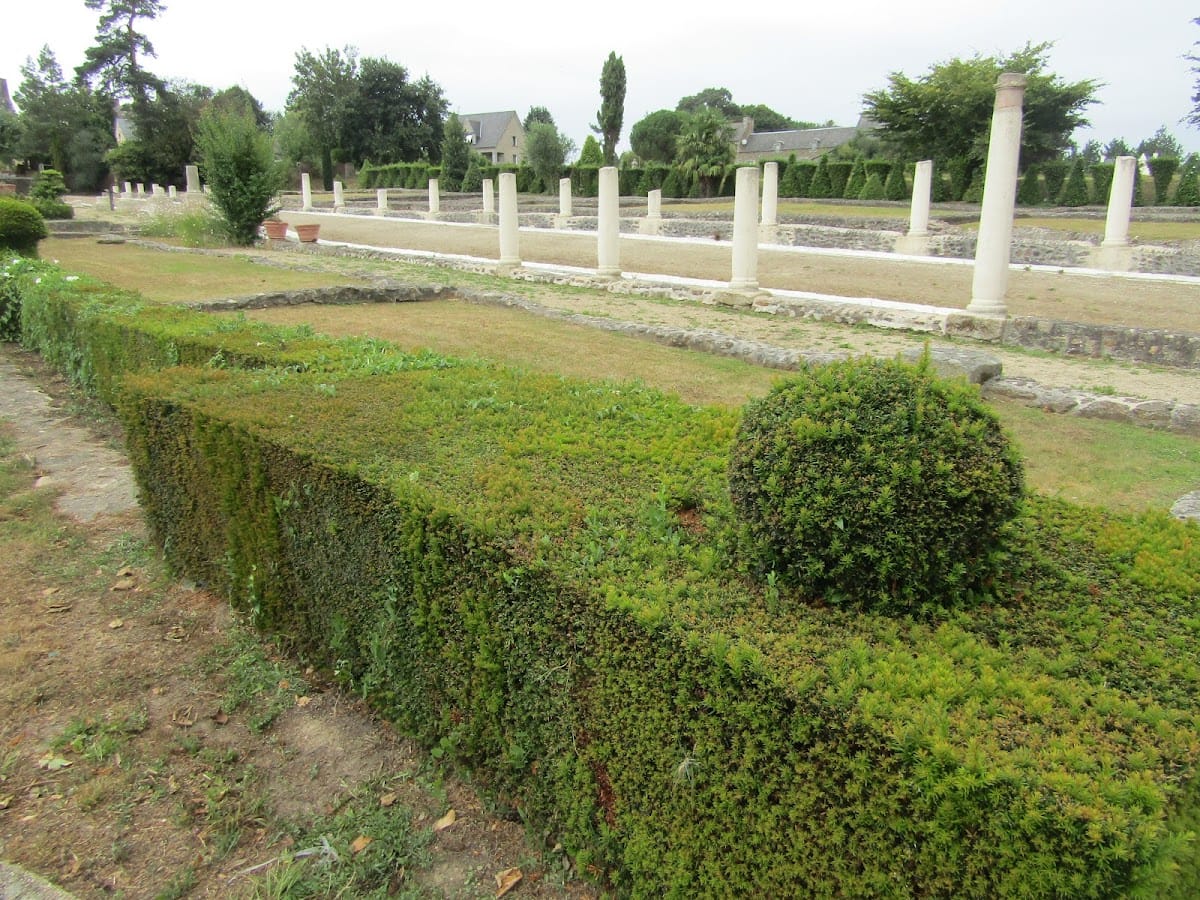
The first domus, substantial private urban houses, at Clos-Mulon were built during the 1st century within a planned street grid. The grid divided the settlement into residential blocks known as insulae. Their foundations remain visible. During the first three centuries AD, the houses probably belonged to a prosperous Coriosolite notable who received clients there. A thermal complex was later added on the western side.
Monterfil domestic area
Monterfil has produced substantial material from domestic ruins, including fragments of fine sigillata pottery. Three particularly elaborate pieces have unusual designs. One carries two decorative bands, including a hunting scene with a human figure and small bead-like ornaments. Another shows a gladiator and deer alternating with plant motifs and rosettes.
Roman road
Archaeological survey has identified a major Roman road that probably connected Fanum Martis with Cæsarodunum, the ancient city at modern Tours. Its route passed through the areas of Bazougers, Laval, Saulges, Bazouge-de-Chemeré, Vindunum at modern Le Mans, and Le Chenu. The road formed part of the wider network associated with the city and remained in use into the Early Middle Ages.
Burial ground
The Courtil Saint-Antoine burial ground was discovered during preventive archaeology in 1986 beneath the foundations of a private house. The funerary complex included 12 individual graves and one collective tomb. The individual graves were rectangular, flat-bottomed pits averaging about 1.90 metres in length. Bodies were placed along an east-west axis in wooden coffins, represented by surviving iron nail fittings.
The necropolis belongs to the Late Roman Empire and was probably used into the Early Middle Ages. Archaeometric analysis of one Gallo-Roman grave identified finger-mark impressions on seven bricks forming the pit walls. Each examined brick also had incisions on the same side as the impressions, preserving details of the construction process.