Basilica of San Domenico: Dominican Sanctuary in Bologna


Site at a Glance
- Rating
- 4.7
- Popularity
- Medium
- Country
- Italy
- Primary era
- Medieval
- External website
- Open
- Eras represented
- Medieval, Early Modern
- Civilizations
- Papal States
- Site type
- Religious
- Remains
- Basilica
On this page21 sections
History
The Basilica of San Domenico is a Roman Catholic Dominican sanctuary in Bologna, Italy, built by the Dominican order in a Romanesque setting from the early thirteenth century. It preserves the remains of Saint Dominic, founder of the Order of Preachers, a Catholic mendicant order devoted especially to preaching, theological study, and religious instruction. The adjoining convent hosted the order’s first General Chapters, giving the site a central place in Dominican history.
Foundation of the Dominican centre
Pope Honorius III approved Dominic’s rule on 22 December 1216. As the order expanded, friars were sent to Bologna and Paris, both important urban and university centres. Dominic arrived in Bologna in January 1218 and first lived with his companions at Santa Maria della Purificazione, known as the Mascarella, then outside the city walls.
The growing community moved in 1219 to the church and convent of San Nicolò delle Vigne, on the site of the present basilica. The Dominicans acquired the surrounding land, described as 31.5 stremmata, a traditional land measure, and developed it into their permanent Bolognese centre. Between 1220 and 1221 Dominic presided there over the order’s first two General Chapters. He died at San Nicolò on 6 August 1221 and was initially buried behind the church altar.
The convent expanded between 1219 and 1243 into a large monastic complex. From 1228, the church was enlarged by demolishing its existing apse and extending the nave. Its main construction was substantially complete by 1240, and the basilica subsequently served as a model for numerous Dominican churches. Pope Innocent IV consecrated it on 17 October 1251. Giunta Pisano’s celebrated crucifix was displayed for that occasion and remains in the basilica.
The tomb of Saint Dominic
In 1233 Dominic’s remains were placed in a cypress coffin inside a simple marble sarcophagus behind the altar of a side chapel in the right aisle. After Pope Gregory IX canonized him on 13 July 1234, the increasing number of pilgrims led to the creation of a more visible monument. In 1267 the remains were transferred to the elaborate shrine now called the Arca di San Domenico, an arca being a monumental shrine or sarcophagus made for the veneration of a saint’s remains.
The shrine continued to receive additions for almost five centuries. Niccolò Pisano and his workshop created its first major form in 1267, while Niccolò dell’Arca, Michelangelo Buonarroti, Alfonso Lombardi, and Jean-Baptiste Boudard contributed to later stages. The accumulation of these works, together with the founder’s tomb and the early convent, made San Domenico an important Dominican pilgrimage sanctuary.
Medieval and early modern transformations
The original thirteenth-century church was divided into an outer church for the faithful and an inner church reserved for the friars. A partition separated the two areas. It carried Giunta Pisano’s crucifix and later supported the wooden choir. The partition was removed in the seventeenth century during liturgical reforms associated with the Council of Trent, and the choir was moved behind the high altar.
The fourteenth century brought additional chapels and the construction of the Gothic bell tower in 1313. Chapels were added or replaced repeatedly during the fifteenth and sixteenth centuries. The Ghisilardi Chapel was built beside the left side of the façade between 1530 and 1534. Baldassarre Peruzzi designed it during his residence in Bologna, Jacopo Ranuzzi directed its construction, Alfonso Lombardi was commissioned for its decoration in 1531, and Pietro Fiorini added the altar late in the sixteenth century.
In 1551 four small Gothic chapels in the left aisle were replaced by a second Pepoli Chapel, designed by Antonio Morandi, known as Terribilia. The fourteenth-century Chapel of San Domenico was rebuilt between 1597 and 1605 to designs by Floriano Ambrosini. The rebuilding replaced the earlier Gothic chapel that had housed Dominic’s remains since 1233.
Carlo Francesco Dotti carried out major alterations and restoration between 1728 and 1732 under the patronage of Pope Benedict XIII. The work brought the medieval interiors into a unified Baroque arrangement, a style known for elaborate decoration and integrated spatial effects. It also added a portico attached to the façade and connected to the convent. Bologna’s municipal authorities demolished both arms of the portico in 1874, removing the fifteenth-century porch incorporated into it.
Modern institutional history
Pope Leo XIII raised the church to the rank of minor basilica in May 1884. Alfonso Rubbiani directed the façade restoration of 1909 and 1910, following Raffaele Faccioli’s design of 1894. The intervention sought to restore the building’s probable Romanesque appearance, including its gabled form and large rose window.
The adjoining convent was confiscated by the state in 1866 and served as a military hospital during the Second World War. Its gradual recovery allowed young religious preparing for religious life to return. In 1962 the convent was incorporated into the Theological Faculty of the Pontifical University of Saint Thomas Aquinas. The basilica and convent remain closely associated with Dominican religious life.
Remains
The basilica combines a Romanesque brick façade with Gothic, Renaissance, and Baroque additions. Its plan contains a long central nave, two lower side aisles, numerous chapels, a transept, a choir, and a deep polygonal apse. The adjoining convent extends longitudinally beyond and above the façade on the right, while the Renaissance Ghisilardi Chapel projects from its left side.
Façade and Piazza San Domenico
Romanesque façade
Completed in 1240, the façade is a simple gabled front built entirely of brick, reflecting the austere construction associated with mendicant orders. A corbelled arched frieze runs beneath the roofline. The entrance has a slightly projecting portal with a shallow porch and two narrow single-light windows. At the centre is a large openwork rose window of white marble, divided into twelve radial pairs of columns and surmounted by a Greek cross. Its gabled profile and rose window were reconstructed or restored in 1909 and 1910 in imitation of their probable original appearance. The portal lunette contains a mosaic of Saint Dominic blessing Bologna, based on an eighteenth-century painting by Lucia Casalini Torelli at the convent entrance.
Square and funerary monuments
Piazza San Domenico is paved with river cobbles in a manner associated with medieval Bologna. The square historically accommodated large crowds attending Dominican preaching and was originally separated from the street by a wall. It also served as the original cemetery. Its rear section contains Giulio Cesare Conventi’s stone-and-copper column of the Madonna of the Rosary, dated 1632 and commemorating the end of a plague epidemic. Another column carries a statue of Saint Dominic.
The square contains the tomb of the glossator Rolandino de’ Passaggeri, dated 1305, and the tomb of Egidio Foscherari, dated 1289. Foscherari’s monument incorporates an ancient Byzantine marble arch with ninth-century relief decoration. A similar tomb of the Muzzarelli family formerly stood beside Rolandino’s monument.
Nave, chapels, and transept
Nave and side chapels
The exceptionally long nave has alternating arches and entablatures. Its ceiling was lowered during the Baroque remodelling, and a large dome interrupts the central axis. Ten paintings in the lunettes or wall areas above the Ionic supports show historical and legendary episodes associated with the church. Giuseppe Pedretti painted the first two, while Vittorio Bigari painted the remainder. Four stucco statues by Giuseppe Mazza on the interior side of the façade represent Prudence, Fortitude, Temperance, and Justice.
The substantially lower side aisles contain chapels of different sizes. Filippino Lippi’s Mystical Marriage of Saint Catherine of Alexandria, painted in 1501, is in the Casali or Isolani Chapel. Francesco di Simone Ferrucci of Fiesole made Alessandro Tartagni’s tomb in the side-entrance vault. Ludovico Carracci’s Saint Raymond of Peñafort Crossing the Sea on His Mantle is in the second chapel on the left, while Donato Creti’s Saint Vincent Ferrer Reviving a Child is in the second chapel on the right.
Chapel of San Domenico
The Chapel of San Domenico occupies the right side of the basilica’s long body, approximately halfway along its length and opposite the Rosary Chapel. Floriano Ambrosini rebuilt it in the Baroque style between 1597 and 1605. The square chapel has a semicircular apse and a dome, and its floor stands about 1.5 metres above that of the basilica. It measures approximately 13.60 metres wide, 23.80 metres long, and 38 metres high. Verona marble faces the interior, while an iron-and-brass railing at the entrance bears the date 1621.
Four paintings from 1613 to 1615 depict miracles associated with Saint Dominic. Lionello Spada painted the fire-resistant book, Alessandro Tiarini painted the resurrection of a child, and Giovanni Andrea Donducci, known as il Mastelletta, painted the resurrection of Napoleone Orsini and the resurrection of drowned pilgrims. Guido Reni painted the apse fresco of the Glory of Saint Dominic during the same period. Seven statues made by Giovanni Todeschi between 1617 and 1631 represent Faith, Hope, and Charity, together with Temperance, Fortitude, Justice, and Prudence.
Rosary Chapel
The Rosary Chapel lies opposite the Chapel of San Domenico. Francesco Abaco and Giovanni di Pietro of Como built it for the Guidotti family between 1460 and 1465. From the second half of the sixteenth century it belonged to the Confraternity of the Rosary, an organization formed within the Dominican order, and acquired its present name. Floriano Ambrosini rebuilt the altar in 1589.
The altar’s central image is the Madonna of the Rosary, surrounded by fifteen painted panels representing the fifteen Mysteries of the Rosary. Completed in 1601, the panels include works by Ludovico Carracci, Guido Reni, Bartolomeo Cesi, Denis Calvaert, Lavinia Fontana, Francesco Albani, and Domenichino. Angelo Michele Colonna and Agostino Mitelli decorated the vault and apse between 1655 and 1657. The vault shows the Assumption, while the apse represents Heaven and Earth glorifying the Madonna of the Rosary. Carlo Francesco Dotti designed the two choir galleries in 1736.
Petronio Giovagnoni built the chapel’s pipe organ between 1759 and 1762. It has a 45-key keyboard, an 18-pedal short-octave pedalboard, and ten stops, and was restored by Seri and Ungarelli in 2003. Wolfgang Amadeus Mozart studied on this instrument in Bologna with the Dominican musician and scholar Giovanni Battista Martini while preparing for admission to the Accademia Filarmonica di Bologna. Guido Reni and Elisabetta Sirani were buried in the chapel.
Transept chapels
The left transept contains an eighteenth-century cenotaph for Enzio of Sardinia, who was buried in the church in 1279, and the tomb of the Dominican bishop Martino of Opavia. It also contains the remains of Blessed James Griesinger of Ulm, a Dominican artist who produced important Gothic stained-glass windows for the Basilica of San Petronio.
The Chapel of Saint Michael in the right transept wall contains Giunta Pisano’s crucifix, made around 1250 and formerly installed on the partition between the two medieval sections of the church. A detached mid-fourteenth-century fresco attributed to Jacopo Benintendi, known as il Biondo, depicts Saint Thomas Aquinas and Saint Antony Abbot, the latter sometimes identified as Saint Benedict. Thomas wears the Dominican habit and holds an open book and a model of a church. Antony or Benedict wears the Benedictine habit and holds a closed book and a pastoral staff.
A sixteenth-century reconstruction of the monument to Taddeo Pepoli preserves marble slabs carved in high relief with four scenes from the life of the ruler of Bologna. A Pisan sculptor made the scenes around 1347. The monument spans two chapels and was completed only in the sixteenth century. Guercino’s Saint Thomas Aquinas, painted in 1662, is in the right transept.
Apse, choir, and shrine
High altar and choir
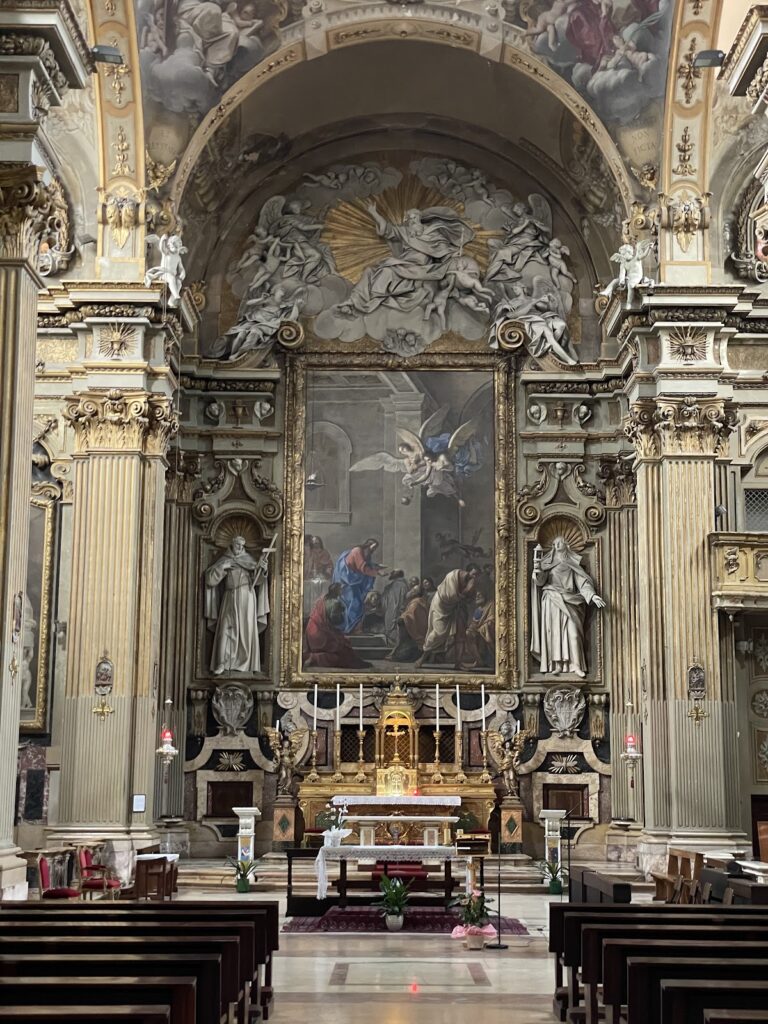
The central nave ends in a deep polygonal apse illuminated by large rectangular windows. The present high altar is an eighteenth-century work by Alfonso Torreggiani. It replaced Giovanni di Balduccio’s 1330 altar, a large sculpted polyptych, meaning a multi-panel altarpiece, commissioned by the papal legate Bertrando del Poggetto for the principal chapel of the Castello di Porta Galliera. Its surviving parts are now dispersed among museums and collections in Detroit, Bologna, Marseille, Faenza, and a private collection.
Behind the high altar is a monumental wooden choir made by Fra Damiano da Bergamo. Its 102 stalls were designed for Dominican conventual Mass and the Liturgy of the Hours. The Renaissance intarsia, an inlaid wood decoration made from pieces of different colours or grains, was executed principally between 1541 and 1549 and completed by Bernardino da Bologna. Drawings associated with Jacopo Barozzi da Vignola guide the arrangement, with scenes from the Old Testament on the right and scenes from the New Testament on the left. Giorgio Vasari recorded the work in the Vite.
The apse polyptych by Bartolomeo Cesi stands within a richly carved and gilded wooden frame. Its central image is the Adoration of the Magi, with the Last Supper below. The ensemble also includes Saint Nicholas of Bari and Saint Dominic at the sides, and Vincenzo Spisanelli’s Miracle of the Bread below.
Arca di San Domenico
The Arca di San Domenico is a marble sarcophagus and shrine containing the saint’s remains. Niccolò Pisano and his pupils created its first major form in 1267, decorating the sarcophagus with six panels showing episodes from Dominic’s life. The original support included column-statues, several of which are now in museums including the Bargello in Florence, the Museum of Fine Arts in Boston, the Victoria and Albert Museum in London, and the Louvre in Paris.
Niccolò dell’Arca worked on the shrine between 1469 and 1473, creating the upper decorative zone and the left angel bearing a candelabrum. In 1494 the young Michelangelo contributed the statues of Saints Petronius and Proculus and the right candelabrum-bearing angel. Alfonso Lombardi made the central panel of the Adoration of the Magi and lateral scenes from Dominic’s life in 1532. Jean-Baptiste Boudard created the bas-relief of Dominic’s death beneath the altar in 1768.
The upper section depicts God the Father holding the world, symbols of earth, sky, and sea, the dead Christ between angels, and the four Evangelists. Eight statues represent Bologna’s protectors. Francis, Petronius, Dominic, and Florian appear on the front, while Agricola, John the Baptist, Proculus, and Vitalis are at the rear. The lower zone contains the Adoration of the Magi, scenes from Dominic’s life, and the relief of his death. Behind the shrine is a fourteenth-century reliquary made by Jacopo Roseto da Bologna in 1383. It contains Dominic’s head and was formerly carried through Bologna in procession during the saint’s feast.
Bell tower, organs, and convent
Gothic bell tower
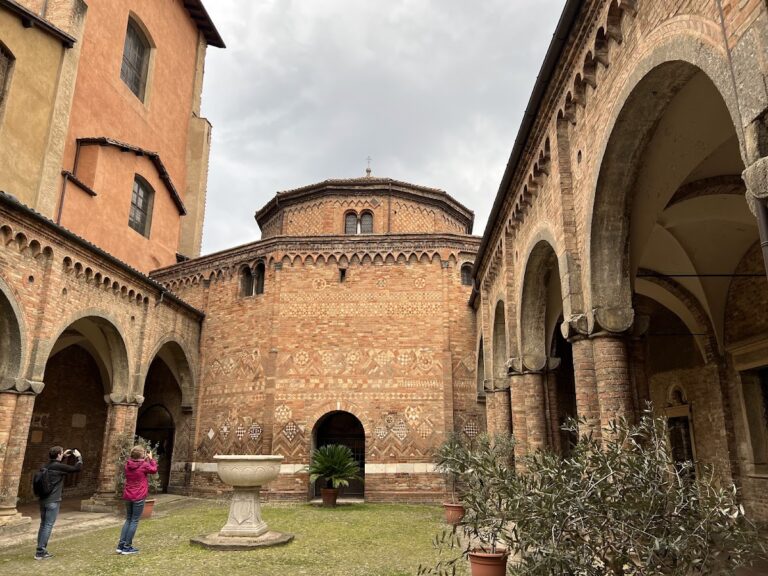
The Gothic bell tower dates from 1313 and rises in three stages. Visible from the inner cloister, its lowest stage has single-light windows, the middle stage has double-light windows, and the bell chamber has triple-light windows. A slender spire brings the tower to a height of 52 metres.
The bell chamber contains five bells mounted in the Bolognese manner on wooden frames and hubs. The two smaller bells are placed above the three larger ones. The largest was cast by Antonio and Pietro Francesco Censori in 1603, has a diameter of 127 centimetres, and weighs approximately 1,500 kilograms. The Mezzana bell, cast by Giacomo and Antonio Bonettini in 1707, measures 93.2 centimetres and weighs about 600 kilograms. The Mezzanella, cast by Antonio and Pietro Francesco Censori in 1615, measures 83 centimetres and weighs about 450 kilograms. The smaller bell was cast by Clemente Brighenti in 1857, while the Piccola del Maggiore was cast by Domenico Fantuzzi in 1782.
Organs and convent buildings
The basilica has three pipe organs. Adeodato Bossi Urbani built one in 1851, reusing the case and façade pipes of Giuseppe Gatti’s 1739 instrument. Fratelli Rasori built another in 1854, also reusing the case and façade pipes of a Gatti organ from 1739, modified in 1760 by Pietro Nacchini and Francesco Dacci. The third is Giovagnoni’s organ in the Rosary Chapel.
The convent includes fourteenth-, fifteenth-, and sixteenth-century cloisters, together with a chapter room containing a fourteenth-century image of Saint Dominic described as the oldest known representation of him. A cell is traditionally identified as Dominic’s original cell, or possibly the cell in which he died. Original letters of introduction and his canonization bull of 9 July 1234 are displayed in the convent.
The Renaissance library dates from 1466 and was planned as a basilica-like structure divided by columns. It contains valuable manuscripts and is associated with Dominican philosophical and theological study. The library complex includes the Bolognini Hall, whose wooden coffered ceiling shelters Marcantonio Franceschini’s Ecstasy of Saint Thomas Aquinas. Other parts of the complex serve the faculty of philosophy and theology and a conference room.
Museum and associated works
The small museum contains works and relics connected with the basilica and convent. They include a thirteenth-century Gothic reliquary of Saint Louis IX of France, Lippo di Dalmasio’s Madonna and Child, known as the Madonna of the Velvet, and remains of Baccio da Montelupo’s terracotta Pietà of 1495. The collection also includes Niccolò dell’Arca’s polychromed terracotta bust of Saint Dominic from 1474, remains of a fourteenth-century fresco of the Madonna and Child with Saint Dominic, Ubaldo Gandolfi’s Madonna and Child with Saint Dominic and Vincent Ferrer, the Paschal Lamb, sometimes attributed to Giorgio Vasari, and several intarsia panels by Fra Damiano da Bergamo.
A fourteenth-century fresco of the Madonna and Child with Saint Dominic is noted for the detailed pattern of the water-flow wake near Saint Christopher’s heels. This feature has been proposed as an influence on Theodore von Kármán’s studies. Tombstones and memorial tablets remain in the cloister walls, adding to the material record of the Dominican complex.
Nearby sites