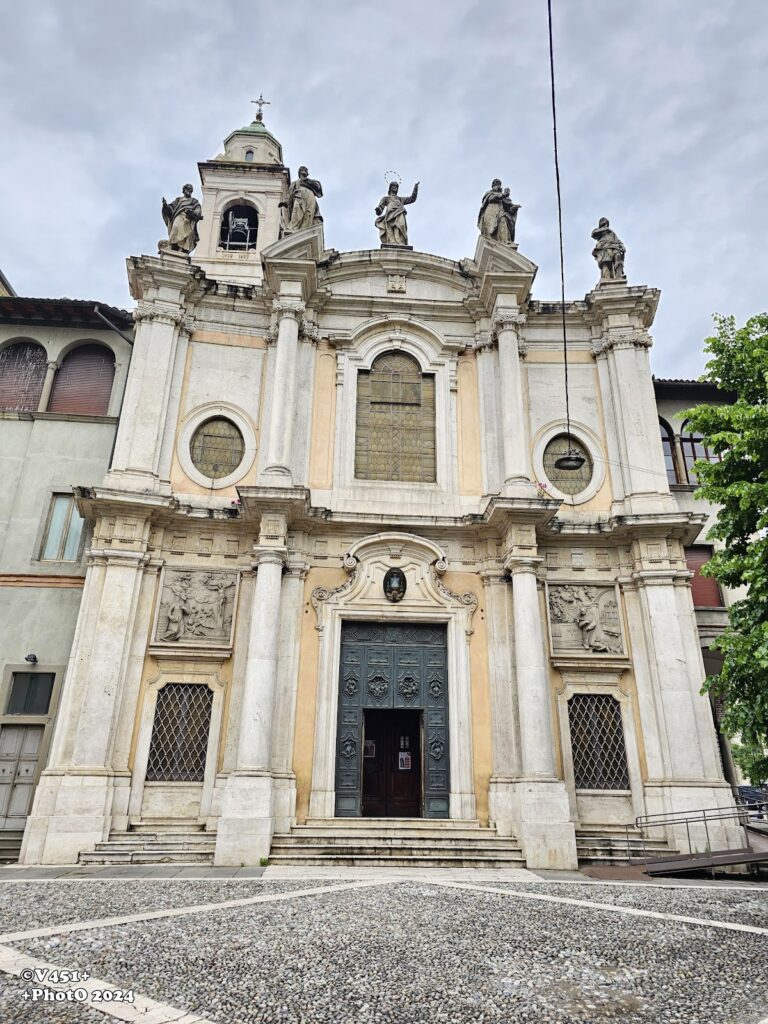
Church of Santo Spirito, Bergamo: A Renaissance Church and Former Monastic Complex
Site at a Glance
- Rating
- 4.6
- Popularity
- Low
- Country
- Italy
- Primary era
- Early Modern
- External website
- Open
- Eras represented
- Medieval, Early Modern, Modern
- Civilizations
- Austrian Empire, Habsburg, Venetian
- Site type
- Religious
- Remains
- Church
On this page20 sections
History
The Church of Santo Spirito is a Roman Catholic church in Italy, in the city of Bergamo. Its consecration dates to the fourteenth century, and its history began with the Santo Spirito monastery founded in 1311 by Cardinal Guglielmo Longhi. The complex was entrusted to the Celestines, a Benedictine congregation founded by Pietro da Morrone, later Pope Celestine V. Its early community was a double religious house for monks and nuns, known initially as the “brothers of the Holy Spirit.”
Foundation and Celestine monastery
The original foundation included a three-aisled church, a cloister, and a hospital. By the end of the fourteenth century, the church had been rebuilt on a larger scale, again with three aisles. The monastery therefore developed as both a religious and charitable institution, with its church forming part of a wider complex rather than standing as an isolated building.
In 1475, at the direction of Pope Sixtus IV, Canon Andrea da Ponte transferred the church from the Celestines to the Lateran Canons Regular of the Order of Saint Augustine. The Lateran Canons were an Augustinian canonical order whose members followed a common religious rule while serving in a collegiate community. Their arrival began a new phase in the history of Santo Spirito.
Lateran reconstruction and Renaissance patronage
During the early sixteenth century, the Lateran Canons undertook a major reconstruction of the church, monastery, and chapter house. The church became locally known as the “Church of the Tasso” because the Bergamo Tasso family contributed to its enlargement, helping to affirm the family’s social standing. The suggestion that the family promoted Lorenzo Lotto’s altarpiece is not supported.
The community followed an ascetic regime based on poverty, penance, and silence. Its substantial library contained Latin, Hebrew, and Greek works on theology and humanist culture. The collection was later donated to the Angelo Mai Civic Library. The movement of canons between monasteries also brought new ideas to Santo Spirito, and Canon Pietro Ritta da Luca stayed there during Easter in 1520.
The church and monastery took part in religious debates associated with the spread of Lutheran ideas. After the Council of Trent, the sixteenth-century Catholic council that defined Catholic reforms and doctrine in response to the Protestant Reformation, the canons conformed to its directives. Canon Gerolamo Zanchi later left for Germany and became a Calvinist, joining a Protestant tradition associated with the teachings of John Calvin.
Newly established families living in the Renaissance palaces along Via Pignolo commissioned chapels in the church. The first three chapels on the right were begun in 1512, with major involvement by the Bergamasque architect Pietro Isabello, also known as Abano and Cleri. He may have worked from an earlier design by an unknown architect. The right central chapel was completed in 1512, while the chapels on the left were completed later, between 1558 and 1560, under the direction of Paolo Berlendis. The Cassotti Mazzoleni, Gozzi, Angelini, and Tasso families financed four chapels, with the Tasso chapel dedicated to Saints Peter and Paul.
Later alterations and suppression
The unfinished reconstruction continued in the early eighteenth century. Around 1720, Giovanni Battista Caniana removed the medieval nave columns and built the barrel vault that remains a defining feature of the interior. In the nineteenth century, the architect Vincenzo Lucchini redesigned the choir and presbytery. Maintenance work in 1856 caused the loss of the burials of three members of the Tasso family, whose graves had occupied the central part of the floor. In 1858, Lucchini’s design also reduced the choir from fifty stalls to seventeen.
The Republic of Venice suppressed the monastery in 1785. Its buildings passed to the House of Industry and Labor, while the church became a subsidiary church of Sant’Alessandro della Croce. The former monastic picture collection was dispersed after the closure. Many works by Antonio Cifrondi were sold and entered churches elsewhere in the Bergamo diocese, while other paintings remained in Santo Spirito, particularly in the sacristy.
Remains
Plan, facade, and interior structure
The church is a Renaissance building with a rectangular plan and a single nave. Five chapels line each side, leading toward a narrower raised presbytery, a choir, and a sacristy. The presbytery stands five steps above the nave, with the steps made of Zandobbio marble. A gabled facade completes the exterior, although its unfinished surface preserves evidence of several building phases.
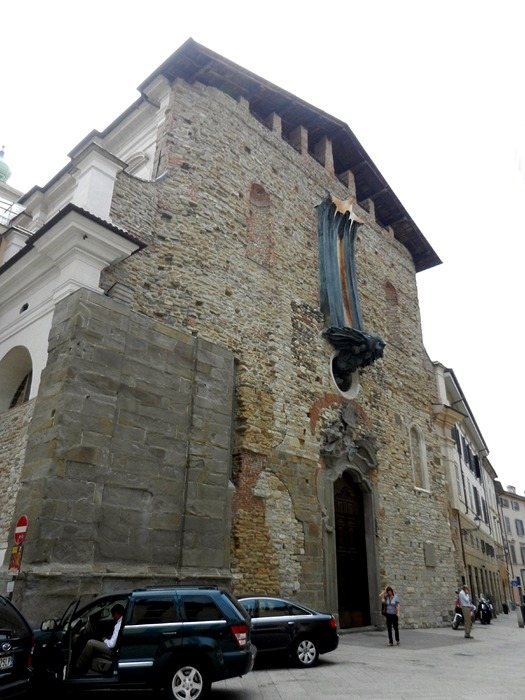
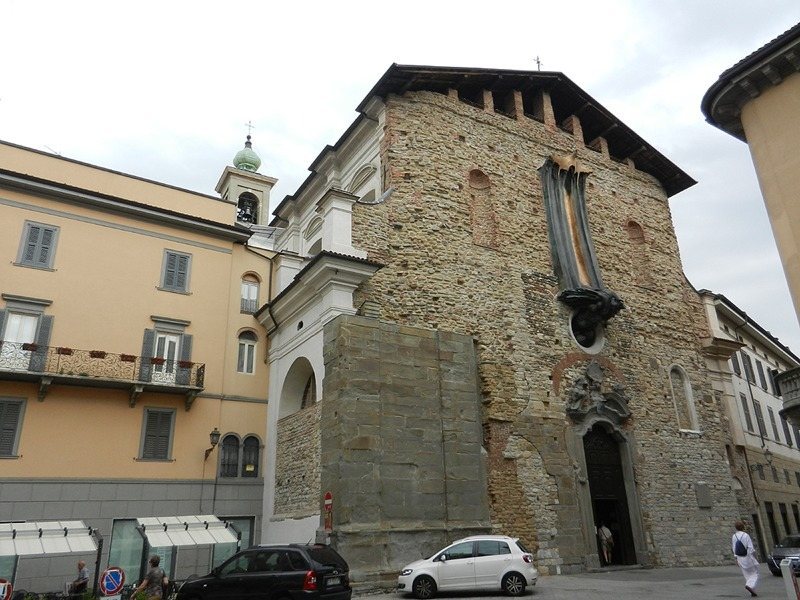
Facade
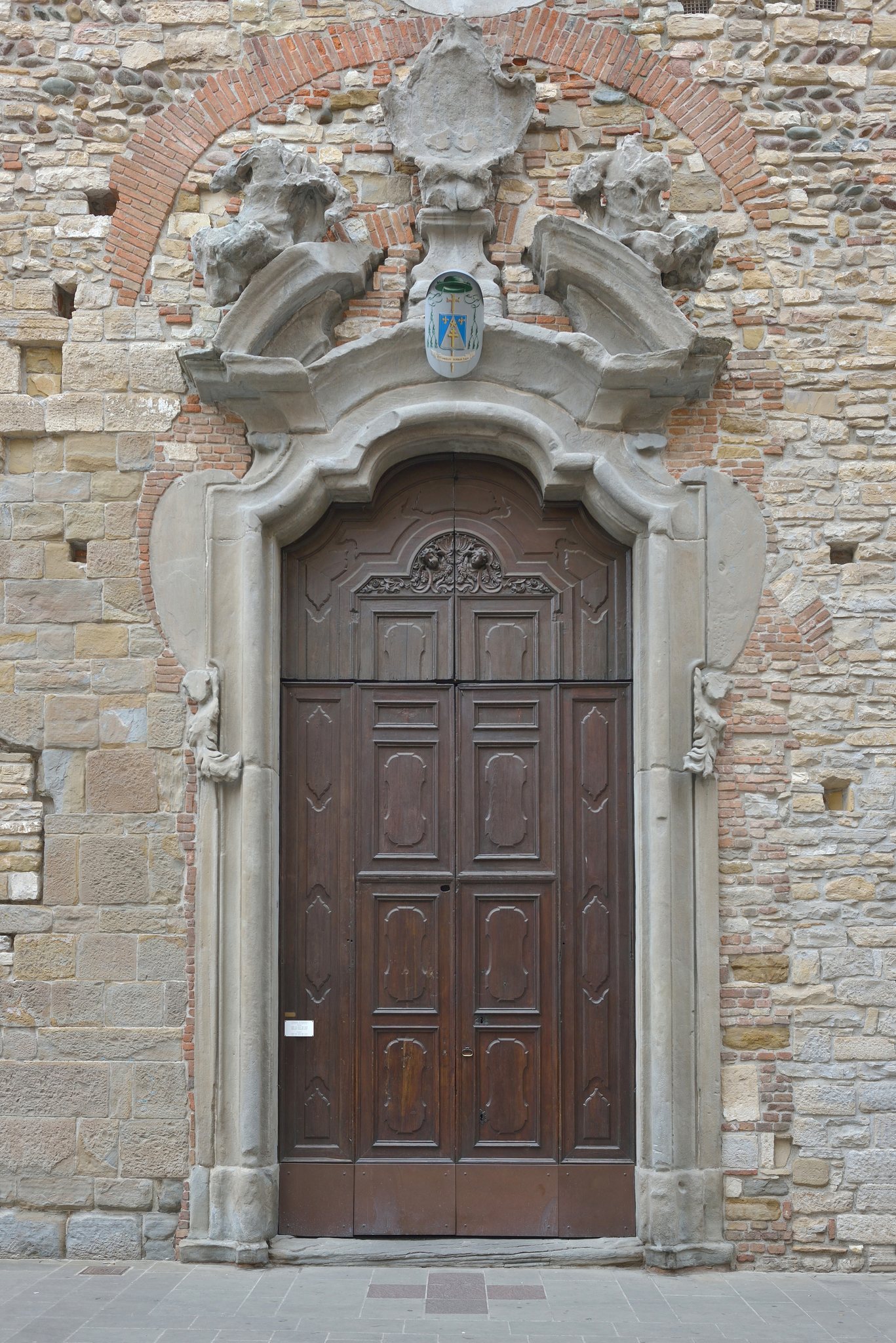
The facade contains blocked and opened apertures that reveal successive alterations. Its stone base and the small rose window above the entrance belong to the original fourteenth-century construction. The left portion dates from the sixteenth century, while the portal and two empty niches were added in the eighteenth century. A sandstone facing begun on the left side in 1569 was never completed. Antonio Pirovano made the portal in the eighteenth century. A bronze sculpture by Francesco Somaini, installed in 1971, represents the descent and power of the Holy Spirit, with a nearby plaque recording its commission and purpose.
Nave and chapels
Large sculpted sandstone columns stand on high pedestals inside the nave. They have composite capitals, with some supports fluted and others decorated with friezes and garlands. The columns carry a projecting entablature and Caniana’s eighteenth-century coffered barrel vault, a vault divided into recessed decorative panels. High-relief medallions beside the capitals show biblical figures. These medallions are the only elements specifically identified as surviving from the former Celestine church. The columns also bear an S crossed by a cross, the symbol of the Holy Spirit.
A cornice and semi-columns join the side chapels, although the chapels are not equally deep. Those on the right extend farther than those on the left. This difference resulted from the restricted building area and the effort to reduce construction costs, rather than from a single uniform design.
Right-side chapels
First and second chapels
The canons commissioned the first two chapels on the right in 1519. They contain Giulio Carpioni’s Deposition of Our Lord and Domenico Maria Viani’s seventeenth-century Miracle of Saint Antony of Padua.
Casotti chapel
The third chapel on the right was designed by Pietro Isabello and became the model for later chapels. An act dated 10 July 1512 calls it the first chapel constructed in the church. The Casotti brothers commissioned it, and their initials remain in a roundel on the outer column. Dedicated to the Sacred Heart of Jesus, it originally held Andrea Previtali’s Saint John the Baptist among Other Saints, which was later moved to a chapel on the left. A high-altar mensa is also associated with Isabello.
Angelini chapel
The fourth chapel on the right contains Lorenzo Lotto’s Madonna and Child with Saint Catherine, Saint Augustine, Saint Sebastian, and Saint Antony Abbot. This oil painting on panel is signed “L. Lotus” and dated 1521. The Marchetti Angelini merchants commissioned it. Gian Paolo Cavagna’s paintings of Daniel in the Lions’ Den and Saint Francis Receiving the Stigmata, made in the second half of the sixteenth century, flank Lotto’s work. The upper part of the composition shows celebrating angels, referring to the Angelini family coat of arms.
Gozzi chapel
The canons commissioned the fifth chapel on the right toward the end of 1512, and it was soon granted to the Gozzi brothers. Their coat of arms and the letter B for Bartolomeo Gozzi recur among the column decorations. The chapel contains a two-level polyptych, an altarpiece made of several painted or carved panels, dated 1525 and made by Andrea Previtali with his pupil and assistant Agostino Facheris. Its lower level includes Saints Lucy and Catherine and Saint Ursula protecting kneeling female figures.
Left-side chapels
Paintings and devotional works
The left-side chapels contain Andrea Previtali’s Saint John the Baptist among Other Saints, dated 1515, and Ambrogio Bergognone’s eight-panel polyptych showing the Descent of the Holy Spirit upon the Madonna and the Apostles. Bergognone’s work was commissioned by Domenico Tasso and originally stood on the high altar. A fifteenth-century Madonna and Child by an anonymous artist was formerly owned by the Rota family and donated to the church after a reported devotional miracle in which the Virgin was believed to have moved her eyes. Paintings of the Passion of Christ are attributed to Pietro Rotari.
Tasso chapel
Domenico Tasso commissioned the chapel dedicated to the Tasso family. Its decoration includes the initials of Domenico and his wife, Elisabetta Rota, who completed it in 1541 after her husband’s death. The chapel contains the funerary monument of Agostino Tasso, who died in 1510, and Caterina Tasso, who died after 1516. Antonio Fantoni of Rosciano made the monument in 1511 for their son Luigi Tasso, a bishop. It originally stood beside the high altar, while its upper sculptural group was later converted into the high altar facing the congregation after the reforms of the Second Vatican Council.
The chapel also contains Scipione Piazza’s 1545 altarpiece, Madonna and Child with Saints Peter and Paul and an Angel. Its imagery presents the Virgin as the Church, Saint Peter receiving the keys, and an angel reading Saint Paul’s Epistle to the Romans. Andrea Cifrondi’s Christ Dead with the Magdalene is placed beside it.
Presbytery, choir, and sacristy
Presbytery
The presbytery contains the marble body of the former Agostino and Caterina Tasso monument. It incorporates the Madonna, Saint Augustine, and Saint Catherine, separated by two richly carved pilasters. Other paintings in this area include Francesco Capella’s Crucifixion with Saint Apollonia, the Magdalene, and Disciples, Marco Olmo’s Adoration of the Shepherds, and Saverio Veronese’s Madonna Appearing to Saint Jerome.
Choir
The canons commissioned the wooden choir in 1501, with Giacomo Tasso paying half its cost. It was completed in 1504. Seventeen of its original fifty stalls survive after the reduction carried out in 1858. Rich carving and distinctive small columns define the remaining choir furniture.
Sacristy
The sacristy preserves works that once belonged to the monastery’s large picture collection. It contains the cenotaph of Bishop Luigi Tasso, a commemorative monument that does not necessarily contain the deceased’s remains, commissioned by his brothers Domenico and Pietro Andrea Tasso. Nearby is Agostino Facheris’s 1531 painting Madonna and Child with Saints and Bishop Luigi Tasso, which shows the bishop kneeling before the Virgin with Saint Antony of Padua and Saint Louis of Toulouse.
Further paintings by Antonio Cifrondi depict biblical figures. Seventeen surviving works form part of a larger series of at least fifty paintings commissioned by the Lateran fathers between 1701 and 1705. The other works were dispersed after the monastery closed. The church’s preserved artistic ensemble also includes Previtali’s 1525 ten-panel polyptych of the Madonna and Child with Saints, the 1521 Lotto altarpiece, Bergognone’s Holy Spirit polyptych, Piazza’s painting of the Madonna and Child with Saints Peter and Paul and an Angel, and Previtali’s Saint John the Baptist among Other Saints.