Palazzo della Provincia: Bergamo’s Provincial and Prefectural Seat


Site at a Glance
- Rating
- 4.7
- Popularity
- Very Low
- Country
- Italy
- Primary era
- Modern
- External website
- Open
- Eras represented
- Modern
- Civilizations
- Italian
- Site type
- Civic
- Remains
- Palace
On this page13 sections
History
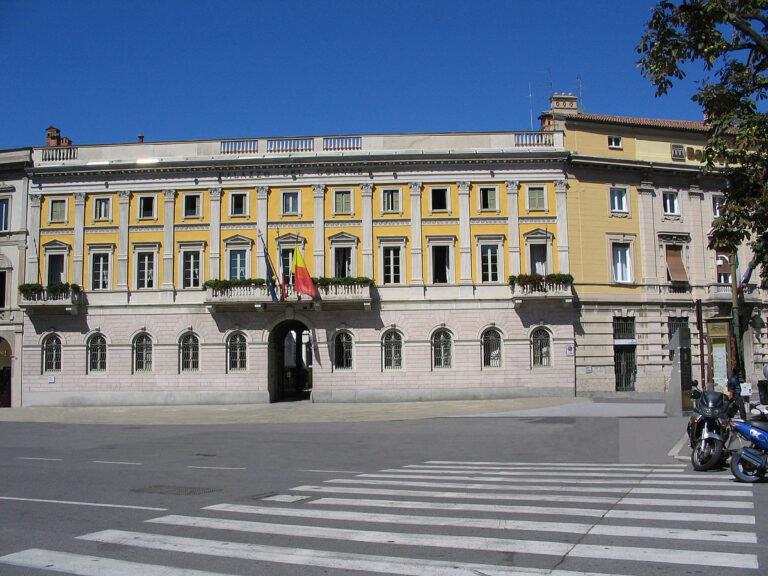
Palazzo della Provincia in Bergamo, Italy, is a Renaissance-style public building constructed between 1864 and 1871 during the nineteenth-century expansion of the city’s lower district. It was the first public work erected in Bergamo after the establishment of the Kingdom of Italy in 1861, and it remains the seat of the Province of Bergamo and the prefecture, the local office of the state prefect.
From the Visconti citadel to a new administrative centre
Until the middle of the nineteenth century, the provincial administration, prefecture, and tribunal operated in cramped premises within the Visconti citadel. These offices occupied the section built by Bernabò Visconti, the fourteenth-century lord of Milan whose ruling family controlled Bergamo during parts of the late medieval period. Population growth and the development of the lower city made relocation necessary, leading to plans for a purpose-built administrative complex in a more convenient position.
Two designers were initially involved. Angelo Ponzetti was asked to convert an older building near the church of Saints Bartholomew and Stephen, while Giovanni Savoia proposed a new palace on the former meadow of Sant’Alessandro. The meadow had hosted a fair and, in the area selected for the building, a cattle market. It was also regarded as unhealthy. Savoia’s proposal was chosen, later modified by Antonio Preda, and completed by Giovanni Cuminetti.
Construction and urban transformation
The palace formed part of the rapid urbanization of Bergamo’s lower city. Removing the market huts helped transform the Sant’Alessandro meadow, an area also associated with the nearby Gaetano Donizetti Theatre, inaugurated in 1791. Construction lasted from 1864 to 1871 and produced 2,450 square metres of space for the offices of the provincial administration and prefecture.
The project attracted criticism for its ambitious scale, elaborate finishes, and white granite columns. Its cost was said to have increased by 60 percent, provoking opposition during construction. As the lower city continued to develop, however, acceptance of the completed building grew, and the palace became an established centre of public administration in Bergamo.
Collections and civic uses
The provincial administration created the Premio Ulisse career award in 2001 for artists whose twentieth-century work had strengthened Bergamo’s artistic reputation, including at national level. Works acquired through the award, together with earlier donations and purchases, contributed to the Galleria dei Maestri del Novecento in the presidential room.
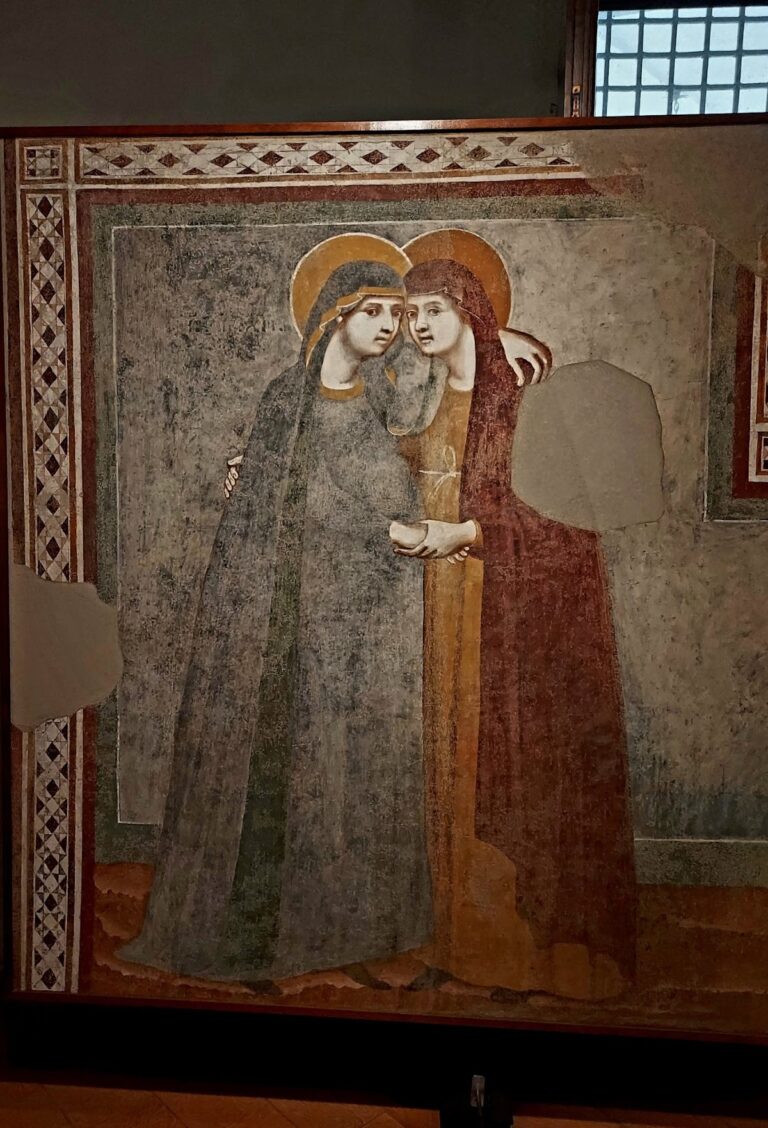
In 2003, the province purchased a cycle of frescoes by Jacopino Scipioni that had originally been made for the Trinity chapel of the church of Santa Maria delle Grazie in Bergamo. The paintings had been removed from the church in 1857 and later transferred to Vertova. They are now located at the entrance to the sacristy of the church of the Grazie. The frescoes associated with the Ulisse collection underwent extensive technical study in 2008 to examine their painting and transfer methods and to plan restoration.
The province also acquired three paintings by Antonio Cifrondi in 2003. Because an unsuitable restoration in the 1980s had left them in poor condition, they later received further conservation treatment and new frames. These works form part of the palace’s wider role as an administrative building that also preserves art connected with Bergamo and its surrounding area.
The attic contains the 2,050-square-metre Spazio Viterbi, inaugurated in 2004. Andrew Viterbi, an Italian-American electrical engineer and co-inventor of the Viterbi algorithm who was originally from Bergamo, inaugurated the space and dedicated it to his parents. It was created to bring citizens closer to provincial projects and is used for exhibitions, cultural initiatives, and meetings.
Remains
Palazzo della Provincia is a four-storey building arranged in three main sections, with a central block to the north and lateral blocks to the east and west. Its principal facade faces Via Torquato Tasso, while the gardens extend toward and join Via Gabriele Camozzi. The building is currently in use and has one elevator. Its physical form combines a monumental public layout with Renaissance-style architectural treatment and extensive decorative work.
Facade and entrance sequence
Principal facade
The main entrance opens into the entrance hall through three large arched portals. A tall gate closes the portals, which rise from the ground floor to include the mezzanine. Two further arches at the sides are closed by windows. Six columns extend upward to the attic band, whose decoration includes animal festoons and floral motifs.
A bas-relief beneath the eaves presents episodes associated with Bergamo’s history. Its scenes include Bartolomeo Colleoni’s appointment as captain of the Venetian Republic, his benefaction to the citizens, Bergamo personified as a woman between the Serio and Brembo rivers, the Oath of Pontida, and Alberico da Rosciate presenting statutes to the citizens. Colleoni was a fifteenth-century military commander from Bergamo who served Venice, while Alberico da Rosciate was a medieval jurist and civic official associated with the city.
Interior circulation and offices
Effigies of famous people from Bergamo appear beneath some window sills. Stucco, pilasters, and representations of animals, flowers, and putti further decorate the facades. From the ground-floor atrium, the prefecture’s rooms open on the left and the police headquarters offices on the right. The main staircase rises to the first floor, where the provincial administration and salons containing works by artists from Bergamo are located.
Frescoes and painted interiors
Salone di Ulisse
The Salone di Ulisse faces the colonnade of the principal facade. Its walls hold frescoes transferred from the Sala Quadra of Villa Lanzi at Gorlago. Giovan Battista Castello painted them in 1556 for Guido and Paolo Lanzi. The scenes titled Agamemnon Assigning Achilles’ Arms to Ulysses and Ajax’s Suicide depict episodes from the story of Ulysses.
Prince Giuseppe Giovannelli donated the frescoes to the municipality of Bergamo after finding the rooms of the villa deteriorated. The municipality moved them to the new palace using the strappo technique, which detaches the painted surface from its underlying plaster and mounts it on a new support. A salon was constructed for the paintings and to reproduce the ideals of justice and equity associated with their original setting. Antonio Zanchi supervised the work with the scenographer Carlo Rota, and the difficult transfer and transport caused no damage to the frescoes.
Presidential room
The presidential room contains the Galleria dei Maestri del Novecento. The collection includes works by Trento Longaretti, Erminio Maffioleti, Cesare Paolantonio, Ponziano Loverini, Luigi Scarpanti, and other artists. The room therefore combines its administrative function with a display of twentieth-century artistic production associated with Bergamo.
Staircase paintings
Three paintings by Antonio Cifrondi hang on the staircase between the ground and first floors. Painted between 1712 and 1716, they are The Presentation of Mary in the Temple, Curtius Rufus on Horseback Plunging into the Roman Forum Chasm, and The Killing of Julius Caesar. They originally belonged to a larger decorative cycle at Villa Colleoni Zanchi in Scanzorosciate. After the three paintings had suffered from an unsuitable restoration in the 1980s, they received new treatment and frames designed to prevent further damage.
Garden sculpture park
The garden was conceived as a sculpture park. It contains five works by the Bergamasque sculptor Giacomo Manzù, together with works by Stefano Locatelli, Marisa Lambertini, Mario Gotti, Ferruccio Guidotti, Franco Daverio, and Piero Brolis. The garden extends the palace’s presentation of regional artistic work beyond its interior rooms and connects the administrative complex with its surrounding urban grounds.
Nearby sites