Collégiale Notre-Dame d’Écouis: A Gothic Collegiate Church in France
Site at a Glance
- Rating
- 4.4
- Popularity
- Medium
- Country
- France
- Primary era
- Medieval
- Eras represented
- Medieval, Early Modern
- Civilizations
- French
- Site type
- Religious
- Remains
- Church
On this page15 sections
History
Foundation and consecration
The Collégiale Notre-Dame d’Écouis is a Gothic collegiate church in Écouis, France, founded by Enguerrand de Marigny and built from 1310 to 1313. A collegiate church was served by a chapter, or body, of clergy called canons. The institution was associated with the Diocese of Évreux.
A church dedicated to Saint Aubin stood on the site before the collegiate church, and Bec Abbey had authority over it from 1141. On 10 June 1308, Enguerrand de Marigny took it over. His estate at Écouis also included a hospital and a college of canons.
Marigny secured royal approval in February 1310, followed by episcopal approval in May 1311 and Pope Clement V’s approval on 1 May of that year. The proposed chapter included a dean, treasurer, and cantor, who led its music. The new church replaced the earlier Saint Aubin church and was consecrated to the Assumption of Mary on 9 September 1313 by Cardinal Nicolas Caignet de Fréauville. The Assumption is the Christian belief that Mary was taken body and soul into heaven.
Marigny and the collegiate chapter
Marigny had served as royal chamberlain and finance minister under Philip IV. After the church was completed, he fell from power. Under Louis X, he was accused of financial fraud, convicted, and hanged at Montfaucon in 1315. A new proceeding rehabilitated him in 1317. His remains were brought to the church in 1326 and placed in the choir.
The collegiate institution continued for centuries. Louis XI and Louis XII visited the church, and Saint Vincent de Paul served as one of its canons. A north chapel was added in the early fourteenth century, while construction of the south Chapel of Saint Aubin began in 1528 for parish worship.
Revolution and parish church
The French Revolution brought an end to the collegiate chapter, which was suppressed on 24 August 1790. Antoine Marie François Hallé d’Amfreville, a former canon who refused the required oath, was executed at Évreux on 13 July 1794. That year the church became a Temple of Reason, a public building used by a civic movement seeking to displace Christian worship. It was later used as a workshop and then as a barn, until 1797.
A fire during the Revolution destroyed furnishings, while the spire was lost and the main portal altered. After the Napoleonic era, the building returned to Catholic worship and became Écouis’s parish church. It was designated a French historic monument on 13 June 1913.
Remains
Plan and exterior
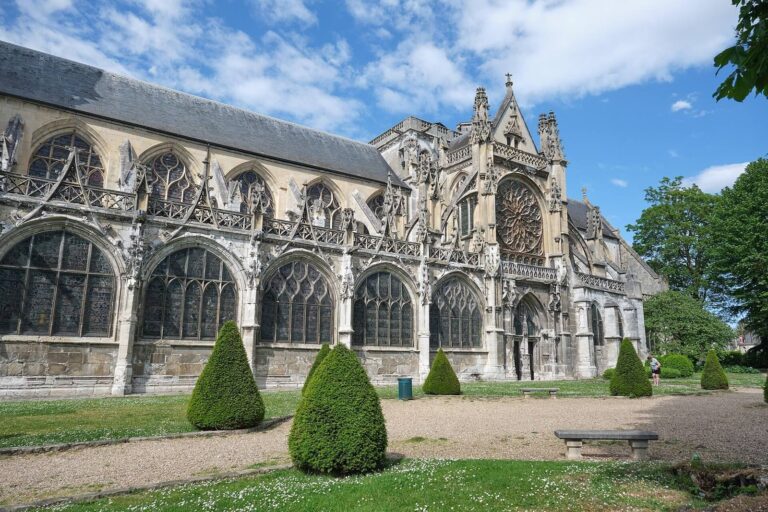
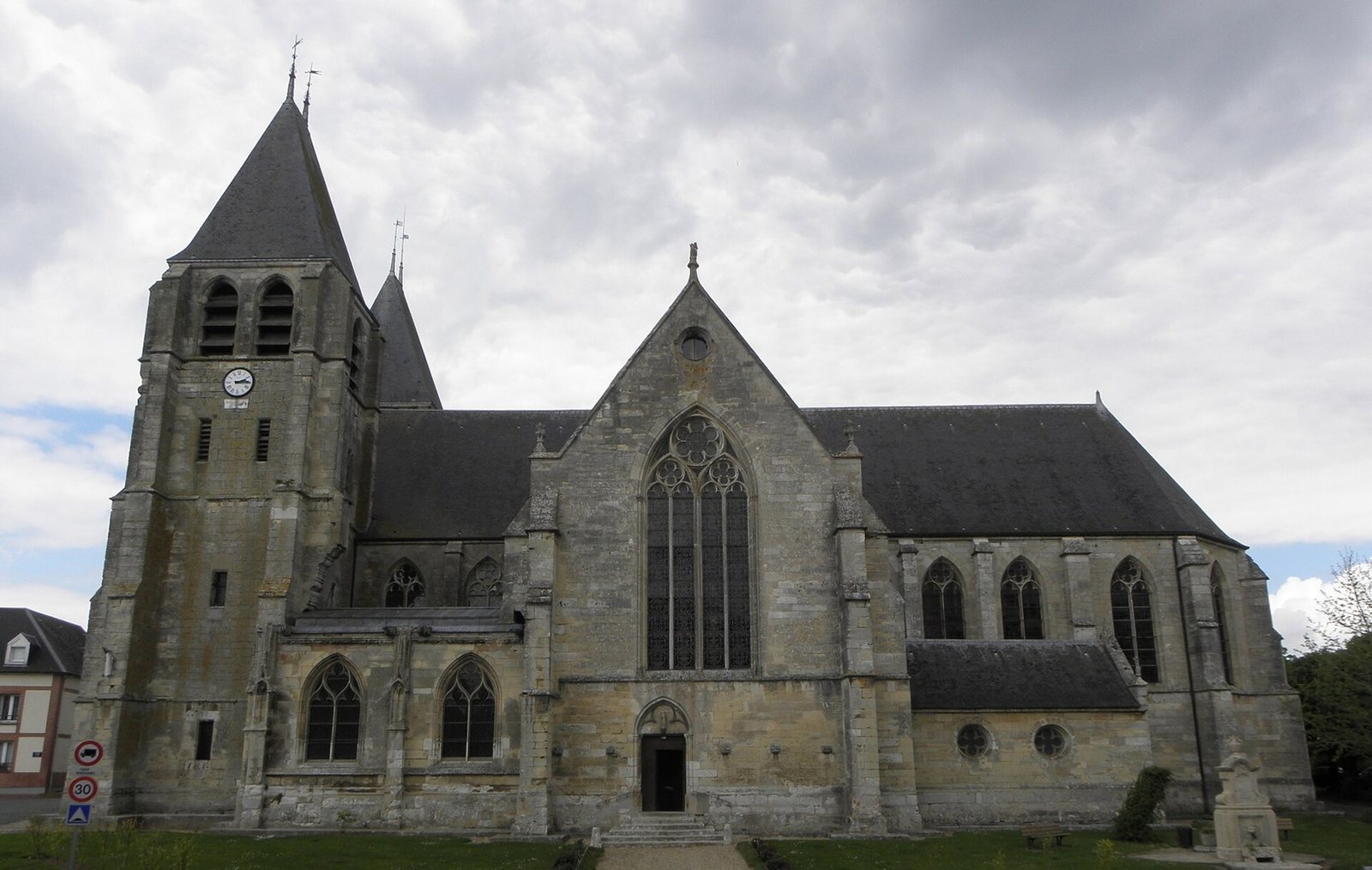
The church is oriented northeast and has a cross-shaped plan formed by a single nave, a crosswise transept, and a choir. The choir measures 20.90 metres, longer than the 15.65-metre nave, and the transept is 10.40 metres wide. Vernon stone was used throughout the construction, which required 4,000 stones.
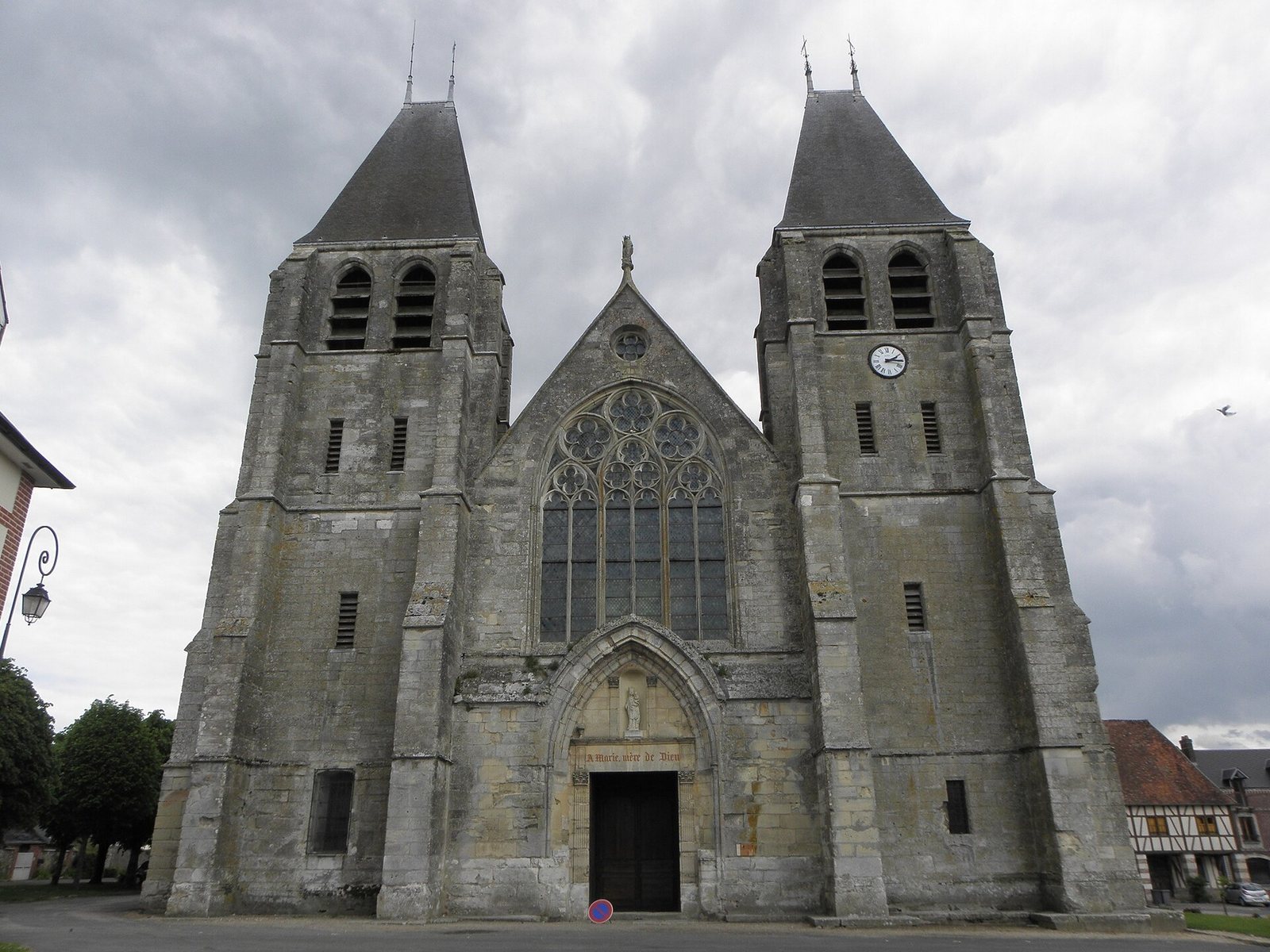
The fourteenth-century west façade is framed by two large towers set on buttresses. Their appearance is more Romanesque, an earlier medieval architectural style, than Gothic. A large western window is divided by stone tracery, the framework that separates parts of a window. The square in front of the church served as a cemetery until 1765.
Vaults and chapels
Vaults
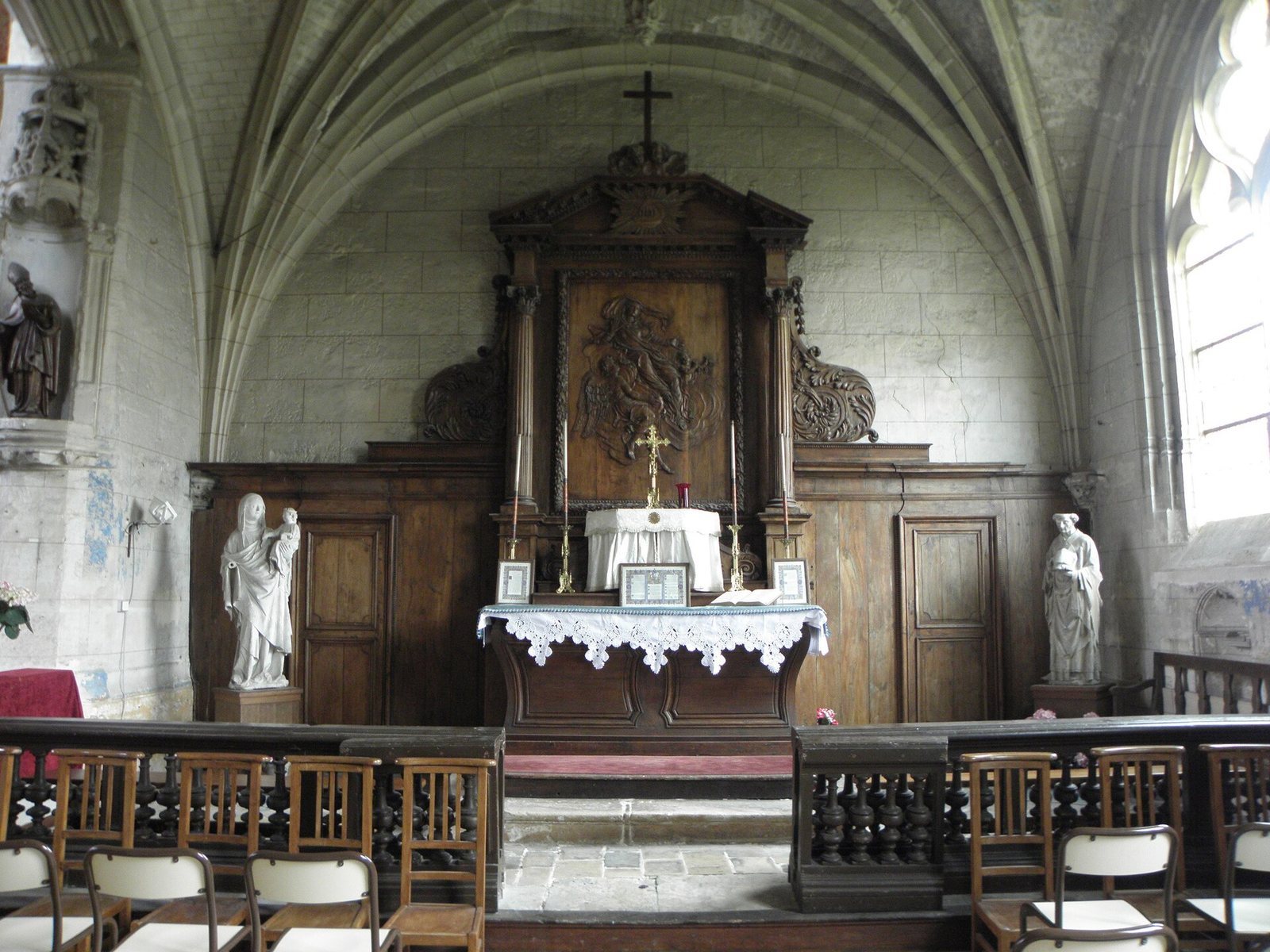
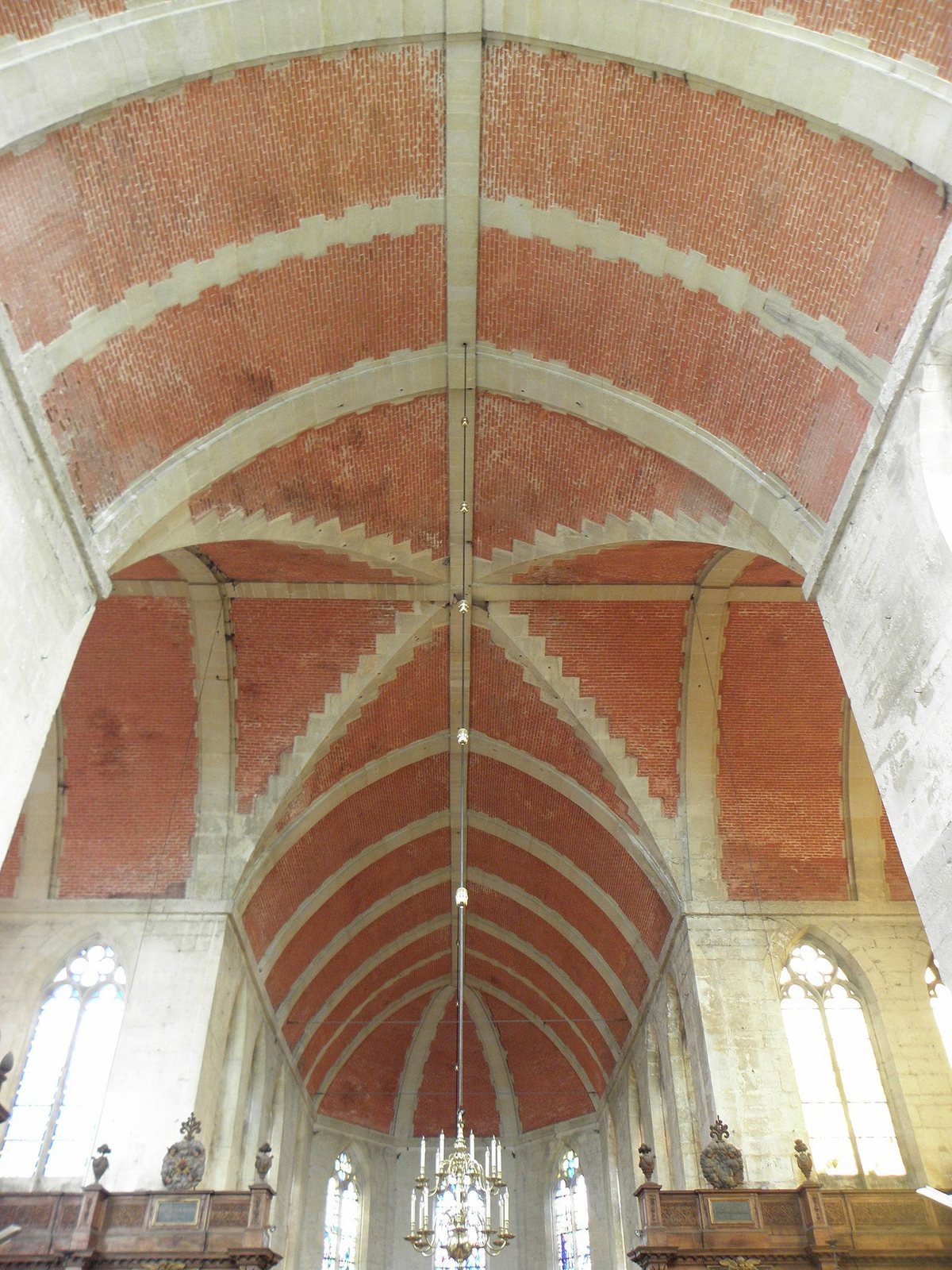
The main vault, 18 metres high, was rebuilt in brick in 1768, replacing an earlier timber ceiling. It is a pointed barrel vault, a continuous arched ceiling with a pointed profile, reinforced by crosswise arches of light sandstone. Wooden barrel-vault ceilings survive in the side chapels.
Chapels
The north chapel stands beside the nave, between the façade tower and the transept. Its four-lobed round window contains stained glass showing Christ on the cross with the Virgin Mary and Saint John. Two further chapels adjoin the choir. The northern one connects with the sacristy, which formerly served as the chapter house, or room where the canons met. The south Chapel of Saint Aubin, begun in 1528, has Flamboyant Gothic ornament, a late Gothic style with flame-like forms.
Memorials and sculpture
Burial monuments
An annex to the church forms Enguerrand de Marigny’s funerary chapel. Its cenotaph, a funerary monument that does not contain the person’s remains, was vandalized during the Revolution. The church also contains the mid-fourteenth-century tomb of Bishop Jean de Marigny.
Sculptures
An Annunciation group showing the Virgin Mary and the angel Gabriel is set on the north nave wall. Sculptures in the north transept include Saint Veronica holding the cloth associated with the Holy Face, an image of Christ’s face; a figure probably representing Mary of Egypt, an early Christian ascetic venerated as a saint; and a fifteenth-century depiction of Christ presented before his crucifixion. The south transept contains Saint Margaret trampling a dragon.
The north chapel holds a fourteenth-century statue of Saint Cecilia, a polychrome statue of Saint Lawrence, and statues of Saint Denis and Saint Martin, the latter dating to the fifteenth century. A statue of Saint Nicasius and another Annunciation group are also fourteenth-century works. It is uncertain whether the surviving sculptures from that century were commissioned by Enguerrand de Marigny or his descendants. A fifteenth-century crucifix is also among the church’s furnishings.
Furnishings
Choir and organ
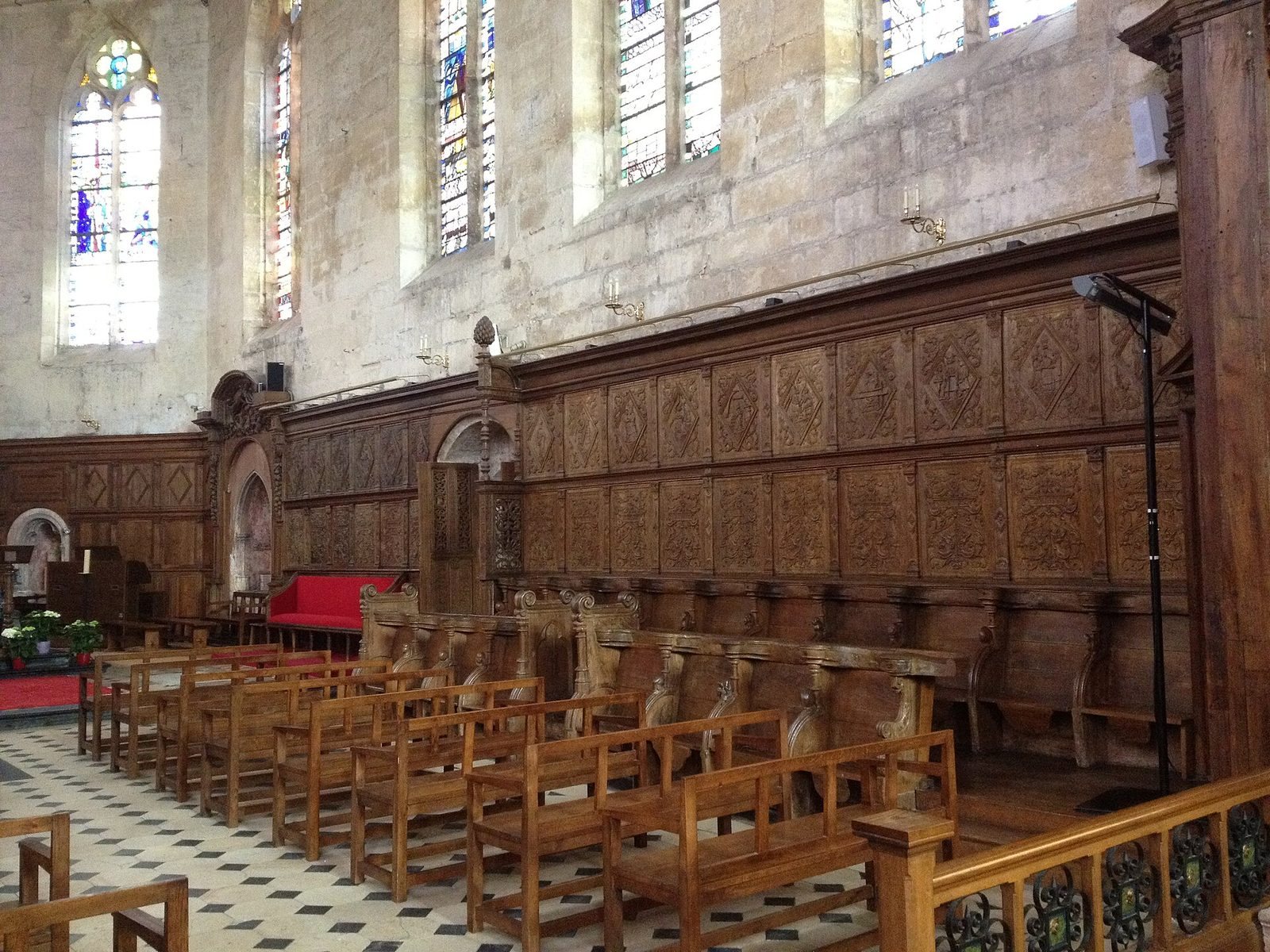
The choir has 36 stalls dating from the church’s foundation, among the oldest in France. The altarpieces and woodwork are mainly seventeenth-century. The organ gallery retains seventeenth-century cases. In 2008, plans to rebuild the organ were abandoned because of the cost, and an Allen Elite Opus II digital organ, designed for the church, was installed instead.
Other furnishings
An eighteenth-century baptismal font and a cross of the same century above the confessional remain in the church. The twelfth-century pulpit rests on a base symbolically depicting the four Evangelists.