Co-Cathedral Basilica of the Assumption, Kołobrzeg: A Gothic Church and Diocesan Seat

Site at a Glance
- Rating
- 4.8
- Popularity
- Very Low
- Country
- Poland
- Primary era
- Medieval
- Eras represented
- Medieval
- Civilizations
- Duchy of Pomerania, Holy Roman Empire
- Site type
- Religious
- Remains
- Cathedral
On this page19 sections
History
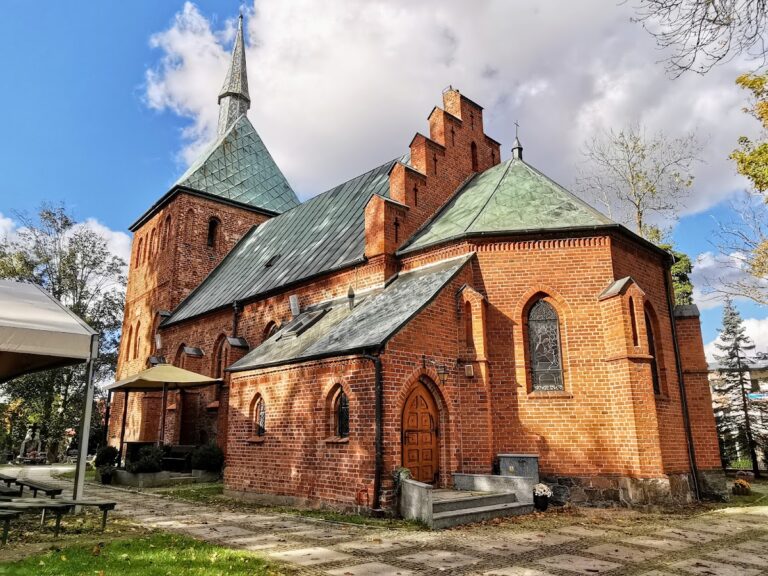
The Co-Cathedral Basilica of the Assumption in Kołobrzeg, Poland, is a Gothic brick church begun around 1300 or in the early fourteenth century by the city’s Catholic community. Its first construction phase was complete by 1321, when Mass was celebrated there. Built in the prosperous Hanseatic city, it developed over the following two centuries into a monumental five-aisled hall church and became one of Kołobrzeg’s principal religious institutions.
Foundation and medieval expansion
The church was erected on the site of an earlier Church of St. Nicholas. From the fourteenth century, it served as Kołobrzeg’s collegiate church and principal Catholic parish church. A collegiate church was served by a chapter of clergy, a body responsible for aspects of its administration and liturgical life. The building’s growth reflected the prosperity of the Hanseatic city, whose commercial connections supported an ambitious ecclesiastical foundation.
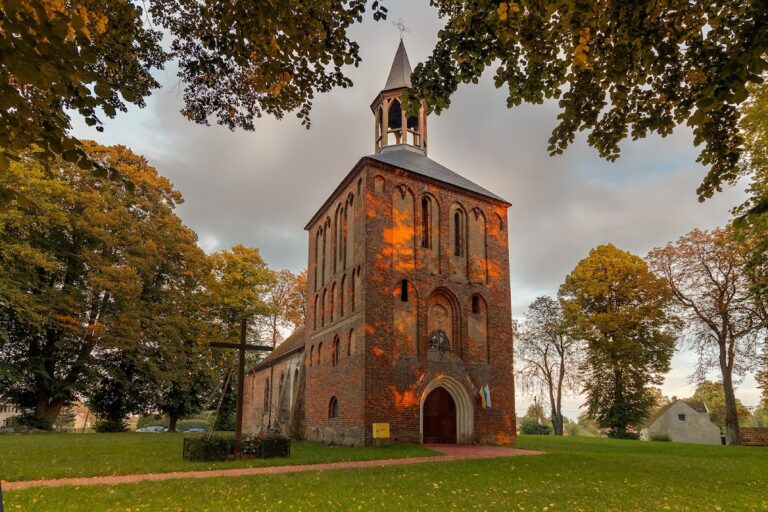
The original structure was a three-aisled hall church. It later received a larger choir and, during the second half of the fourteenth century, two further aisles, creating the five-aisled arrangement that survives in its reconstructed form. The tower complex was added in a later phase. At the end of the fifteenth century, two separate towers on the north and south were connected by a walled central section, which was crowned with a roof or spire and produced the massive tower block visible today.
Reformation and Lutheran use
During the Reformation, the sixteenth-century movement that produced Protestant churches in western Christianity, the church became Lutheran in 1531. It first belonged to the Pomeranian Evangelical Church and, from 1817, to the Prussian Union Church, a Protestant union of Lutheran and Reformed congregations within the Prussian state. Galleries were inserted into the side aisles to provide additional seating.
War damage and nineteenth-century repair
Military conflict repeatedly damaged the church between the seventeenth and twentieth centuries. By the beginning of the eighteenth century, its condition was very poor. Sieges and bombardment between 1758 and 1761, the explosion of a nearby powder tower, and subsequent fires caused further destruction. A comprehensive renovation was eventually carried out at the end of the nineteenth century.
The Napoleonic siege of Kołobrzeg in 1807 brought a particularly damaging blow. A projectile fired by troops under General Loison struck the presbytery and destroyed its furnishings, including a late-seventeenth-century altar funded by Gabriel Maurersberg.
Destruction and reconstruction after 1945
In March 1945, during the battle and capture of Kołobrzeg, the church became an important defensive position. Soviet artillery and fighting between the Red Army and Polish forces heavily damaged the building. The main nave vault collapsed, and the interior burned out.
After the Second World War, demolition of the ruins was initially proposed. The building was handed to the Catholic Church in 1957, and reconstruction then began. The presbytery was consecrated in 1958, when the first postwar Mass was celebrated. During the 1960s, the unreconstructed part of the church housed the Museum of Polish Arms, whose military display included cannons and tanks in the main nave. These exhibits were later transferred to a separate site near the city canal, and by 1974 the entire church had returned to religious use.
Contemporary ecclesiastical status
In 1972, the church became the co-cathedral of the Diocese of Koszalin–Kołobrzeg. A co-cathedral is a cathedral-level church that shares a bishop’s seat with another cathedral. Its collegiate function was restored in 1979, and a parish was established there in 1980. On 10 June 1986, Pope John Paul II elevated the parish church to the status of a minor basilica, a Catholic church granted a special papal distinction because of its religious, historical, or pastoral importance. It remains the co-cathedral of the Diocese of Koszalin–Kołobrzeg within the Archdiocese of Szczecin–Kamień.
Cardinal Ignacy Jeż, the first ordinary of the Diocese of Koszalin–Kołobrzeg, was buried in the crypt beneath the church on 23 October 2007. The basilica is entered in Poland’s register of monuments under number 98, dated 10 August 1956.
Remains
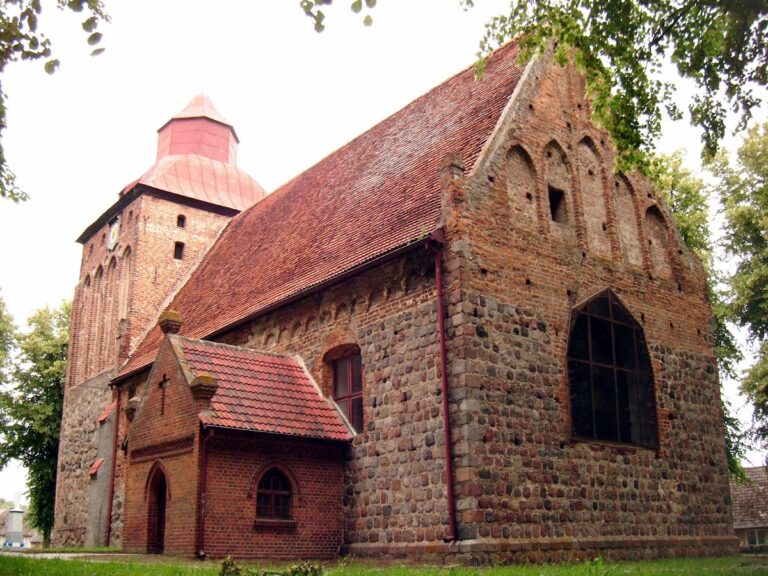
The surviving church is a five-aisled Gothic hall church built principally of brick. In a hall church, the nave and aisles are approximately equal in height, without a clearly dominant main nave lit by a clerestory. The building is organized around one massive tower complex, the five aisles, the choir and presbytery, and a group of medieval and later furnishings that preserve different stages of its religious history.
Church structure and liturgical furnishings
Tower complex
The tower mass developed from two separate northern and southern towers. At the end of the fifteenth century, the space between them was enclosed, and a central roof or spire was added. This intervention created the church’s broad, monumental tower block. Three bells now hang in the tower. The oldest was cast in 1895 for the Church of St. Martin in Kołobrzeg and placed in the co-cathedral’s tower lantern in 1984. The other two, named Joseph and Mary, were cast in 1986 at the Saturnin Skubiszyński Bell Foundry in Poznań and installed in the former northern and southern towers.
Altars and triptychs
The church contains a main altar, a pulpit, two side altars, and three surviving late-fifteenth- or early-sixteenth-century wooden triptychs. A triptych is a three-part altarpiece with a central shrine or panel and two hinged wings. At least 22 Gothic altars once belonged to the Kołobrzeg cathedral. Four survive, with three in the church and one in the National Museum in Szczecin. The surviving examples were probably made by local craftsmen and artists around 1500.
The presbytery contains the Last Supper altar, probably made by Andrzej Wentzel. The reverse of its wings carries an Annunciation painting probably made by Jakub Vidrach, while its predella, the lower part of an altarpiece, came from another altar and depicts scenes from the life of Saint James.
To the left of the main altar stands the Adoration of the Magi altar. Alongside its central scene are eight figures of saints, and the reverse of the wings is painted with an Annunciation. The altar on the right contains figures of Saint Anne with the Virgin and Child and Saint Nicholas. The same saints appear on the reverse of its wings. Katarzyna Baden, the daughter of Kołobrzeg’s mayor, founded this altar, which was made in the workshop of the Master of the Chociwel Passion.
Stalls and baptismal font
Small council stalls in the south aisle were made during the first quarter of the fifteenth century, probably in a Cistercian workshop. Cistercians are members of a Catholic monastic order that developed from the Benedictine tradition. The richly decorated sides show subjects including the Tiburtine Sibyl with Emperor Augustus, the Virgin and Child, a sinner being devoured by a dragon-devil, a bishop, and a knight. Helmets, shields, and other displays of arms and armour are also carved into the stalls.
Oak chapter stalls remain in the presbytery. Made around 1340 in the carving workshop of Herman Walther of Kołobrzeg, they are decorated with low-relief dragons and manticores. Their creatures have human, canine, and dragon heads, while their long tails become branching vegetal ornament. They are regarded as the oldest surviving objects of their type in Poland.
A bronze baptismal font dated 1355 was cast by the local craftsman Jan Alart. Its basin rests on four lions and carries 26 low-relief scenes from the life of Christ arranged in two horizontal rows. A Latin inscription names the date and maker. The font is regarded as the oldest metal baptismal font in Western Pomerania, and its cover dates from 1679.
Candelabra and devotional sculpture
Gothic bronze candelabrum
A bronze seven-branched candelabrum made in 1327 by Jan Apengeter stands among the church’s most notable medieval furnishings. A candelabrum is a branched candle-holder. A testamentary bequest from Gotfryd de Wida, dean of the Kołobrzeg chapter, endowed the object. It is 4 metres high, spans 380 centimetres, and weighs more than 900 kilograms.
Jan Apengeter used the lost-wax process, in which a wax model is enclosed in a mould, melted out, and replaced with molten metal. The base rests on three dragon heads, each mounted on a lion’s back. Its inverted-bowl base bears inscriptions referring to the founder and maker. Lilies, grapevines, the twelve Apostles, and four winged angels decorate the column. The seven candles refer to the seven gifts of the Holy Spirit, the vine to Christ’s teaching about the vine and its branches, and the lilies to immortality. The meaning of the lions and dragons remains unresolved.
The candelabrum suffered minor damage during the Seven Years’ War and the Napoleonic campaign. During the Second World War, it was dismantled and hidden in a utility room. Polish workers found it accidentally in the 1950s, when it was nearly sold for scrap. Jan Frankowski rescued it by purchasing it from a scrapyard. After conservation in Warsaw and display in the Museum of Central Pomerania in Słupsk, it returned to the church in 1981.
Later hanging candelabra
A wooden hanging candelabrum from 1523 was founded by the Schlieffen family and made in the workshop of Master Michael of Augsburg. It combines late Gothic forms with early Renaissance elements. Large sculptures of the Virgin and Child and Saint John the Baptist are accompanied by smaller figures of the twelve Apostles and musical angels. A canopy painted as a celestial vault, together with extensive polychromy and gilding, completes the object. A legend connects its foundation with penance for the execution of Jakub Adebar.
A brass hanging candelabrum founded by the Holken family dates from 1420. Its maker is unknown. The Virgin and Child stand at its centre, surrounded by nine curved rods resembling leafy vine shoots, while the lights are shaped like inverted crowns. It is regarded as the only surviving Gothic metal candelabrum in Pomerania.
Crucifixes
The larger of two Gothic crucifixes hangs from the rood beam between the main nave and the presbytery. A rood beam spans a church interior and traditionally supports a crucifix or rood. The crucifix measures 3.5 metres high and 2.2 metres wide, dates from the fourteenth century, and came from the church at Rymań in 1976. It is shaped as a tree of life, with shoots and buds symbolizing the renewal and flourishing of Christianity. The ends of the cross carry the symbols of the Evangelists, and the letters INRI appear above Christ’s head.
A smaller oak crucifix in the sacristy dates from 1330 and also takes the form of a tree of life.
Paintings and funerary monuments
Painted panels
A tempera painting dated 1494 bears the name Ivan von Coztenbach, whose role as artist or donor is uncertain. It shows a woman surrounded by symbolic attributes and includes an extensive German explanatory text. A lock and keys, crucifix, wreath, serpent, dove, falcon, and horse hooves represent warnings against gossip, faith, purity, prudence, fidelity and gentleness, intelligence and foresight, and the rejection of sin.
An oil painting on panel from 1640 was made by Joachim Knochenhauer and depicts figures dressed in contemporary seventeenth-century clothing. Another tempera panel, dated 1492 and also called the Dance of Death, shows an armoured knight surrounded by skeletons rising from graves. The skeletons carry tools associated with their former occupations and protect the knight from mounted figures bearing a red dragon standard. The image expresses the belief that the dead could aid the living when invoked in prayer. It also serves as the epitaph of Siewert Grantzin, whose name appears below with images of Saints Andrew and James the Elder and a prayer for his soul.
A tempera panel from the first half of the sixteenth century, probably by the Flemish painter Schmidt of Antwerp, depicts the Crucifixion with the two thieves, the donor, the Virgin Mary, and Saint John the Evangelist. It was stolen in 1990 and later recovered. The lack of halos around Mary and Saint John reflects the painter’s Protestant theological influence.
Funerary monuments
Gothic tomb slabs and epitaphs survive among the church’s memorial furnishings. During renovations between 1870 and 1890, slabs that had progressively covered much of the floor were removed, and 22 of the most valuable were placed upright against the walls. Some remain in the church, including a Gothic slab showing a young man named Benedict, regarded as the most valuable of the group.
Two well-preserved slabs and the Kameke family epitaph came from the church in Strachomino and were brought to Kołobrzeg after the Second World War. A Baroque sandstone epitaph dated 1718 combines alabaster figures of Diana with a stag and Hercules with a club, the family arms, displays of arms and armour, and a relief of a winged skull. Nearby slabs include a relief of Paulus Damitz with his wife.
Displays, memorials, and transferred furnishings
Historical display panels inside the church present its destruction and reconstruction, including its condition after 1945. Memorial plaques in the entrance area commemorate people and events connected with the cathedral, including Polish soldiers who fell in 1945, Pope John Paul II, and the Solidarity movement, an independent Polish trade-union and social movement that emerged in 1980. A newly designed bronze door occupies the main portal.
A monument erected in 2000 before the main entrance depicts Pope John Paul II, Emperor Otto III, Bolesław Chrobry, and Pope Benedict XVI. Otto III ruled the Holy Roman Empire in the tenth and early eleventh centuries. Bolesław Chrobry, also called Bolesław I the Brave, was Poland’s first king, while Benedict XVI led the Roman Catholic Church from 2005 to 2013. The monument’s pedestal bears the inscription “Kołobrzeg 2000,” and an arch with a dove rises above the central figures. It commemorates the millennium of the establishment of the Archdiocese of Gniezno and the Act of Gniezno, the early-eleventh-century ecclesiastical and political arrangements associated with Gniezno.
Several historical furnishings from the basilica are preserved in the National Museum in Szczecin. They include a wooden triptych of Saint James the Elder, made around 1500–1520 in the workshop of the Master of the Chociwel Passion. Its central shrine contains Saints Peter, James, and Paul, while eight smaller saints occupy the wings. The museum also holds a bronze lion-head door handle made around 1344 in Jan Apengeter’s workshop, a predella depicting the Fourteen Holy Helpers from around 1500–1520 made in the same workshop, and two oak panels from the town council stalls. Made in a West Pomeranian workshop during the fifteenth century, the panels include one carved figure of Saint Olaf.
Nearby sites