Cliffe Fort: A Victorian Coastal Artillery Fortification on the Thames


Site at a Glance
- Rating
- 4
- Popularity
- Very Low
- Country
- United Kingdom
- Primary era
- Modern
- Eras represented
- Modern
- Civilizations
- British
- Site type
- Military
- Remains
- Fort
On this page10 sections
History
Cliffe Fort is a disused coastal artillery fortification in the United Kingdom, built by the British military between 1861 and 1870 in the Victorian period on the south bank of the River Thames. It guarded the entrance to Cliffe Creek in the Cliffe marshes on the Hoo Peninsula, forming part of a defensive network intended to protect London and important naval and industrial installations farther upriver.
The lower Thames defensive scheme
The fort followed recommendations made in 1860 by the Royal Commission on the Defence of the United Kingdom, a government body that reviewed Britain’s coastal and other defensive needs. The proposed system east of Gravesend formed a defensive triangle using Cliffe Fort, Coalhouse Fort, and Shornemead Fort. Cliffe replaced an eighteenth-century battery at Lower Hope Point, about 2.1 kilometres farther downriver, while the three positions were arranged to create overlapping fields of fire.
The scheme emerged during an arms race between Britain and France. Rifled guns, which used spiral grooves to improve the accuracy of their projectiles, had become increasingly powerful, while steam-powered ironclad warships appeared capable of challenging older coastal defences. Although the river was too shallow above Deptford for large warships to reach central London, naval experience showed that warships could pass coastal forts and continue up navigable rivers. Cliffe Fort was therefore intended to help close the lower Thames to attack.
Captain Siborne of the Royal Engineers, the British Army corps responsible for military engineering and fortification, designed Cliffe Fort and the corresponding works at Coalhouse and Shornemead, apart from their ironwork. Captain English and Lieutenant English of the same corps developed the casemate shields. Construction cost approximately £163,000.
Construction problems and completion
The marshy site created severe difficulties. In 1865, while the fort was still being built, the partly completed structure began to subside and crack. The foundations were consequently deepened and the design was substantially altered. Planned artillery on the roof was abandoned, and the fort became a wholly casemated work, meaning that its guns were placed in enclosed, protected chambers. The construction environment was also hazardous, with persistent malaria and bronchitis affecting the workforce.
Cliffe Fort was completed around 1870 and remained an artillery fort for roughly six decades. By 1887, its main armament consisted of two 12.5-inch and nine 11-inch rifled muzzle-loading guns, large weapons loaded through the barrel, in casemates, together with two 9-inch rifled muzzle-loading guns in an open battery. Its fire was intended to work with that of Coalhouse and Shornemead Forts. Roof-mounted fire-control positions were later added because no nearby high ground was suitable for optical range-finding.
Modernisation and wartime service
A Brennan torpedo launching station was installed in 1890. The Brennan torpedo was a wire-guided weapon operated from a shore installation and is often described as the first practical guided missile. At Cliffe, the installation required one magazine to be converted into an engine room and one open-battery emplacement to be taken out of service. The station remained active for only a few years.
Modernisation after 1895 and into the early twentieth century brought roof emplacements for quick-firing guns, searchlights, and defences associated with a planned boom and minefield. A boom was a floating barrier used to obstruct or channel vessels, while a minefield consisted of explosive naval mines intended to hinder shipping.
During the First World War, two 6-inch breech-loading Mk. VII guns replaced the 12-pounder guns. Breech-loading guns were loaded from the rear, a later development than the older muzzle-loading system. Near the end of the war, the 6-inch weapons were replaced by four quick-firing guns. The Brennan torpedo station had already been dismantled by this period.
Cliffe Fort was disarmed in 1927. During the Second World War, two roof positions were adapted for two 4-inch anti-aircraft guns, and the fort became a base for the Royal Navy Auxiliary Service, a wartime organisation that provided naval support and auxiliary duties for the Royal Navy.
Disuse and later ownership
The War Office sold the fort during the 1950s or 1960s to the owners of the neighbouring aggregates works. It was formerly owned by Blue Circle Aggregates and is now owned by Brett Aggregates, whose adjacent wharf processes sea-dredged aggregate. For a period, the fort served as the headquarters of the Blue Circle Sailing Club before it was abandoned.
Cliffe Fort is not open to the public and appears on the English Heritage Heritage at Risk register because of its poor and deteriorating condition.
Remains
Foundations and defensive layout
The fort was planned around a quadrant-shaped front protected by three flanking caponiers, covered passages projecting into the ditch so defenders could fire along it. Its rear, or gorge, side incorporated two bastioned fronts, while the original arrangement also included a main magazine, four shell-filling rooms for preparing artillery shells, and four smaller expense magazines for ammunition needed immediately. The entire structure was first intended to stand on a concrete bed 7 feet, or 2.1 metres, thick.
Waterlogged ground beside the Thames forced a heavier foundation solution. Piles 30 feet, or 9.1 metres, long supported a concrete bed 14 feet, or 4.3 metres, thick. Subsidence and cracking led to the removal of the planned roof artillery and the conversion of the work into a casemated fort with an appearance similar to Coalhouse Fort. A moat and earthworks added protection on the river-facing side.
Casemates and gun positions
Much of the fort’s masonry survives, together with the casemates and rails used to move gun carriages. The original design called for 20 guns in granite-faced casemates protected by iron shields, alongside weapons on the roof platform, open barbette positions, and guns intended for land defence. A terreplein is the level roof or gun platform of a fort, while a barbette mounting allows a gun to fire over a parapet.
The roof emplacements were altered repeatedly as artillery changed. They accommodated three 3-pounder quick-firing guns, later four 12-pounder quick-firing guns, the First World War weapons, and the Second World War anti-aircraft guns. Searchlights were also installed during modernisation, and the ditch was later largely filled in.
Brennan torpedo installation
The Brennan torpedo installation occupied part of the fort’s front and roof. A large concrete room was built to store the torpedoes, which were launched along a rail mounted on the room’s roof. Flank walls protected the launch crew from enemy fire. Two slipways were constructed at different dates, with the second probably added in the 1900s.
A telescopic control tower on the roof directed the launches. One slipway survives, while the other has been infilled, and remnants of the control tower remain. The associated machinery and launch arrangements were later dismantled.
Present condition
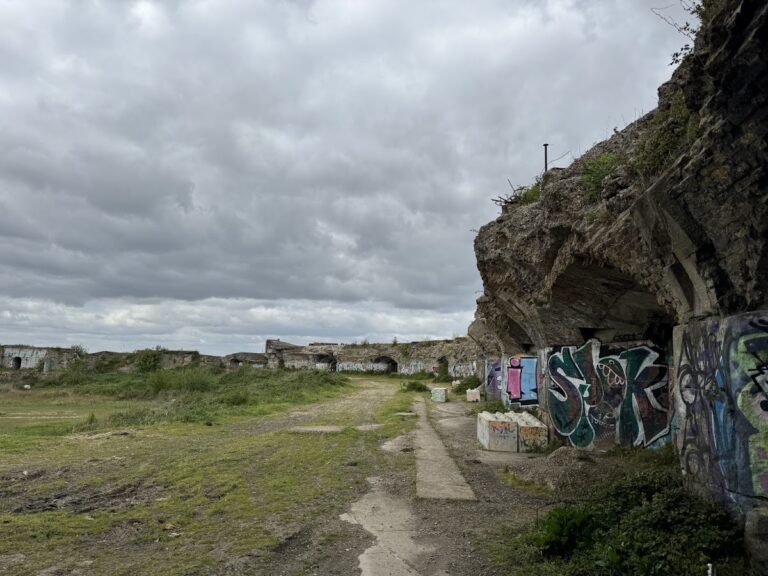
Cliffe Fort is now overgrown and partly flooded. Its interior is heavily flooded and has suffered vandalism, while the domestic range has fallen into ruin. Sand piles from the neighbouring aggregates works surround parts of the exterior. The exterior itself is described as structurally sound.
Nearby sites