Civita Castellana Cathedral: A Medieval Romanesque and Baroque Episcopal Church


Site at a Glance
- Rating
- 4.7
- Popularity
- Low
- Country
- Italy
- Primary era
- Medieval
- External website
- Open
- Eras represented
- Classical, Medieval, Early Modern
- Civilizations
- Papal States, Roman
- Site type
- Religious
- Remains
- Cathedral
On this page17 sections
History
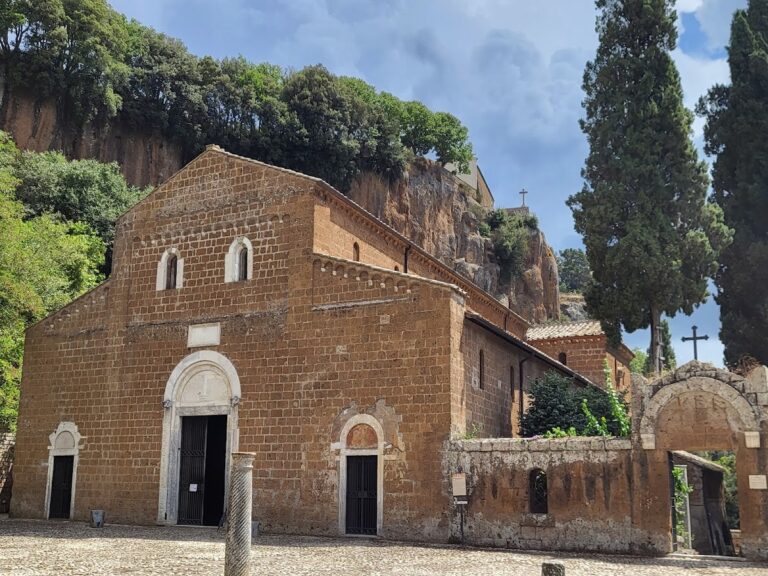
Civita Castellana Cathedral, also known as Santa Maria Maggiore or Santa Maria di Pozzano, is a Roman Catholic cathedral in Civita Castellana, Italy. Construction began around 1185 over an earlier sacred building, and the church was completed with the addition of its portico in 1210. Its medieval Romanesque exterior and eighteenth-century Baroque interior reflect the major phases of its development. The cathedral is the episcopal seat of the Diocese of Civita Castellana, a church jurisdiction governed by a bishop, as well as a minor basilica and parish church within the Faleritana vicariate.
Medieval construction
The cathedral’s medieval completion included the portico added in 1210. The work involved the Roman Cosmati, a family of architects and marble workers whose inlaid geometric marble and mosaic decoration is known as Cosmatesque. Jacopo di Lorenzo and his son Cosma were particularly associated with the project. The portico and the Romanesque exterior established the building’s earliest surviving architectural character.
Eighteenth-century renewal
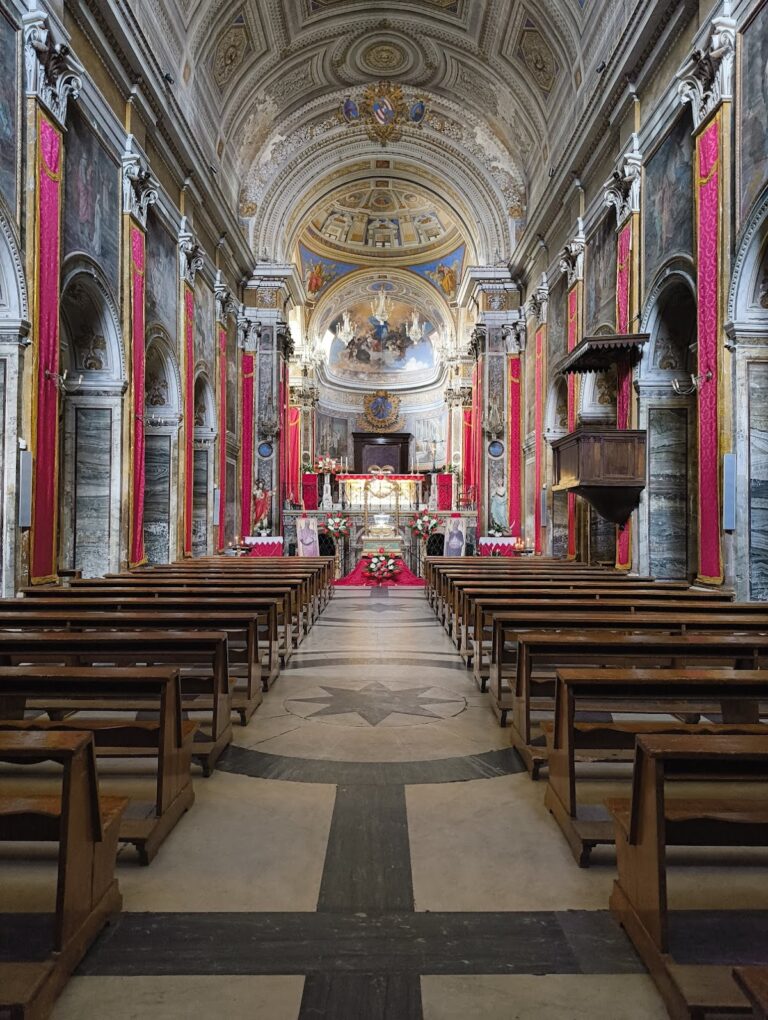
After centuries of deterioration, the church underwent a complete restoration in the eighteenth century. The architect Gaetano Fabrizi remodeled the interior in the Baroque style, a later architectural language known for elaborate ornament and visual movement. He transformed the former three-aisled plan into a single nave with interconnected side chapels, giving the interior the form it retains today.
Mozart’s stay
A marble plaque on the exterior commemorates Wolfgang Amadeus Mozart’s stay in Civita Castellana on 17 July 1770. Mozart, an eighteenth-century Austrian composer and musician, played the cathedral organ during the Sunday Mass held that day.
Remains
Portico and exterior
Cosmatesque portico
The cathedral is preceded by a thirteenth-century portico supported by two central piers and a rounded arch. Its architrave originally carried a mosaic frieze with gilded lettering, of which a few fragments survive. The arch bears the inscription “Gloria in excelsis Deo…,” while an inscription above it identifies the designer as “IACOBUS CIVIS ROMANUS” and gives the execution date as 1210.
Marble symbols of the Four Evangelists, Matthew, Mark, Luke, and John, decorate the central and outer piers. A lamb representing Jesus Christ occupies the center of the arch. Three entrance gates open onto the cathedral. The monumental central gate is flanked by four Corinthian columns, with two resting on marble lions. Beneath the right-hand lion is a representation of a child, symbolizing a member of the faithful entering the church. The lunettes, semicircular decorative fields above the side gates, contain Cosmatesque mosaics, including Christ blessing in the right lunette.
Archaeological marble elements
Under the portico, cippi, slabs, capitals, tomb inscriptions, and a valuable Roman altar with ornamental reliefs are arranged together. These marble elements form part of the visible material setting around the cathedral entrance.
Bell tower
A Romanesque bell tower stands beside the cathedral, preserving another part of the building’s medieval exterior.
Interior and liturgical furnishings
Nave and chapels
The interior consists of a single nave with six interconnected side chapels. The nave reaches a transept, the cross-arm that intersects the main body of a church, before the raised presbytery, the area reserved for the principal ministers and altar. A crypt lies beneath the presbytery, and most of the floor is decorated in the Cosmatesque style.
Transept altars
Two monumental Baroque altars occupy the arms of the transept. The right altar is dedicated to the Madonna of the Light and incorporates an eleventh-century fresco. The left altar is dedicated to the Madonna of the Rosary and contains a sixteenth-century canvas surrounded by fifteen panels representing the Mysteries of the Rosary, a Marian prayer devotion commemorating events in the lives of Jesus and Mary.
High altar and presbytery
The high altar in the raised presbytery consists of a fourth-century Roman-Palaeochristian sarcophagus, a Roman sarcophagus decorated with imagery associated with early Christianity. Its seven niches contain biblical scenes: the Sacrifice of Abraham, Daniel killing the serpent, the prediction of Peter’s betrayal, the healing of the paralytic, the handing of the keys to Peter, the healing of the hemorrhaging woman, and the miracle at Cana.
At the rear of the presbytery, above the wooden choir, is Pietro Nelli’s canvas of the Annunciation. Two frescoes flank it, depicting the Resurrection of John and the Martyrdom of Saints John and Marcianus.
Oratory and crypt
Oratory of the Heart of Mary
A door on the left side of the presbytery leads to the Oratory of the Heart of Mary, built as a chapel in the fourteenth century. Several twelfth-century frescoes show the Madonna with the Child, an angel, and saints. The oratory also contains the front section of a ninth-century early-medieval sarcophagus decorated with hunting scenes.
Two Cosmatesque parapets flanked by lions are preserved in the oratory. They originally formed part of the cathedral’s presbytery enclosure and date from approximately 1231 to 1240.
Twelfth-century crypt
The crypt beneath the presbytery has cross-vaults and dates from the twelfth century, although it was renewed in later periods. It contains two Renaissance marble ciboria, covered liturgical structures associated with an altar. The ciboria originally stood in the upper presbytery and were transferred and walled into the crypt during the eighteenth-century renovation.
Organ and choir loft
On the choir loft at the rear of the nave is a pipe organ built in 1890 by the Aletti brothers. The Paoli firm extensively modified it in 1961 and 1962, and Barthélemy Formentelli restored it to its original characteristics in 2002.
The instrument is enclosed in a richly carved eighteenth-century Baroque wooden case. Its facade has principal pipes with mitred mouths arranged in three cusps within three fields. The console has one keyboard and a pedalboard, while the organ has 37 stops and 1,294 pipes.
Nearby sites