Cîteaux Abbey: Founding House of the Cistercian Order
Site at a Glance
- Popularity
- Very High
- Country
- France
- Primary era
- Modern
- Eras represented
- Medieval, Early Modern, Modern
- Civilizations
- Duchy of Burgundy, French
- Site type
- Religious
- Remains
- Monastery
On this page19 sections
History
Cîteaux Abbey is a Catholic monastery at Cîteaux in France, founded in 1098 in the Duchy of Burgundy by Robert of Molesme and about twenty monks. They left Molesme to follow the Rule of Saint Benedict, a sixth-century guide to communal monastic life, more strictly, and to support the Gregorian Reform, a medieval movement to strengthen church discipline. Their community gave rise to the Cistercians, a Catholic monastic order that emphasized closer observance of the Benedictine rule.
Foundation and expansion
The monks settled on land granted by Renard, Viscount of Beaune. His family gave up its claims to the property, and Duke Odo I of Burgundy confirmed the grant and aided the foundation. Tradition places the community’s arrival on 21 March. Its first settlement stood beside the Coindon stream, but the water supply proved inadequate. Under Abbot Aubry, the monks moved about 2.5 kilometres south, to the meeting point of the Coindon and Vouge rivers. The first buildings were made of wood. In 1106, Bishop Gauthier of Chalon dedicated a stone chapel there to Our Lady; it later became known as the Chapel of Saint Edme.
Cîteaux was dedicated to Mary, mother of Christ, and received papal protection from Paschal II in 1100. It began as the only monastery in the new order. Its growth quickened in 1112, when Bernard of Clairvaux arrived with thirty companions. The first daughter houses followed: La Ferté in 1113, Pontigny in 1114, and Clairvaux and Morimond in 1115. Bernard was sent to establish Clairvaux, and the Cistercian network subsequently spread across Europe.
In 1119, the first general chapter, an assembly that makes decisions for a monastic order, met at Cîteaux. Its abbot presided, while the assembled members governed the order’s affairs. Pope Callixtus II approved the Carta Caritatis, or Charter of Charity, on 23 December that year. Stephen Harding helped compose this foundational text, which set out shared observance of the Benedictine rule and mutual support among monasteries. The general chapter continued to meet at Cîteaux for centuries, although attendance and regularity diminished from the late thirteenth century. The last meeting there before the French Revolution took place in 1785.
The abbey, its estates, and its order
Cîteaux’s position as the order’s head house brought practical demands as well as authority. Visiting abbots and their entourages needed accommodation, along with their horses, and the Burgundian ducal family also stayed at the abbey. The community hosted prominent gatherings and visitors. Louis VI attended a general chapter in 1128, and Pope Eugenius III presided over one in 1147 or 1148. Louis VII and Duke Hugh III of Burgundy were there in 1164. In 1244, Louis IX, his mother Blanche of Castile, and other members of the royal party visited. Francis I presided over a meeting of the Order of Saint Michael, a French chivalric order, at Cîteaux in 1521. Louis XIV visited in 1648 or 1649, in 1650, and again in 1683, when he gave the church one of its eight bells.
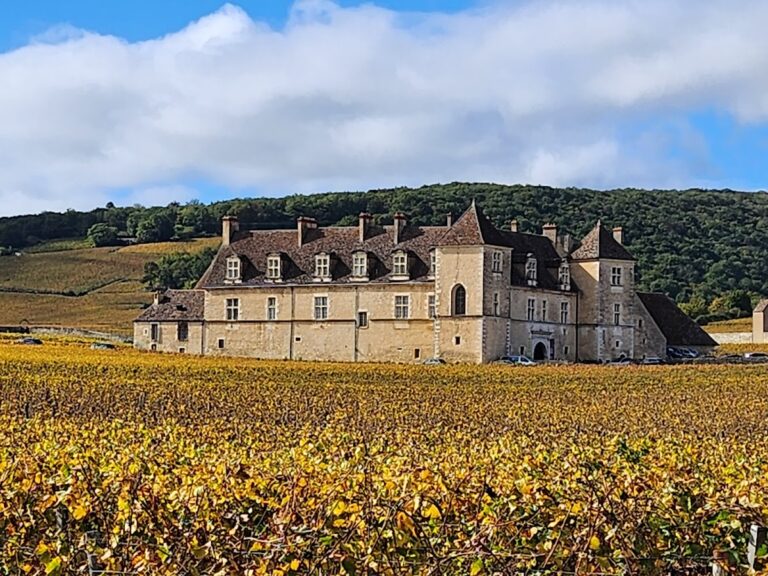
The abbey’s wealth rested on farms called granges, rural estates worked by lay brothers, who performed manual work, and sometimes by hired seasonal labourers. Its lands included many holdings across Burgundy. The vineyard at Clos de Vougeot began before 1110 on uncultivated land donated by the lords of Vergy. Odo I’s 1098 gift included a vineyard at Meursault, and the monks later obtained more vineyards on the Côte. They became known for selecting vines and improving winemaking.
Cîteaux’s estate covered about 5,000 hectares by the end of the twelfth century. An inventory from 1718 counted 9,190 hectares: 20 within the abbey enclosure, 150 of ponds, 120 of vineyards, 700 of meadows, 4,000 of arable land, and 4,200 of woodland, including 2,000 hectares around the abbey. Its revenues were recorded as 120,000 livres in 1726.
Conflict, damage, and reform
The abbey suffered repeated attacks and losses. A fire in 1297 destroyed all the buildings except the church. During the Hundred Years’ War, raids in 1360, 1365, 1434, and 1438 drove the monks to seek refuge in Dijon. In 1476, troops of Maximilian, who had occupied Beaune, devastated the complex.
Further violence struck during the Wars of Religion. In 1574, Protestant Huguenot forces led by the Prince of Condé and John Casimir pillaged the abbey. Its abbot paid 3,000 écus to prevent its complete ruin. In 1589, troops associated with Charles of Mayenne and the Count of Tavannes took the church bells to make cannon and carried off livestock and other goods. Marshal Biron’s troops sacked the abbey in 1595 and removed the church roof’s lead. The abbey’s herd of one hundred pregnant mares was reduced to five or six. Henry IV recognized 200,000 livres in losses suffered between 1590 and 1595.
In 1636, troops under Gallas pillaged Cîteaux and partly destroyed its archives. Abbot Claude Vaussin later collected contributions from other Cistercian monasteries to repair the order’s mother house. The community was also involved in a seventeenth-century dispute over monastic discipline and governance. The conflict, known as the War of the Observances, began around 1606 and divided communities between the Strict and Common Observances. Louis XIII sought papal intervention around 1620, and Richelieu became the order’s cardinal protector in 1635. Pope Alexander VII’s 1666 bull eased the dispute, but the general chapter rejected it in 1672. Cîteaux did not then adopt the Strict Observance, the reform whose monks became known as Trappists.
Revolution and changing uses
French revolutionary measures nationalized church property in 1789 and abolished religious orders in 1790. Of the 45 religious counted at Cîteaux, 31 chose private life and 14 communal life; seven lay brothers were also recorded. By about 10 May 1791, the religious and lay brothers had left. The estate was sold, and systematic demolition began that year. The abbey library’s 10,353 volumes were taken to Dijon in 1791, and its manuscripts are now held by the municipal library there. Napoleon Bonaparte may have visited on 12 June 1791, but his presence is uncertain.
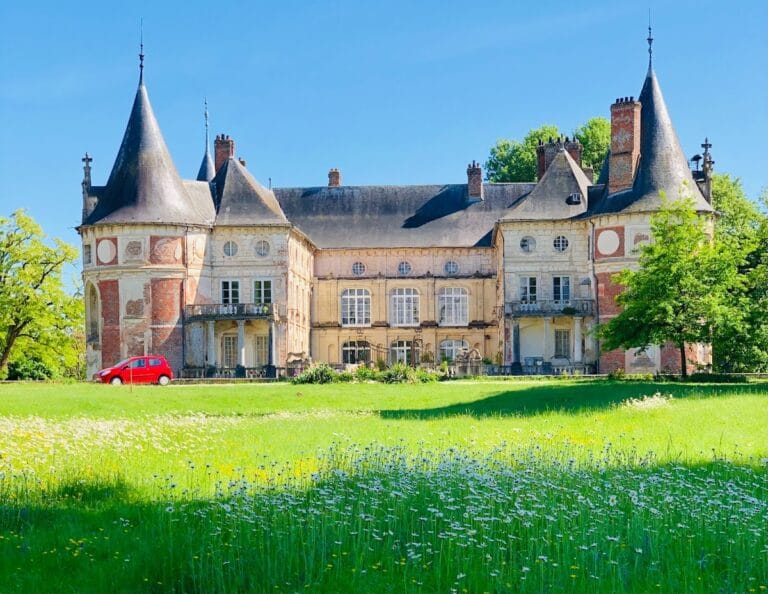
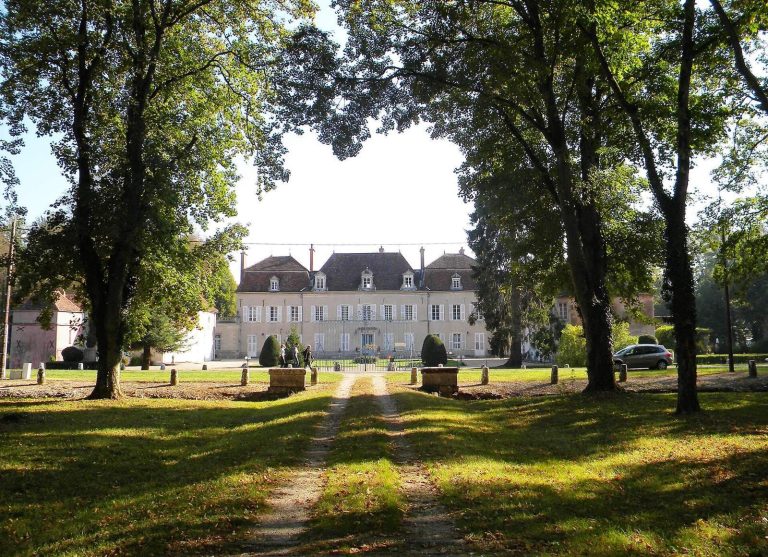
Buildings that remained were adapted to new purposes. The former abbot’s residence became a château, and a large orangery, a building for growing orange trees, was added beside it in 1814. The library became a theatre with 500 seats in 1804. From 1824 to 1839, the Definitoire served as a sugar factory.
In 1841, English merchant Arthur Young and Belgian Fourierist Zoé de Gamond acquired the estate for a cooperative community, or phalanstery, based on the social ideas of Charles Fourier. The project had at most 167 residents by early 1843 and was sold under seizure in 1846. On 25 June that year, Joseph Rey bought 300 hectares and the buildings to establish an agricultural penal colony for young people, including offenders, orphans, and vagrants. Its population reached 1,863 in 1874. Reports of poor hygiene, food, and teaching led the Interior Ministry to stop sending detainees in 1883. Following a scandal in 1888, the Society of the Brothers of Saint Joseph lost its public-utility recognition; the estate passed to the state and declined.
Return of the monastic community
A plan to restore monastic life took shape from 1895, led by Sébastien Wyart, abbot of Sept-Fons, and Frédéric Oury, bishop of Dijon. Marie de Rochefort bought the estate on 22 August 1898 and leased it to Trappist Cistercians. Four monks from Sept-Fons arrived on 2 October, re-establishing a community of the Order of Cistercians of the Strict Observance. Cîteaux has belonged to that order since 1898. In 2009, its community sent four monks to begin a pre-foundation at Munkeby in Norway.
During the First World War, military requisitions reduced the community to about twenty monks, and part of the abbey became a military hospital with capacity for about 1,000 beds. In the Second World War, German forces used the premises as a hospital and occupied the guesthouse. A papal authorization in 1963 allowed the community to elect its own abbot; thereafter, the order’s abbot general held the honorary title of archabbot of Cîteaux. The church inherited from the penal colony was renovated and consecrated in 1970. A separate monastic church was built from 1997 and inaugurated in 1998, providing a place for monastic prayer as well as separate access for the faithful. The library, Definitoire, and Lenoir building were classified as historic monuments in 1978.
Remains
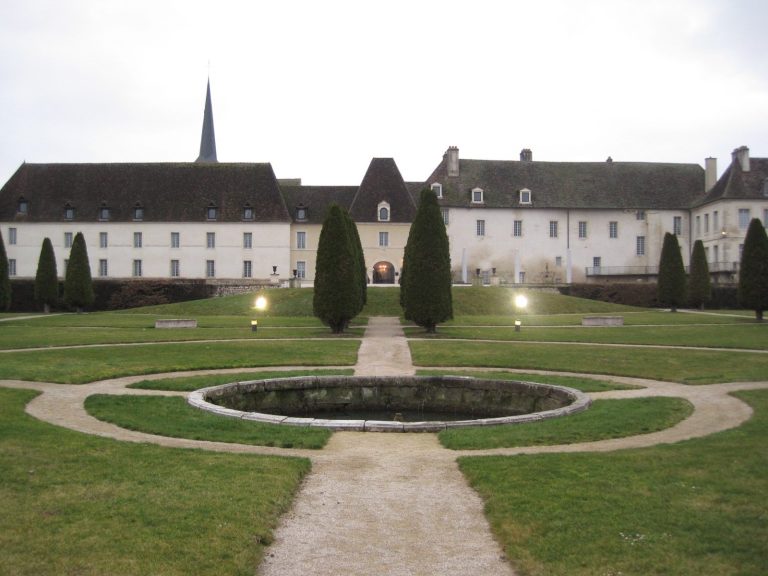
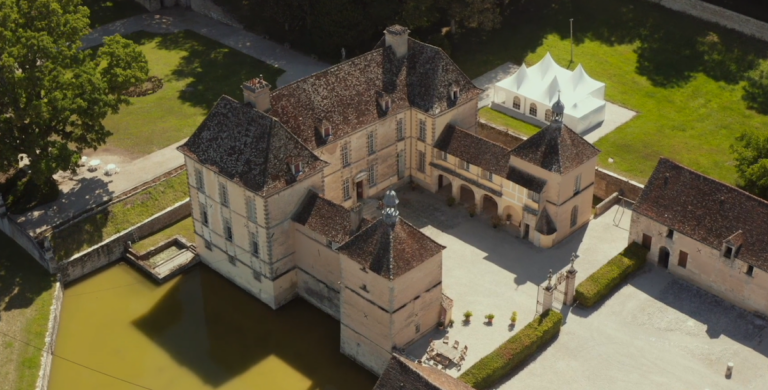
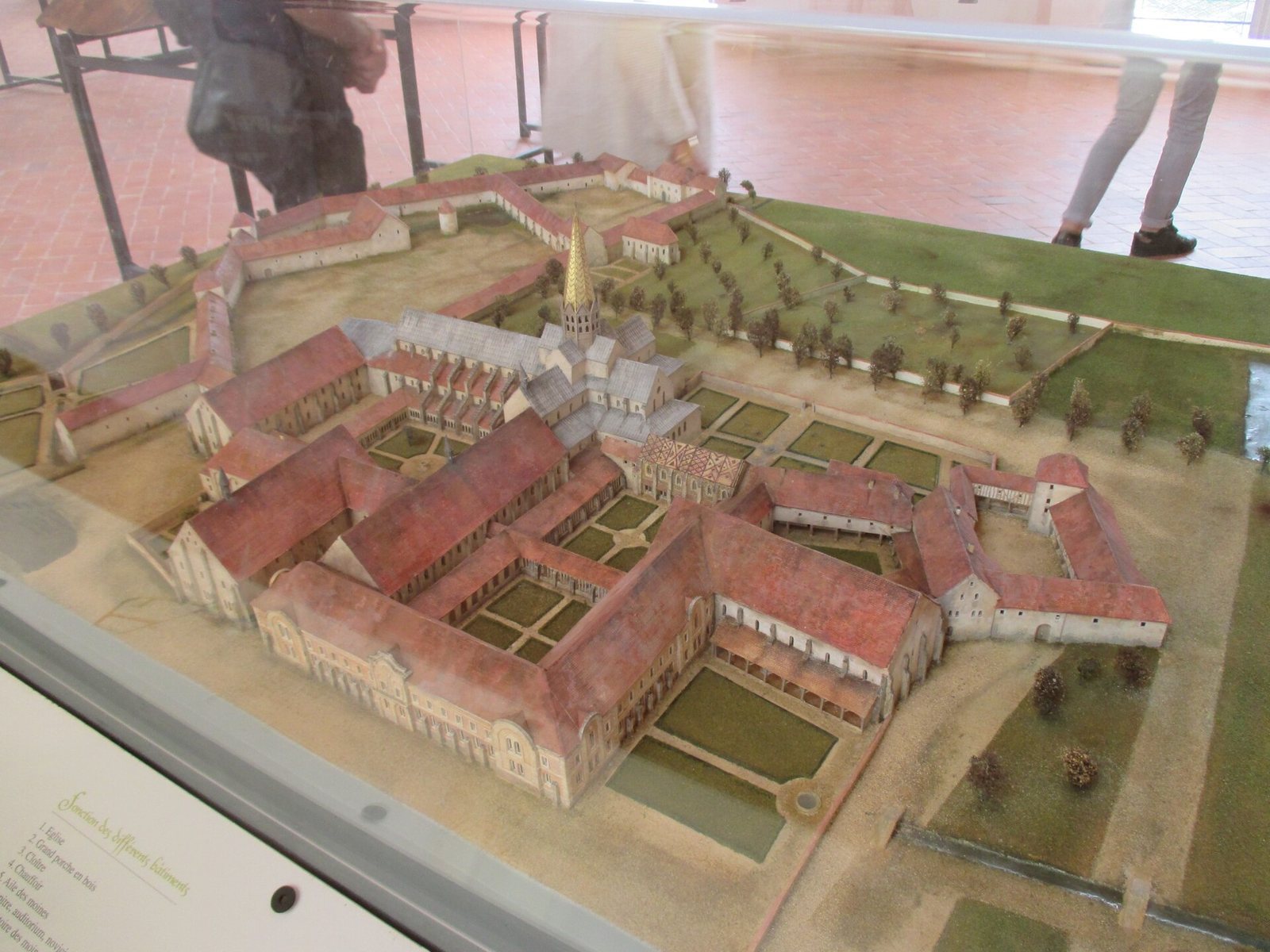
The historic complex developed within a large walled enclosure, with courts, guest buildings, a ducal residence, and monastic buildings arranged around three cloisters, covered walks around courtyards. The principal surviving buildings from the earlier abbey include the library, the Definitoire, and the Lenoir building. The site’s recorded layout also includes the former church, its burial monuments, and an engineered water supply.
Courts and monastic layout
By the seventeenth century, an entrance at the north opened into a lower court bordered by extensive guest and visitor buildings. A second gate at the south end had rooms above it for the duchesses of Burgundy and led to a court of honour. The ducal residence stood along the southern side of that court; other buildings there accommodated the general chapter.
The Great Cloister, the Cloister of the Colloquy, and the Cloister of Saint Edme organized the main monastic spaces. These included the church, a chapter house for monks’ meetings, a parlour, warming room, refectory, kitchen, and dormitory. The general chapter’s assembly hall was square, measuring 19 metres on each side, with seating for about 300. The abbot general’s lodging first stood east of the Cloister of Saint Edme, then moved into the ducal residence.
Water supply and power
In 1206, the monks dug a four-kilometre channel from the Vouge, but it supplied too little water. They then diverted the Sansfond, also called the Cent-Fonts. Its ten-kilometre canal began near Saulon-la-Chapelle and crossed the Varaude on the Arvaux aqueduct bridge, which rose five metres. Water reached the monastery around 1221 at a flow of about 320 litres per second.
A nine-metre drop along the canal powered at least one mill and a forge. Water from the Sansfond and Vouge channels, as well as from the Coindon stream, passed through underground pipes beneath the ducal lodging, the lay brothers’ building, refectory, kitchen, and novice quarters before entering an open channel.
The former abbey church
Church and chapels
The principal church was built between 1130 and 1150, probably beginning around 1140, and consecrated in 1193. It measured 102 metres in length, with a nave, the church’s central area, 11.5 metres wide. Behind the high altar, a stone monument described as an obelisk held Pope Callixtus II’s heart in a reliquary, a container for a sacred relic. The Chapel of All Saints contained a projecting tomb supported by two nearly life-size angels and holding numerous relics.
Burials and tombs
The church served as a burial place for more than sixty members of the House of Burgundy. Those buried there included dukes Odo I, Hugh II, Henry of Burgundy, Odo II, Hugh III, Odo III, and Philip of Rouvres, along with Bernard of Clairvaux, Guy of Burgundy, later Pope Callixtus II, and other religious and noble figures. Marble tombs and other monuments were dismantled or sold during the Revolution. Philippe Pot’s tomb escaped the sale and is now in the Louvre.
Surviving historic buildings
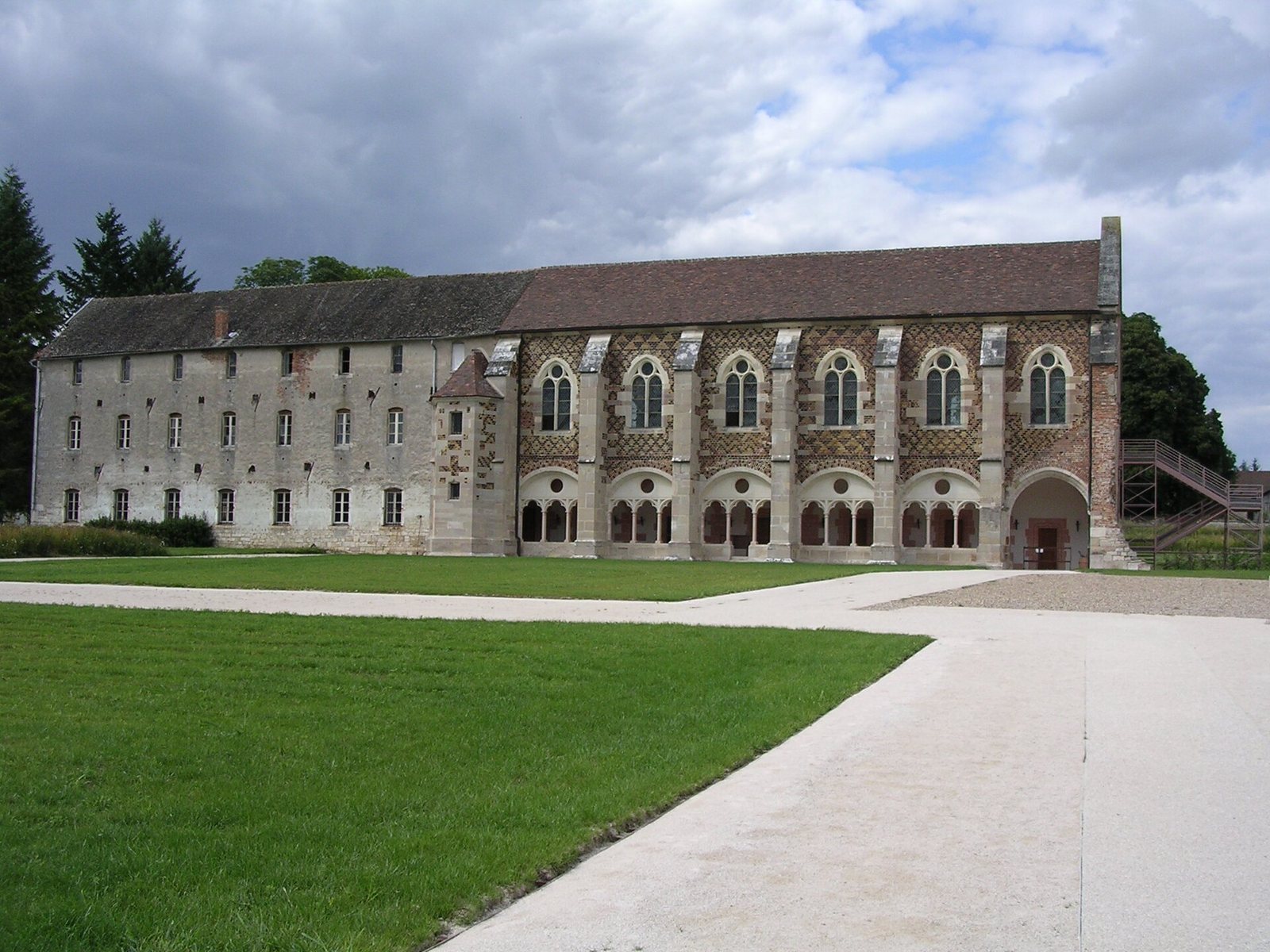
Library
Completed in 1509, the library is the oldest surviving building from the abbey’s earlier period. Its ceiling has a ribbed vault, a structure supported by projecting ribs. When the room became a theatre in 1804, half of the vaulting was lost. The library’s manuscripts are held by the municipal library in Dijon.
Definitoire
Construction of the Definitoire began in 1685 to provide meeting space for the general chapter and larger quarters for novices. Work and fitting-out continued into the late seventeenth century. Its rooms included a dormitory for novices on the first floor, and rooms and a chapel on the eastern ground floor. A large hall with columns on the west side served the general chapter. A groin vault, formed by intersecting barrel-shaped ceilings, spans the building. Fire damaged it before the Trappists returned in 1898.
Lenoir building
Also called the abbot’s lodging, the Lenoir building measures 100 by 20 metres and was completed in 1771. It formed part of a larger rebuilding plan prepared by Nicolas Lenoir and Jean Caristie, of which only a portion was carried out.
Churches of the restored community
Church built for the agricultural colony
A church built in 1861 for the agricultural colony was inherited by the returning community. Renovated and consecrated in 1970, it served both monks and the faithful before the community commissioned a separate monastic church.
Monastic church
Construction of the separate monastic church began in 1997, and it was inaugurated in 1998. Its purpose was to provide the community with a space better suited to prayer while keeping access for the faithful separate.