Church of the Holy Blood of Christ in Armsheim: A Late-Gothic Pilgrimage Church
Site at a Glance
- Rating
- 4.8
- Popularity
- Very Low
- Country
- Germany
- Primary era
- Medieval
- Eras represented
- Medieval, Early Modern, Modern
- Civilizations
- Electoral Palatinate, German, Holy Roman Empire
- Site type
- Religious
- Remains
- Fortified Church
On this page13 sections
History
The Church of the Holy Blood of Christ in Armsheim, Germany, is a late-Gothic pilgrimage church built in the 15th century on a fortified churchyard. It served the veneration of Christ’s Holy Blood, while an earlier church on the site was dedicated to Remigius of Reims, an early medieval bishop revered as a saint.
Medieval construction
Work on the choir began in 1431. The nave was probably built by master builders from Oberdiebach or Ober-Ingelheim. The choir’s builders were associated with the circle of Madern Gerthener, a late-Gothic master builder and sculptor.
Construction of the tower started after 1471 and was completed around 1500. Positioned at the western end toward the old town wall, it served as a protective structure.
Reformation and later changes
During the Reformation, the religious movement that established Protestant churches across parts of Europe, the parish became Protestant in 1556. The high altar was replaced by an altar table, the pulpit was moved, and the division between the choir and side aisles was removed.
A fire in 1854 was followed by renewal of the vault in the tower entrance hall. The tracery gallery, which had been destroyed earlier, was also renewed around that time. A hailstorm in 1859 damaged most of the stained glass. Otto Linnemann redesigned several windows in 1914, and Hans Gottfried von Stockhausen filled remaining gaps between 2006 and 2008.
Johann Michael Stumm built the church’s Baroque organ in 1739, in a style prominent in 17th- and 18th-century Europe. Jakob Köhler renewed its keyboards and linked one keyboard to another in 1840, and Carl Förster altered it further in 1911. The Oberlinger brothers restored it in 1959 and 1990, reversing later changes and reconstructing three lost reed stops. In 2021, Quentin Blumenroeder renewed the keyboards and reconstructed the reeds. The church belongs to Armsheim parish, within the Alzey-Wöllstein deanery and the Rheinhessen and Nassauer Land provostship, regional administrative units of the Evangelical Church in Hesse and Nassau.
Remains
The late-Gothic church is arranged around an eastern choir, a nave with two side aisles, and a tall western tower. Its surviving features include vaulted spaces, medieval stonework, stained glass, a historic organ, and memorial stones.
Church architecture
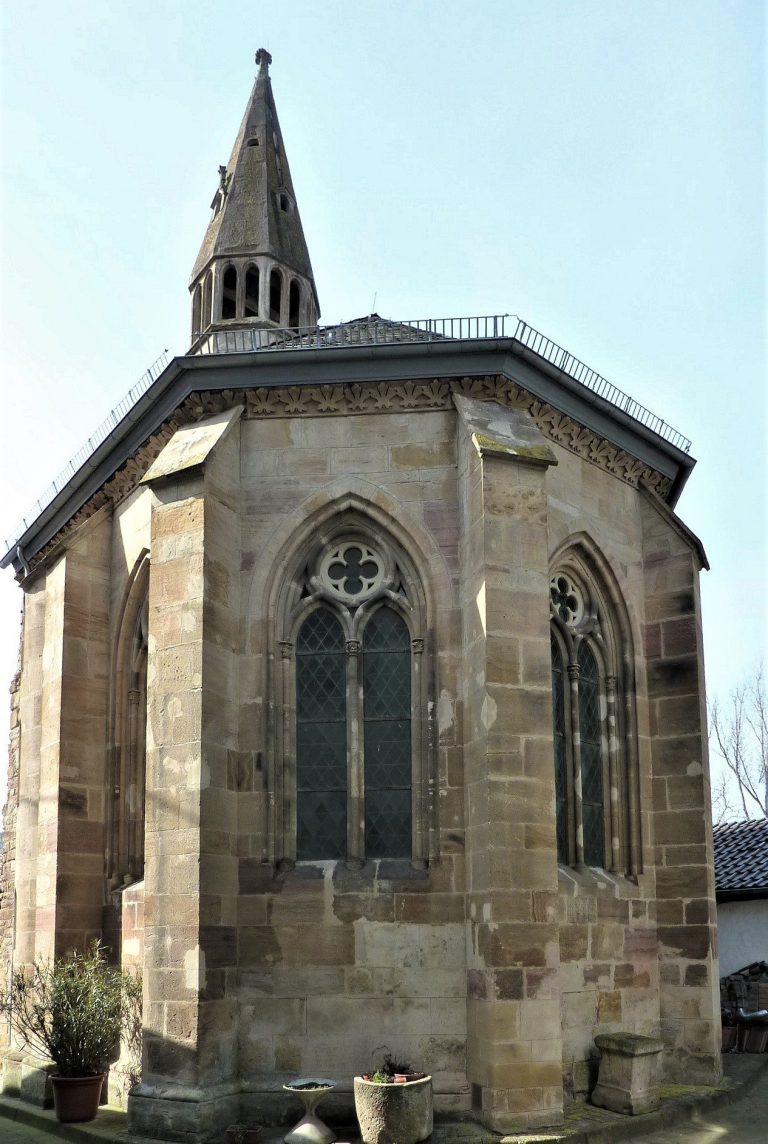
Choir
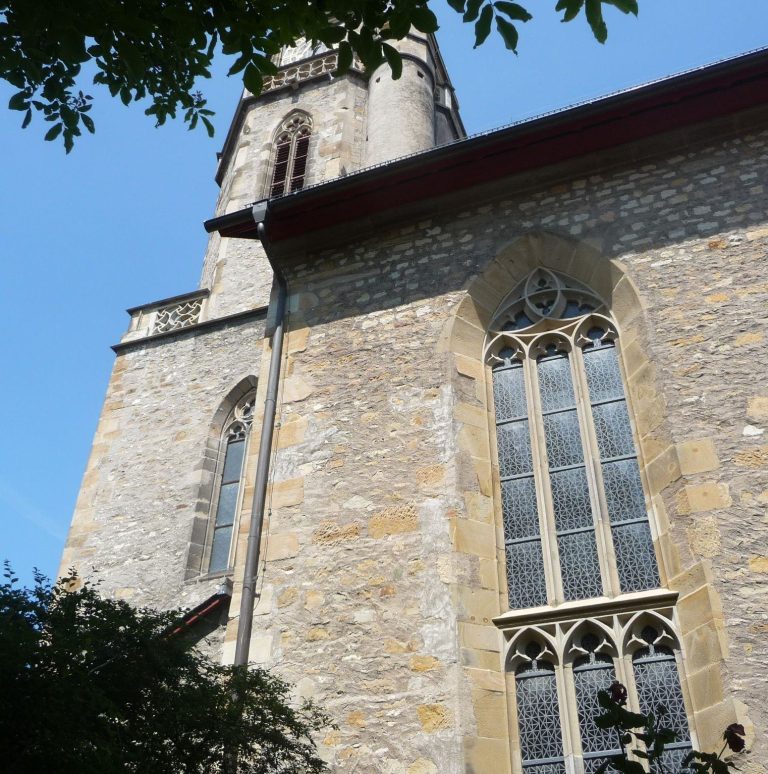
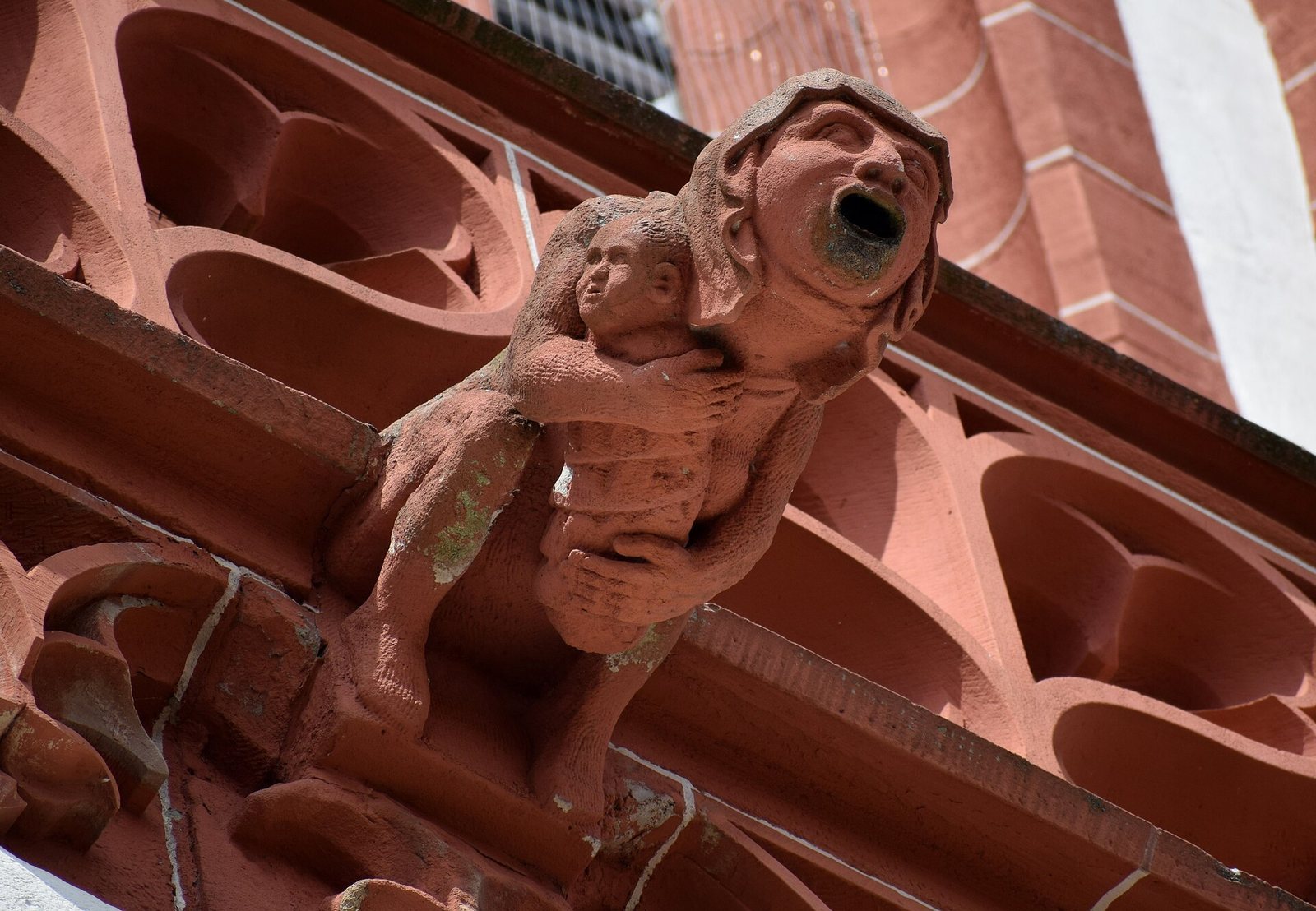
The eastern high choir rises more than 14 metres and ends in five sides, with a steep roof sloping over three of them. Six large windows have stone tracery, the patterned stonework that divides a Gothic window into sections. Inside, a star-patterned vault rests on wall shafts with foliage-decorated tops. Its central keystone shows an angel holding a chalice and a corporal, the square cloth placed beneath the chalice during the Eucharist. Projecting heads appear in two spaces between the vault ribs, while mocking, fool-like faces decorate the side vault fields.
The choir’s design is comparable to the Leonhardskirche in Frankfurt and the west choir of the Katharinenkirche in Oppenheim. A relic displayed in the choir is believed to contain miraculous blood of Christ and is venerated by pilgrims.
Nave
The nave comprises three full sections and a half-section. Its two side aisles are about half as wide as the central space but nearly as tall. Sturdy round piers support the central nave’s ribbed vaults, which were decorated with elaborate paintings in the second half of the 15th century.
Tower
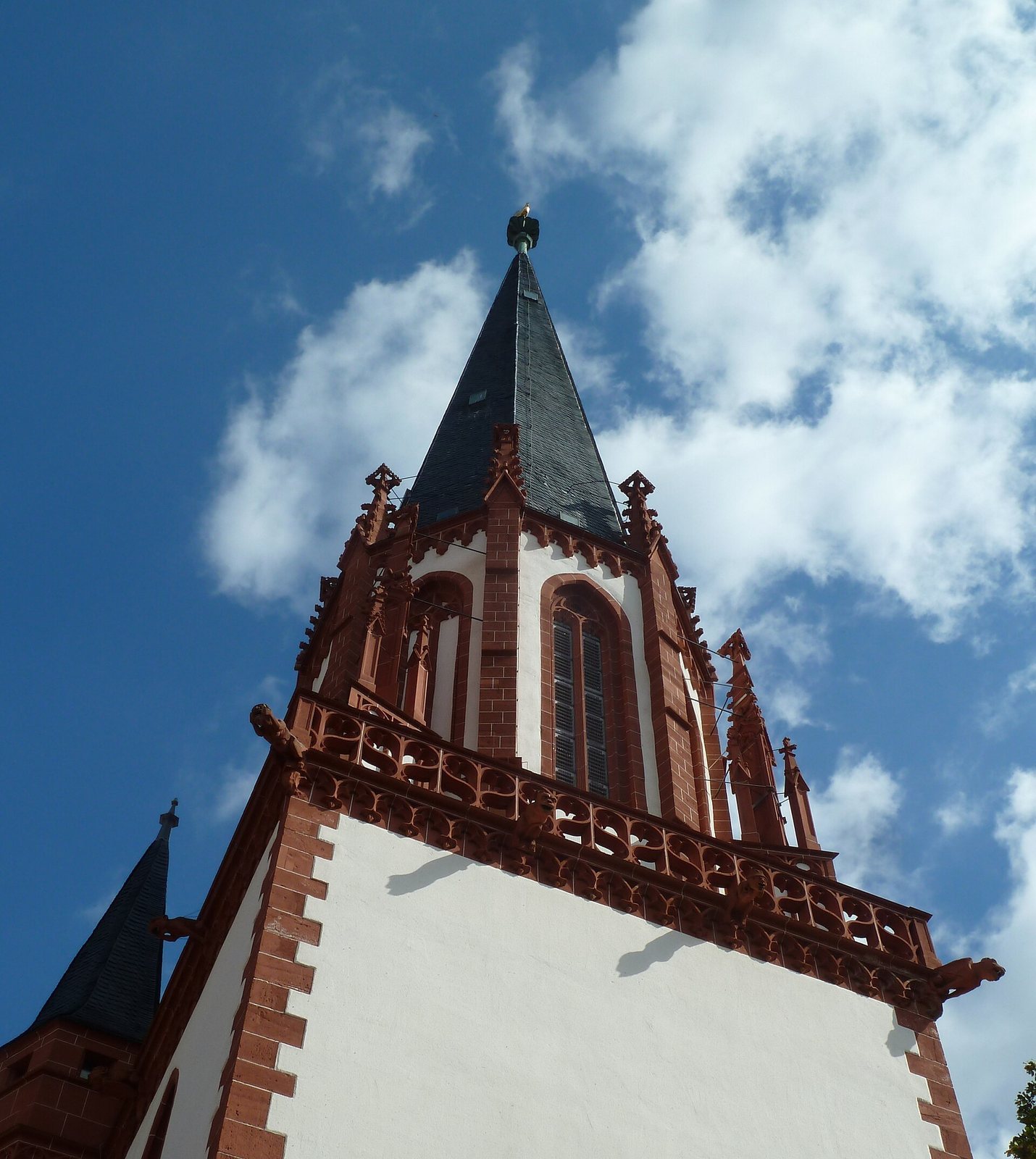
Rising more than 60 metres, the tower has two tall, square lower storeys and an octagonal upper storey encircled by a walkable gallery. Its entrance hall has a vault. The tower resembles the Church of the Holy Spirit in Heidelberg, and its design may also be by the medieval master builder Nikolaus Eseler.
South entrance
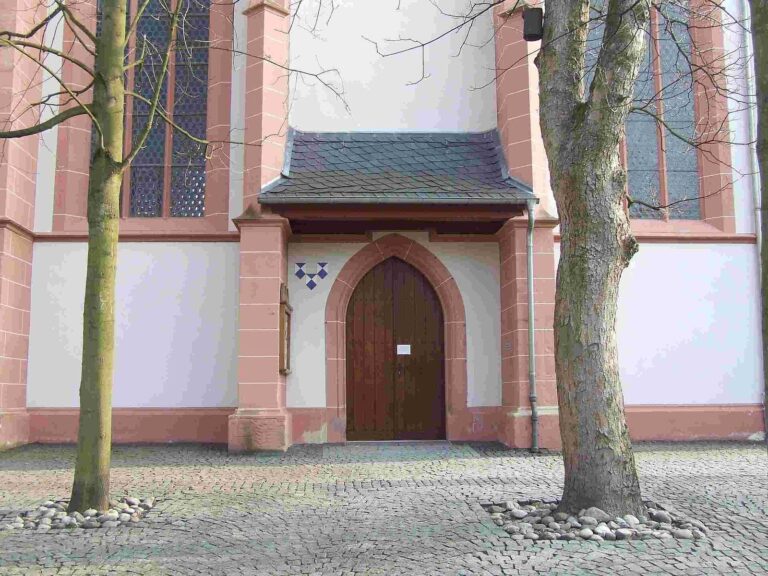
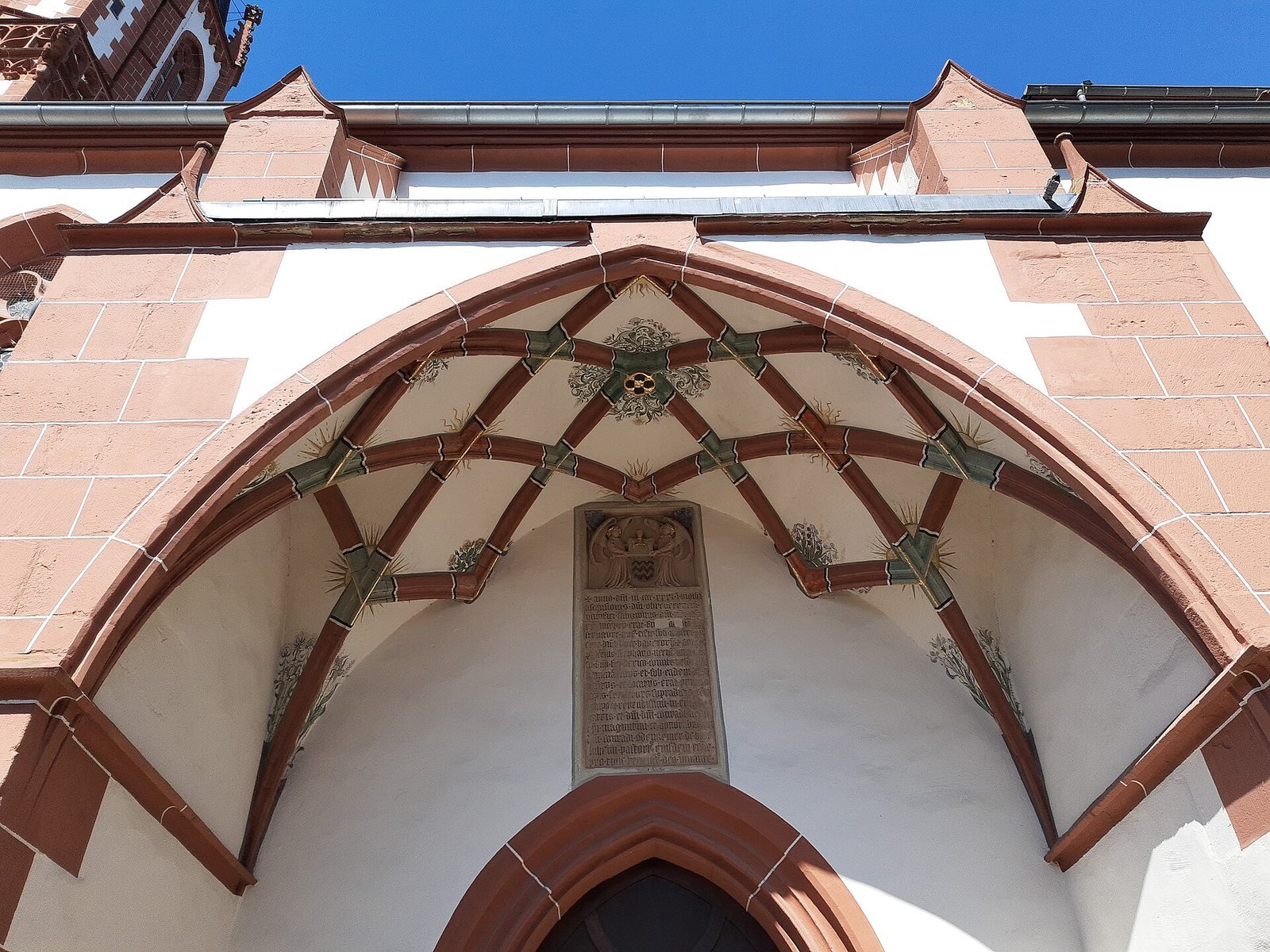
The main entrance is on the south side, beneath a porch with a richly painted net-patterned vault and floral decoration. A prominent foundation stone marks the laying of the church’s foundation in 1431. A relief depicts two richly dressed angels holding a chalice and corporal, referring to the church’s dedication to Christ’s Holy Blood.
Glass, furnishings, and memorials
Stained glass
Fragments of artistic stained glass from 1440 are kept in the sacristy, and a few remnants remain in the stonework of pointed-arch windows. The three eastern choir windows show episodes from Jesus’ life associated with salvation. Another notable window depicts the Beatitudes.
Organ
The organ has 20 stops, which select sets of pipes, two hand-played keyboards and a foot-operated pedal. Its painted and gilded pipes at the front date to 1760 and name the pastor, organist, and church elders, as well as the year, but not the organ builder. The side carvings were also gilded in 1760. The instrument is in good condition and retains Stumm’s oldest surviving bellows system. Its pipework has been substantially altered, and the internal cores of its pipes have been renewed except for the core of the Flaut 4-foot stop on the main keyboard.
Pulpit and memorials
The base of the medieval pulpit, dating to around 1500, bears symbols of angels and the Gospel writers. Its heraldic shields display the Arma Christi, objects associated with Christ’s Passion. The church also contains gravestones for Siegfried von Löwenstein, Margarete von Heppenheim, and Conrad Odenkemmer, along with a heraldic stone of the Puller von Hohenburg.