Church of the Assumption in Kartuzy: A Former Carthusian Monastic Church


Site at a Glance
- Rating
- 4.8
- Popularity
- Low
- Country
- Poland
- Primary era
- Medieval
- External website
- Open
- Eras represented
- Medieval, Early Modern
- Civilizations
- Crusader, Polish–Lithuanian Commonwealth, Teutonic Order
- Site type
- Religious
- Remains
- Monastery
On this page16 sections
History
The Church of the Assumption in Kartuzy is a former Carthusian monastic church in Poland, built by the Carthusian Order in the Gothic period between 1383 and 1405. It belonged to the monastery of Domus Paradisi Mariae, or Mary’s Paradise, founded around 1380–1381 in the monastic state of the Teutonic Knights. The church was consecrated to Our Lady of Paradise, also identified with the Assumption of the Blessed Virgin Mary, on 7 October 1403.
Foundation and monastic development
The monastery was founded by Jean Russeczin, and Johann Deterhus of Westphalia became its first prior. The Carthusian Order, a Catholic community founded by Bruno of Cologne in 1084, organized monastic life around separate cells, limited communal worship, and shared work. The house received substantial early donations from the Teutonic Order, while citizens of Danzig endowed many of its sixteen individual cells.
Its estate grew through gifts, bequests, and land purchases. In the surrounding forests, the monks operated tar works, glassworks, and charcoal-burning facilities. Peasant settlers created clearings around the monastery, and many came from Pomerania and later followed Protestant forms of Christianity after the Reformation. The monastery was situated in Prussia and eventually became the only Carthusian house in Royal Prussia. After 1772, it was the order’s only monastery in the Kingdom of Prussia.
Conflict and recovery
Lutherans plundered the monastery in 1525. By 1541, its community had fallen to four choir monks, the members responsible for the principal liturgical duties, apart from the lay brothers who generally carried out practical work. In 1565, the monastery was placed under the administration of the Cistercian Abbey of Oliva. It was forcibly united with that abbey between 1580 and 1589, but the Carthusians recovered their property in 1589.
The monastery regained strength during the seventeenth century. In 1648, monks from Marienparadies founded the Carthusian monastery of Bereza in the Grand Duchy of Lithuania at the invitation of the grand duchy’s chancellor, Casimir Leon Sapieha. Swedish troops occupied the monastery in 1705, and it suffered further damage during the siege of Danzig in 1734. A later period of prosperity followed. In 1760, Prior Georg Schwengel compiled Apparatus ad annales Cartusiae paradisi B.M.V., a history of the monastery drawn from its foundation documents and institutional records.
Dissolution and parish use
In 1772, the monastery and Pomerelia became part of Prussia. The monastery was dissolved in 1826 after the Prussian state and the Holy See agreed to secularization, the transfer of religious institutions or property out of ecclesiastical control, under the papal bull De salute animarum of 1821.
The former monastic church became a Catholic parish church in 1849, when Karthaus was established as a parish. It is now the Church of the Assumption of the Blessed Virgin Mary in Kartuzy, serving as both a parish and collegiate church. A collegiate church is served by a chapter of clergy, while a parish church serves a defined local Catholic community. The building is also the seat of the Kartuzy Collegiate Chapter. Jan Bernard Szlaga conferred its collegiate title on 20 October 1992. Its liturgical dedication is celebrated on 15 August.
Remains
Architectural remains
The Gothic church
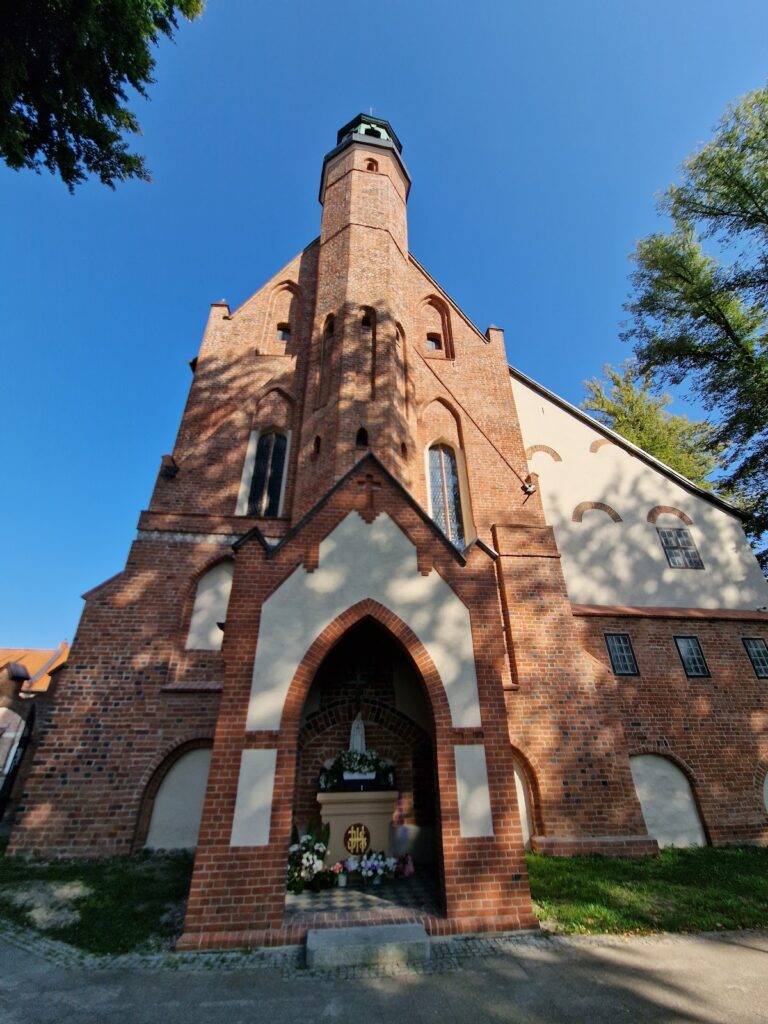
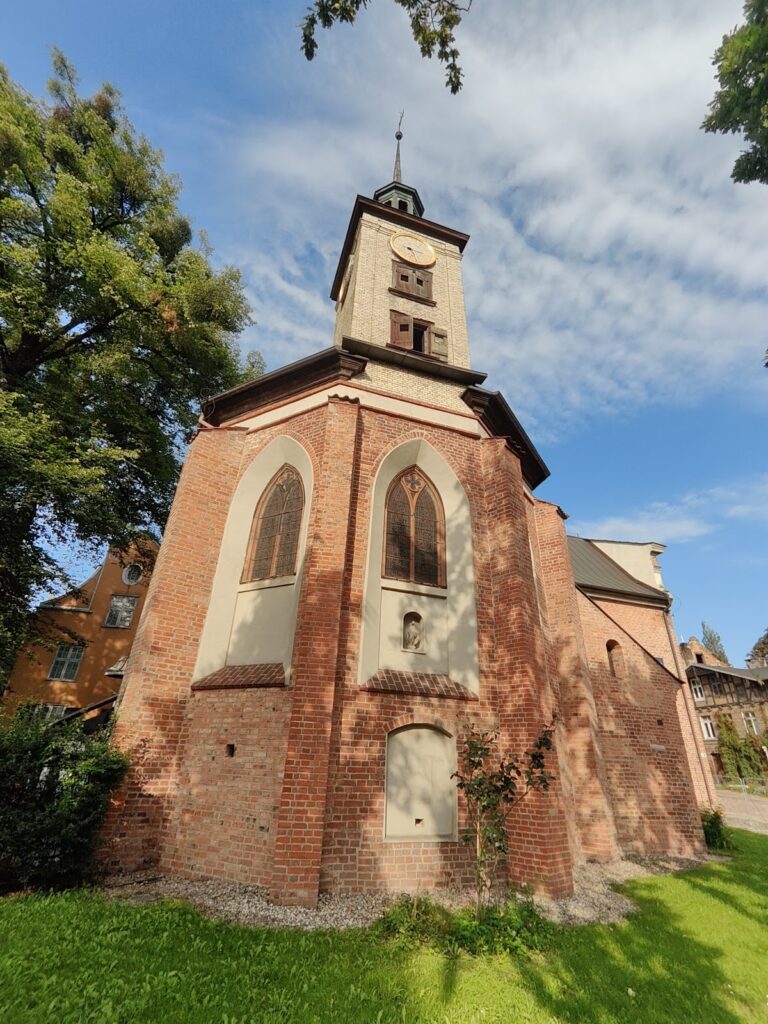
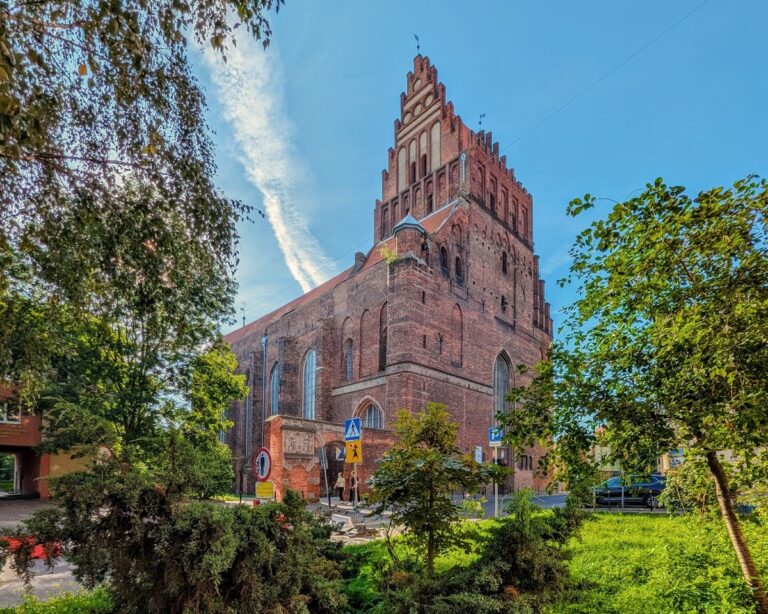
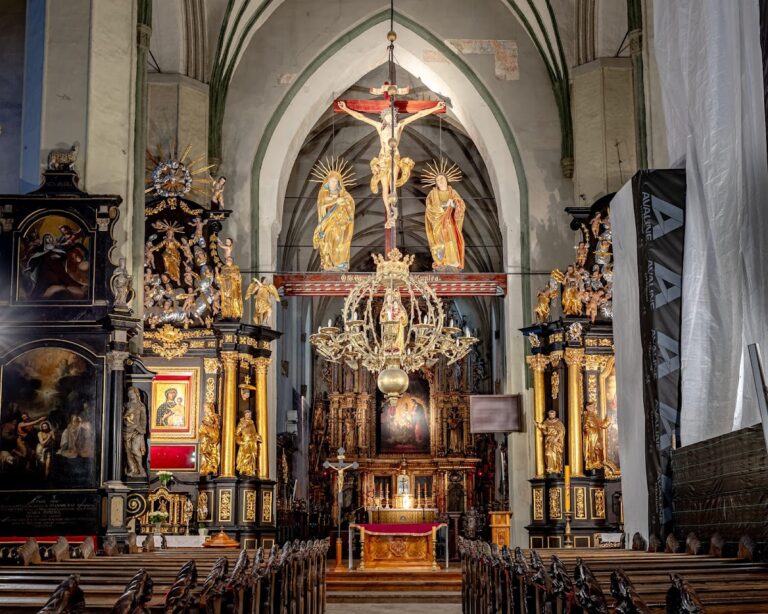
The former monastic church is a one-towered Gothic building constructed between 1383 and 1405. Its original roof had a coffin-like form. The tower received its Baroque spire or cap in 1731–1733, when the interior was remodelled in the Baroque style.
Former monastic buildings
Parts of the former monastic complex survive around the church. They include farm buildings, a hermitage or monks’ cell, and the refectory. Since 1995, the refectory has housed a contemporary art gallery.
Altars and devotional furnishings
Side altars
Four side altars stand along the north and south walls of the nave. They are dedicated to the Lord’s Supper, All Saints, the Three Kings, and the Nativity. The Lord’s Supper altar was made in 1678 by the Gdańsk master Hans Caspar for Prior Johannes Billstein. It combines black marble with white English alabaster. Billstein’s successor, Prior Laurentius Fendrich, commissioned the other three altars from the woodcarver Matthias Scholler.
Late Gothic triptych
A late Gothic triptych, an altarpiece composed of three panels, was made in a Gdańsk workshop in 1444 and served as the high altar until 1639. Its surviving central retable section and predella, the lower part of an altarpiece, are now installed in the Golden Chapel.
The central section presents eight symmetrically arranged figures beneath a Late Gothic canopy. Christ and the Virgin Mary appear enthroned, alongside Saint John the Baptist, Saint John the Evangelist, Saint George, a saint holding a model of a church, and two female saints. The predella contains a painting of Christ, Mary, and the twelve apostles, arranged with six figures on each side.
Prior’s throne and baptismal font
A carved wooden prior’s or celebrant’s throne, dated 1677, occupies a wall niche on the right side of the high altar in the chancel. God the Father appears above the seat, pointing upward with his right hand and toward Christ on the back panel with his left. Saint Bruno and Saint Jerome stand on the decorative wings.
The church also contains a portable, richly decorated wooden baptismal font. Sleeping figures form its base, praying monks fill the middle section, and vegetal ornaments and angels’ heads decorate the upper section. Saint John the Baptist crowns the lid; this figure was made in 1930 by Antoni Kollek of Kartuzy.
Choir and musical furnishings
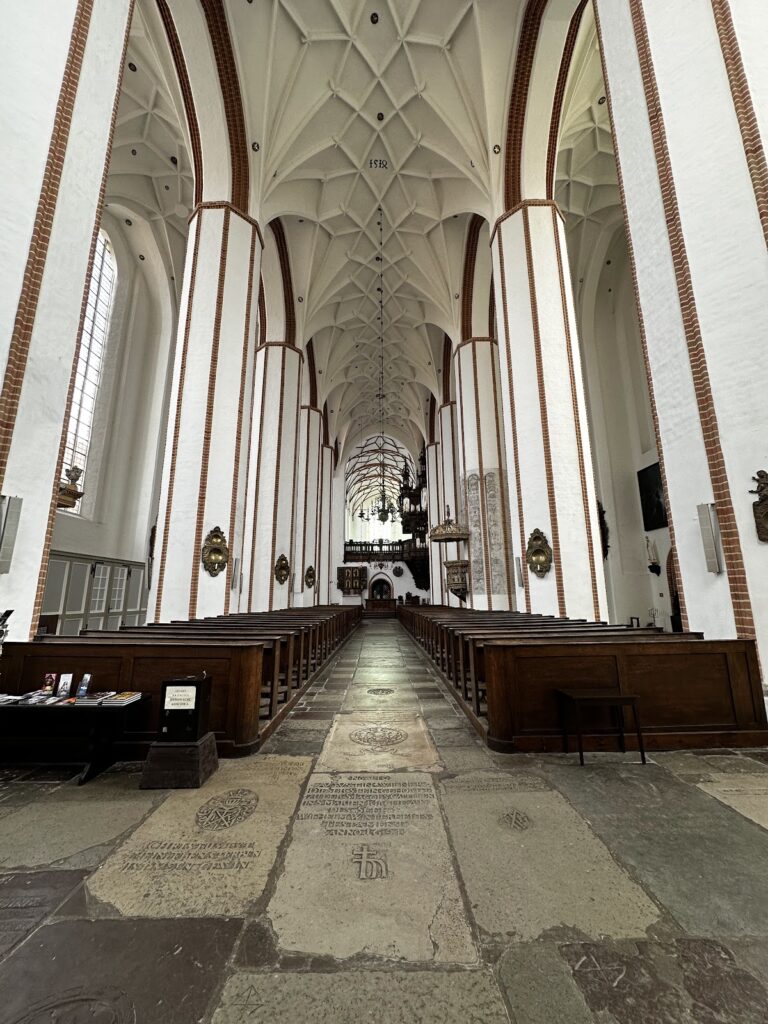
Baroque choir stalls
Two rows of richly carved Baroque wooden choir stalls extend along the north and south walls in the front part of the nave, which formerly served as the choir of the priest-monks. The older row was installed on 5 October 1643, on the eve of Saint Bruno’s feast, and the second was added in 1677. The southern stalls depict the apostles, while the northern stalls show hermits and patron saints of the Carthusians.
Closer to the entrance, more modest stall panels depict the Evangelists and scenes from the Passion. These were intended for the lay brothers.
Organ gallery
A late Renaissance organ gallery, made around 1640, occupies the wall opposite the chancel. Its richly decorated symmetrical balustrade has eleven bays separated by herm pilasters with Ionic capitals. The panels contain arcades framed by pairs of Doric half-columns, entablatures, and openwork pediments.
The central square bay contains a single-hand clock whose pendulum ends in an angel holding a scythe, swinging above the main entrance. The first organ was installed in 1850 with fourteen stops, nine operated manually and five by pedals. It was later renovated and modernized several times. The church now has an organ with fifteen stops and two manuals.
Cordovan wall decoration
Gilded Córdoba leather wall hangings, known as cordovan, survive in their intended position on the lower walls of the chancel. Cordovan is embossed and painted leather used as ornamental wall covering rather than painted plaster. This is the only church in Poland where such decoration remains in place.
Prior Laurentius Fendrich commissioned the set in 1685. It originally consisted of sixty panels and cost 270 florins; fewer panels now hang on both sides of the high altar. Their translucent colors allow the gold and silver beneath to show through, with red and green predominating.
The decoration includes tulips, sunflowers, pomegranates, pears, apples, floral garlands, a butterfly, a bird of paradise, a squirrel splitting a nut, and putti playing with flowers and fruit. The wall hangings are associated with the visit of King John III Sobieski to Pomerania, including Danzig, Żukowo, and Kartuzy.