Church of Saint Mary of the Assumption in Żukowo: A Gothic Norbertine Convent Church


Site at a Glance
- Rating
- 4.8
- Popularity
- Low
- Country
- Poland
- Primary era
- Medieval
- External website
- Open
- Eras represented
- Medieval, Early Modern
- Civilizations
- Polish–Lithuanian Commonwealth, Teutonic Order
- Site type
- Religious
- Remains
- Church
On this page10 sections
History
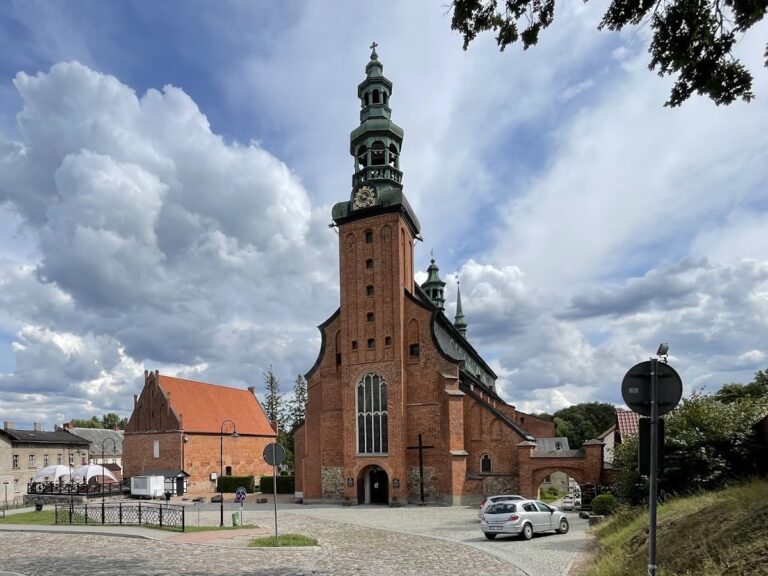
The Church of Saint Mary of the Assumption in Żukowo, Poland, is a Gothic brick parish church that developed from a medieval Norbertine convent foundation. The Norbertines were members of the Premonstratensian order, a Roman Catholic religious order founded by Saint Norbert. Dedicated to the Assumption of the Blessed Virgin Mary, the church celebrates its liturgical feast on 15 August.
Foundation and medieval development
The convent was transferred from nearby Stolpa, now part of Żukowo, after a raid in 1226. The relocated monastery became the setting for the church, whose foundation is attributed to Mestwin I, a medieval duke of Pomerelia, and his wife, Zwinisława. The church walls are associated with the Pomeranian dukes of the thirteenth century.
An early thirteenth-century church formed the first major stage of construction. Its western four bays remain incorporated into the present building. During the fourteenth century, the church was raised, extended by three bays, and given a three-sided choir. Archaeological research in 1999 identified two medieval construction phases, dated to 1375 and 1433. Further alterations followed in the fifteenth and seventeenth centuries.
From convent church to parish church
The church remained in the possession of the convent until 1834, when the Prussian government dissolved the community. The Żukowo parish took over the church in 1836. The convent buildings were sold, while the former stable was converted into a rectory.
The former convent complex retains the church together with several associated structures, including a stable, a coach house, and a vaulted building with a central pillar. A wall contains niches with representations of nuns, and a statue of Saint Norbert stands in the courtyard. The church cemetery dates from the seventeenth century. The church has been registered as a monument under entry no. 155 since 4 December 1961.
Remains
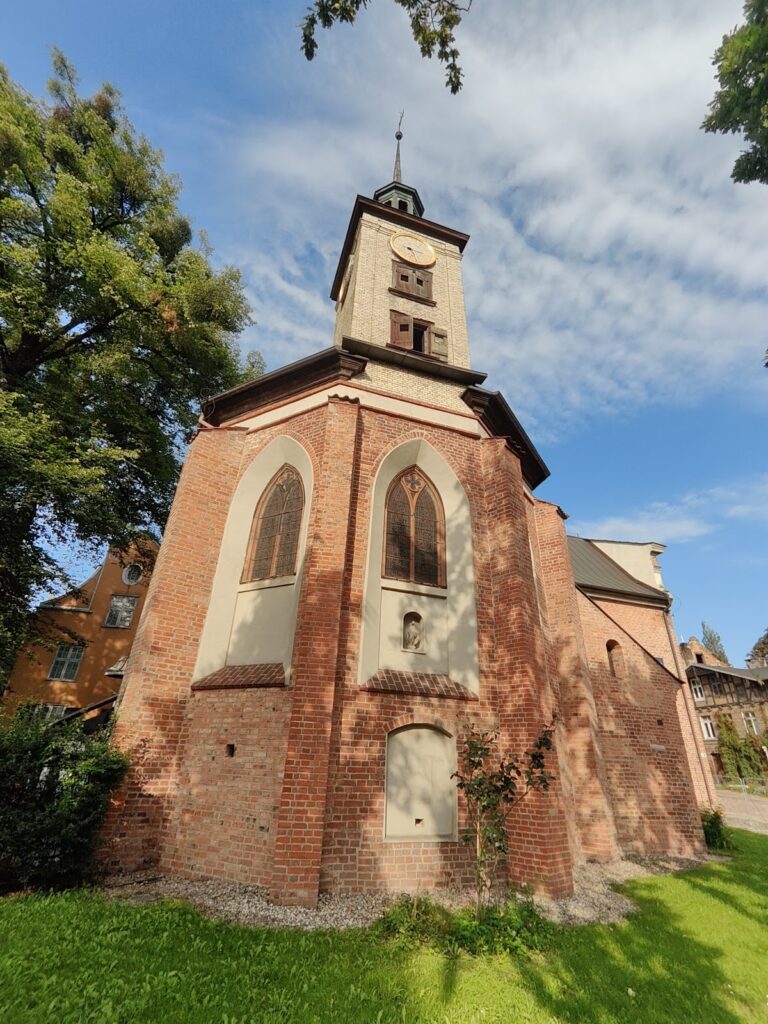
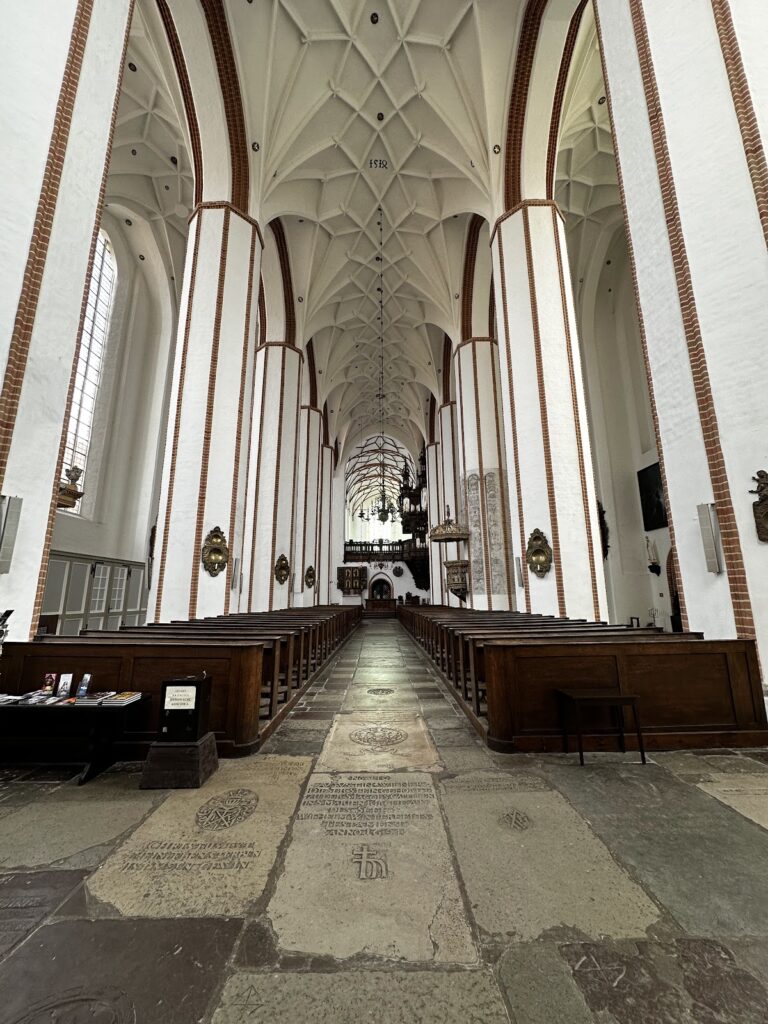
The surviving church is a single-nave Gothic brick building approximately 38 metres long, 9 metres wide, and 14 metres high. The main nave is 9 metres across. Medieval buttresses support the walls. Vaulting had originally been planned, but the intended scheme was replaced by a wooden ceiling, remnants of which survive in the roof space. The interior now contains both cross vaults, formed by the intersection of two barrel vaults, and barrel vaults. The present cross vaults date from the beginning of the seventeenth century.
Exterior and galleries
Two towers rise from the church. The principal tower is accompanied by a narrow octagonal western turret, whose openwork cap dates from the eighteenth century. A bell turret, or small roof tower, was installed in 1737. The exterior elevations of the sacristy and the stairway leading to the choir date from the beginning of the eighteenth century.
Inside, a nuns’ gallery dates from the beginning of the seventeenth century. A choir gallery connected with the pulpit was completed on 23 July 1766. A seventeenth-century rood beam, a transverse beam associated with a representation of the Crucifixion, is preserved in the church. The cross above the entrance to the sacristy dates from around 1360.
Altars and devotional works
High altar
The seventeenth-century high altar has a two-level design. It includes Herman Han’s paintings Madonna among the Angels and The Holy Trinity, along with a reliquary and figures of the Risen Christ, Saint Mary Magdalene, Saint John the Evangelist, and angels. The altar belongs to the same workshop tradition as the high altar in Kartuzy and the Marian altar in Pelplin.
Side altars and triptych
The sixteenth-century altar of the Holy Family contains a late Gothic figure known as the Wadzińska Madonna. An eighteenth-century altar is dedicated to Saint Norbert. The church also preserves a sixteenth-century Antwerp triptych, an artwork made from three connected panels, depicting the youth and life of Jesus Christ.
Shrine and paintings
Another sixteenth-century shrine altar, with a central sculptural or painted compartment, is a local work and supposedly depicts Mestwin I, identified as the monastery’s founder. Eighteenth-century paintings include Norbertine Nuns Murdered by the Prussians in 1226 and The Descent from the Cross.
Bell turret and organs
The 1737 bell turret contains two additional chain-driven bells named Maria and Norbert, cast in the 1950s. The organs were built during the same decade and placed on the former nuns’ choir. Their dark-green case contains 25 stops, two manuals, pedals, bellows, pneumatic action, and an electric blower. The instrument requires repair.