Church of St Peter & St Paul, Godalming: An Anglo-Saxon and Medieval Parish Church
Site at a Glance
- Rating
- 4.3
- Popularity
- Medium
- Country
- United Kingdom
- Primary era
- Medieval
- Eras represented
- Medieval, Early Modern, Modern
- Civilizations
- Anglo-Saxon, British, English, Norman
- Site type
- Religious
- Remains
- Church
On this page11 sections
History
The Church of St Peter & St Paul, Godalming, is a Church of England parish church in the United Kingdom. Anglo-Saxon communities had established a church here by at least the mid-ninth century, before the Norman Conquest of 1066. The present building replaced an earlier Anglo-Saxon church and was largely rebuilt in the twelfth century. It is described as Godalming’s oldest building.
Early church and medieval development
In 1086, the Domesday Book, an English survey of landholding and resources, named Ranulf Flambard as holder of Godalming church. Flambard, a Norman cleric and royal administrator, was justiciar to William Rufus, or William II. A justiciar was a senior royal officer responsible for judicial and administrative duties. Common Lammas land lay around the church, alongside a substantial glebe, land attached to a church benefice that could provide income. Income from the glebe helped fund a spacious church.
Building work continued through the medieval period, particularly in the fourteenth century. The church’s layout and fabric were altered as new spaces and extensions were added, and further major enlargement took place in the nineteenth century.
The rectory and its owners
The rectory, a church benefice and its associated property, was treated as a manor but was not owned by the church. A lay owner appointed Ulmaer as vicar, or parish priest, in 1066; Ulmaer had held the rectory under Edward the Confessor, king from 1042 to 1066. The Dean and Chapter of Salisbury Cathedral, its senior clergy and governing body, held the rectory from 1128 to 1846, except for an 11-year seizure under Cromwell’s governments. The Ecclesiastical Commissioners took charge in 1846, and the property was sold to John Simmonds in 1860. He later left it by will to J. Whateley Simmonds.
Religious life in the seventeenth century
During the later years of Charles I’s reign, Godalming was a Calvinistic stronghold. Calvinism is a Protestant tradition associated with the teachings of John Calvin. The vicar, Dr. Andrews, was removed from his benefice in 1640, and the town welcomed the Calvinist preacher Thomas Edwards. Edwards travelled from London along the Portsmouth Road, making the 30-mile journey three or four times a week and preaching at points on the way. Some land in and around Godalming belonged to Salisbury Cathedral, and a contemporary proverb praised the town for its piety.
Later changes and present identity
In 1947 the church was listed at Grade I, a category for buildings of exceptional architectural or historic interest in England. Window-frame paintings were brought back to view in the twenty-first century. In 2017, John Taylor & Co. restored and recast all the bells; the tenor was made two hundredweight heavier than before. The church has Broad Churchmanship, an Anglican outlook accommodating a wide range of theological views, and has formed part of Godalming Minster since its establishment in 2024.
Remains
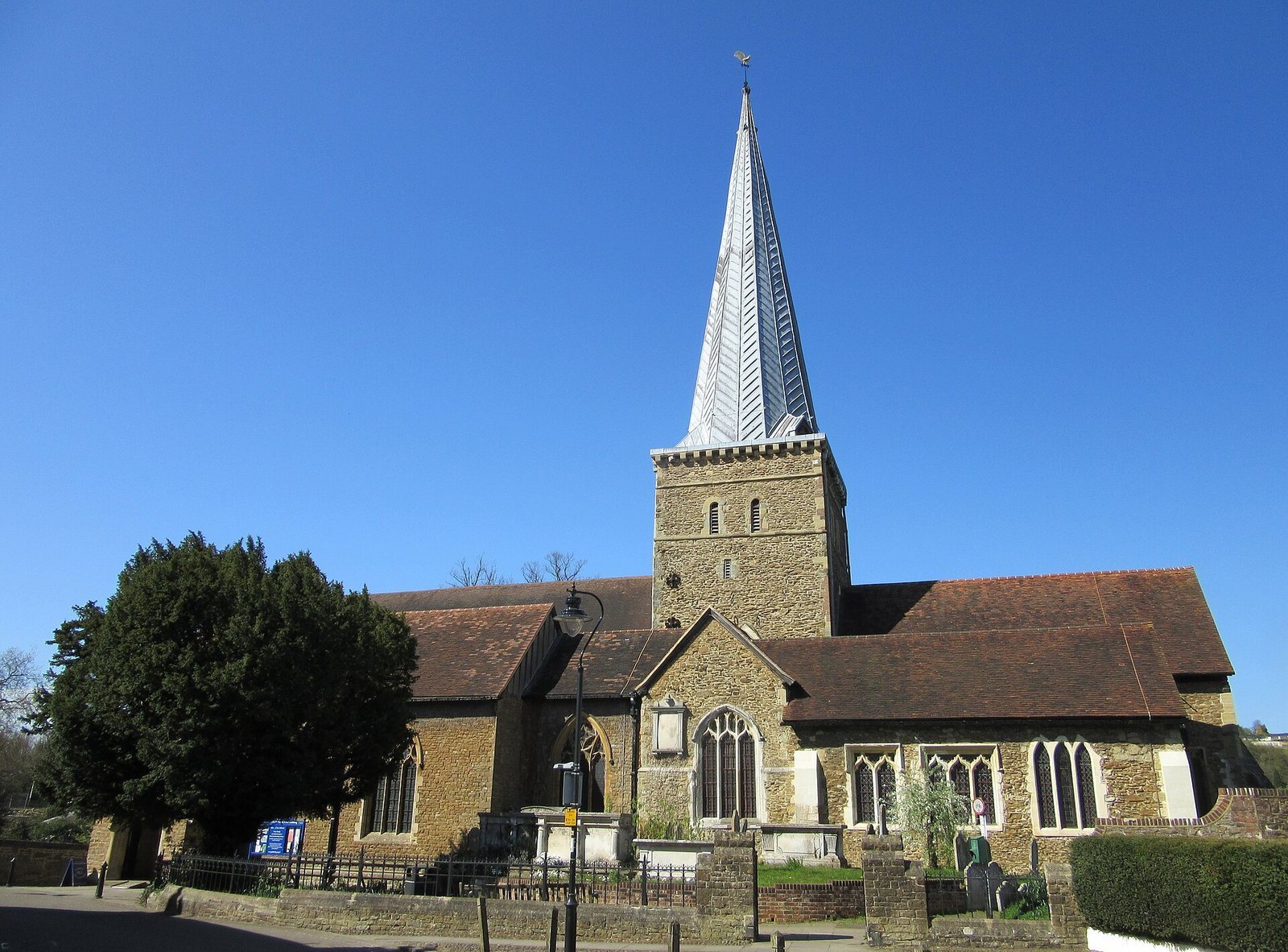
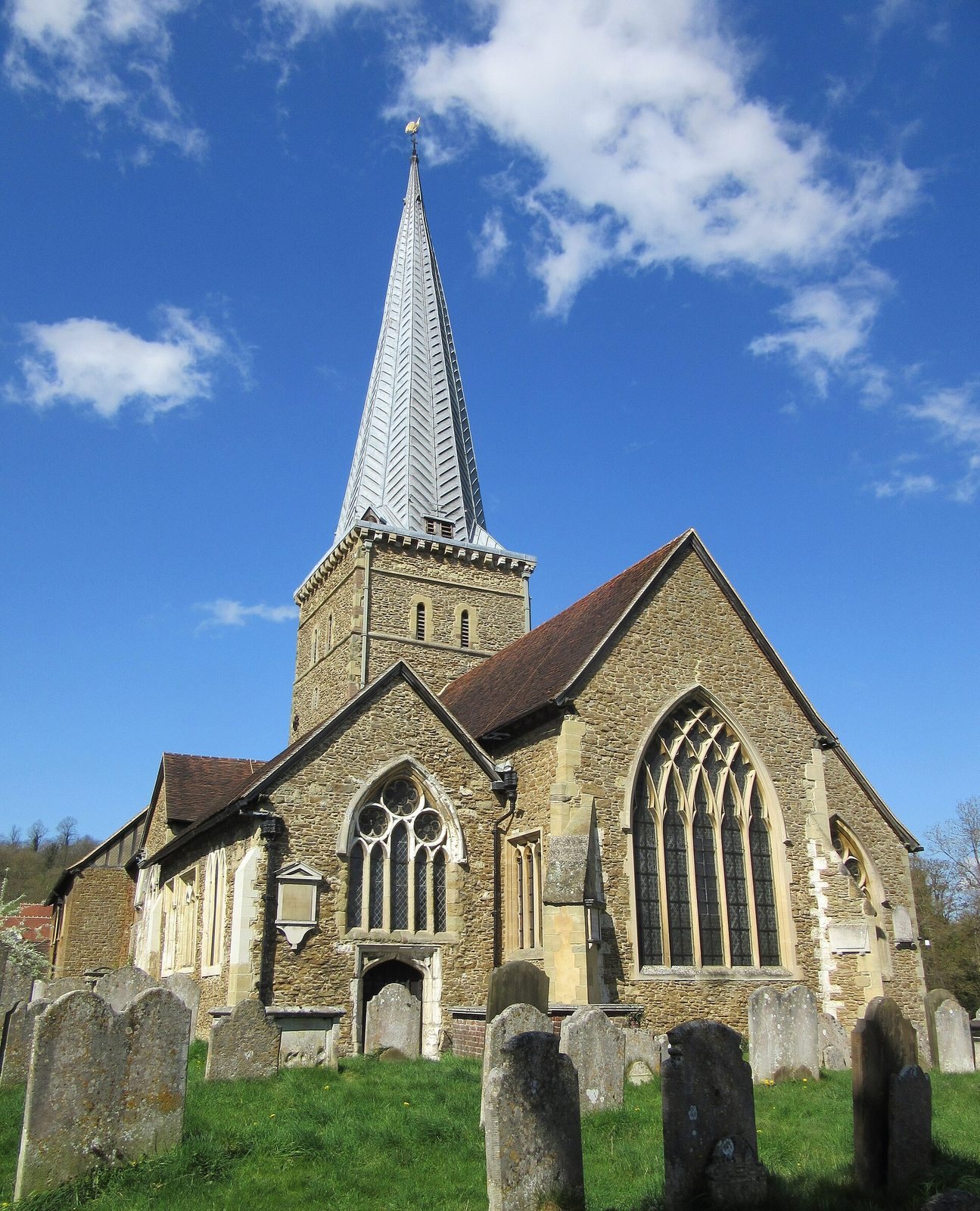
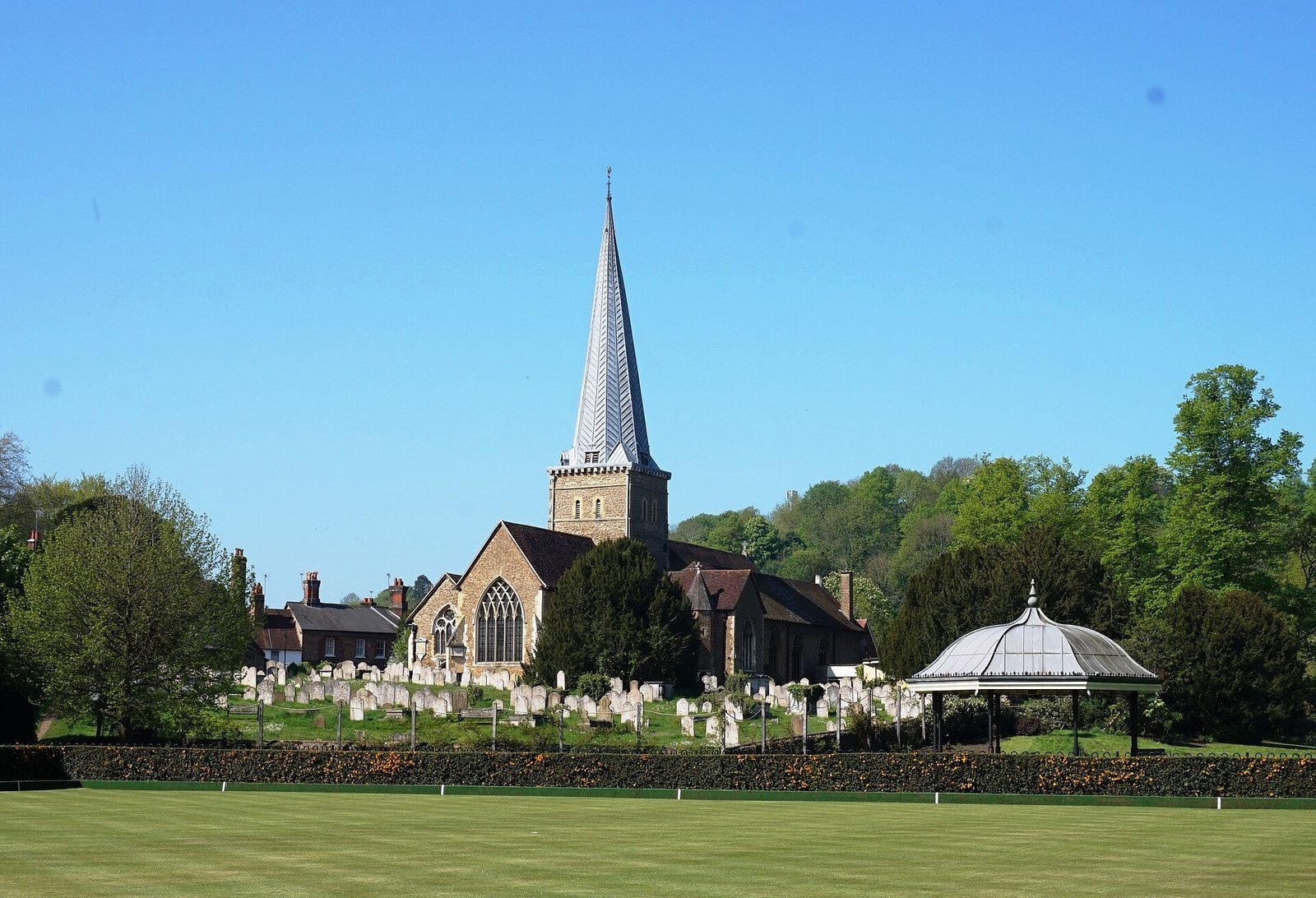
Set on Church Street within Godalming’s urban area, the church is built largely of local sandstone, including Bargate stone from the nearby Greensand Ridge. Its plan developed from an aisleless church with a central tower into a more extended arrangement, and later additions produced the broad, rectangular layout of the present building.
Anglo-Saxon core
Anglo-Saxon remains survive in the structure, and several carved stones associated with the church date from 820 to 840. The earlier church is reconstructed as having an aisleless nave, represented by the eastern half of the present nave, and a central tower corresponding to a short, square chancel. The nave is estimated to have measured about 32 by 20 feet. The chancel was 16 feet 6 inches wide and originally about a foot longer. Its walls averaged 3 feet thick and stood about 25 feet high.
Twelfth-century chancel and arch
Around 1100, a longer chancel measuring about 33 feet 3 inches by 17 feet 3 inches was added, and a low tower was raised on the gabled walls of the original chancel. The eastern wall was thickened by about a foot on its western side. An arch was cut through it and survives, with two plain orders (successive arch bands) and chamfered imposts (sloping blocks from which an arch springs).
Medieval chapels, aisles, and roof
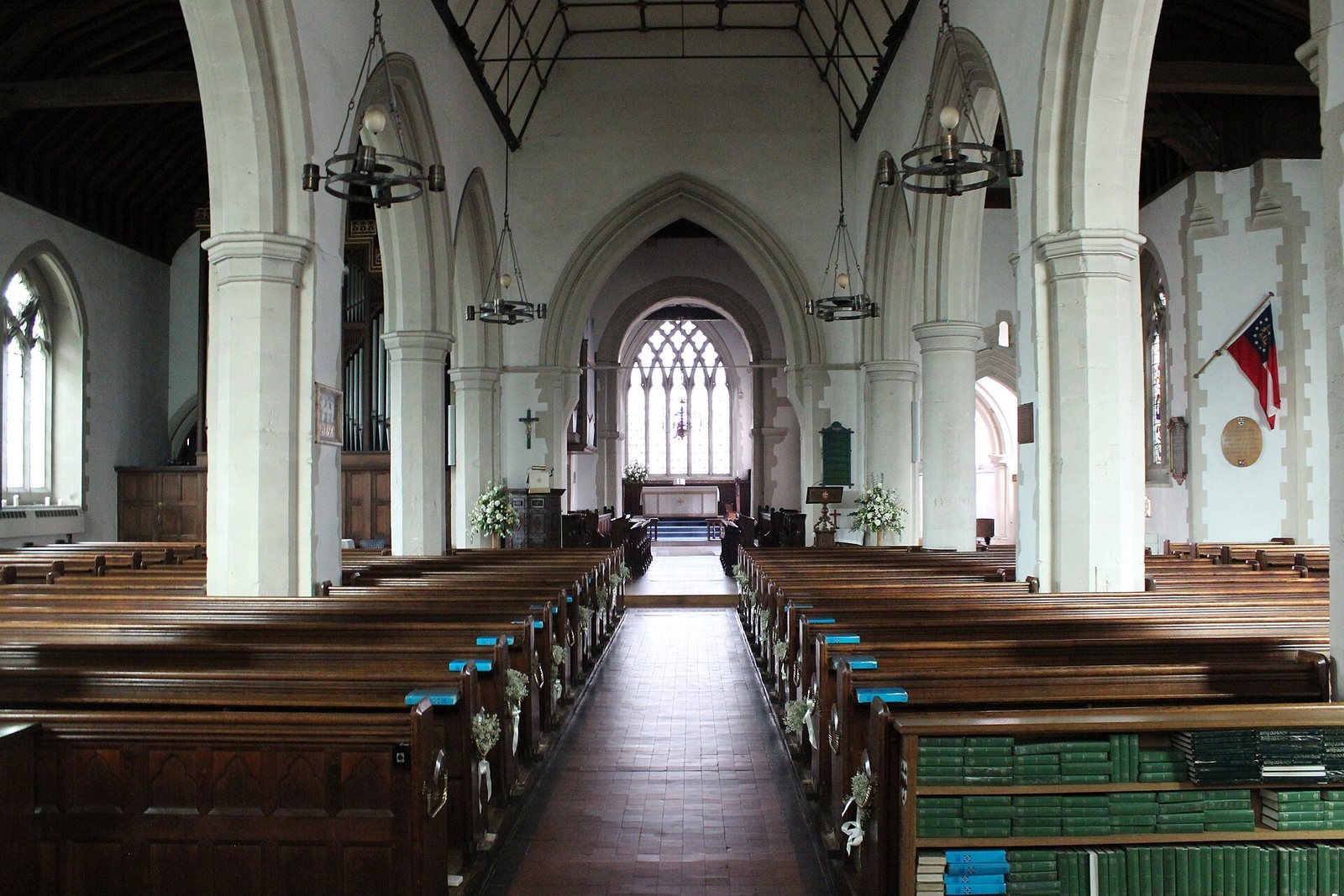
North and south chapels added in the thirteenth century are incorporated into the present church. Widening the nave aisles changed the plan from cruciform, or cross-shaped, to rectangular. The church’s oak-timbered spire also dates to the thirteenth century and remains covered in lead. The nave has 68 roof bosses, carved features at the meeting of roof timbers, which are no longer in their original positions. One carries the arms of Thomas Howard, Earl of Surrey, associated with the English victory over Scottish forces at the Battle of Flodden on 9 September 1513.
Paintings and memorials
The chapel areas contain decorative wall paintings and a medieval painting of St. John the Baptist. Painted decoration also survives on window frames. Interior memorials commemorate Judeth Elyott, who died in 1615; Thomas and Joan Purvoche, who died in 1509; John Barker, who died in 1595; and John and Elizabeth Westbrook. Elyott’s monument shows a kneeling woman facing a book on a lectern, set within an elaborate aedicule, a small temple-like frame. Its cornice bears a coat of arms, its end pedestals carry a skull and an hourglass, and the tablet below displays a skull and crossbones.
Later additions and bells
Nineteenth-century work lengthened the nave and widened the aisles, extending them westward. In 1879 an arch was raised onto higher piers. A porch was added in 1911 and vestries in 1925. The church’s bells are hung for traditional English-style ringing. The tenor, the largest and usually lowest-pitched bell, weighs 1,221 kilograms, or 24 hundredweight, 0 quarters and 4 pounds.