St Mary’s Church, Guildford: A Medieval Parish Church with Anglo-Saxon Origins
Site at a Glance
- Rating
- 4.8
- Popularity
- Low
- Country
- United Kingdom
- Primary era
- Medieval
- Eras represented
- Medieval, Modern
- Civilizations
- Anglo-Saxon, British, English
- Site type
- Religious
- Remains
- Church
On this page12 sections
History
St Mary’s Church is in Guildford, United Kingdom, and is believed to occupy the site of the town’s first church. Much of the present building dates from the 1180s, following earlier Anglo-Saxon phases.
Early churches and medieval rebuilding
A small timber church probably stood on the site around 600. Around 1040, an Anglo-Saxon church built of stone replaced it.
About 1120, canons from Merton Priory, clergy who lived together in a religious community, acquired the church and rebuilt it on a cross-shaped plan. They added a chapel dedicated to St John in the 1140s.
Royal worship and the 1274 vigil
Guildford Castle served as a royal residence during the 12th and 13th centuries, and nearby St Mary’s was sometimes used for royal worship. Thomas Becket, the archbishop of Canterbury and a major figure in medieval English church history, may have celebrated Mass there.
In 1274, thirteen widows kept an overnight vigil at the church for Henry, the six-year-old son of Edward I, who was dying at the castle. Edward I was king of England from 1272 to 1307. After Henry’s death, three masses were held at St Mary’s for his soul.
Religious change, restoration and later history
The Reformation, a period of major religious change in 16th-century England, brought changes to the church’s decoration. In 1862, Thomas Goodchild restored the building, renewing stonework and removing the gallery while retaining fabric from the 11th and 12th centuries.
Charles Lutwidge Dodgson, the writer known as Lewis Carroll, sometimes preached at St Mary’s while staying with his family at nearby Chestnuts. His funeral took place at the church in 1898.
Guildford Methodist Church formally joined St Mary’s on 1 September 2013, forming an Anglican and Methodist congregation. St Mary’s shares a parish, or local church district, with nearby Holy Trinity and belongs to the Diocese of Guildford, a regional church administration. Its stated churchmanship is Liberal. The church has been Grade I listed since 1953.
Remains
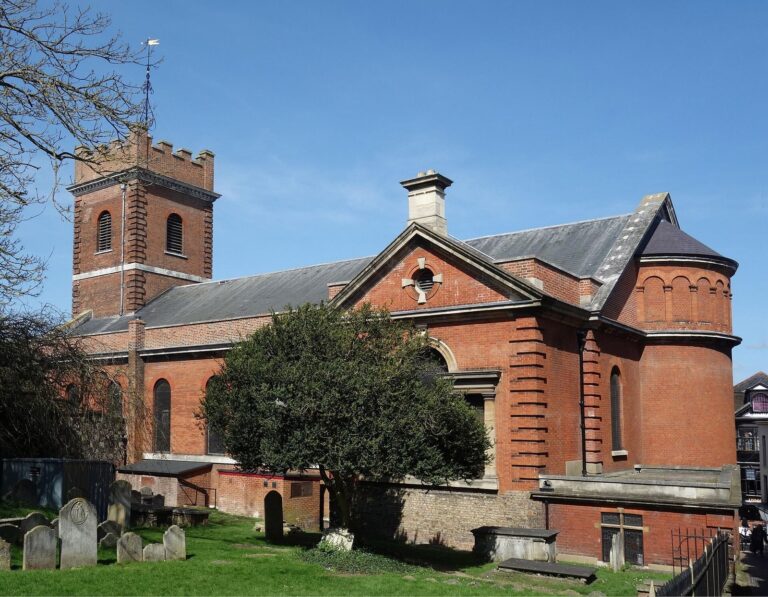
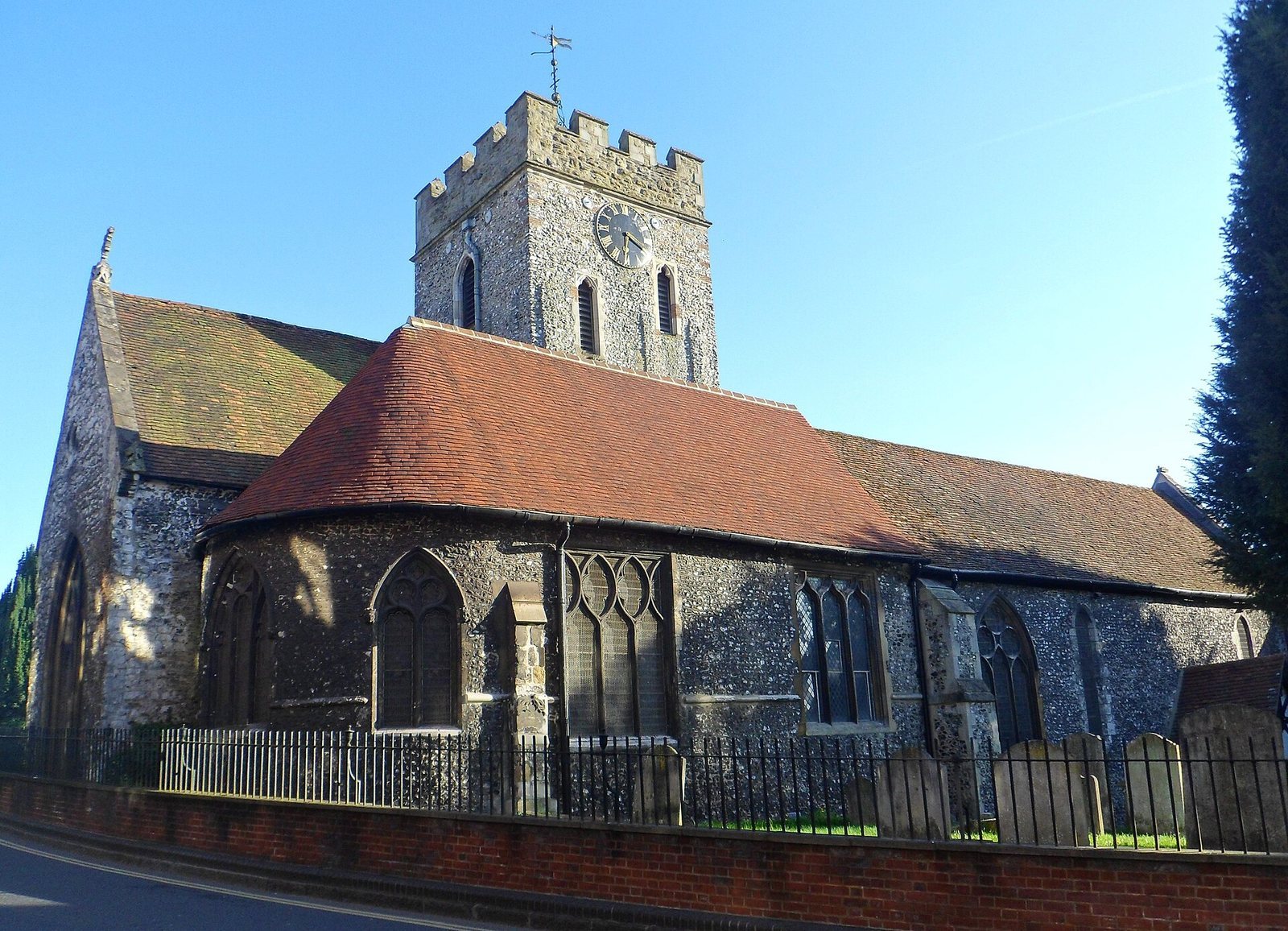
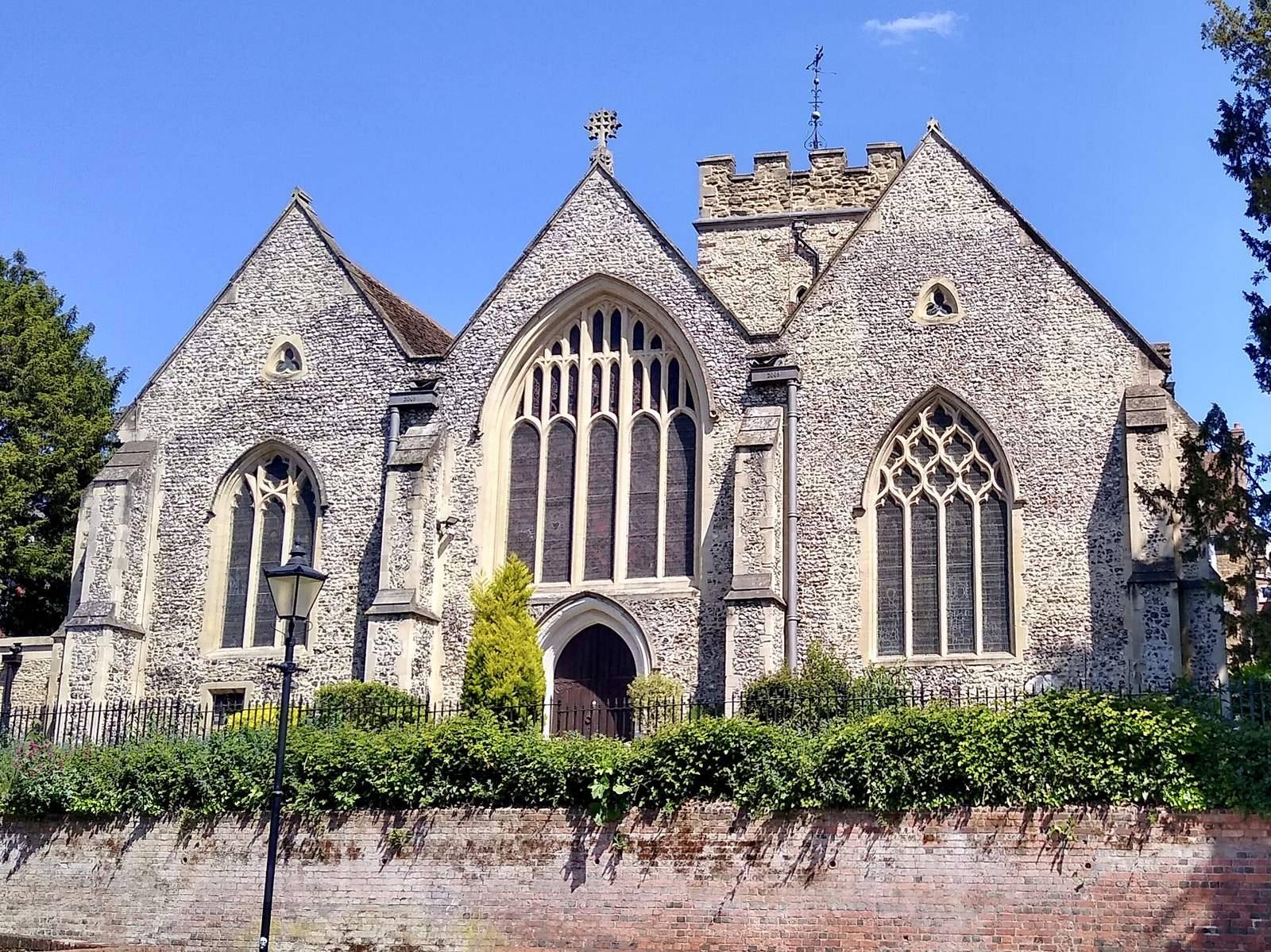
The church has a cross-shaped plan, with St John’s Chapel on its south side. Flint covers most of the exterior walling, while the tower and east wall are exceptions; the east wall is built of chalk. The buttresses are Victorian apart from one.
Tower and chancel
The rough-flint tower is the oldest surviving architectural structure in Guildford and is at least 70 years older than nearby Guildford Castle. The chancel formerly ended in an apse, a semicircular or polygonal part of a church. That end was demolished when the chancel was shortened in 1825 to allow Quarry Street to be widened.
Windows and carved decoration
Windows
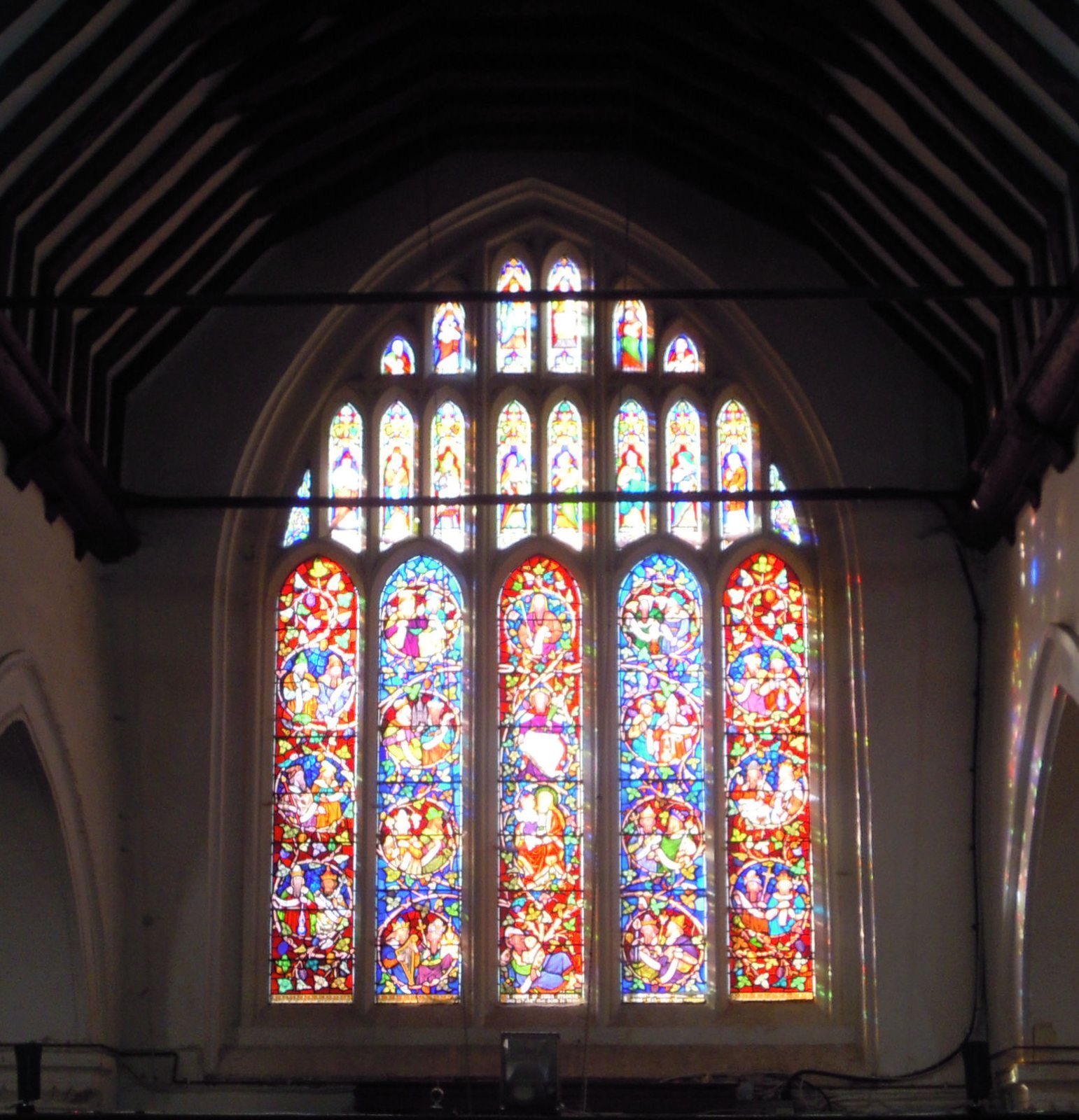
Many of the church’s windows were inserted in the 14th century. The 15th-century chancel east window has five openings with five-lobed heads, ornamental stonework dividing them, and a flattened pointed arch formed by four centres. Its glass, attributed to William Holland, depicts the Nativity, Baptism, Crucifixion, Resurrection and Ascension of Jesus Christ. A west window in the north aisle, made around 1850, was produced by the Royal Bavarian Art Institute for Stained Glass.
Carved corbels
Several carved corbels, which are projecting features, survived the changes to the church’s decoration. One on the south side shows ravens placing food in the mouth of Elijah. Two north-aisle corbels carved with angels bear signs of damage from the Reformation period.
Interior fittings
Baptismal font
The Victorian font has a square bowl made from clunch, a soft building stone, with a scalloped underside. It rests on a square stem with beveled edges and four small stone shafts, topped by scalloped capitals and set on shaped bases.
Pulpit
Goodchild added a pulpit of stone and marble, replacing a 17th-century pulpit.