Church of St. Mary of the Mongols: A Byzantine Greek Orthodox Church in Istanbul



Site at a Glance
- Rating
- 4.4
- Popularity
- Medium
- Country
- Turkey
- Primary era
- Medieval
- Eras represented
- Medieval, Modern
- Civilizations
- Byzantine, Ottoman
- Site type
- Religious
- Remains
- Church
On this page11 sections
History
The Church of St. Mary of the Mongols is a Byzantine church in Istanbul, Türkiye, whose history reaches back to the early seventh century. Princess Sopatra, daughter of the Byzantine emperor Maurikios, and her companion Eustolia founded a nunnery on the slope of Constantinople’s fifth hill. The Byzantine Empire was the medieval continuation of the Roman Empire centered on Constantinople. The emperor granted land north of the Cistern of Aspar, a site previously used as a cemetery, and the new foundation was dedicated to Saint Eustolia.
From Nunnery to Monastery
During the eleventh century, a monastery dedicated to All Saints was added to the religious complex. It maintained close ties with the Great Lavra, a major Orthodox monastery on Mount Athos in northern Greece. The monastery disappeared during the Latin domination that followed the Fourth Crusade, when Western European forces controlled Constantinople before the Byzantine restoration in 1261.
After the Byzantine reconquest, Isaac Doukas rebuilt a small, single-storey monastery dedicated to the Theotokos Panaghiotissa. The Theotokos is the Christian title meaning “Mother of God,” used especially in Eastern Orthodox worship for the Virgin Mary. The building was enlarged and decorated by the painter Modestos in 1266.
Maria Palaiologina and the Palaiologan Foundation
In 1281, Maria Palaiologina returned to Constantinople after fifteen years away. She was an illegitimate daughter of Emperor Michael VIII Palaiologos and the widow of Abaqa, the khan, or Mongol ruler, of the Ilkhanate. The Ilkhanate was the Mongol dynasty that ruled much of Iran and neighboring regions during the thirteenth and fourteenth centuries.
Maria purchased the site, its vineyards, and the monastery ruins. She repaired some buildings, constructed others, and probably established a women’s convent there around 1285. She also used her fortune to acquire relics, liturgical objects, and manuscripts. Maria received the title Ktētorissa, meaning “foundress” or principal female patron of a religious foundation, and retired to the complex until her death.
After Maria died, her brother-in-law Isaac Palaiologos Asen administered the convent’s properties but diverted their revenues for his own benefit. The nuns first appealed to the emperor and then to the patriarch. Isaac presented a chrysobull as proof of his rights, but the charter was judged false. A chrysobull was an imperial Byzantine charter authenticated by a golden seal and used to confirm grants, privileges, or legal rights. The patriarch restored the convent’s properties to the nuns. The convent continued until the end of the Byzantine Empire and was then abandoned.
The Conquest and Ottoman Rule
During the fall of Constantinople on 29 May 1453, intense fighting took place around the church. Greek civilians and surrendered soldiers barricaded themselves inside while resisting Ottoman attacks, and an Ottoman standard-bearer was killed there. The church consequently acquired the Turkish name Kanlı Kilise, meaning “Church of the Blood.” The road leading from the Golden Horn became known as Sancaktar yokuşu, or “Ascent of the Standard Bearer.”
Tradition holds that Sultan Mehmed II granted the church to the mother of Christodoulos, the Greek architect associated with the Fatih Mosque, in recognition of his work. Bayezid II is said to have confirmed the grant in recognition of the services of Christodoulos’s nephew, who built the mosque named for Bayezid.
Ottoman authorities made two attempts to convert the church into a mosque, first under Sultan Selim I and later under Sultan Ahmed II. The later attempt, led by Grand Vizier Ali Koprülü at the end of the seventeenth century, was thwarted by Dimitrie Cantemir, a Moldavian prince, scholar, and historian. The grants attributed to Mehmed II and Bayezid II allowed the church to remain a parish of the Greek community, preserving its ancient dedication and continuous Greek Orthodox use.
Fire, Restoration, and Continuing Use
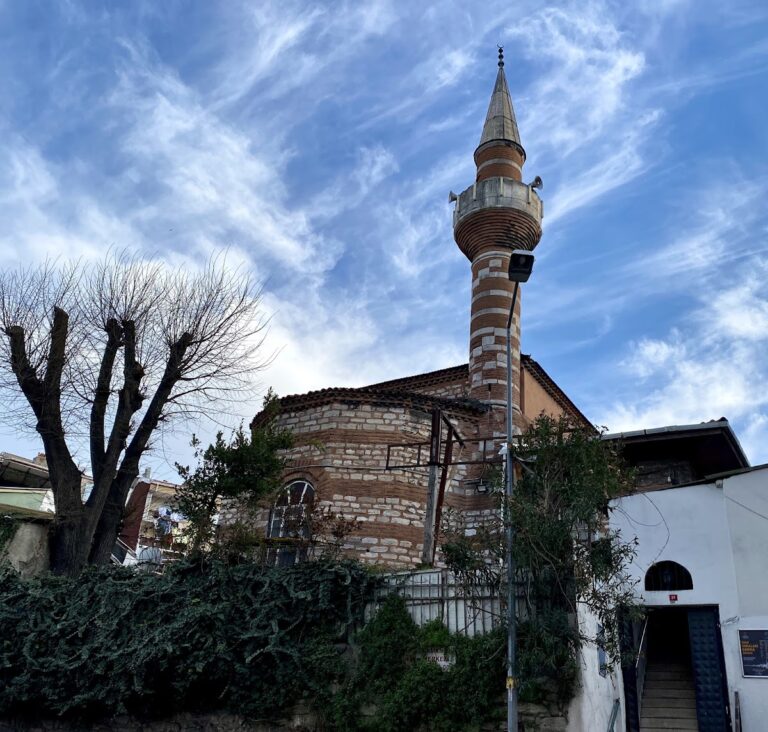
Fires that affected Fener damaged the building in 1633, 1640, and 1729. Repairs and enlargement followed, and the church lost much of its original elegance. A small school was built nearby at the end of the nineteenth century, and a small bell tower was added in 1892.
The church was damaged during the anti-Greek violence in Istanbul in 1955 and was subsequently restored. It remains a Greek Orthodox church belonging to the Greek Orthodox community and associated with the Orthodox Archdiocese of Constantinople. It is described as the only surviving Byzantine church of Constantinople to have continuously functioned as a Greek Orthodox place of worship. Along with Hagia Irene, another Byzantine church in Istanbul that was never converted into a mosque, it is one of two Byzantine churches in the city that retained this distinction. Its dedication remains to the Theotokos Panaghiotissa, the Mother of God.
Remains
Setting and Byzantine Plan
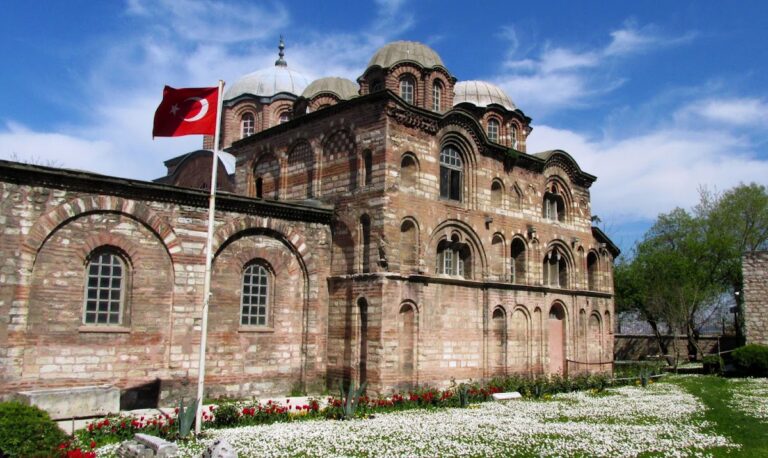
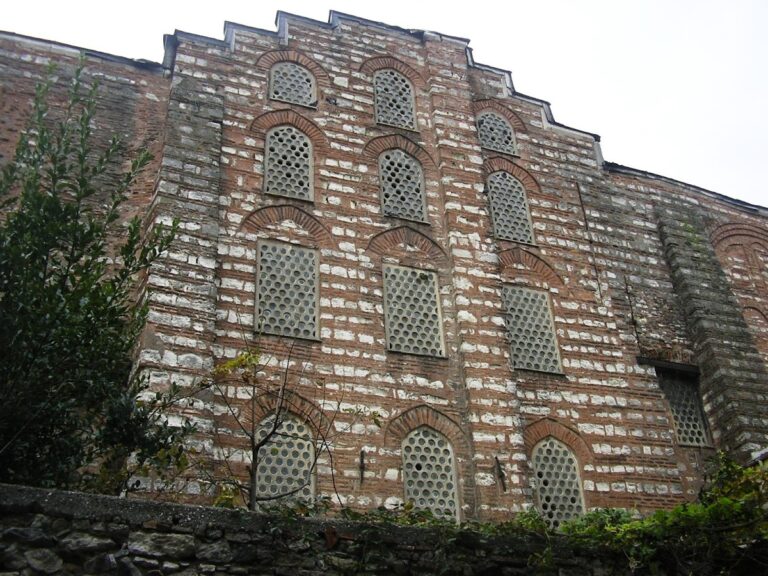
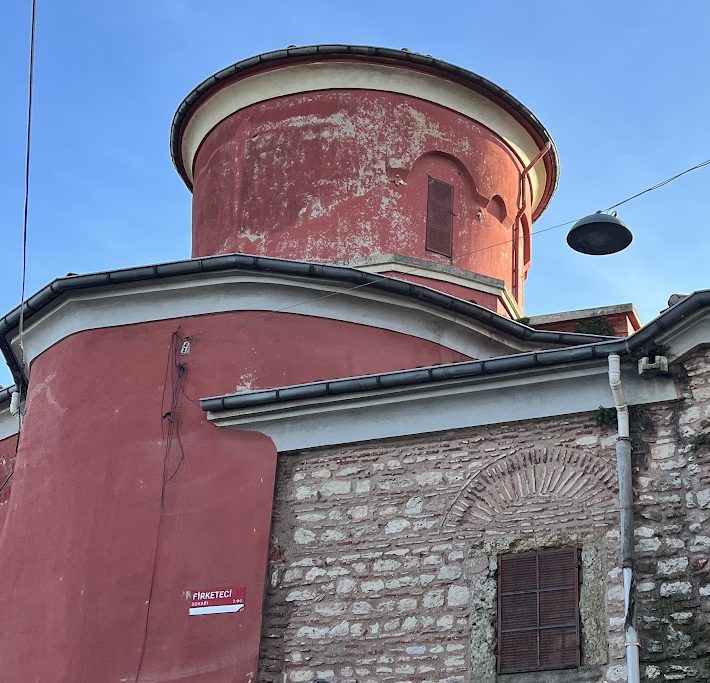
The church stands in Fener, in Istanbul’s Fatih district, at the summit of a slope overlooking the Golden Horn. It lies near the Phanar Greek Orthodox College and is enclosed by a high wall. The surviving building is Byzantine in style but has undergone extensive alteration. It has, or originally had, a tetraconch plan, a centralized arrangement with four lobes or apses, and a central dome enclosed within a tower. This arrangement is described as unique in the Byzantine architecture of Constantinople and as a smaller architectural precedent for many large Ottoman mosques.
The central dome rests on a cross formed by four half-domes. At the entrance, the narthex, or vestibule of the church, has three bays. Its central bay is covered by a barrel vault, a continuous vaulted ceiling formed by extending a semicircular arch along an axis. The southern part of the church was demolished and rebuilt. The southern half-dome and the southern bay of the narthex were removed and replaced by three aisles.
Interior Decoration and Icons
Wall Painting
The original interior decoration has been removed, while the present interior is filled with icons and other ornaments that make architectural examination difficult. A large representation of the Last Judgement occupies the east wall. It may have been painted by Modestos in 1266, linking the surviving interior imagery with the enlargement and decoration of the Palaiologan-period monastery.
Icons
The church contains an eleventh-century mosaic icon depicting the Theotokos. Four additional icons date to the thirteenth and fourteenth centuries. They portray Saint Paraskeve, Saint Euphemia, the Three Hierarchs, and Saints Theodore. The images of Saint Paraskeve and Saint Euphemia measure approximately 1.35 by 0.40 metres each. The icon of the Three Hierarchs measures about 1.25 by 0.60 metres, while the image of Saints Theodore measures approximately 1.27 by 0.54 metres.
Excavated Features
Excavations remain visible beneath the church. An underground passage is traditionally said to connect the church with Hagia Sophia, although the two buildings are several kilometres apart. Despite the church’s historical importance, it has not received a comprehensive architectural study.
Nearby sites