Church of St Lawrence and St Zdislava: Dominican Monastery Church in Czechia
Site at a Glance
- Popularity
- High
- Country
- Czechia
- Primary era
- Early Modern
- Eras represented
- Early Modern, Modern
- Civilizations
- Austria-Hungary, Austrian Empire, Habsburg, Habsburg Austria, Holy Roman Empire, Kingdom of Bohemia
- Site type
- Religious
- Remains
- Basilica
On this page18 sections
History
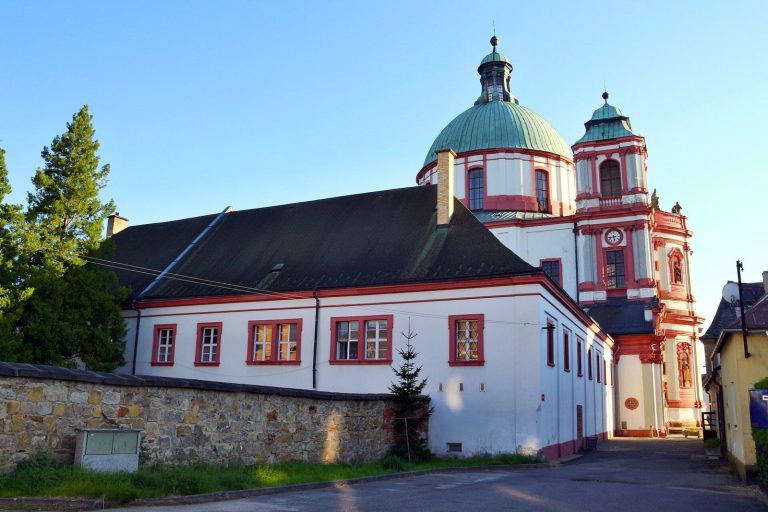
The Church of St Lawrence and St Zdislava is a Roman Catholic Dominican monastery church in Jablonné v Podještědí, Czechia, built between 1699 and 1729 in the Baroque style. It serves the Jablonné parish and is associated with Zdislava, a medieval Bohemian noblewoman venerated as a saint. The church belongs to the Dominican Order, a Catholic religious order also known as the Order of Preachers.
Medieval foundation and wartime damage
The Dominican monastery was founded around 1250. The Dalimil Chronicle, an early fourteenth-century Czech verse chronicle, relates that Zdislava and her husband initiated the monastery and an earlier Church of St Lawrence. The present church was later built where Zdislava’s remains had been laid.
The monastery and church suffered damage during the Hussite Wars, fifteenth-century religious and political conflicts in Bohemia, and the Thirty Years’ War, a major European conflict of the seventeenth century. Near the end of that century, Count Franz Anton Berka of Dubá sponsored the renewal of the complex.
Baroque rebuilding
A new Dominican convent was constructed from 1690 to 1696, followed by the church. Austrian Baroque architect Johann Lucas von Hildebrandt designed the building, and Berka initiated and initially financed the project. Builder Pietro Bianchi directed the work until Berka’s death in 1706. Funding then became scarce, delaying construction; as the original design was not carried out in full, Hildebrandt withdrew from supervising the project.
Berka’s heir, Františka Rozálie Berková, later Kinská, assumed patronage and hoped to complete the church by 1713. Commemorative medals were struck at Kremnica for that intended date, but the plan was not fulfilled. She died on 1 January 1714. From 1708 to 1711, builder Domenico Perini continued construction, completing the upper floors and dome while altering Hildebrandt’s design. The Pachta family of Rájov funded the final alterations from 1718 to 1729. The church was consecrated on 4 August 1729.
Veneration and later history
Zdislava’s relics were transferred to the church in 1731 and have been venerated there. A fire in 1788 destroyed part of the furnishings. The church remains a pilgrimage destination of national significance, with its principal pilgrimage held on the last Saturday of May.
After Zdislava’s canonization in 1995, the formal declaration of sainthood, Pope John Paul II elevated the church to a minor basilica in 1996. This honorary title is conferred by the pope, and Zdislava was added to the church’s dedication. Since 28 April 2008, the building has been protected as a National Cultural Monument of the Czech Republic. Comprehensive renovation took place from late 2020 to mid-2024.
Remains
Plan and exterior
Overall plan
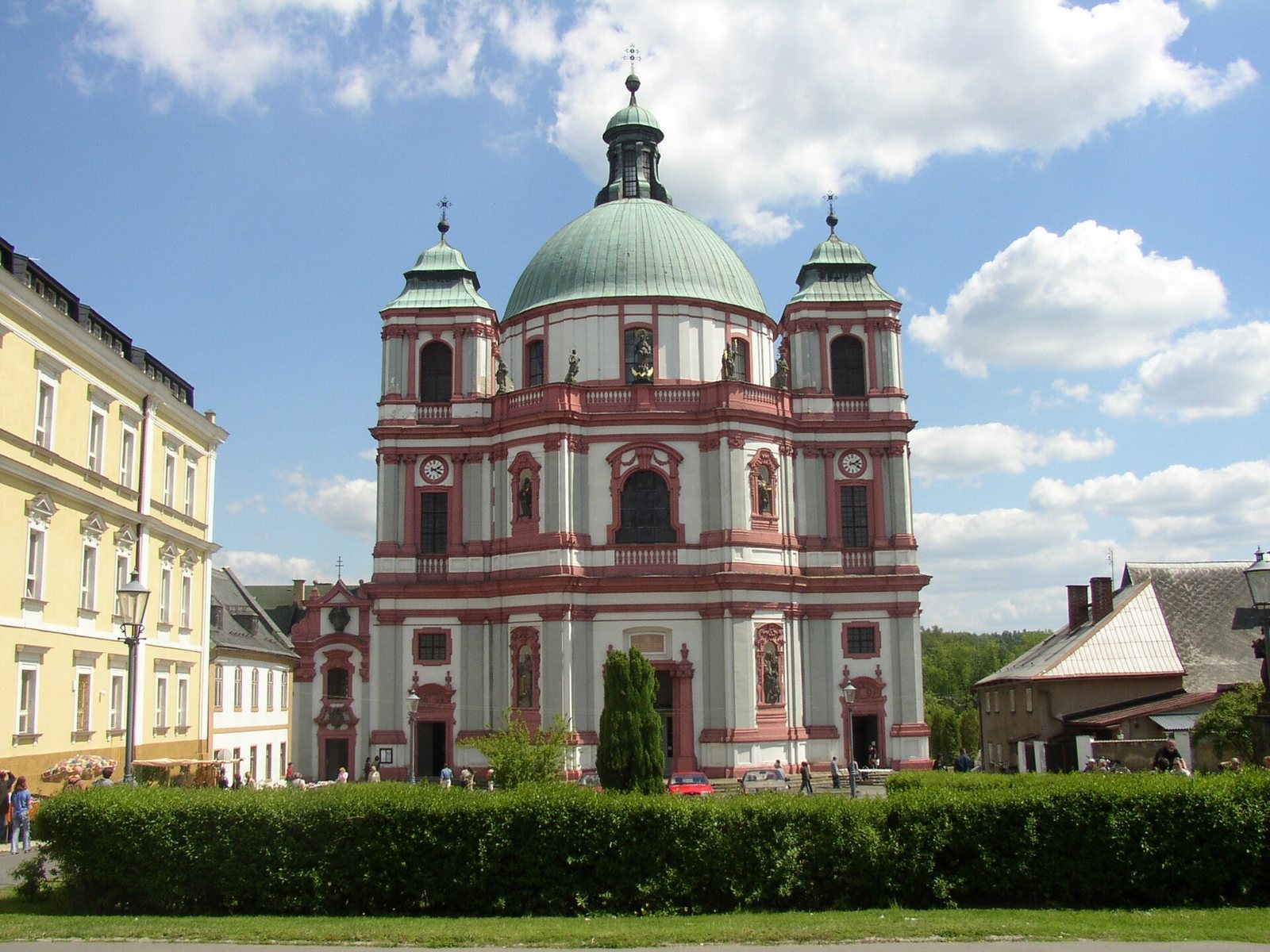
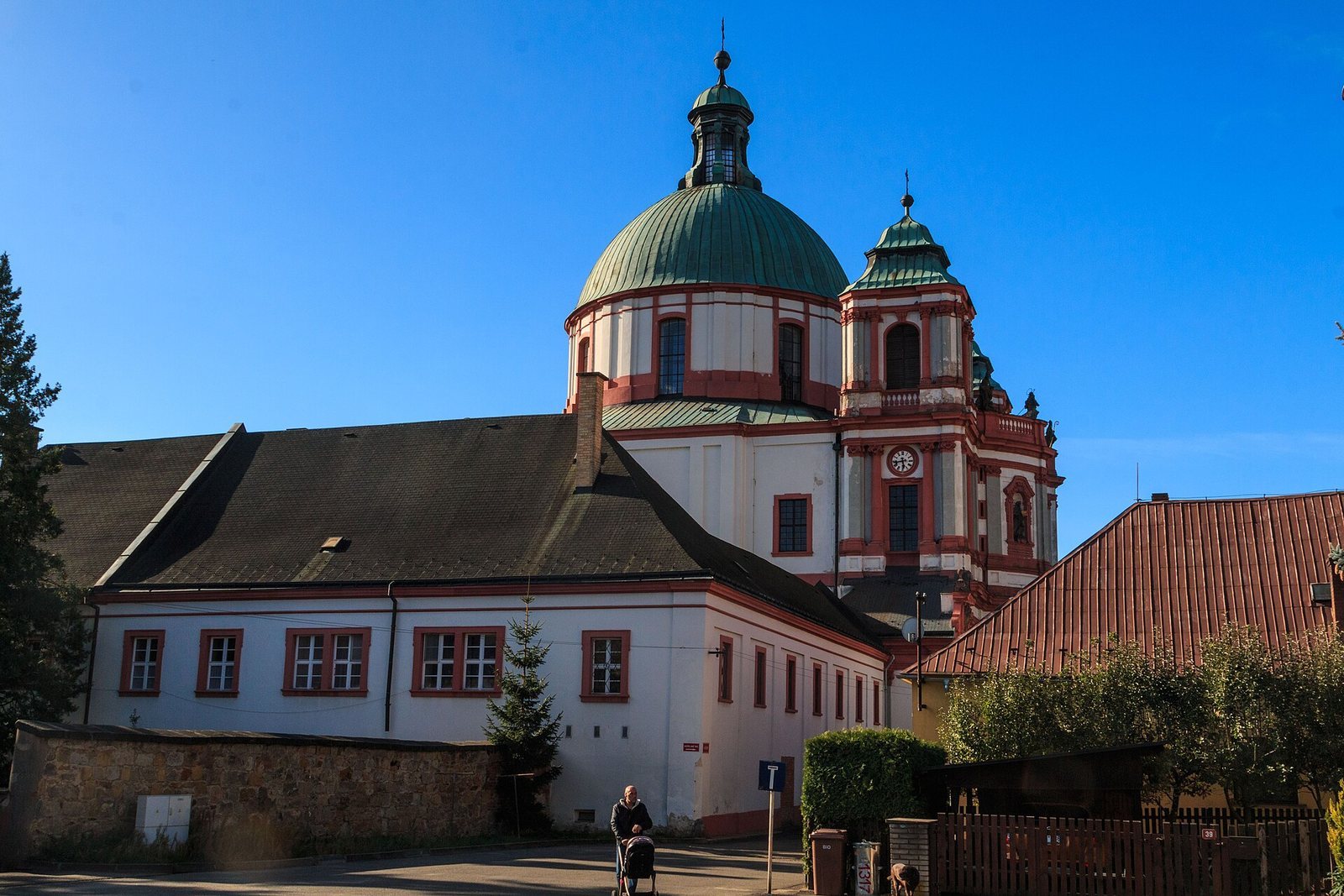
Built of stone, the church measures 47.5 metres long and 28.5 metres wide, with the altar facing southeast. Its exterior is rectangular, while the interior follows an elongated-cross plan formed by intersecting elliptical spaces. An octagonal central space rises beneath a high dome with a copper roof, visible across a wide area.
Facade and outer walls
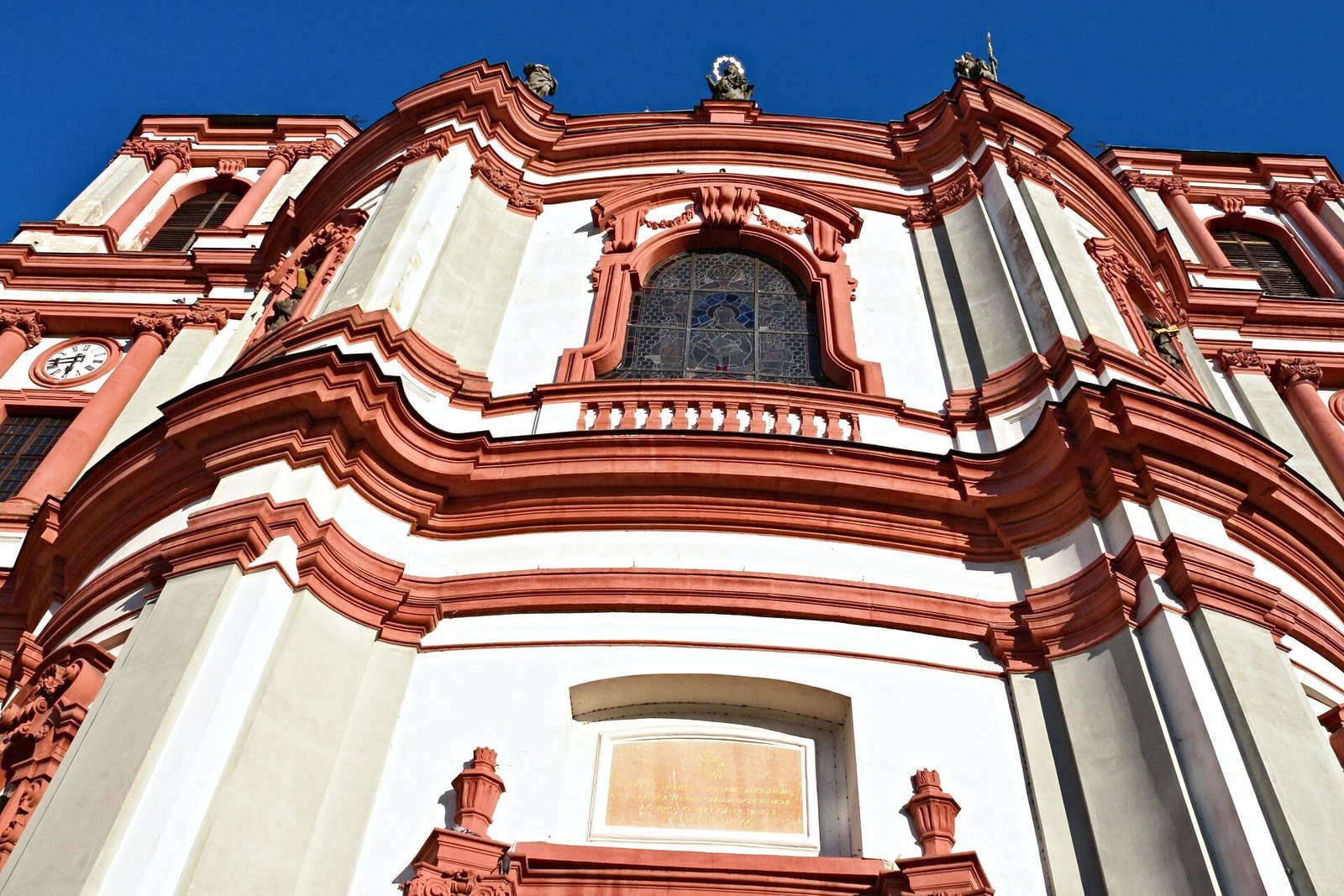
The three-part facade is built from cut stone blocks and has three portals. Its one-storey central section sits between two square-sided towers, each two storeys high. The upper parts of the towers and the main portal were left unfinished. The lower tower walls have pilasters, shallow wall projections resembling columns, while half-columns also decorate the upper storeys. A concave projection at the centre has pilasters, niches, a semicircular window dating to 1713, and a balustrade. Sculptor Franz Bienert made the facade figures in 1711, depicting St Zdislava, St Lawrence, St Dominic, and St Thomas Aquinas. Above them, a Madonna and figures of St John of Nepomuk, St Adalbert, and St John the Baptist decorate the upper facade. The otherwise plain side walls have slight central projections and high, semicircular-headed windows; an apse, the curved end of the church, closes the eastern end.
Interior structure and design
Central space and adjoining areas
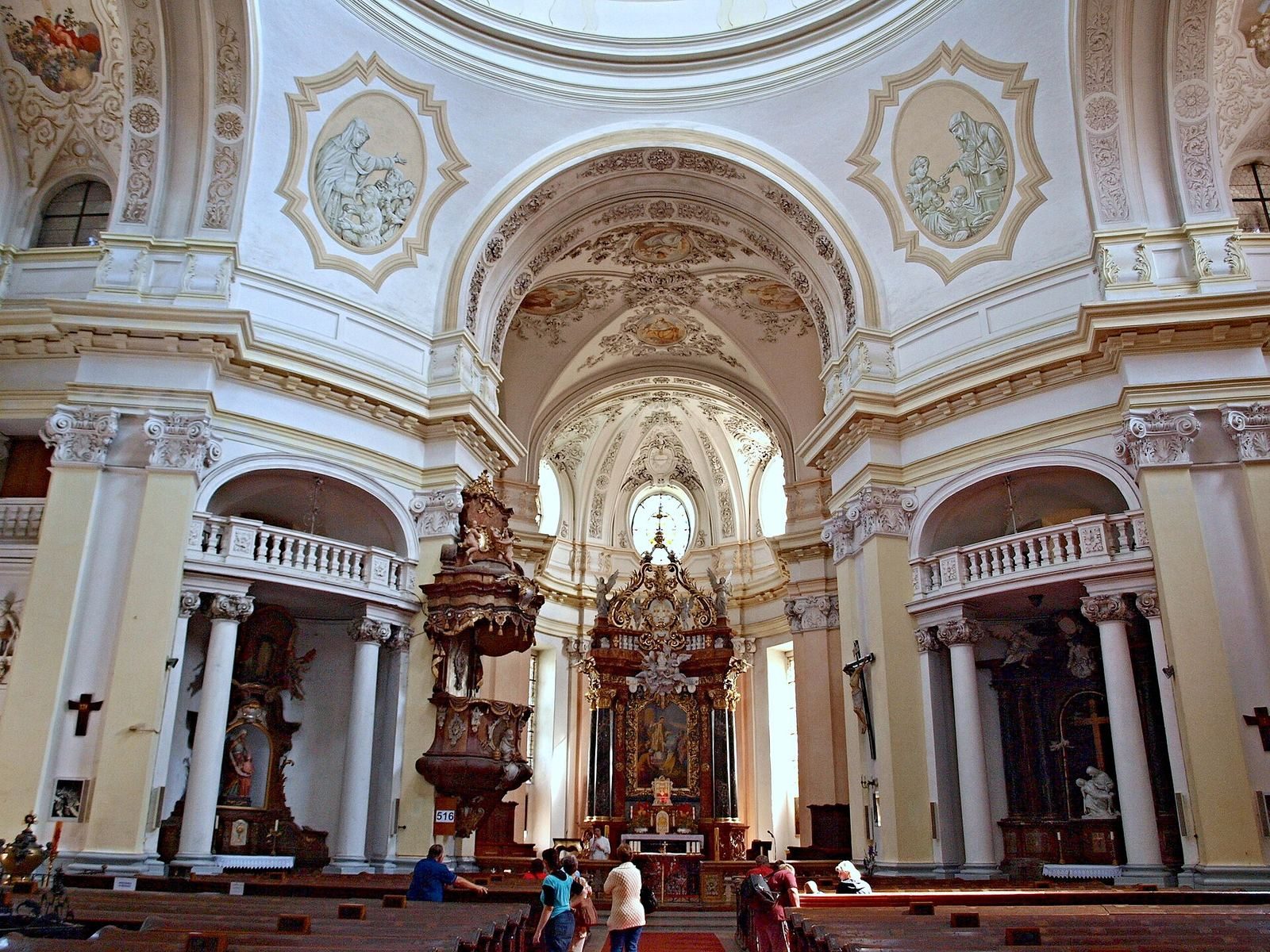
The octagonal centre connects to elliptical spaces at either end, with the choir loft to the west and the presbytery, the area around the main altar, to the east. Both have vaulted ceilings formed by intersecting arches. The presbytery continues into an apse with a half-dome vault and two windows. Two barrel-vaulted elliptical chapels open from the centre to the north and south. Massive piers between these spaces contain rectangular chapels with flat lintels resting on two free-standing columns; galleries rise above the lintels. Pilasters at the pier corners support a horizontal architectural band, above which curved supports carry the dome. The dome rests on a circular wall, or drum, with eight windows. Corridors with intersecting vaults link spaces around the centre, and the undulating choir loft rests on two columns. The usual entrance is a side portal below the north tower.
Dome and Baroque forms
The dome’s paintings of Zdislava and the Four Evangelists were made by Karel Krattner in 1852 using chiaroscuro, a contrast of light and dark that suggests depth. The church’s curving design drew on Italian architect Guarino Guarini’s project for San Lorenzo in Turin and Hildebrandt’s version of that design for the Church of St Peter in Vienna. It is an important early example of dynamic forms in Czech Baroque architecture and a forerunner of later buildings in this style. Its design also served as a model for builders Johann Dientzenhofer, Christoph Dientzenhofer, and Kilian Ignaz Dientzenhofer.
Altars and furnishings
Chapels on the left
The first chapel on the left has an altar to the Virgin Mary with a Rococo ornamental frame, dating to around 1770. Its niche holds a Late Gothic Madonna from around 1510; Late Gothic describes the final phase of Gothic art. The chapel also contains an 1853 painting of St Teresa and statues of St Catherine of Siena and St Henry Suso from the church’s construction period. In the central chapel on this side, a 1911 altar dedicated to the Sacred Heart of Jesus imitates Baroque forms and combines a portal-like frame with columns. It includes Baroque statues of St Peter and St Paul from the church’s construction period, as well as a later painting of Christ. Nearby are a late eighteenth-century Neoclassical confessional, drawing on classical Greek and Roman forms, and a 1764 Rococo baptismal font decorated with tin angels. An eighteenth-century copy of the Madonna of Zbraslav hangs above the font.
The smaller left chapel has an altar to St Anne with an ornamental frame and sculptures dating to 1886; its upper section contains a 1764 painting of St Vincent Ferrer. The Neoclassical pulpit, made in 1789 by J. Neumann of Jablonné, includes a bust of St Peter. In the corridor leading to the sacristy is a Baroque painting of the Martyrdom of St Lawrence from the first half of the eighteenth century. It was probably made originally for the main altar.
Chapels on the right
The small chapel to the right of the main altar contains a marble Baroque altar to the Holy Cross, made by M. Gugel in 1718. Its portal-and-column form includes later sculpture, among it an 1881 Pietà, and a Madonna painting in a Rococo frame. The central chapel on the right has a 1732 Baroque altar dedicated to the Rosary. Its figures show the Virgin Mary and infant Jesus giving a rosary to St Dominic, with St Thomas Aquinas, St Albert the Great, God the Father, and angels. A wall painting of St Aloysius is set in a Neoclassical frame dating from after 1789.
The last small chapel on the right has a cartouche-shaped Baroque altar to St Joseph. Its furnishings include a painting of St John of Nepomuk from the church’s construction period, and later statues of St Joseph and King David made between 1885 and 1889. Two further confessionals date to the late eighteenth century.
Main altar and other furnishings
The main altar is a canopy-like structure made in 1898 by V. Angst. K. Krattner painted its image of St Lawrence, which was later joined by a twentieth-century painting of St Zdislava. The inlaid choir stalls are Rococo work from the second half of the eighteenth century. The Stations of the Cross, made by Johann Birnbaum, date to 1854, and the organ is in a later imitation of Rococo style, dating to 1859.
Memorials and relics
Donor portraits and papal busts
Marble busts of Franz Anton Berka of Dubá and Františka Rozálie Berková, later Kinská, stand above the entrances to the sacristy and the opposite repository. Made around 1700 by Jan Blommendael, they are noted as examples of Dutch portrait sculpture in the Czech lands. Busts of Popes Pius X and John Paul II are at the rear of the church; their papacies were associated with Zdislava’s beatification and canonization.
Relics and crypt
A glazed, gilded case in a pseudo-Baroque style, made in 1908, housed Zdislava’s skull. The skull lacks its facial portion. A glass container for relics on the altar held four long bones. On 12 May 2026, between 6:00 and 6:15 p.m., a thief stole the skull after electronic security covering the presbytery had been temporarily disabled before Mass, breaking through two layers of protective glass. The thief was allegedly motivated by opposition to relics, encased the skull in concrete, and planned to submerge it in a river as a burial. It was recovered from the concrete on 17 May and restored without serious damage. The decision was subsequently made not to display it publicly in its former manner.
Beneath the altar, the crypt contains a coffin with part of Zdislava’s lower jaw, several teeth, and small bones and bone fragments. A Baroque wrought-iron grille made in 1732 encloses the crypt entrance. Inside are 24 paintings on copper illustrating Zdislava’s legend, made in 1660 after older engraved models.