Church of Saint Joseph: A Royal Chapel and Parish Church in Waterloo, Belgium
Site at a Glance
- Popularity
- Low
- Country
- Belgium
- Primary era
- Early Modern
- Eras represented
- Early Modern, Modern
- Civilizations
- Belgian, Dutch, Spanish
- Site type
- Religious
- Remains
- Church
On this page16 sections
History
The Church of Saint Joseph is a Catholic church in Waterloo, Belgium, whose original Spanish royal chapel was begun in 1687 in a French-influenced Baroque style, known for dramatic forms and ornament, with classical elements. The chapel was sponsored by a governor-general of the Spanish Netherlands, the territories ruled by the Spanish monarchy, and later developed into the town’s parish church.
Royal foundation and disputed jurisdiction
A forest chapel dedicated to Saint Anne burned around 1650. Local timber producers then contributed a levy of one hundredth of their sales for about two decades, raising nearly 15,000 florins, but the sum did not cover the cost of rebuilding. Don Francisco Antonio de Agurto, Marquis of Gastañaga and governor-general of the Spanish Netherlands, instead sponsored a royal chapel dedicated to Saint Joseph. Its purpose included a prayer for divine favor: Agurto hoped that Charles II, the last king of Spain’s Habsburg dynasty, would have a male heir.
On 26 June 1687, Archbishop Alphonsus van Bergen of Mechelen blessed the chapel’s first stone in the governor-general’s presence. Its design is attributed to Philippe Delsaux, and the chapel opened on 19 February 1690. Its location in Petit Waterloo created a jurisdictional dispute. Petit Waterloo belonged to the parish of Rhode-Saint-Genèse in the Diocese of Mechelen, while most of Waterloo fell within the parish of Braine-l’Alleud in the Diocese of Namur. The Braine priest temporarily took responsibility to spare the elderly Rhode priest hazardous trips through the forest. As a royal foundation financed by Spain, however, the chapel remained under the appointment authority of officials in Brussels. Guillaume-Albert Le Roy, who had served as chaplain for three years, became rector rather than the Braine priest.
French rule, return to worship, and expansion
After the French Revolution brought the southern Netherlands under French rule, the chapel was sold as national property in 1798 to Parisian businessman Thomas Gillet. He dismantled buildings to sell their materials and stripped lead from the chapel roof for ammunition suppliers. Local resistance made him reluctant to continue. Meanwhile, priest Bierlaire, who refused the oath demanded by the French authorities, held clandestine Mass in a barn.
Following Napoleon’s 1801 agreement with the pope on relations between civil and Catholic authorities, Waterloo became an autonomous parish. The community bought back the chapel for 4,000 francs, with 139 inhabitants contributing, and it returned to religious use on 10 June 1806. With a congregation of about 1,500, the chapel proved too small. An enlargement plan by architect Louis Montoyer had been drawn up in 1789, and rebuilding at Mont-Saint-Jean was also considered. The community chose expansion on suitable municipal land as the less costly option. Work in 1823–24 added space, with donations and subsidies that included British support. Further restoration and enlargement followed in 1855–58 under Émile Coulon and Joseph Dumont. British contributions and the support of Marie-Françoise Mouchet helped finance the work. A 22-metre copper spire was placed on the tower in 1899.
Restoration and parish life
The rotunda and portico received protected-monument status in 1956. The building later suffered from the two world wars, storms, and pollution from early automobiles. An urgent restoration effort began in 1965; an appeal by the Duke of Wellington in 1964 helped raise funds, and descendants of soldiers killed at Waterloo mobilized British support. Architect Albert Degand directed the work carried out from 1968 to 1972. It separated the original royal chapel from the church nave. The former presbytery was taken out of use in 1968 because of its poor condition and restored for reuse in 1995. The church belongs to the Archdiocese of Mechelen-Brussels.
Remains
Chapel and church buildings
The domed chapel
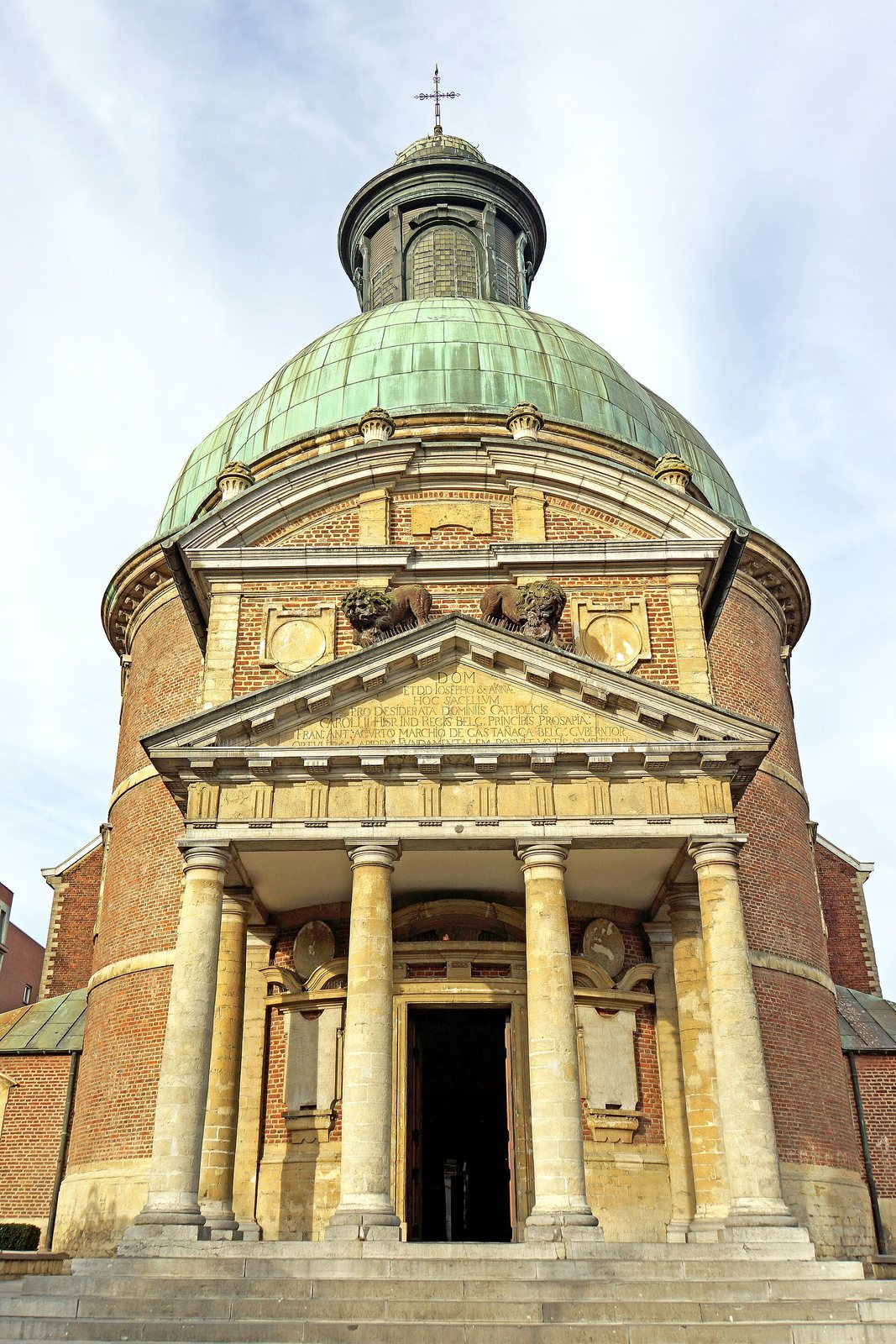
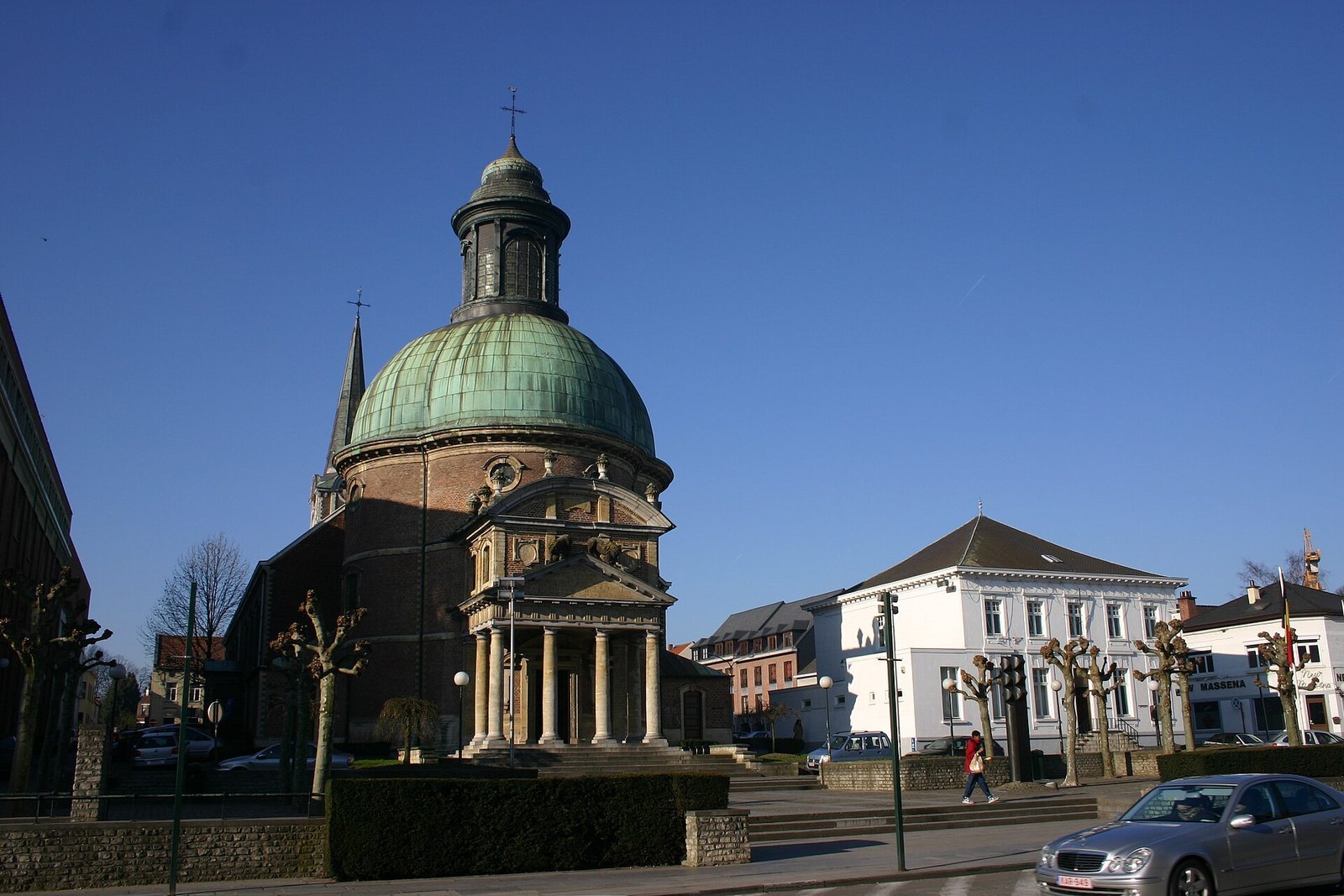
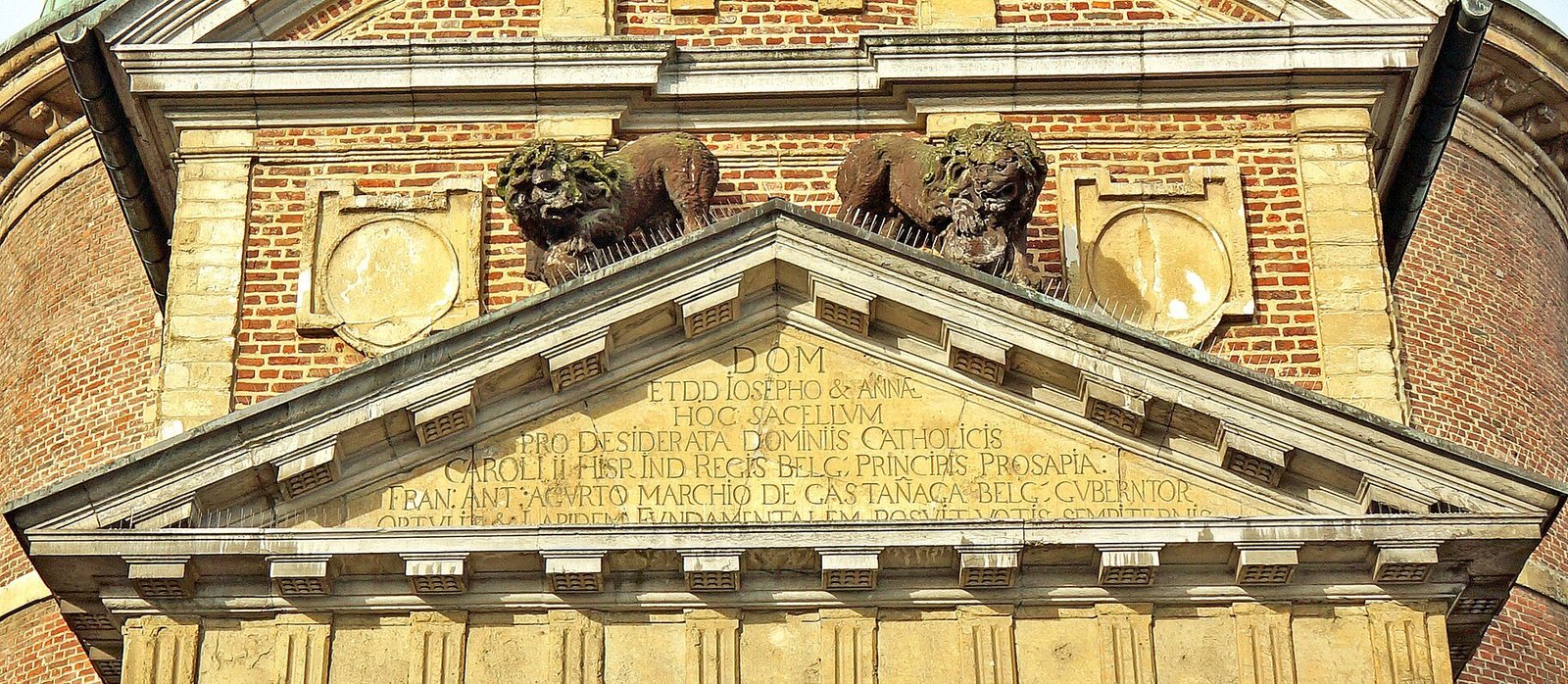
The late-seventeenth-century chapel forms the church’s round central core. Its dome is articulated by paired ribs and lit by six circular windows and a lantern, a raised roof structure with openings that admit light. A projecting porch is supported by four plain Tuscan columns. Two lions sit on the pediment, which bears a Latin inscription recalling Agurto’s hope for Charles II. Above it is an elevated gallery.
The hall and nave
A brick hall with a slate roof extends behind the dome. Its end facing the street is closed, and the space accommodated the choir. Beyond it, the church’s main body is a three-aisled nave, with long side spaces alongside it, in a Neoclassical style drawing on ancient Greek and Roman models. A square brick tower stands at the nave’s western end and carries the copper spire. Inside, light stone and white stucco frame Ionic pilasters, flattened columns attached to the walls, which support a heavy horizontal entablature. Crossed ribs run beneath the roof and the dome’s inner vault. The former entrance arch between chapel and nave has been bricked up; a glazed internal door, framed in proportions recalling the porch, provides the remaining passage between them.
The former presbytery
The former presbytery stands to the right of the church. Built during the first enlargement, it has a square plan and a Neoclassical façade. Its contractor is said to have worked from plans by Louis Montoyer. The building was restored in 1995 for reuse.
Furnishings, paintings, and windows
Pulpit and communion bench
The oak pulpit came from the former Cistercian abbey of Aywiers. Cistercians were members of a Catholic monastic order. Sculptor Jan Baptist Van Hool made the pulpit as a naturalistic work in the nineteenth century. Four carved panels portray the Sermon on the Mount, the miraculous catch of fish, Jesus meeting the Samaritan woman, and Jesus welcoming children. Beneath the pulpit bowl, a separate carving shows Jesus with Martha and Mary. A large carved-oak communion bench from Aywiers, used by worshippers receiving Communion, has been divided into sections now placed in different parts of the church. One section bears a Last Supper by the Goyer brothers.
Choir stalls and paintings
The oak choir stalls date from the seventeenth century. They originated at Our Lady of Leliëndaal and were acquired from Saint Rumbold’s Cathedral in 1863. The church also contains a copy of Rubens’s Descent from the Cross, attributed, with uncertainty, to Frédéric Dumesnil. Fanny Geefs-Cr painted a copy of Murillo’s Assumption of the Virgin in 1860; it hangs at the main altar. Dumesnil’s Healing of the Sick Woman, painted in 1772 and brought from Aywiers, is in a side chapel. The fourteen Stations of the Cross, devotional images of episodes from Jesus’s final journey to the crucifixion, were painted by J. B. De Coninck in 1848.
Stained glass
Six stained-glass windows illuminate the sanctuary. Four depict the Virgin Mary and Saints Joseph, James, and Philip. Two further windows in the choir were installed in 1918 to commemorate those killed in the First World War and to express gratitude for Belgium’s liberation and the soldiers’ return from the front.
Waterloo campaign memorials
Plaques and monuments
Twenty-seven broad plaques on the rear walls commemorate British and other officers killed in the Waterloo campaign on 16, 17, or 18 June 1815. Erected in 1858, they were first placed in the domed chapel. Some refer to Restalrig Barracks in Edinburgh, home of the Scots Greys, a British cavalry regiment known for its charge during the battle. The chapel also contains a bust of the Duke of Wellington by George Gammon Adams. A white-marble monument by Willem Geefs, dated 1858, commemorates British dead; a separate monument, with a bronze sculpture by Leopold Wiener, honors Frederik of Nassau, a Dutch prince and military officer.
Jean-Baptiste van Merlen
Jean-Baptiste van Merlen, a Dutch major general who commanded the Second Dutch Light Cavalry Brigade, was killed near the church during the Battle of Waterloo and buried in the church. Several memorial plaques honor him.