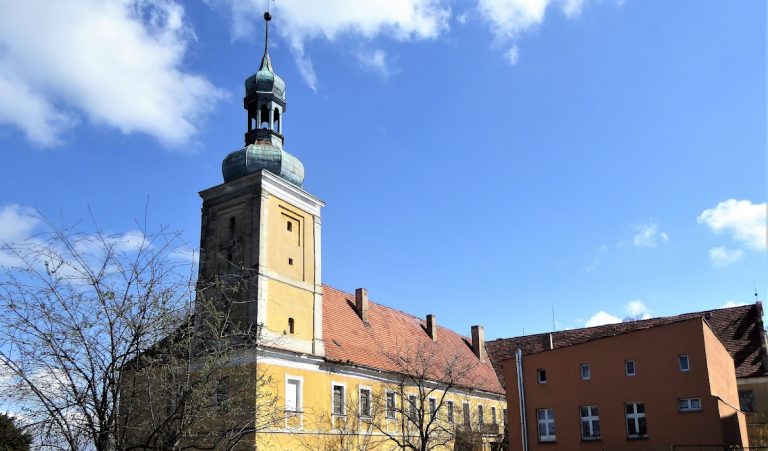
Church of Saint Bartholomew in Głogówek: A Gothic Parish and Collegiate Church


Site at a Glance
- Rating
- 5
- Popularity
- Very Low
- Country
- Poland
- Primary era
- Medieval
- External website
- Open
- Eras represented
- Medieval, Early Modern
- Civilizations
- Habsburg, Holy Roman Empire, Kingdom of Prussia
- Site type
- Religious
- Remains
- Church
On this page19 sections
History
The Church of Saint Bartholomew in Głogówek is a Roman Catholic parish church in Poland, built in the second half of the fourteenth century, probably around 1380, in the Gothic period and later given a Baroque interior. Its parish is first mentioned on 10 June 1284, when its priest, Tilo, was named. The present building probably occupies the site of an earlier church.
Parish and collegiate church
A visitation record states that the Duke of Opole founded a new church at Głogówek in 1350. On 24 February 1379, a Duke of Opole established a collegiate chapter there. A collegiate church was served by a chapter of clergy called canons, giving the parish a status above that of an ordinary parish church without making it a cathedral. The church subsequently became known locally as the “Głogówek Cathedral.”
The medieval building was destroyed in 1428 during the Hussite Wars, religious and political conflicts that began in Bohemia and spread into neighboring parts of Central Europe, including Silesia. It was rebuilt in 1463. During the Reformation, Protestants used the church briefly from 1524. A fire in 1582 destroyed its towers, which were then rebuilt.
Chapels and Baroque transformation
The Oppersdorff Chapel was added after the medieval church had been built. The Oppersdorff noble family used it for burials, and a family crypt was installed there in 1601. The Saint Joseph Chapel was built in 1688. In 1641, Pope Urban VIII gave Głogówek relics associated with Saint Candida, a Christian saint whose relics became linked with the town.
Another fire in 1765 destroyed the interior and towers. Between 1775 and 1781, Prelate Anton Borek directed an extensive refurbishment in the Baroque style. The late Gothic ribs of the net vault, a ribbed vault whose supports form a web-like pattern, were removed during the work. The Oppersdorff Chapel was consecrated, and the chapels of Saint Candida and Saint Joseph were established or endowed during this period. Franz Anton Sebastini painted the frescoes, while Johann Schubert produced the figures and sculptural ornament.
Modern restoration and continuing use
The collegiate chapter was secularized in 1810. Extensive renovation followed in 1906–1908, including thorough restoration of the paintings by the conservator Joseph Langer. Fighting at the end of the Second World War destroyed the Baroque roofs of the towers in 1945, and they were reconstructed in 1958.
The church remains the Roman Catholic parish church of Saint Bartholomew in Głogówek, within the Głogówek deanery of the Diocese of Opole. It has been legally protected as a monument since 1951 and is listed under monument register number 9/51, dated 5 February 1951. The building is popularly called the “Pearl of the Opole Land.” Its religious calendar includes the annual feast of Saint Bartholomew on 24 August. Six new bells were consecrated by Bishop Andrzej Czaja on 29 August 2015, and their first ringing took place on 8 December that year.
Remains
The church stands on a hill in the old town. It is built of brick and is partly plastered, combining an originally Gothic structure with a richly remodeled Baroque interior. The plan includes a three-aisled nave, a single-aisled choir, a south sacristy, and the Oppersdorff Chapel on the north side of the choir.
Building and layout
Towers and nave
The west front is dominated by two bell towers. Their lower sections are quadrangular, while the upper sections are octagonal. Tall, narrow pointed-arch windows contain tracery. Behind the front, the three-aisled nave has a raised gabled roof. Its central aisle is covered by a barrel vault with lunettes, the curved areas formed where a vault meets a wall or another vault.
Choir and presbytery
The single-aisled choir ends in three sides of an octagon, a form known as a three-eighths termination. It has an interior net vault, while the long presbytery retains richly decorated Gothic vaulting whose late Gothic ribs were removed during the eighteenth-century remodeling. A sacristy adjoins the choir on the south, and the Oppersdorff Chapel adjoins it on the north.
Baroque decoration
Presbytery paintings and high altar
Franz Anton Sebastini’s presbytery frescoes personify faith, hope, charity, and either humility or gentleness. Four large wall paintings show episodes from the life of Saint Bartholomew, one of the Twelve Apostles and a traditionally recognized evangelist and martyr. They depict his calling as an apostle, his evangelizing mission, his sermon before King Polymius of Armenia, and his condemnation to death by the king’s brother, Astrages.
The high altar contains Sebastini’s oil painting of the death of Saint Bartholomew. Sculptures of the four Evangelists stand on either side, each accompanied by an identifying attribute.
Central nave and painted pillars
A large fresco on the central-nave vault presents the apotheosis of Saint Bartholomew. In the western section, the Holy Trinity appears above Saint Bartholomew adoring a cross held by an angel. The eastern section contains angels’ heads and putti among clouds. Frescoes on the side-aisle walls were formerly attributed to Sebastini, but Joseph Langer painted them during the restoration of 1906–1908.
The pillars carry figures of Saint John of Nepomuk, Saint Francis Xavier, Saint Helena, and Constantine. They also bear representations of the four Fathers of the Western Church, Gregory the Great, Jerome, Ambrose, and Augustine, whose writings helped shape Western Christian doctrine and church tradition. Angels emerging from clouds hold the attributes of the Fathers.
Pulpit and baptismal font
At the junction of the presbytery and central nave stand a pulpit and a corresponding superstructure over the baptismal font. The pulpit basket shows Saint Peter healing a sick person, together with two youths holding a church on a rock and a lamb. Its canopy is crowned by a sculpture of Saint Peter receiving the keys of the Kingdom of Heaven.
The baptismal font is decorated with Adam and Eve, with a terrestrial globe between them encircled by a serpent. Sculptures on the canopy represent the baptism of Christ in the Jordan.
Chapels and memorials
Saint Candida Chapel
The Saint Candida Chapel stands on the left side of the central nave. Its eighteenth-century elliptical dome rises above an altar containing a reliquary with the saint’s relics. A two-storey vestibule stands beside the chapel, and its upper storey has housed a library since 1768.
Saint Joseph Chapel
The Saint Joseph Chapel has a square plan and a dome with a lantern, a small raised structure or opening at the top of a dome that admits light. Its dome fresco depicts the marriage of Mary and Joseph. Wall paintings show the Flight into Egypt and the twelve-year-old Christ teaching in the Temple.
Oppersdorff Chapel
The Oppersdorff Chapel, also called the Black Chapel or Mortuary Chapel, has a star vault supported by stone corbels and keystones. It contains a late Renaissance tombstone commemorating Johann Georg von Oppersdorff and a relief depicting the Oppersdorff family tree.
Organ and bells
Organ
The organ was built in 1929 by the Rieger company in Krnov as opus 2370. It followed the rebuilding of the music gallery during the 1920s and incorporates parts of an earlier instrument by Schlag & Söhne. The instrument has 39 stops, three manuals, and a pedal. Józef Ludwig of Rybnik probably carried out its first repair in 1966. A general renovation took place around 2010, with the final voicing of part of the instrument completed by Zbigniew Pluta. The organ is also used for concerts.
Bells
Until 2015, four cast-iron bells were distributed among different locations: one remained in a tower, one hung in a purpose-built belfry, and two stood in front of the rectory. Seven bells now hang in one tower. Six are new bells from the Jubilee Year of Mercy set, while the seventh is a historic bell used for funerals. The bells are rung on festive occasions, with four sounding before Sunday Masses. The Saint Bartholomew bell was displayed at an international religious-goods fair in Vicenza, Italy, from 18 to 21 April 2015.