Chiran Castle: A Medieval Japanese Mountain Castle
Site at a Glance
- Country
- Japan
- Primary era
- Medieval
- Eras represented
- Medieval
- Civilizations
- Unclassified
- Site type
- Military
- Remains
- Castle
On this page9 sections
History
Chiran Castle was a medieval Japanese mountain castle on a narrow point at the head of the Satsuma Peninsula in Japan. Its foundation is generally placed in the twelfth century and attributed to the local Chiran clan, though its exact date is uncertain. A local tradition names a district governor as the first builder. The castle later became part of the Shimazu clan’s contests for authority in southern Japan.
Early foundation and medieval rule
During the Nanboku-cho period, when rival imperial courts competed for control, the Shimazu made use of Chiran’s remote position. They supported either the Muromachi shogunate, the military government established under the Ashikaga shoguns, or Emperor Go-Daigo, leader of the Southern Court. The Shimazu replaced the Chiran clan with the Sata, a branch of their own family. An order from Ashikaga Takauji appointed a third son of Shimazu Tadamune as lord of the area; that son belonged to the Sata branch.
Struggles among the Shimazu branches
From around 1400, branches of the Shimazu family fought for control of the clan. The Ijuin family took over the western coast of the Satsuma Peninsula, including Chiran, until Shimazu Hisatoyo drove them out in the 1420s and restored the Sata to the castle. Sata Hisamasa and Sata Hisayoshi also served as commanders there.
Sata rule and the castle’s end
During the Sengoku period, an era of widespread political and military conflict, the Sata supported Shimazu Tadayoshi, his son Tadahisa, and Tadahisa’s four sons in their campaign to bring Kyushu under Shimazu rule. After the Shimazu surrendered to Toyotomi Hideyoshi in 1587, the Sata retainer Tadamasu, a senior member of Shimazu Yoshihisa’s household, fought in Hideyoshi’s campaigns against the Odawara Hojo, a powerful warrior family defeated during Hideyoshi’s drive to unify Japan.
The Sata lost their lands in 1591 after accusations of piracy, but regained Chiran in 1610 and remained its lords through the end of the Edo period. The castle burned in 1615, during the rule of the clan’s eleventh head, and was abolished before a policy requiring each province to retain only one castle took effect. The associated town continued to develop during the Edo period as a residential district for senior retainers of Satsuma Domain, the feudal territory ruled by the Shimazu. The castle ruins became a National Historic Site in 1993.
Remains
Plateau and setting
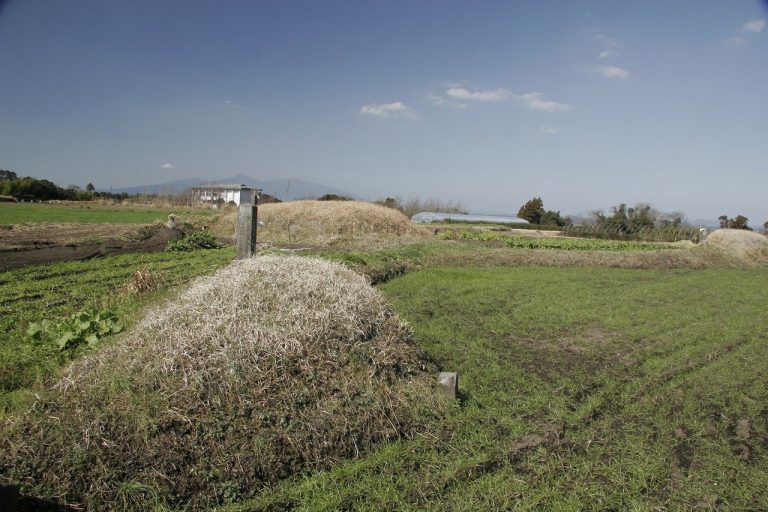
The castle occupied a volcanic-ash plateau overlooking a small valley formed by the Fumotogawa River, which contributed to its defenses. The ash consists mainly of pumice; it drains readily but is poorly suited to rice cultivation. The full castle area is described as about 800 by 900 metres, or approximately 45 hectares. More than ten terraces of different sizes survive across an area roughly 250 metres square.
Defensive layout
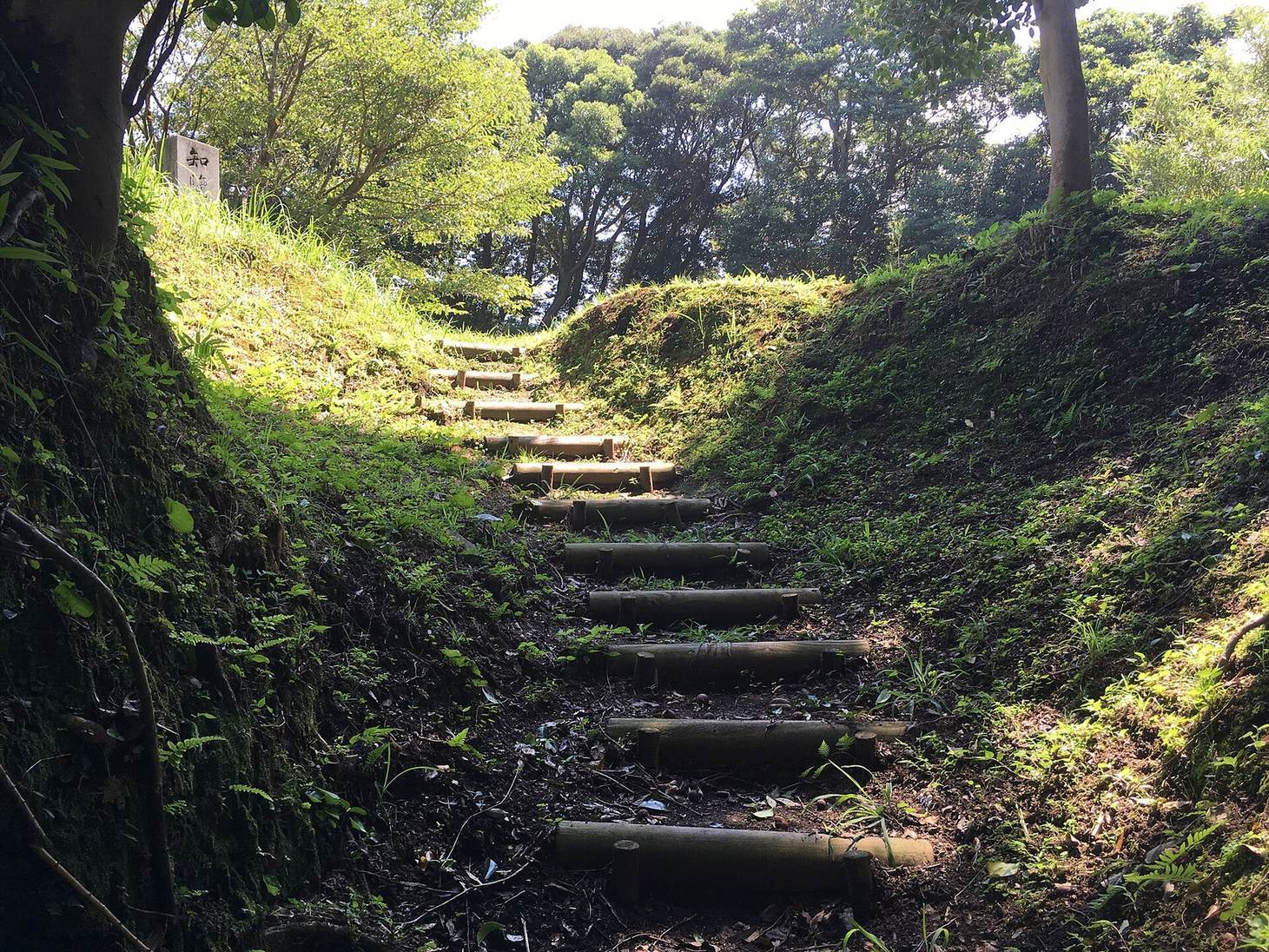
A large valley served as a dry moat, while a valley divided the central area into northern and southern halves. Areas beyond the main enclosed one had further protection from paired, deep dry moats. The central bailey, or enclosed castle area, stood at the eastern edge of the northern half and measured about 50 metres on each side. Clay walls enclosed all four sides, and an entrance compound had a forecourt that forced entrants to turn. The wider complex also included other baileys, defensive enclosures on its eastern, western, and southern sides, and a residence compound.
Excavated objects
Finds from the castle include Chinese ceramics from the fifteenth and sixteenth centuries, pottery made in Southeast Asia, everyday wares, and iron objects. A Hongwu Tongbao coin was also recovered.
The castle town
The town’s main street bends at its center as a defensive measure. Many samurai residences survive, protected by stone walls and hedges and accompanied by Japanese gardens.