Church of Santa Maria Assunta: A Romanesque Church in Assergi, Italy
Site at a Glance
- Country
- Italy
- Primary era
- Medieval
- Eras represented
- Medieval, Early Modern
- Civilizations
- Kingdom of Naples, Kingdom of Sicily, Spanish
- Site type
- Religious
- Remains
- Church
On this page14 sections
History
Foundation and medieval development
The Church of Santa Maria Assunta stands in Assergi, within the municipality of L’Aquila, Italy. Built in 1150 in the late Romanesque style, it occupies the site of an earlier monastery, probably dedicated to Santa Maria in Selice. The church was established at the initiative of Bishop Berardo of Forcona and initially formed part of a larger monastery founded by Saint Equizio, an early medieval Italian monastic saint.
A parchment recording the church’s foundation came to light in the late eighteenth century, when an altar dedicated to Saint Giles was dismantled. The crypt preserves remains of an earlier church dedicated to San Franco, the patron saint of Assergi.
Later changes and restoration
Altars were added along the church walls in the sixteenth century, and alterations in the eighteenth century introduced Baroque features. In 1902, the columns received a marble-like finish, along with gilding and further ornament. A controversial restoration directed by Moretti in 1965 and 1966 aimed to recover the church’s Romanesque appearance. It removed those later treatments and exposed structures dating to the late thirteenth century.
The church is Roman Catholic and follows the Roman rite, the principal liturgical tradition of the Latin Church. It belongs to the Archdiocese of L’Aquila, an ecclesiastical jurisdiction headed by an archbishop.
Remains
The church
Layout and interior
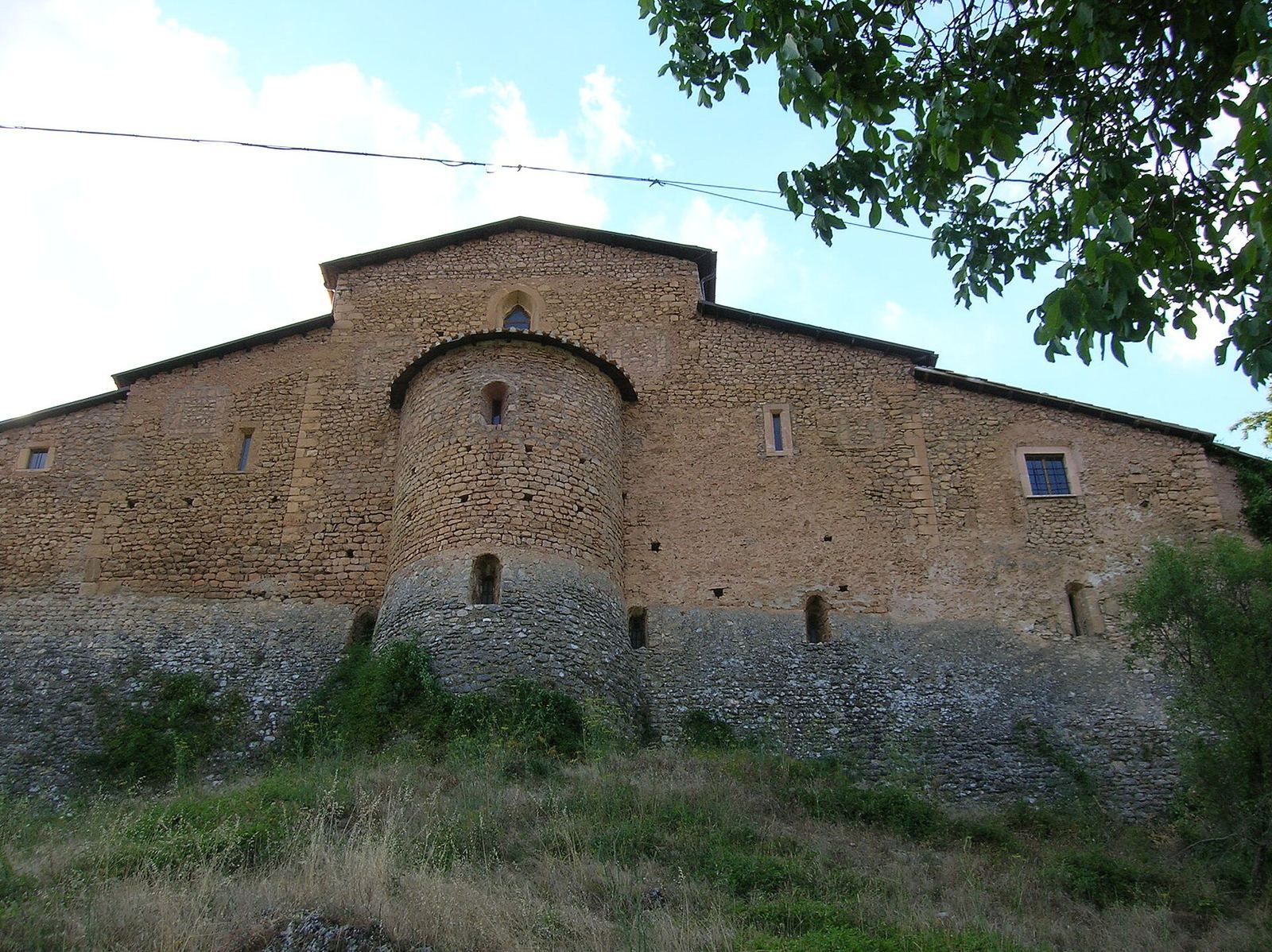
The late Romanesque church has an interior dating from the late thirteenth to early fourteenth century. Two rows of columns divide it into three aisles, or lengthwise sections, and support round arches. Above them is an exposed-beam timber roof. Behind the main altar, a rounded apse, the end space of the church, contains a broad window with a single opening.
Facade and bell gable
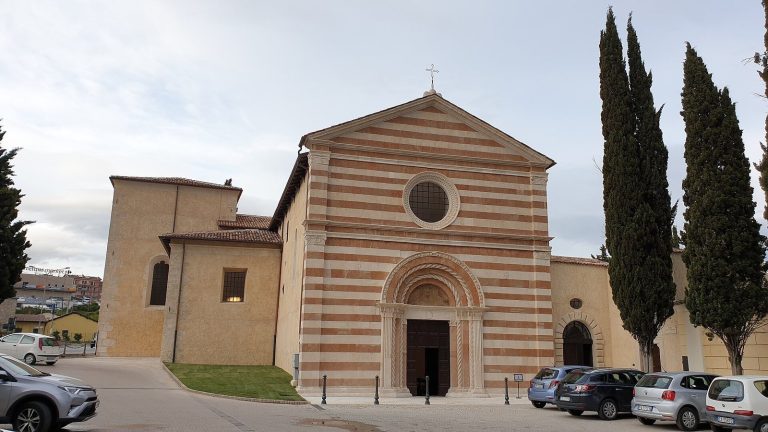
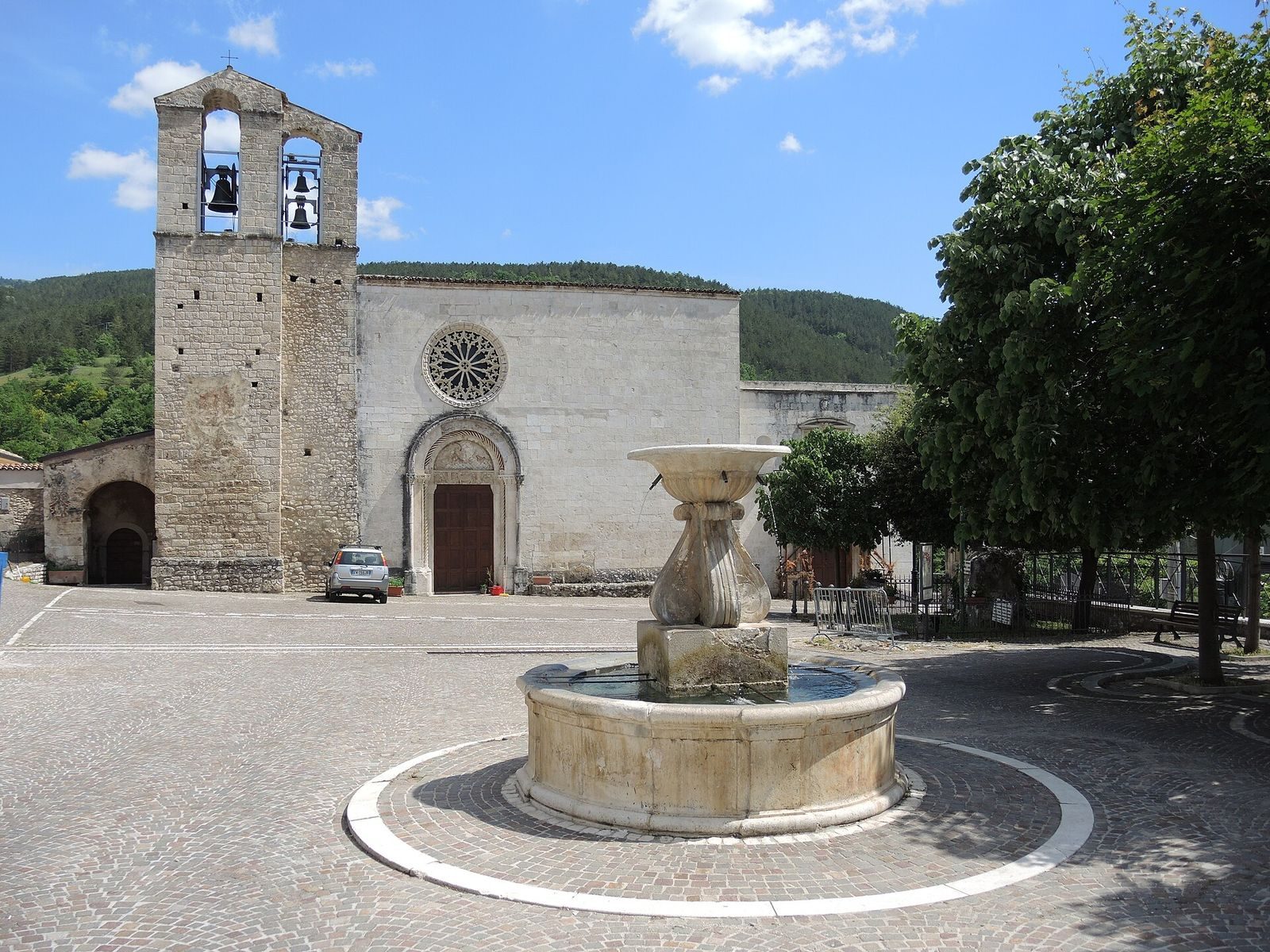
The fifteenth-century facade is built of white stone and has a horizontal top. Its portal has a rounded area above the doorway, where small columns with carved upper sections support rounded arches decorated with leaf and spiral patterns. Traces of frescoes show angels in flight. Two town coats of arms appear on the horizontal stonework above the opening, incorporating a lamb that represents Christ.
The circular rose window, a window with ornamental tracery, has pierced stonework resembling examples at the Basilica of Santa Maria di Collemaggio in L’Aquila and Santa Maria delle Grazie in Rosciolo. A fifteenth-century bell gable, a wall structure with an opening for a bell, stands to the left of the facade.
Paintings and devotional works
Last Judgment and Hell
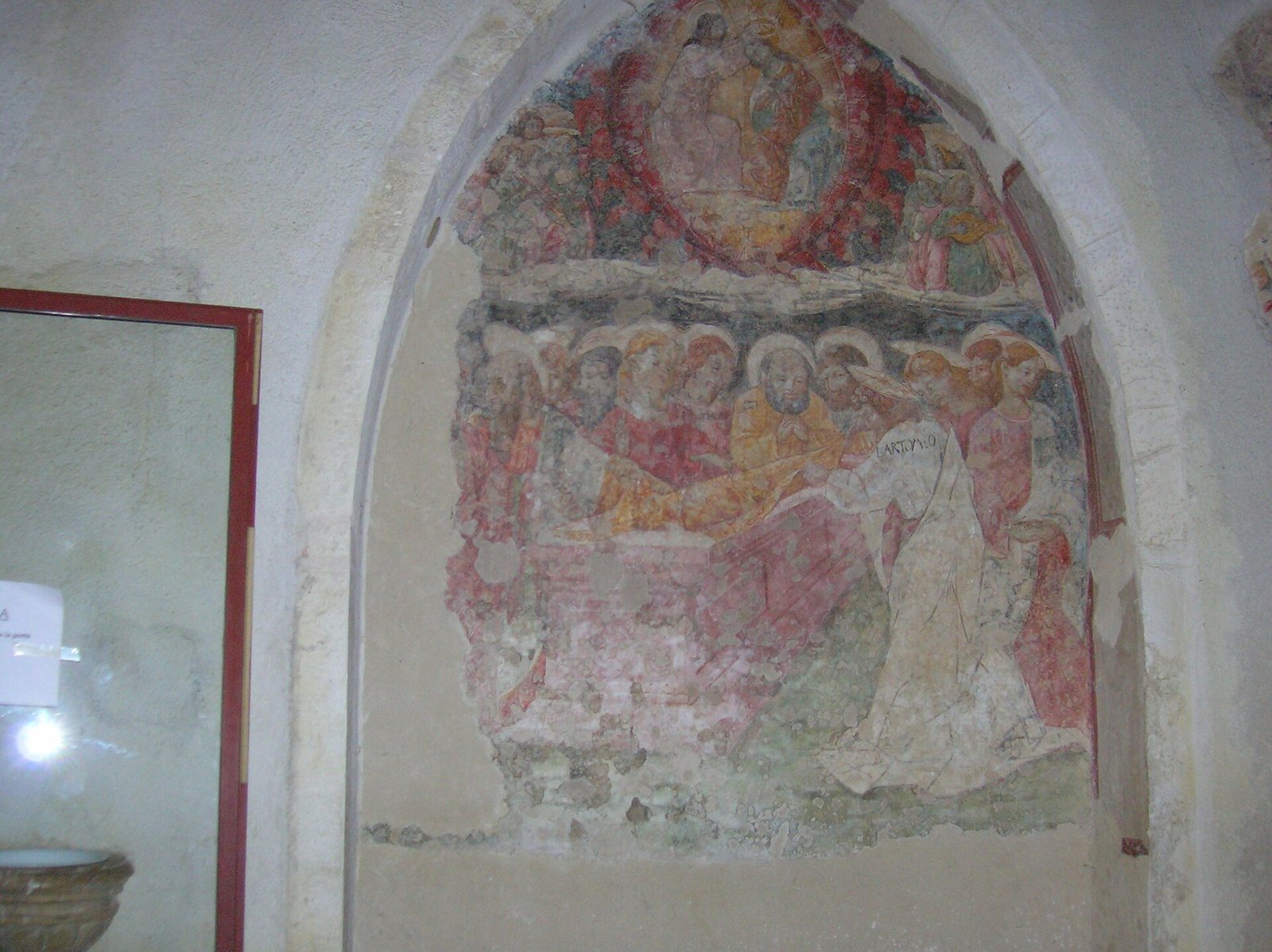
Fresco remains survive on the walls and columns, which were once decorated throughout. A fifteenth-century Last Judgment has a poorly preserved lower part that suggests the Resurrection of the dead. Above, Christ appears as Judge within a mandorla, an almond-shaped frame around a sacred figure, surrounded by apostles and saints. A panel to the right depicts Hell, where the damned are entwined by demonic snakes. One snake holds scales, perhaps referring to punishment for fraud.
Paintings and scenes of Saint Franco
Some framed paintings date to the fifteenth and sixteenth centuries and are attributed to the Italian painters Saturnino Gatti and Francesco da Montereale. Behind the 1502 tabernacle is a preserved fresco of a Pietà, a scene of Mary mourning the dead Christ, alongside a wooden sculpture of San Franco. Fifteenth-century frescoes depicting episodes from the saint’s life form the background.
Crypt
Rock-cut chamber
The crypt is carved into rock and divided into three aisles. Round arches support a ceiling of intersecting curved sections, known as cross-vaulting. Its columns have no bases; two capitals, the upper parts of the columns, are cubical, while others have toothed decoration.
Relics and furnishings
A silver-gilt reliquary, made of silver with a thin layer of gold, dates to 1481 and is attributed to the goldsmith Giacomo di Paolo di Sulmona. It contains relics of San Franco and rests on a carved parapet from an earlier raised platform for readings. The parapet bears four rosettes and a peacock. In the left aisle, a wooden chest dated 1636 is painted with the Madonna and Child with Saints and supports a wooden Madonna sculpture dating to the fourteenth century.
Room beside the crypt
A room beside the crypt has a central column supporting four bays with cross-vaulted ceilings. A staircase in the room leads to the sacristy.