Chiesa di Sant’Agata la Vetere: Catania’s First Cathedral and Shrine of Saint Agatha


Site at a Glance
- Rating
- 4.6
- Popularity
- Low
- Country
- Italy
- Primary era
- Early Modern
- External website
- Open
- Eras represented
- Classical, Medieval, Early Modern, Modern
- Civilizations
- Byzantine, Kingdom of Sicily, Kingdom of the Two Sicilies, Roman
- Site type
- Religious
- Remains
- Cathedral
On this page15 sections
History
Chiesa di Sant’Agata la Vetere is a historic church in Catania, Italy, whose present late-Baroque form followed reconstruction in 1772. It was Catania’s first cathedral and served as the seat of the city’s bishop from approximately 380 until 1094, when Bishop Ansgerius transferred the episcopal see to the Norman cathedral established by Count Roger. The older church was then known as la Vetere, meaning “the old,” and remained associated with the cult of Saint Agatha, the Christian martyr and patron saint of Catania.
Origins and Episcopal Cathedral
The site’s association with Saint Agatha reaches back to 264, when Bishop Everio consecrated a small votive shrine connected with the saint. The structure later became obscured among the ruins of the former praetorium, the official residence or administrative headquarters of the Roman proconsul Quintianus, in the area now occupied by Sant’Agata al Carcere.
Between 380 and 436, Bishop Severinus oversaw the construction of a larger church. It became the first cathedral of Catania, and Saint Agatha’s relics were transferred there from the church of San Leone when the new episcopal seat was established. The church retained this role for more than seven centuries. Pope Vigilius visited it during his two stays in Sicily between 547 and 555, while travelling to Constantinople.
In 776, Bishop Leo II, known as “the Thaumaturge,” enlarged and improved the building, changing the form of the earlier church. In 1040, the Byzantine general George Maniakes removed Saint Agatha’s relics from Catania during an attempt, ordered by Emperor Michael IV the Paphlagonian, to reconquer Sicily from Arab rule. The relics were kept in the cathedral basilica of Hagia Sophia in Constantinople for 86 years. The church later received the pilgrim Silvester of Troina in 1135.
Religious Communities and Later Destruction
Between 1355 and 1375, Bishop Marziale raised Sant’Agata la Vetere to the status of a priory, a religious house governed by a prior. He endowed it with numerous properties and granted its administration and income in commendam to Benedictine monks who were also canons of the cathedral chapter, the clergy responsible for the cathedral’s administration and worship.
In 1465, Observant Friars Minor took possession of the church through the intervention of Bernardino of Siena or one of his close disciples. The site was later assigned to the Reformati Friars Minor of Santa Maria di Gesu. In 1605, the cathedral chapter granted it to the Capuchins, another branch of the Franciscan tradition, although they did not occupy it. Between 1613 and 1614, Bishop Bonaventura Secusio petitioned for its transfer to the Friars Minor. At his expense, an adjoining convent was built, where he lived until his death. He was buried in the cathedral between the doors of the Chapel of the Most Holy Crucifix and the sacristy. The convent’s succession of communities also included the Theatine Clerics before it returned to the Observants.
The church and convent formed part of Forte della Carcarella, incorporated into Catania’s circuit of city walls. Both were destroyed by the earthquake of 11 January 1693. Reconstruction in 1772 created a larger complex slightly farther west. The new church had a single nave and a more austere character associated with the Franciscan model of the Observant Friars Minor. A further earthquake on 20 February 1818 caused the vault to collapse.
Modern Transformation and Agatha Shrine
Following the state’s confiscation of religious property under suppressive laws, the former convent was converted into a hospital or clinic in 1869. A legal entity responsible for managing the church was established in 1933 and continues in that role. The church remains associated with the Catholic Archdiocese of Catania.
After the 1990 Carlentini earthquake, also called the Santa Lucia earthquake because it occurred on 13 December, the church closed temporarily for restoration and reopened for worship in 2003. Work inside and around the building revealed remains connected with Saint Agatha and other archaeological evidence, helping establish the church’s identity as an Agatha shrine. Its solemn celebrations include the customary placement of an urn containing a recumbent figure of Saint Lucy, a practice reflecting the religious tradition that links Lucy with Agatha’s martyrdom.
Remains
Church Exterior and Interior
Facade and Nave
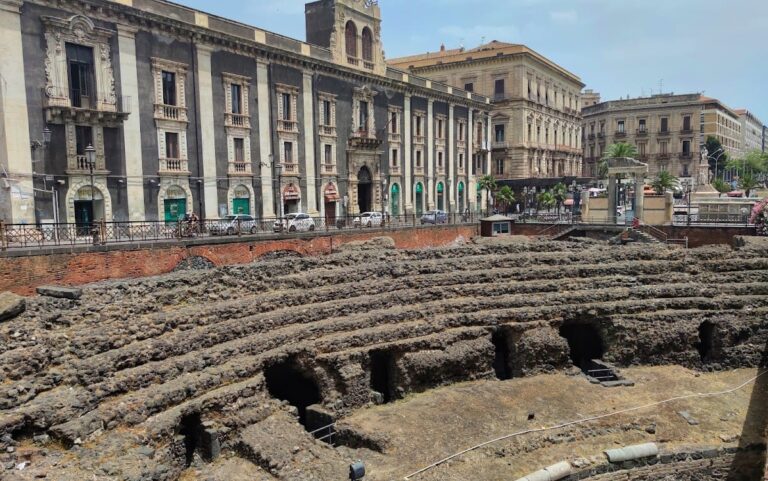
The present church stands in the piazza that bears its name, along Via Santa Maddalena in Catania’s San Biagio della Calcarella, or Roman Amphitheatre, district. Sant’Agata al Carcere lies nearby to the east, while Sant’Agata alla Fornace, now known as San Biagio, stands two blocks east in Piazza Stesicoro and faces in the opposite direction.
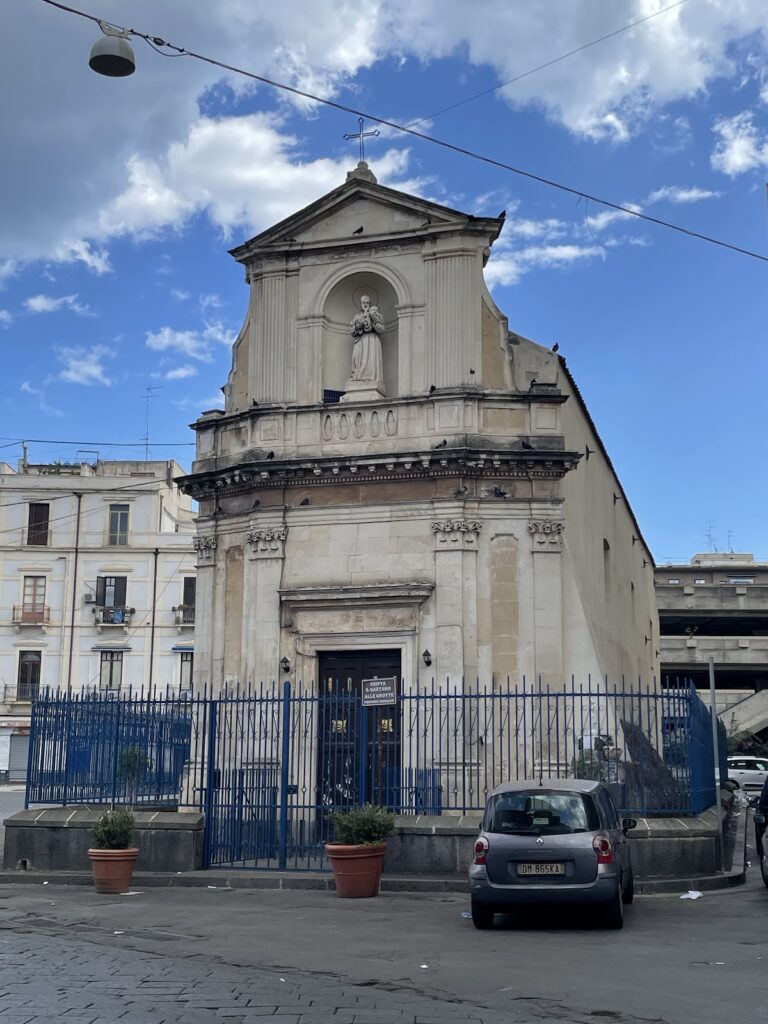
The sparse late-Baroque facade is enclosed by pilasters, flat vertical supports resembling columns, made of pale limestone. A massive central portal with a broken-arched pediment forms the principal entrance, above which is a large intermediate window. Oculi, or circular openings, lanterns, and marble plaques complete the elevation. A projecting cornice and pediment crown the facade.
Inside, the church follows a simple linear plan with a single nave. The present building dates from the reconstruction after the 1693 earthquake, while its crypt retains traces of ancient Roman substructures. The nave is organized into lateral bays containing chapels, paintings, exits, relic niches, and devotional images.
Chapel of Saint Agatha
The second bay on the right contains the Chapel of Saint Agatha. Its principal work is Antonio Pennisi’s 1851 painting The Martyrdom of Agatha, which depicts the cutting of the saint’s breasts and includes Saint Peter the Apostle and an angel. An inscription beside the scene provides a brief biography of the martyr. A small painting of Saint Lucy is also kept in the chapel.
Chapels on the Left
The first bay on the left contains a painting and a niche or chamber for relics and devotional images. The second is the Chapel of the Virgin of the Children. Its altar bears Giuseppe Sciuti’s 1898 oil painting Madonna of Maternity, also called the Madonna of the Children. A smaller painting shows Cardinal Bonaventure of Bagnoregio, Louis of Anjou, Bishop of Toulouse, and the Madonna above them.
The third left-hand bay contains the Chapel of the Virgin of the Angels. Paolo Ferro Vaccaro’s 1851 painting Madonna of the Angels is displayed above the raised section. Another niche holds relics and devotional images. The third bay on the right contains an additional chapel and painting, while a further opening serves as a lateral exit. The first right-hand bay also has a lateral exit.
Relics, Tomb, and Subterranean Spaces
Chest of Saint Agatha
Near the entrance, a glass case displays the wooden chest that held Saint Agatha’s remains for more than 500 years. The object links the present church to the long history of the saint’s relics and to the building’s continuing religious identity.
Putative Tomb of Saint Agatha
The presbytery, the area around the main altar, contains the putative original tomb of Saint Agatha, identified by an inscription associated with Francesco Castro. Its lower sarcophagus is Roman and decorated with reliefs, including two symmetrical griffins facing one another on the front. The Byzantine lid bears religious reliefs and a Byzantine representation of Agatha. The sarcophagus now serves as the altar and is traditionally identified as the container of the saint’s relics.
Crypt and Earlier Structures
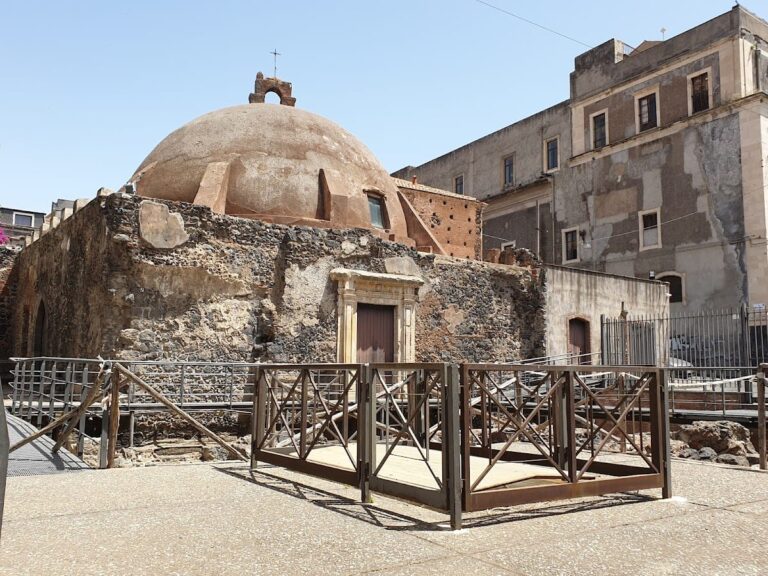
Archaeological excavations inside and outside the church exposed structures belonging to the earlier medieval cathedral. The subterranean rooms include hypogean spaces, meaning underground chambers or complexes, traditionally understood as places where Christians escaped persecution. They also contain the foundations of the former cathedral, a cemetery crypt, a mortuary chamber, and two seventeenth-century colatoi, funerary installations used to drain or dry bodies before burial.
Convent and Fortified Complex
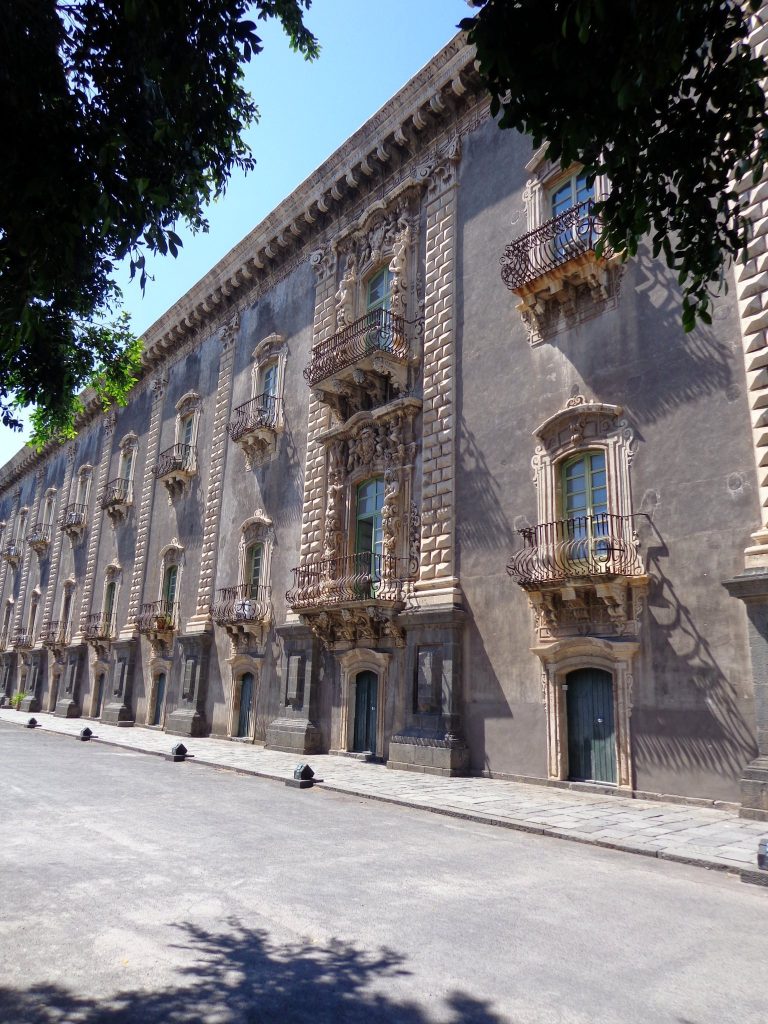
The adjoining convent formed part of the complex enclosed by Forte della Carcarella and Catania’s city walls. Its buildings underwent a major change after the religious-property confiscations of 1869, when they were converted for use as a hospital or clinic. The convent’s physical history therefore preserves the relationship between the church, the former religious house, and the fortified urban circuit that once surrounded them.
Memorials and Wall Inscriptions
The church contains the 1854 mausoleum of Mario Musumeci, a historian, archaeologist, and architect, made by Antonio Calì. Marble inscriptions on the walls include one that records the dialogue associated with the appearance of Saint Peter the Apostle to Saint Agatha. Together with the relic chest, the tomb traditionally linked to the saint, and the archaeological remains beneath the building, these memorials reinforce the church’s role as a place connected with the history and veneration of Catania’s patron saint.