Château Vieux: The Viscounts of Marsan’s Castle at Mont-de-Marsan
Site at a Glance
- Country
- France
- Primary era
- Medieval
- Eras represented
- Medieval
- Civilizations
- Duchy of Aquitaine
- Site type
- Military
- Remains
- Castle
On this page11 sections
History
Château Vieux was a castle in Mont-de-Marsan, France, probably built under Pierre de Marsan in the twelfth century. Its precise construction date is unknown, as is whether it was built before or around the time Pierre founded the town, between 1133 and 1144. The castle became the principal residence of the Viscounts of Marsan, hereditary lords who governed the surrounding territory, and an important center of their political and judicial authority.
Foundation and vicomtal residence
Before the early twelfth century, the viscounts were based at Roquefort, at the Castle of Marsan. An earlier watchtower may have stood near the confluence at Mont-de-Marsan, perhaps built by the viscounts or by Pierre’s father, Loup-Aner. The suggestion rests on a 1108 reference to a lord’s tower at Roquefort, but the date and existence of a precursor at Mont-de-Marsan remain uncertain.
Once established, Château Vieux probably became the viscounts’ permanent home. It housed the viscount and his family, served as the seat of the Viscounty of Marsan and its sovereign court, and hosted formal acts of allegiance, known as homage, from townspeople and vassal lords. Its position also helped control the port’s trade, a watermill, and roads leading to the town’s two bridges, while providing protection for residents.
The viscounts later acquired lordships in Bigorre, Comminges, and Béarn, leaving them with several territories to govern and defend. After the death of Pierre’s son Centule III in 1178, they stayed at Château Vieux only from time to time. Marguerite de Moncade built a new residence, later called the Lacataye keep, probably because the old castle was uncomfortable. Château Vieux nevertheless remained an occasional residence and a visible expression of vicomtal authority.
Political and administrative uses
The castle continued to host political business and ceremony. In 1256, Vicomtesse Mathe de Matha signed the purchase of the lordship of Beyrie at Le Frêche there; she later gave it to the Poor Clares, a Catholic order of women, for a convent. When he reached adulthood, Gaston Fébus renewed his homage at the castle. During visits in March 1346, he received the town’s mayor and jurats, or municipal officials, as well as representatives of nearby communities and nobles answerable to the castle’s court. On a later visit, he received the jurats of Roquefort and confirmed their customary privileges.
Gaston Fébus also established a permanent lieutenant-general at Château Vieux, an official who exercised authority on his behalf. The appointees named for the post were Bertrand deus Pujols in 1357, Bernard d’Aydie in 1373, Pierre-Arnaud de Béarn, his cousin, in 1378, and Arnaud-Guilhem de Morlanne, his half-brother, in 1390.
Catherine of Navarre granted Château Vieux to the town on 19 September 1488. By then, the vicomtal family’s center of power was elsewhere, and the castle had become a distant memory for its former occupants. The town took responsibility for its upkeep, probably a substantial burden. Henry III of Navarre, later Henry IV of France, chose to stay there when visiting Mont-de-Marsan, although the newer Castle of Nolibos was more comfortable. Catherine de Médicis and her son, King Charles IX, also stayed at Château Vieux in May and July 1565 during a royal progress through France. They complained about the accommodation.
Religious conflict and changing ownership
During the French Wars of Religion, a series of sixteenth-century conflicts between Catholics and Protestants, Catholic forces under Blaise de Monluc seized the town and castle in September 1569 and massacred the garrison. In 1580, Bertrand de Poyanne, governor of Dax and a Catholic military leader in Gascony, captured Mont-de-Marsan and began demolishing Château Vieux to prevent Protestants from occupying it. Henry IV halted the work before the castle was entirely destroyed. The building was plundered through much of the sixteenth century.
An agreement between Catholics and Protestants on 27 October 1595 allowed Protestants to hold sermons and prayers in part of the castle. Reformed worship there apparently ended in 1627; the town’s Protestant church was not built until 1870. Other parts of the building housed a seneschal’s court, which administered justice for a lord or the Crown, a royal court of justice known as a presidial court, and a prison.
In 1607, the Estates of Marsan, the territory’s representative assembly, were incorporated into the Crown domain, the lands held directly by the French monarchy. The change prompted a dispute between town representatives and royal officers over ownership of the castle and criminal jurisdiction. A royal inspection in 1609 found the buildings in very poor condition, although court hearings and royal judicial business continued amid the ruins. On 16 December 1613, Jean Delaborde, a criminal lieutenant at the seneschal’s court of Saint-Sever, confirmed the town’s ownership of the prison and courthouse in the part of Château Vieux that remained standing.
Demolition
Mont-de-Marsan became the capital of the Landes department in 1790. New administrative buildings took over the castle’s functions: the courthouse and prison were completed in 1809, while the prefecture became the department’s executive seat. The municipality had decided in 1807 to demolish Château Vieux and free central land for development. Work began in 1810, and a drawing by departmental architect Rieutord shows demolition among the ruins in 1813.
Remains
Château Vieux occupied the western end of a rocky spur about 400 metres long and 225 metres wide, on ground now occupied by the municipal theatre and part of Place Charles-de-Gaulle. The Douze and Midou rivers provided natural protection. The castle stood within the first oval-shaped fortified settlement, whose layout and surviving street pattern place it opposite the priory church of the Madeleine at the settlement’s eastern end.
Fortified settlement and moat
The settlement’s perimeter followed the routes of present-day Rue Dominique-de-Gourgues to the west, Rue Lacataye to the south, Rue Pujolin to the east, and Rue Armand-Dulamon and its continuation, Rue Victor-Hugo, to the north. Rue Robert Wlérick linked the castle and the Madeleine; it was among the town’s earliest streets and its first main axis. Formerly called Rue du Château Vieux, it ran through the fortified settlement. A water-filled moat once connected the Douze and Midou. It was filled in during the late thirteenth and early fourteenth centuries, when the town’s ramparts took its place. Rue Molière, near the surviving castle wall, was still called Rue des Fossés in the nineteenth century, recalling the former moat.
Castle complex
Enclosure and entrance
A plan from 1612 shows Château Vieux within Mont-de-Marsan’s ramparts. The castle’s general arrangement dated to the twelfth century and was simpler than the Castle of Nolibos, built two centuries later. A wall enclosed a courtyard entered through a large wooden gate. Above the gate stood a tower with a curved ceiling, a notched top, and projecting openings through which defenders could attack people below. These openings were a later defensive addition, introduced in the fourteenth century in place of temporary wooden galleries.
Residence, tower, and chapel
The courtyard contained a residential building with a two-storey tower at one corner near the river. A 1609 inspection described the tower as partly ruined and adjoining the residence. Its ground floor contained rooms with curved ceilings near the royal hearing room, with another room above. A chapel with curved ceilings stood close by, against a corner of the residence; it had two small windows fitted with iron bars.
Surviving fabric
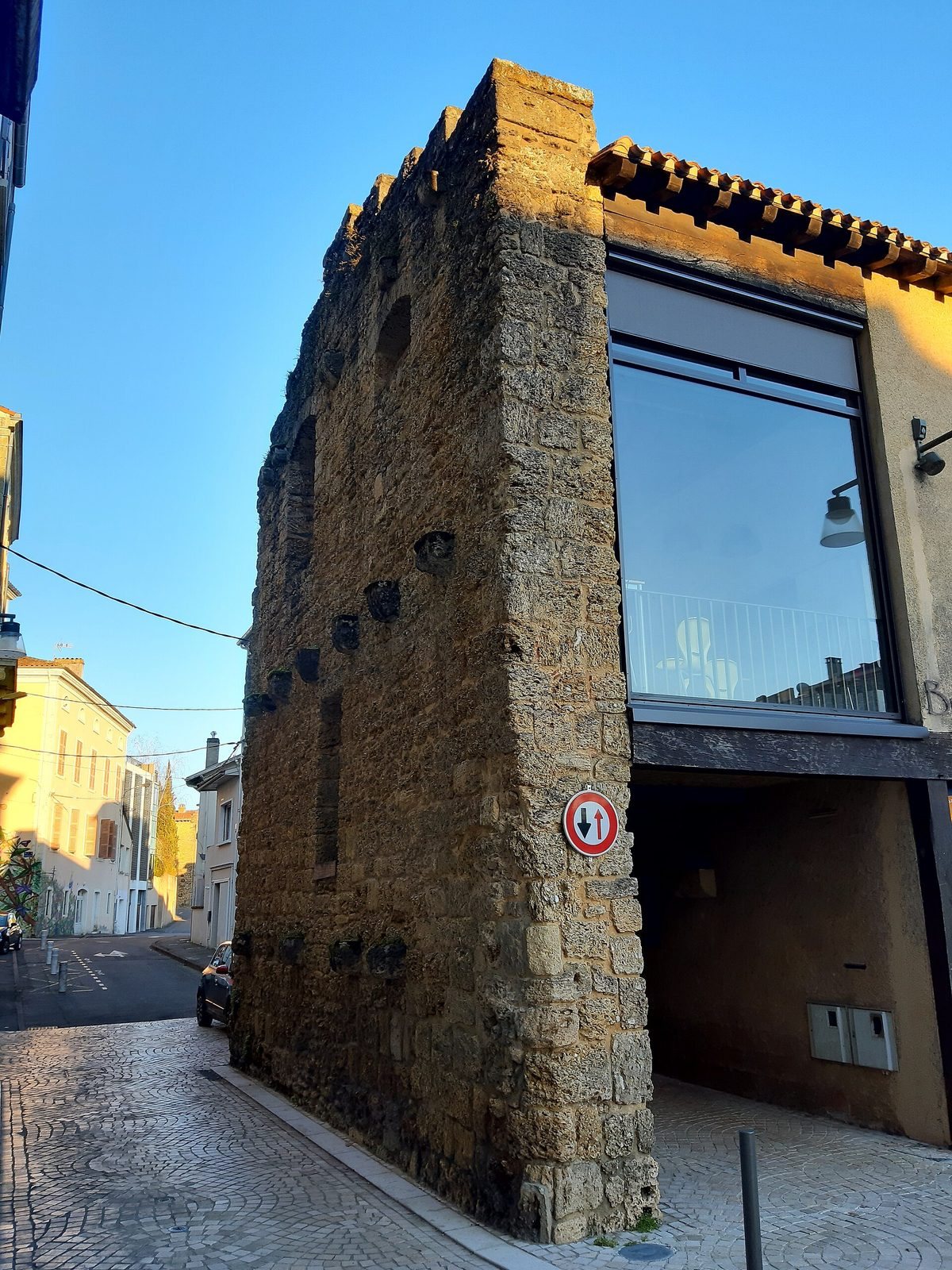
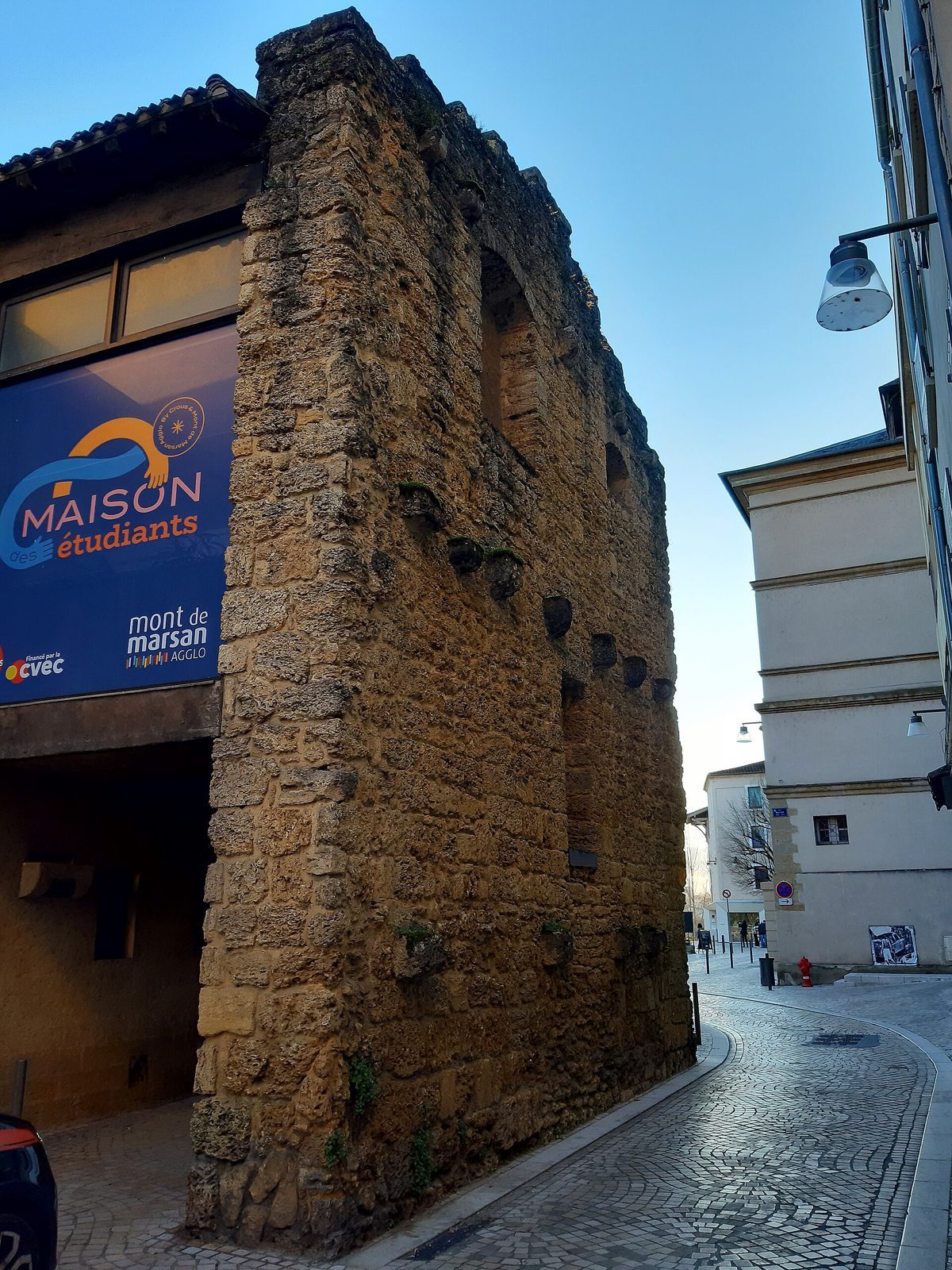
The 1609 inspection found nearly all the roof frames damaged, cracks in the tower walls, and almost no flooring in the rooms. An estimate made in 1807 measured the castle walls at 1.70 metres thick. Dressed stone, 70 centimetres thick, formed the outer facing around a core of rubble bound with mortar. A short section of wall on Rue Lacataye, near Rue Molière, is the surviving remnant of Château Vieux.