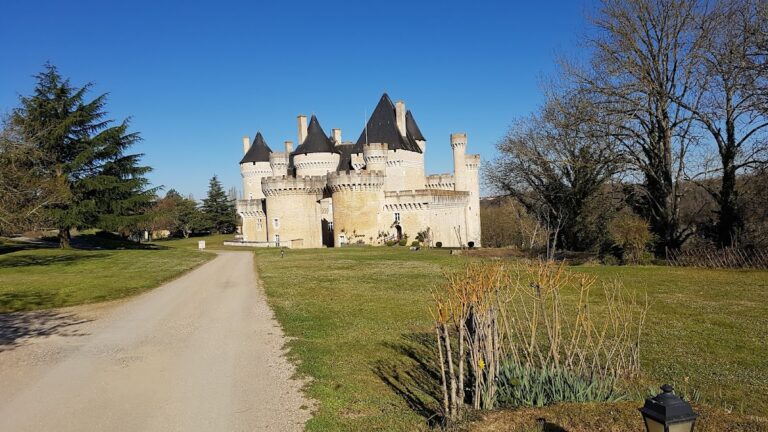
Château Raoul: A Medieval Fortress and Administrative Residence in France


Site at a Glance
- Rating
- 4.2
- Popularity
- Low
- Country
- France
- Primary era
- Medieval
- External website
- Open
- Eras represented
- Medieval, Modern
- Civilizations
- French
- Site type
- Military
- Remains
- Castle
On this page12 sections
History
Château Raoul is a medieval fortress and later administrative residence in Châteauroux, France, whose origins date to the tenth century. Seigneur Raoul, known as “the Large” or “the Liberal,” and the son of Ebbes-le-Noble, left the hereditary settlement of Déols to build a stronghold on a steep mound above the left bank of the Indre.
Origins and the lords of Déols
The fortress appears by 917 in the foundation charter of Déols Abbey. By 1112 at the latest, it was known as Château Raoul, a name drawn from the personal name repeatedly used by the lords of Déols. The castle gave its name to Châteauroux, where artisans and merchants established a settlement under its protection.
Its position placed the stronghold on the boundary between the French royal domain and Aquitaine. During the twelfth century, the Capetians, the French royal dynasty whose rule extended from the late tenth century, and the Plantagenets, the English ruling dynasty that also held extensive lands in France, competed for control of the region. Château Raoul was besieged several times. The lords of Châteauroux controlled territory covering about two-thirds of the present Indre department and issued their own coinage by the eleventh century.
From Déols to Chauvigny
The male line of the Déols family ended in 1176. The lordship and castle then passed through marriage to the Chauvigny family of Poitou. Denise of Déols, the family heiress, married André de Chauvigny in 1189. The marriage was arranged by Richard the Lionheart, the English king Richard I and a major Plantagenet ruler.
During the siege of the town by the Black Prince in 1366, an accidental fire destroyed the castle. The Black Prince was Edward of Woodstock, the English heir and a prominent commander in the Hundred Years’ War. Guy III de Chauvigny rebuilt Château Raoul as a seigneurial residence within a fortified enclosure. A further rebuilding around 1450 created the seigneurial castle whose fifteenth-century fabric still forms much of the present building.
County, duchy, and aristocratic residence
On 16 July 1497, Charles VIII raised the lordship of Châteauroux to a county for Jean V d’Aumont. After the death of the last Chauvigny in 1503, the lordship was divided. Château Raoul passed to the Maillé de La Tour-Landry family, while the d’Aumont co-sharers built Château du Parc. Henri II de Bourbon-Condé reunited the two lordships in 1612.
Château du Parc became the preferred residence of the Bourbon-Condé family, while the administration of the duchy moved to Château Raoul. Claire-Clémence de Maillé-Brézé was exiled there by Henri II de Bourbon-Condé, known as the Grand Condé, in 1671, and remained at the castle until her death in 1694.
Louis XV bought the duchy from the Condé family in 1737 and gave it to his favorite, Marie-Anne de Mailly-Nesle, whom he made Duchess of Châteauroux on 20 October 1743. By the middle of the eighteenth century, the castle housed the duchy’s administrators and their families. Henri Bertrand, father of Napoleon’s future grand marshal Henri Gatien Bertrand, lived there, and Henri Gatien Bertrand was born at the castle on 28 March 1773. Charles Louis Dupin de Francueil, George Sand’s grandfather, lived at Château Raoul from 1778 to 1789.
Administrative use and restoration
On 8 August 1792, the Conseil général of Indre bought Château Raoul for 10,000 livres. The Conseil général, the departmental deliberative council responsible for local administration, had met there from 1790. During the revolutionary and post-revolutionary period, the building housed departmental administration and archives, and it served as the prefecture’s residence and offices. A prefect was the central government’s senior administrative representative in the department.
Work on a new prefectural residence began in 1823, and Château Raoul was converted into an administrative complex. Its medieval keep, or principal fortified tower, was demolished in 1824 because it was considered at risk of collapse. The prefectural services left the former castle site in 1972, while the Conseil général moved to a new building in 1971.
Alfred Dauvergne began a major restoration in a neo-Gothic style in 1879. Neo-Gothic architecture was a nineteenth-century revival of medieval Gothic forms. His son Henry Dauvergne completed the work in 1914. The facade and roof have been protected as registered historic monuments since 1927. A later restoration began in September 2009 after two years of preparatory studies and concluded at the end of 2011. Château Raoul is owned by the Conseil général of Indre and forms part of the prefect’s private residence.
Remains
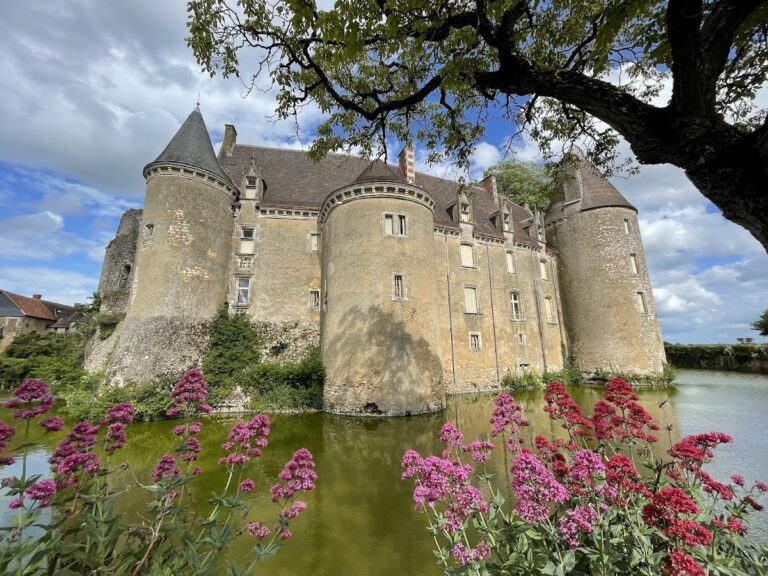
Château Raoul occupies a rocky, steep mound opposite Déols, across the Indre. Its medieval defensive enclosure included several towers, some of which survive. The present building is largely fifteenth-century in fabric, while its interior was remodelled in the neo-Gothic manner from 1879 onward. The 2009 to 2011 restoration treated the roof, balconies, corbels, chimneys, and woodwork.
Fortifications and castle fabric
Rebuilt residence and tower
The original wooden stronghold was replaced by a stone castle in the eleventh century. After the fire of 1366, Guy III de Chauvigny’s rebuilding included an octagonal tower flanked by two wings. One wing was crowned by the square keep belonging to the earlier castle. The medieval keep was later removed in 1824, and the administrative conversion introduced chimney flues through the building.
Porte Vieille-Prison
The Porte Vieille-Prison is a former tower belonging to the castle’s fortifications. It forms part of the surviving defensive elements of the medieval enclosure, alongside several other preserved components of the fortified circuit.
Interior rooms
Salle de la tapisserie
The Salle de la tapisserie has thick walls and a ceiling carried by heavy wooden beams. Seventeenth-century Aubusson tapestries decorate the room with scenes from the biblical story of Esther. Aubusson tapestries are woven wall hangings associated with the French town historically known for textile production. The department acquired these tapestries in 1995.
Salle des délibérations
The Salle des délibérations was used for meetings of the Conseil général of Indre. Its decoration combines wood panelling with wall paintings by Fernand Maillaud, Raoul Adam, and Abel Bertram. The paintings represent the rural and industrial past of Indre. Stained-glass windows made by the Lobin workshop of Tours show the coats of arms of communes in the department.