Scalloway Castle: A Tower House and Seat of Authority in Shetland


Site at a Glance
- Rating
- 4.3
- Popularity
- Low
- Country
- United Kingdom
- Primary era
- Early Modern
- External website
- Open
- Eras represented
- Early Modern
- Civilizations
- Kingdom of Scotland
- Site type
- Military
- Remains
- Castle
On this page8 sections
History
Patrick Stewart’s Stronghold
Scalloway Castle is a tower house in Scotland, United Kingdom, built at Scalloway around 1600 during the early modern period. Patrick Stewart, 2nd Earl of Orkney and Lord of Shetland, began construction after his succession to the earldom was formalized, and the building was completed around 1607. The castle helped him reinforce his authority in Shetland and restrict the influence of Laurence Bruce of Cultmalindie, a local landowner and his principal opponent.
Unpaid workers were summoned from Shetland’s parishes to carry out the construction under the supervision of Andrew Crawford, Patrick Stewart’s master of works. Scalloway was administered separately from Patrick’s principal residence, the Earl’s Palace at Birsay in Orkney. The new castle housed his representative in Shetland and provided a meeting place for the Shetland thing, a Scandinavian-derived assembly responsible for legal and administrative matters.
Decline of Stewart Power
In 1609, Shetland’s lairds appealed to King James VI against Patrick Stewart’s rule. Patrick was imprisoned in Edinburgh Castle and executed in 1615 after encouraging his son Robert to recover the family’s possessions in Orkney. Control of the islands subsequently passed to James Law, Bishop of Orkney, who held his first court at Scalloway Castle in August 1612. The building continued to function as a court after its strategic importance had diminished.
Later Use and Conservation
Troops occupied the castle in 1653, during Oliver Cromwell’s military rule, when his regime controlled Scotland. By the early eighteenth century, the building had deteriorated, and some ornamental stonework was taken away for reuse at the Haa of Sand, an eighteenth-century house northwest of Scalloway. The ruins entered state care in 1908 and are now maintained by Historic Environment Scotland. Excavations in 1979 and 1980 revealed the remains of seventeenth-century outbuildings to the north of the tower. Scalloway Castle is a scheduled monument with protected-monument status in the United Kingdom.
Remains
Plan and Exterior
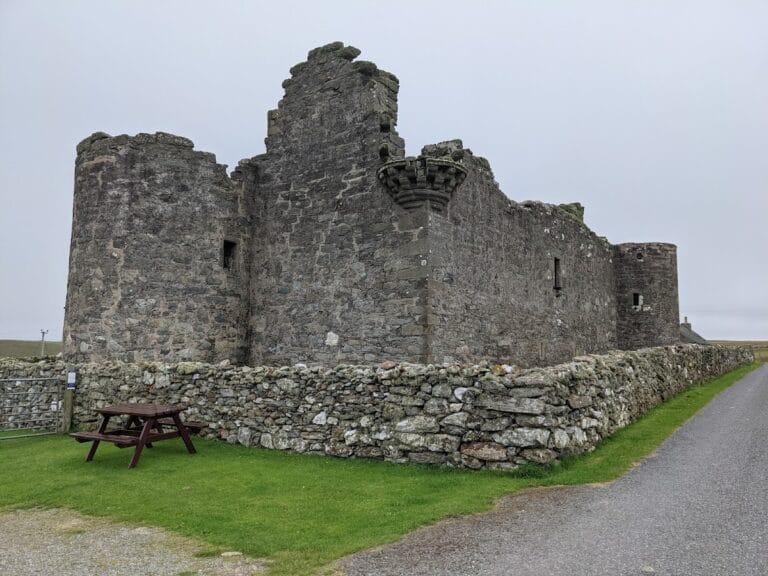
Scalloway Castle has an L-shaped plan, formed by a main block measuring approximately 18 by 10 metres and a square southwestern wing about 8 metres on each side. The roofless structure rises through four storeys, with an additional garret above the main tower. Around the third floor, small bartizans, or projecting corner turrets supported by corbels, mark the exterior. This arrangement of corbelled corner towers is also associated with Andrew Crawford’s work at Muness Castle on Unst.
Entrance Inscription
Three armorial panels and an inscription were placed above the main entrance. Erosion has erased the contents of the panels. An eighteenth-century description of the inscription identified Patrick Stewart as Earl of Orkney and Shetland and referred to James V, King of Scots. It also included a maxim contrasting a house founded on rock, which will endure, with one founded on sand, which will fall. The version then preserved gave the date as 1600.
Interior Arrangement
The ground level was tunnel-vaulted and contained kitchens, storage rooms and a well. A straight staircase connected this level with the first-floor hall, while spiral staircases served the upper storeys. The hall had nine windows and two fireplaces, and the kitchen contained a large hearth. A written description from 1701 mentioned elaborate, colourful wall paintings within the castle.