Château Gruaud-Larose: A Historic Wine Estate in Saint-Julien, France


Site at a Glance
- Rating
- 4.9
- Popularity
- Low
- Country
- France
- Primary era
- Modern
- External website
- Open
- Eras represented
- Modern
- Civilizations
- French
- Site type
- Domestic
- Remains
- Manor House
On this page8 sections
History
Château Gruaud-Larose is a historic château and wine estate in Saint-Julien-Beychevelle, France, producing wine under the Saint-Julien appellation, a protected designation for wines from the Saint-Julien area. Its origins date to 1725 and are associated with the priest Joseph Stanislas Gruaud. The estate later became one of the Bordeaux wines classified as a Second Growth in 1855.
Foundation and the Gruaud-Larose name
The first written records of the château date from 1742. In 1757, Joseph Stanislas Gruaud acquired about 50 hectares on the Saint-Julien-Beychevelle plateau by bringing together three small adjoining parcels. The property was then called Fond-Bedeau, although the name Gruaud remained in use.
After Gruaud died, the estate passed to his heir Joseph-Sébastien de Larose. He was an official of the Bordeaux presidial court, an early-modern French judicial court, and lieutenant general of the seneschalcy of Guyenne, a royal judicial and administrative district. The name Larose first appeared in 1791, and the property subsequently became known as Gruaud-Larose.
Partition and nineteenth-century development
Larose died in 1795, leaving descendants who disagreed over the inheritance. The Bordeaux Court of Appeal ordered a partition sale, and the estate was sold at judicial auction on 21 December 1812 to Bordeaux wine merchants Pierre Balguerie-Stuttenberg and Jean-Auguste Sarget. Gruaud-Larose was formally adopted as the estate’s name at this time. Sarget, later styled Baron Sarget, devised the motto “The king of wines, the wine of kings.”
In 1846, the new owners separated and the property was divided. Following negotiations, the vineyards and buildings were shared between the Sarget de la Fontaine family and the Bethmann and de Boisgérard families. Boundary markers recorded the division, and two wines were sold as Gruaud-Larose Sarget and Gruaud-Larose Bethmann. The second branch was also called Gruaud-Larose-Faure after Adrien Faure married Sophie Bethmann, an heiress to part of the estate.
Powdery mildew, a fungal disease affecting vines and grapes, reduced yields between 1852 and 1860. Sulfur treatment then became widespread in the Médoc. The Bordeaux Wine Official Classification of 1855, which ranks leading Bordeaux wines in growth categories, confirmed Gruaud-Larose as a Second Growth, or Deuxième Cru, the second-highest level in that system.
Vine disease and commercial crisis
Phylloxera, a vine pest that attacks grapevines, threatened vineyards in the Médoc from 1874. Beginning in 1895, diseased vines were progressively replaced with more resistant American plants used as rootstock. Downy mildew, another fungal disease, damaged vines, grapes, foliage, and harvest quality from 1878.
A prolonged crisis affected the Médoc from about 1890. Gruaud-Larose sold future harvests through subscription arrangements to secure income. The Sarget branch regained its commercial independence in 1916, followed by the Bethmann branch in 1919.
Reunification and modern ownership
Wine merchant Désiré Cordier acquired Gruaud-Larose Sarget in 1917 and Gruaud-Larose Bethmann in 1935. These purchases reunited the two branches and restored the estate established by Gruaud. Gruaud-Larose became a leading holding of the Cordier wine group in Bordeaux.
After Désiré Cordier died in 1940, Paul and Henri Lemaire managed the estate until Cordier’s grandson, Jean Cordier, took charge in 1947. Jean Cordier modernized management, renewed much of the vineyard, increased plantings of Cabernet Sauvignon, and strengthened the estate’s reputation.
Suez invested in the Cordier company through Banque La Hénin in 1983. Alcatel-Alsthom acquired the château in 1993 and undertook a comprehensive restoration. The grounds were redesigned, the wine cellars were enlarged, and some vats were rebuilt in wood. Technical installations added that year included computerized monitoring of grape reception and wine vats, an oenological laboratory, a weather station, and a wastewater-treatment plant within the estate.
The Merlaut family acquired the property through the Taillan Group in 1997. The estate continued its emphasis on wine production while maintaining environmental practices and established traditions. The château, its tower, and its agricultural hangar were listed as historic monuments in France by an order dated 22 February 2012.
Remains
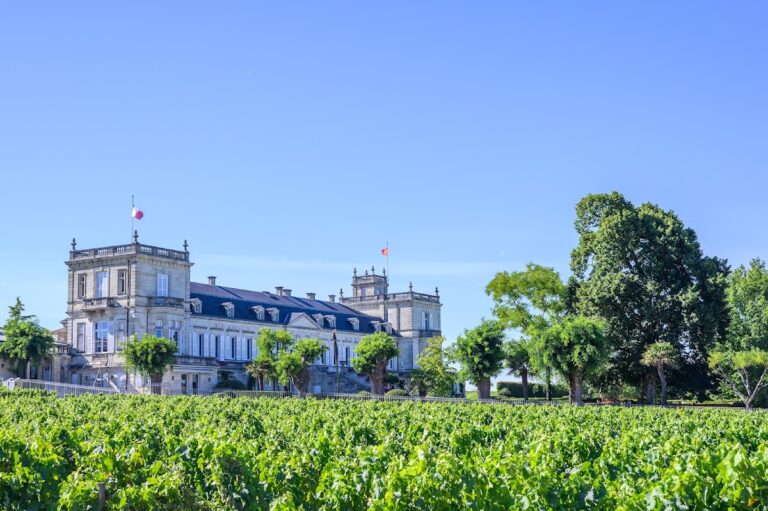
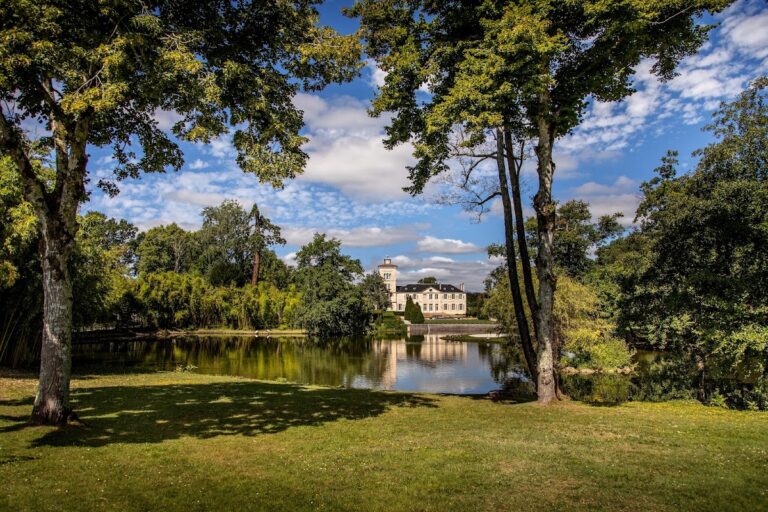
Château Gruaud-Larose combines a reconstructed manor house, associated estate buildings, formal grounds, vineyards, and wine-production facilities. The main house is a two-storey, multi-winged building, while the wider property includes a tower and an agricultural hangar. Its grounds contain lawns, flowers, and white gravel paths.
Château and estate grounds
The present château was reconstructed in 1879, a date preserved on the rear façade. The building forms the principal architectural element of the estate, with the tower and agricultural hangar contributing to the surviving group of historic structures. The grounds are maintained as a garden organized around lawns, planted areas, and white gravel paths.
Vineyards and wine-production facilities
The vineyards cover approximately 82 hectares. They are planted with Cabernet Sauvignon, Merlot, Cabernet Franc, Petit Verdot, and Malbec, with Cabernet Sauvignon and Merlot forming the principal plantings. The wine-production facilities include enlarged cellars and wine vats, some of which were rebuilt in wood during the restoration after 1993.
The estate’s first wine, its principal bottling, is aged for 18 months in French-oak barrels, about 90 percent of them new on average. A separate second wine is marketed as Sarget de Château Gruaud-Larose or Larose de Gruaud, and a third label is called La Roseraie de Gruaud-Larose.