Château Lagrange: A Historic Saint-Julien Wine Estate in France


Site at a Glance
- Rating
- 4.6
- Popularity
- Low
- Country
- France
- Primary era
- Modern
- External website
- Open
- Eras represented
- Early Modern, Modern
- Civilizations
- French
- Site type
- Economic
- Remains
- Production Complex
On this page12 sections
History
Château Lagrange is a historic wine estate near Saint-Julien-Beychevelle in France, whose viticultural vocation developed by the seventeenth century and whose documented wine-growing history reaches back to the early eighteenth century. Associated with the regulated Saint-Julien appellation in the Médoc, the estate has been classified as a Troisième Grand Cru Classé, or Third Growth, since the Bordeaux Wine Official Classification of 1855.
Early ownership and eighteenth-century reputation
The agricultural land first belonged to the lords of the Maison Noble de Lagrange Monteil, a noble residence or landed estate associated with the property. Baron de Brane later held the land and may have established the vineyards during his ownership. He also owned Château Mouton and later Château Brane-Cantenac.
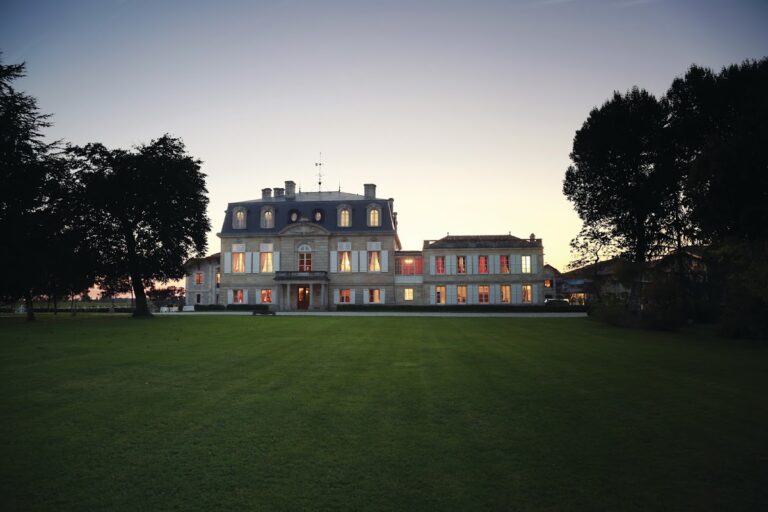
Arbouet de La Bernède subsequently became the owner and probably constructed part of the manor complex that survives today. In 1787, Thomas Jefferson, an American statesman who recorded his observations on Bordeaux wines, placed the estate’s wines among the troisième cru, or Third Growth, properties under the name “Arboete.”
Expansion under Cabarrus and Brown
In 1796, the Bordeaux merchant Jean-Valère Cabarrus acquired Château Lagrange. His position as finance minister in Spain under Napoleon I helped introduce the wine to aristocratic courts, while his ownership also brought a substantial enlargement of the estate.
After Cabarrus died, financial problems resulted in the sale of Château Lagrange to John Lewis Brown for 650,000 francs. Brown already owned Château Cantenac-Brown and invested heavily in extending the wine cellars. His own financial difficulties later brought this phase of expansion to an end.
Duchâtel’s management and the nineteenth-century crisis
Brown sold the estate in 1842 to Charles Marie Tanneguy Duchâtel for 775,000 francs. Duchâtel’s political responsibilities kept him away from the property, so he placed its daily management in the hands of Galos. Under Galos, vineyard drainage and newer cellar practices were used to improve the quality of the wine.
Duchâtel’s ownership lasted from 1842 to 1874 and strengthened Château Lagrange’s reputation across Europe. The property covered approximately 280 to 300 hectares, including about 120 hectares of vines, and a facility for manufacturing drainage pipes was established there. After Duchâtel’s death in 1860, his widow and later his son oversaw the estate. His son sold it in 1875 to the de Muicy Louys family, shortly before phylloxera, an insect pest that devastated European vineyards, reached the Bordeaux region in 1876. Powdery mildew and downy mildew then caused further vineyard losses.
Twentieth-century decline and recovery
In 1918, the Société Immobilière des Grands Crus bought Château Lagrange for 12 million francs. The company could not restore the estate’s earlier quality, and in 1925 it was purchased by the Spanish Basque owners Manuel Cendoya and José Telleria.
The Second World War and several poor harvests caused by difficult climatic conditions placed the Cendoya family under financial pressure. In 1970, they sold a 32-hectare vineyard to Jean-Eugène Borie to repay debts. Henri Martin acquired other parcels for the expansion of Château Gloria.
Suntory, a Japanese drinks and spirits group, purchased Château Lagrange in 1983, when the estate had been reduced to 157 hectares, of which only 56 hectares were planted with vines. The new ownership replanted vineyards and installed modern cellar equipment. Marcel Ducasse, general director from 1983 to 2007, directed the revival through vineyard redevelopment and the modernization of the vat room and cellars. The oenologist Émile Peynaud advised the estate during Suntory’s first six years, while Michel Delon of Château Léoville Las Cases provided assistance for ten years.
Management by Matthieu Bordes and Keiichi Shiina continues the estate’s quality program. Its production methods increasingly emphasize environmental protection and the reduction of the property’s ecological footprint.
Remains
Estate setting and vineyards
Landscape and vineyard structure
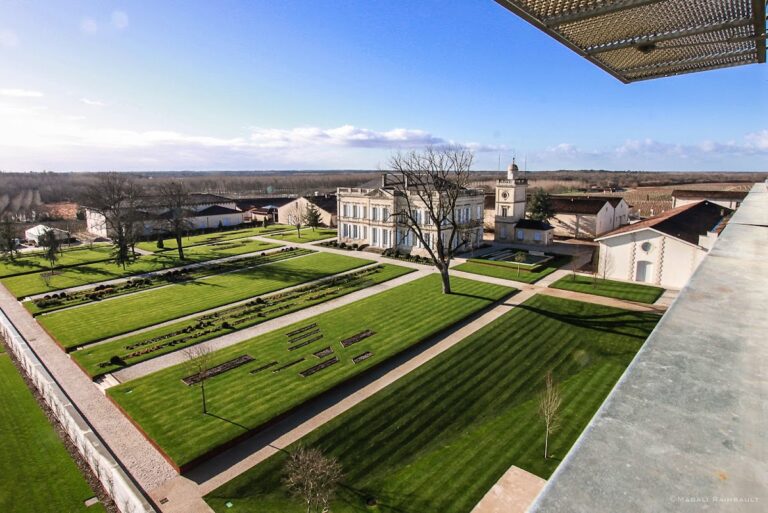
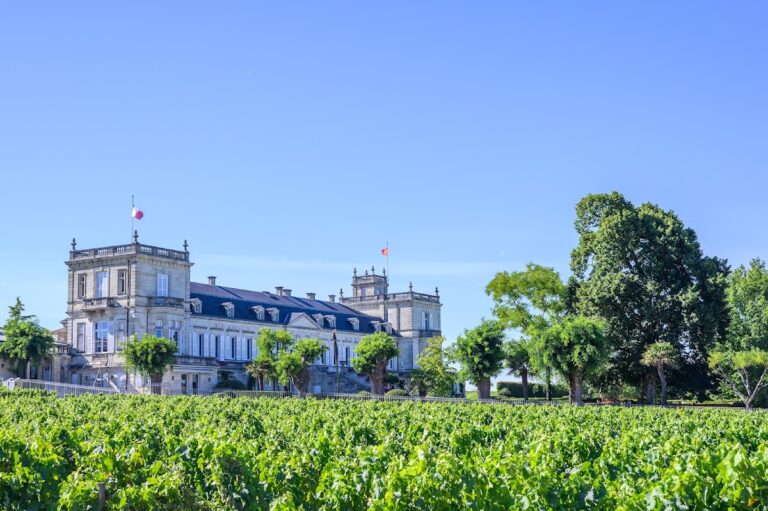
Château Lagrange lies west of Saint-Julien, behind Château Gruaud-Larose and near the boundary with Saint-Laurent-Médoc. The estate covers 157 hectares, while the vineyard occupies approximately 115 hectares arranged on two gravelly rises. The Jalle du Nord and Riou Cla drain these raised areas, continuing the importance of water management that shaped the property’s agricultural development.
Red and white plantings
The red-wine vineyard is planted chiefly with Cabernet Sauvignon, which accounts for about 65 percent of the vines, followed by Merlot at 28 percent and Petit Verdot at 7 percent. The vines have an average age of approximately 30 years. Around 4 hectares are devoted to white grape varieties for Les Arums de Lagrange, a white wine first offered in 1997. These plantings comprise approximately 60 percent Sauvignon Blanc, 30 percent Sémillon, and 10 percent Muscadelle.
Buildings and winemaking facilities
Manor complex and tower
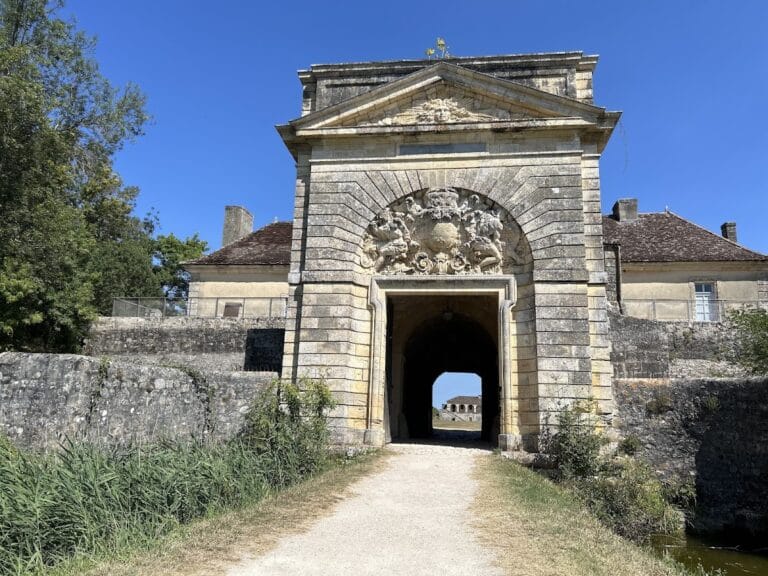
A substantial residential tower was added to the estate buildings in 1820. It forms part of the present complex, which also contains the historic manor buildings and the facilities used for wine production.
Vat room and cellars
Fermentation takes place in temperature-controlled stainless-steel vats ranging from approximately 36 to 220 hectolitres in capacity. The grape skins and juice remain together for about 15 to 20 days during cuvaison, the fermentation and extraction period used for red wine. The wines then mature in small oak barrels, known as barriques, for approximately 16 to 20 months. About 60 percent of the barrels are replaced each year.
The estate produces the grand vin Château Lagrange, the second wine Les Fiefs de Lagrange, and the white wine Les Arums de Lagrange. Average annual production is approximately 270,000 bottles of the grand vin and 370,000 bottles of Les Fiefs de Lagrange. The red wines are made from grapes grown on the gravelly vineyard and matured in oak before bottling.