Château du Bois-Rouaud: A Historic Estate and Stud Farm in France


Site at a Glance
- Rating
- 4.9
- Popularity
- Very Low
- Country
- France
- Primary era
- Modern
- External website
- Open
- Eras represented
- Medieval, Modern
- Civilizations
- Duchy of Brittany, French
- Site type
- Domestic
- Remains
- Elite Residence
On this page10 sections
History
Château du Bois-Rouaud is a historic estate in Chaumes-en-Retz, France, whose present building dates from a 1905 reconstruction and whose origins are traditionally traced to a fifteenth-century castle built on the site of an earlier feudal fortress. Its history is connected with the nearby settlement of Saint-Hilaire-de-Chaléons. The property is listed as a French historic monument, part of the national legal system protecting buildings and sites of historical or architectural importance, and it continues to function as a stud farm and breeding centre for pedigree horses.
Medieval Origins and Seigneurial Ownership
The fifteenth-century castle replaced or occupied the site of an earlier fortified establishment. In 1430, the property was inhabited by its owner, Eustachie Brochereul, widow of the knight Jean Mesléart. The estate later passed to the La Lande de Machecoul family and subsequently followed the history of the lordship of Vieillevigne. Gabriel Le Clerc, Marquis de Juigné, owned it in 1762 and again in 1789.
Destruction and Nineteenth-Century Renewal
The château was ruined during the Wars of the Vendée, a series of counter-revolutionary uprisings and conflicts in western France during the French Revolution. It was later restored. A further remodelling began in 1865, when the landscape architect Édouard André worked on the grounds. In 1867, Count Gustave de Juigné established the Bois-Rouaud stud farm and developed the estate as an agricultural enterprise.
Gustave de Juigné also created an agricultural society at Bourgneuf, promoted improved yields through fertilizers and selective cattle breeding, and made Bois-Rouaud an acknowledged example of agricultural practice. The estate received the society’s gold medal. In 1886, he founded a racing society with the Prince d’Arenberg, extending the property’s association with horse breeding and racing.
The 1905 Reconstruction
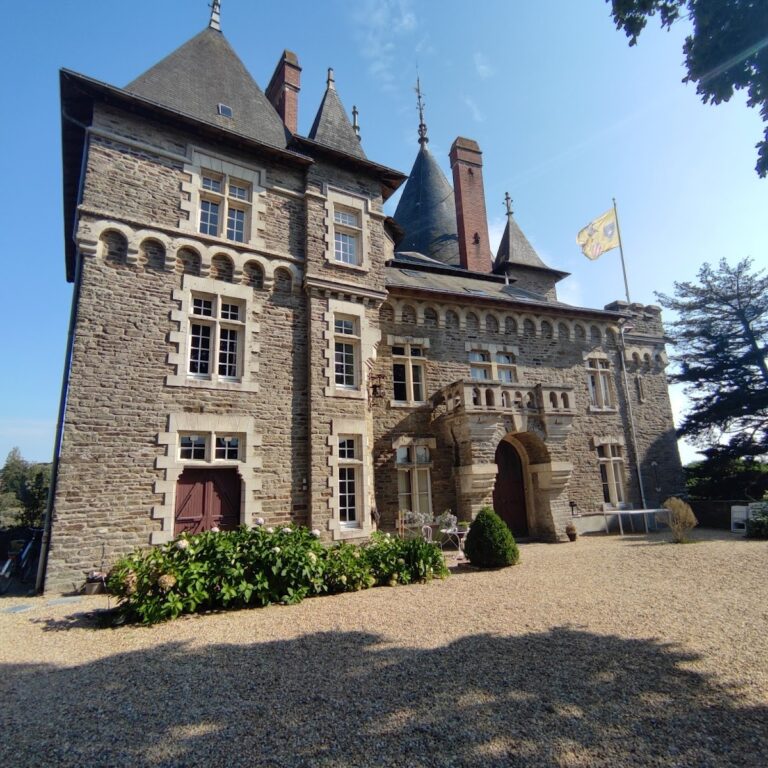
In 1905, Marquis Jacques Auguste Marie Le Clerc de Juigné had the château rebuilt by Alfred Coulomb. Jacques had inherited the property from his uncle. He selected a position that provided views across the landscape, while an English-style park and garden were laid out across land that also formed part of the agricultural estate. Around 1913, Édouard André’s son, René Édouard André, continued the work on the grounds.
Jacques de Juigné spent periods at Bois-Rouaud with his wife, Madeleine, who was an heiress to the Schneider-Creusot fortune and the daughter-in-law of the industrialist Henri Schneider. The couple also lived at Château de Juigné in Juigné-sur-Sarthe.
Wartime Use and the Modern Estate
In 1944, the château housed the Social Insurance and Agricultural Family Allowance organizations after their premises in Nantes were damaged by the bombings of 16 and 23 September 1943. The organizations moved to a smaller château in Nantes in December 1944 and later became the Mutualité Sociale Agricole.
In 1977, the Bois-Rouaud lands supported nineteen tenant farmers and their families. Each leased approximately twenty hectares from Count Armand de Durfort, the son-in-law of Jacques de Juigné. Ownership later remained with Armand de Durfort’s daughter, Marie Armand-Laroche, who was identified as the owner. The estate’s continuing use as a stud farm and breeding centre preserves a function that had shaped its development since the nineteenth century.
Remains
Fortified Site and Landscape
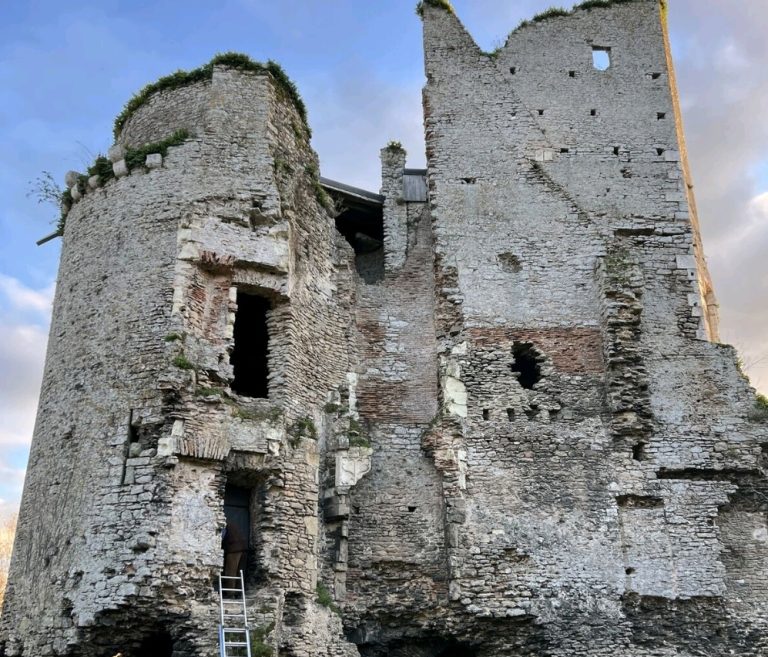
The earlier site included a ditched platform, reflecting the defensive character of the feudal establishment that preceded the later residence. Substructures belonging to that fortress have been found within one wall of an estate outbuilding. These remains connect the present agricultural and residential complex with the medieval history of the property.
The grounds were developed in successive stages. Édouard André began the landscaping in 1865, and René Édouard André continued it around 1913. The estate includes a park, an English-style garden, and a body of water, with the landscaped area extending onto agricultural land. The arrangement reflects the transformation of the property into both a country residence and a working estate.
The Rebuilt Château
The present château is the result of Alfred Coulomb’s 1905 reconstruction. It was intended as a residence, and its roof is particularly noted for its form, which has been described as evoking an ancient soldier’s helmet. The building therefore combines the domestic purpose of the rebuilt house with a strongly distinctive roof profile.
Historic Interiors
The grand salon contains eighteenth-century wood paneling attributed to the father of the sculptor David d’Angers. The dining room has paneling transferred from the Jockey-Club de Paris after that institution was dismantled around 1912. These interior elements were incorporated into the château during the period of its early twentieth-century reconstruction and adaptation.
Stud-Farm Buildings
The estate’s 1867 development included a reserve building arranged for several agricultural and equestrian functions. It contained a dairy, laundry, bakery, shed, and drying room, as well as accommodation for the head of the stables. The building formed part of the infrastructure that supported the stud farm and the wider agricultural operation established under Count Gustave de Juigné.