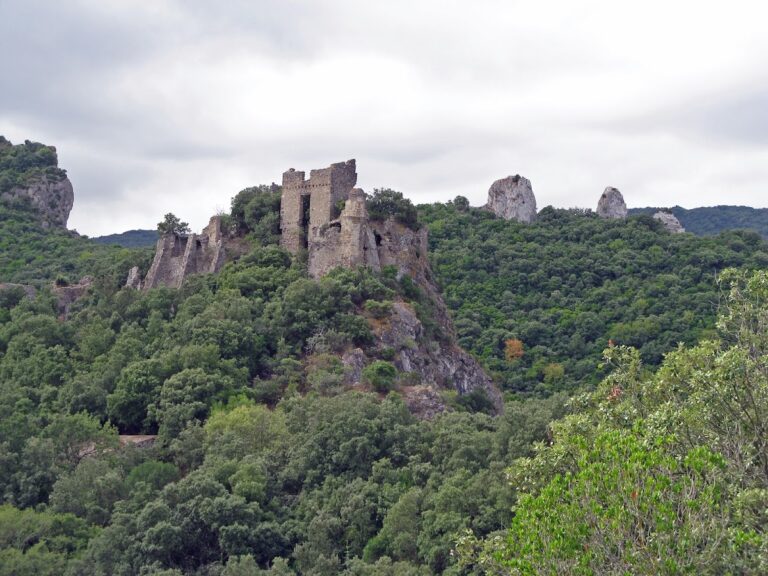
Château de Termes: A Medieval Feudal Fortress in France


Site at a Glance
- Rating
- 4.5
- Popularity
- Low
- Country
- France
- Primary era
- Medieval
- External website
- Open
- Eras represented
- Medieval
- Civilizations
- County of Toulouse, French
- Site type
- Military
- Remains
- Castle
On this page12 sections
History
Château de Termes is a ruined medieval fortress in France, developed by the lords of Termes from a fortification established around 980. Built on a rocky height in the Corbières, it became the seat of a powerful feudal lordship and later a royal frontier fortress. Its history reflects the transformation of southern France during the Albigensian Crusade and the expansion of French royal authority in the thirteenth century.
The lordship of Termes
The family of Termes first appears in written records in 1061, while references to the castle become more frequent during the twelfth century. The lordship formed part of the County of Toulouse, although the counts exercised limited authority in the area. The lords of Termes held their position as vassals of the counts and, later, of the viscounts of Carcassonne. In 1110, they paid homage to the Trencavel viscount, a member of the dynasty that ruled Carcassonne and surrounding territories before the French Crown took control.
From the eleventh and twelfth centuries, the lords expanded the fortress and controlled a territory that included more than 60 villages at its greatest extent. They also engaged in a prolonged dispute with nearby abbeys over the Palairac antimony mine, described as the largest mine in the Corbières. During the twelfth century, the family adhered to Catharism, a medieval Christian dualist movement influential in southern France. Under Raymond de Termes, the castle offered refuge to numerous Cathars. The Inquisition recorded that Mass had not been celebrated at Termes for 30 years.
The siege of 1210
In 1210, during the Albigensian Crusade, the military campaign against the Cathars and their supporters, Simon de Montfort besieged the castle, its nearby settlements, and Raymond de Termes. The siege lasted from August to November, approximately four months. Catapults were used by both the attacking force and the defenders, making the engagement an important episode in the military history of the fortress.
The garrison eventually surrendered after its water supply failed. The water may have become contaminated, causing dysentery among those inside. Raymond de Termes was captured and imprisoned at Carcassonne. By 1228 or 1229, after the transfer of the Carcassonne viscounty to the French Crown and the Treaty of Meaux, Termes had come under direct royal control. Raymond’s son Olivier de Termes later attempted to recover or resist against French rule, but he did not permanently restore the castle to his family.
Royal fortress and later destruction
Termes became part of the royal defensive network along the frontier with Aragon. This network included the group later known as the Five Sons of Carcassonne, while its principal command structure was based at Carcassonne. Royal garrisons occupied the castle for more than four centuries. Its strategic value declined after the frontier moved south following the annexation of Roussillon and the Treaty of the Pyrenees.
After the Hundred Years’ War, the fortress fell into decline, and the province of Languedoc did not provide the funds required for repairs. It was reportedly occupied by bandits and outlaws, and, having lost its military usefulness, was dismantled with gunpowder around 1653 or 1654. The demolition left the castle in ruins.
Protection and archaeological work
The ruins became communal property of the municipality of Termes during the twentieth century. The site was listed as a historic monument in 1951 and classified in 1989. The castle, surviving enclosure remains, and castral village received additional listing in 2023 and classification in 2024. The castle and its surroundings have also been protected as a natural site since 1942.
For approximately two decades, the municipality has pursued the site’s enhancement through the Cathar Country program. Consolidation, archaeological investigation, and topographical and architectural studies have helped clarify the fortress’s development. Research led by Jean-Paul Cazes uncovered a medieval staircase from the thirteenth century leading to the castral church, and the great residential building from the royal period was cleared in 2007. In 2026, Château de Termes was included in the UNESCO World Heritage serial property Capetian Royal Fortresses of Languedoc, alongside fortresses including Carcassonne and the Five Sons of Carcassonne.
Remains
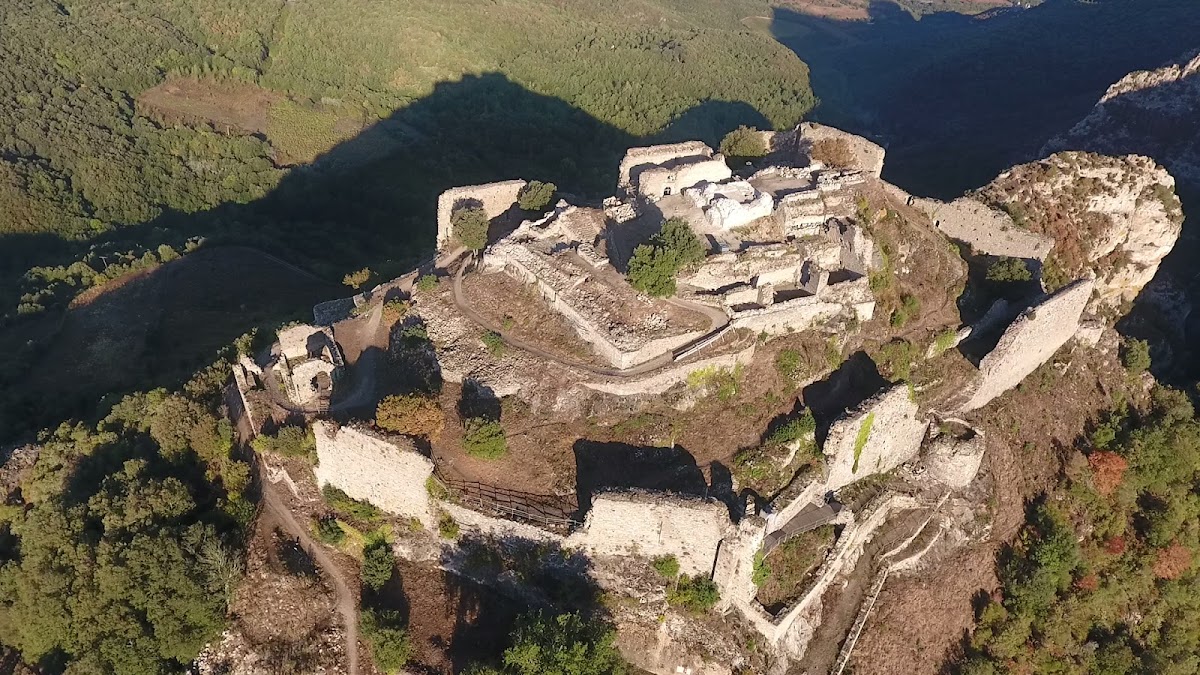
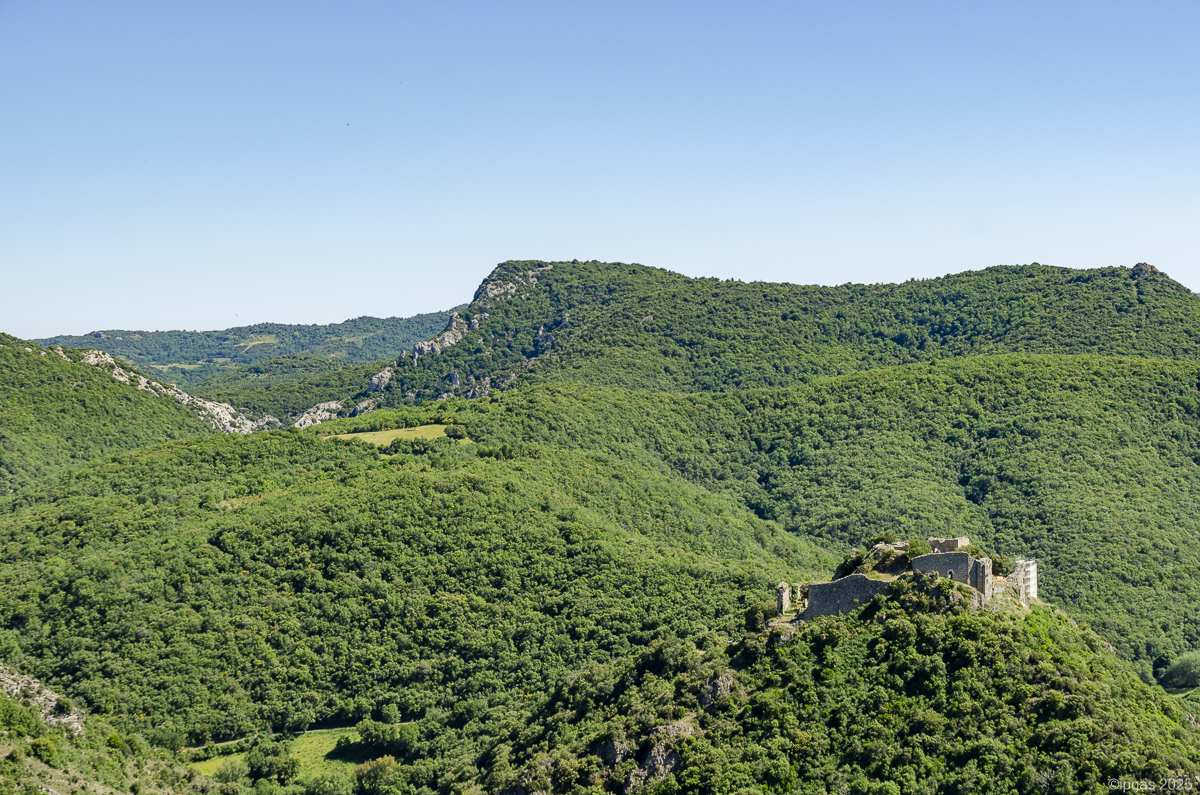
Château de Termes occupies a rocky height in the Corbières, with steep slopes or ravines on three sides. The southern approach had the weakest natural defenses, so the rock was extensively altered there to create a ditch. The fortress has two roughly rectangular concentric enclosures. The lower enclosure is better preserved and measures approximately 125 by 70 metres, while the upper enclosure occupies the highest part of the rock. A wall-walk, a patrol and fighting path along a defensive wall, once occupied the space between them.
The fortified enclosures
Lower enclosure
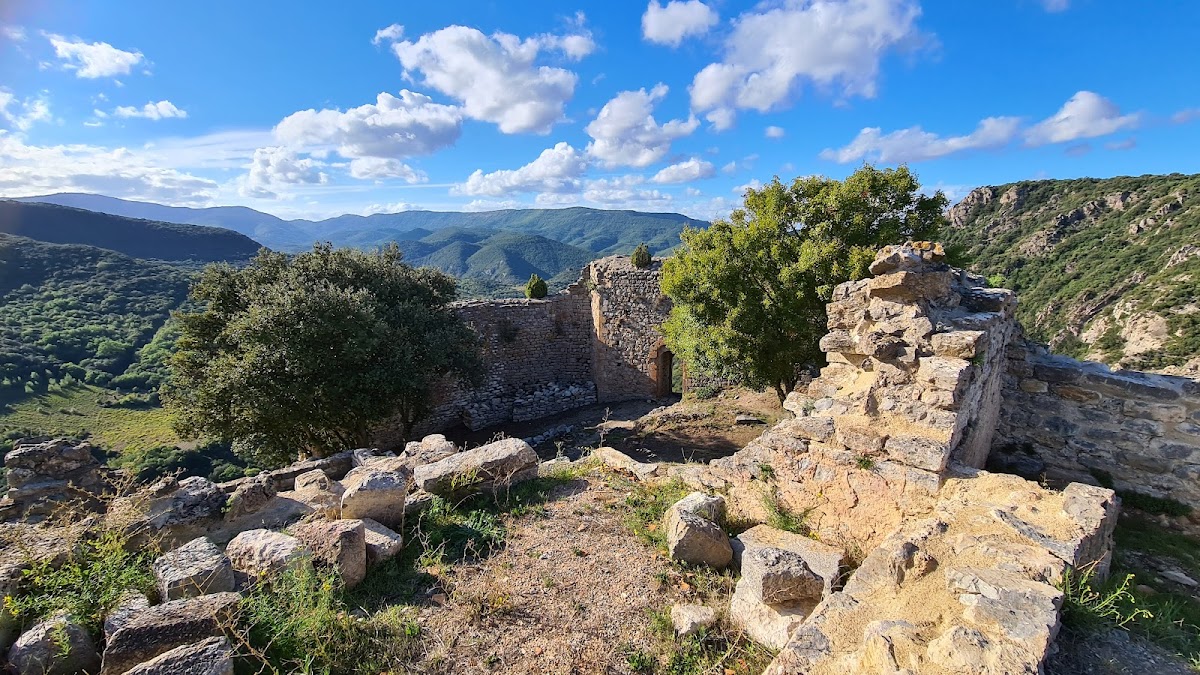
The lower enclosure retains flanking works and several buildings, although the exact outline of its southwestern corner can no longer be traced. Its principal entrance lay on the southeastern side, where a barbican, an outer defensive structure protecting an entrance, and a tower guarded the approach. A defended postern, or smaller secondary gateway, stood on the northwestern side, with a barbican built on buttresses. Rounded lookout and flanking towers are attributed to the twelfth century, while much of the visible fabric was rebuilt in the late thirteenth and early fourteenth centuries by royal architects.
Upper enclosure and chapel
The upper enclosure survives more fragmentarily, chiefly along its southern and eastern sides. A keep, the principal fortified tower of a castle, once stood at the centre and highest point of the rock. Only collapsed wall sections remain, probably following the seventeenth-century demolition with gunpowder. The southeastern area preserves traces of an access ramp and gateway.
On the western side, a rectangular building with a collapsed vault is identified as the chapel. It retains a small cruciform window corresponding to the chapel mentioned in a partition document of 1163. That document also describes the keep as divided between Raymond de Termes and his brother Guillaume, placing the church within the walled enclosure.
Approaches and settlement remains
Southern defenses and castral village
The southern flank contains remains of walls and a zigzag entrance associated with the twelfth-century fortified village. The village was probably moved farther down into the valley, to the site of the present settlement, after the French Crown took possession of the castle in the thirteenth century. Its surviving castral remains form part of the protected ensemble around the fortress.
Termenet
A separate fortified work called Termenet stood on another rocky spur overlooking the gorges, some distance from Château de Termes. Only slight remains survive. Elements on the summit are associated with the primitive castle of the lords of Termes and probably date from the eleventh or twelfth century. Most of the visible remains belong to the second half of the thirteenth century.
The present ruin consists principally of collapsed walls, ruined towers, partial enclosures, traces of access routes, interior buildings, the chapel remains, and archaeological features revealed or consolidated through modern work.