Château de Santenay: A Historic Château and Wine Estate


Site at a Glance
- Rating
- 4.5
- Popularity
- Low
- Country
- France
- Primary era
- Medieval
- External website
- Open
- Eras represented
- Medieval, Early Modern
- Civilizations
- Duchy of Burgundy
- Site type
- Domestic
- Remains
- Castle
On this page8 sections
History
Château de Santenay is a historic château in France, associated with the ninth, twelfth, and sixteenth centuries and possibly with a fourth-century foundation. Its development includes an early earth-and-timber castle, a fortified manor house, and a twelfth-century keep. The residence later became a ducal possession and continued as a seigneurial estate before assuming its present role as a wine estate.
Early Fortifications
An earth-and-timber castle occupied the site during the fourth century, although that date for the château’s construction remains possible rather than certain. It was later replaced by a fortified manor house, whose keep, the strongly defended principal tower of a medieval castle, was built in the twelfth century. The manor was fortified again in the fourteenth century during a period associated with English forces and the Tard-Venus, bands of mercenaries and free companies active in France during the later fourteenth century.
By 1483, the fortified manor was described as a seigneurial residence surrounded by moats. This description reflects its role as the centre of a territorial lordship as well as its defensive character.
Ducal and Seigneurial Ownership
By the late fourteenth century, the château belonged to Philip II, Duke of Burgundy, known as Philip the Bold. He was the son of King John II of France and a principal founder of the Burgundian state. The property subsequently passed through several hands, including Guillaume de Sercy around 1481, François de Ferrières around 1483, Jacques de Ferrières around 1526, and Denis Brulard, the first president of the Parlement of Dijon, Burgundy’s principal high court and judicial institution.
In 1644, the Legoux de la Berchère family raised Santenay to a marquisate, a territorial lordship or jurisdiction held by a marquis or marquise. Two-thirds of the Santenay estate passed to Philibert Parigot in 1739. At that time, it included an old château with full jurisdiction over the territory of Santenay.
Later Ownership and Wine Production
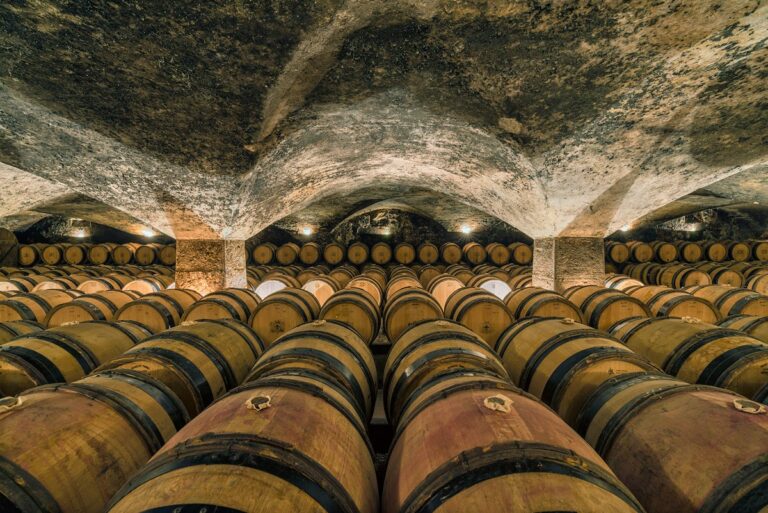
Count Déodat Albert de Drée owned the château in 1828, followed by the winegrower Claudius Guépet in 1920. It is now owned by Grands Crus Investissements, a subsidiary of Crédit Agricole, and operates as a wine estate. Covering 90 hectares on Burgundy’s Route des Grands Crus, the estate produces wines from Chardonnay and Pinot Noir, including Mercurey red and white, Mercurey Premier Cru “Les Puillets,” Saint-Aubin, Bourgogne Hautes-Côtes-de-Beaune blanc, Aloxe-Corton, Santenay Premier Cru, Beaune Premier Cru, Pommard, and Clos-Vougeot Grand Cru.
Remains
Enclosure and Layout
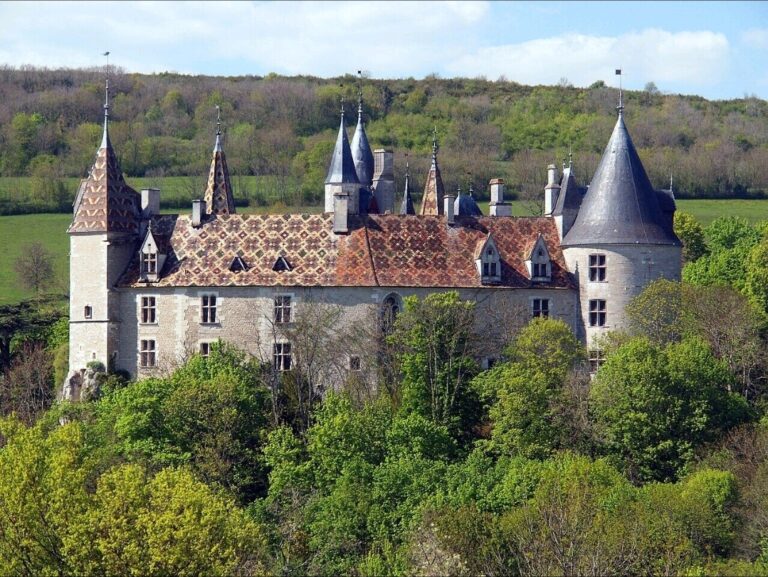
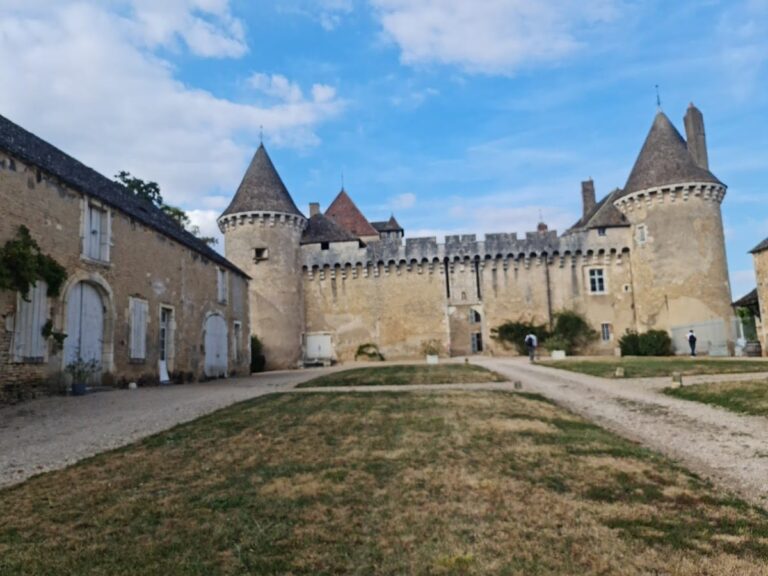
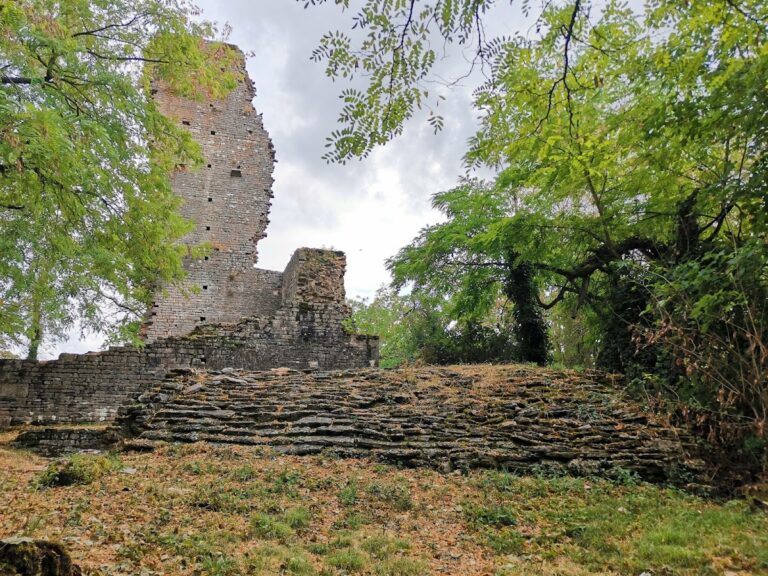
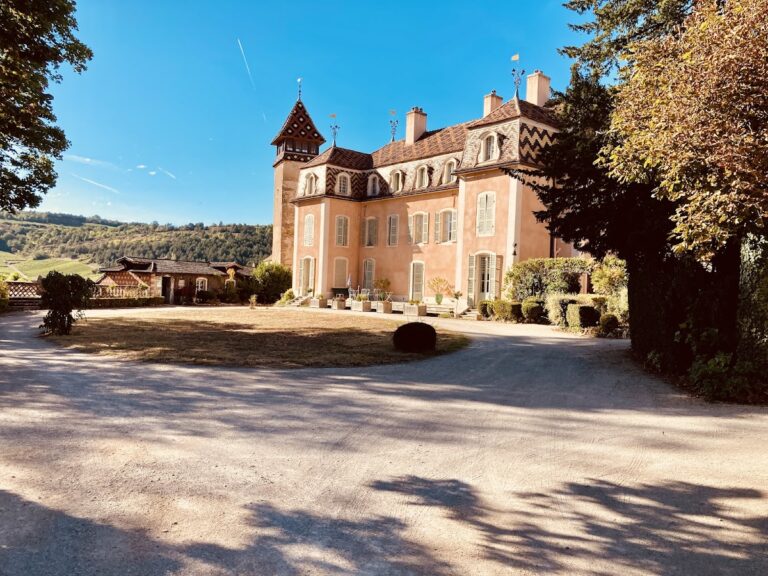
Château de Santenay stands at the northern end of the village on elevated ground above it. A circular dry moat cut into the rock surrounds the complex, and a fixed bridge crosses the moat on the north. The buildings follow a U-shaped plan with the entrance on that northern side. The principal façade, covered with glazed Burgundy tiles, faces the village.
Buildings
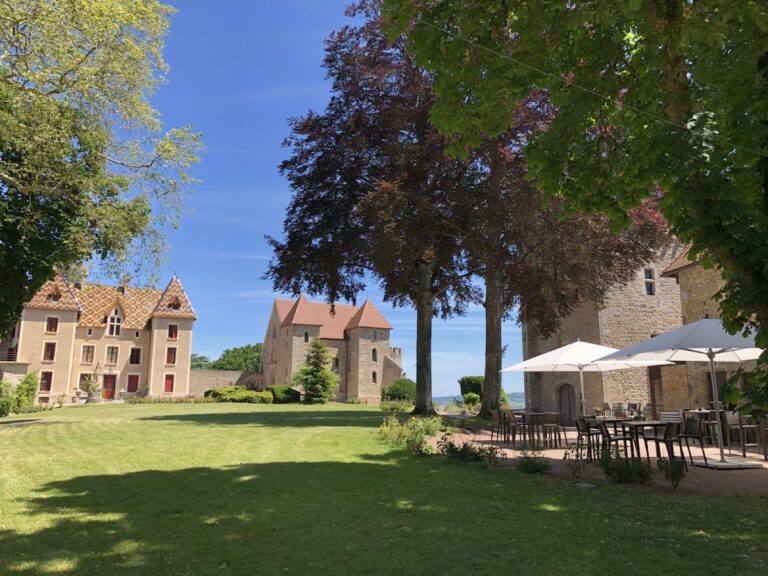
The western building is formed by a large square tower rising three storeys, with a small turret attached at its southwest corner. On the north, the tower connects with a one-and-a-half-storey building dated to 1770. Modern one-storey buildings occupy the southern and eastern sides of the complex, completing the surviving arrangement around the U-shaped plan.
Park Features
A circular dovecote, a structure designed to house pigeons and historically associated with seigneurial estates, stands on the western boundary wall of the park. Two Oriental plane trees grow in the park and have been classified as remarkable trees of France since March 2014.