La Graufesenque Roman Pottery Workshops: A Major Terra Sigillata Center in France

Site at a Glance
- Rating
- 4.3
- Popularity
- Low
- Country
- France
- Primary era
- Classical
- External website
- Open
- Eras represented
- Classical
- Civilizations
- Roman
- Site type
- Economic
- Remains
- Production Complex
On this page12 sections
History
La Graufesenque Roman Pottery Workshops are an archaeological site in France, near Millau, where Roman artisans developed large-scale production of fine tableware from around 10 BC under Augustus. The workshops formed part of Condatomagus, a settlement associated with the Ruteni, a Gallic people of what is now southern France. Their products made the site a major center of terra sigillata, Roman tableware covered with a smooth colored slip, during the first century AD.
From Condatomagus to an industrial settlement
In antiquity, La Graufesenque belonged to the settlement of Condatomagus, a name formed from words meaning “confluence” and “market.” The name appears on the Peutinger Table, a late copy of a Roman road map. A vicus, or small settlement, grew across the plain near the earlier fortified settlement of La Granède, about 1.5 kilometers southeast. Its economic expansion was closely connected with pottery modeled on Italian products.
Pottery manufacture began during Augustus’s reign, probably around 10 BC, and continued until about the middle of the third century AD. The workshops reached their greatest prosperity in the middle decades of the first century. At that time, La Graufesenque surpassed the Italian workshops and became the Roman Empire’s most important center for terra sigillata production.
Expansion and changing production
La Graufesenque’s tableware circulated through the western Roman Empire and reached Germania, Greece, Syria, Egypt, the Black Sea coast, the Iberian Peninsula, and regions extending as far as the Indo region. The Rhine area was the principal market, with Vechten an especially important destination. The cemetery at Andernach has produced some of the earliest known exports, dating from approximately AD 16 to the accession of the Flavian dynasty in AD 69. The Flavians ruled the Roman Empire from AD 69 to 96.
Alain Vernhet divided the workshops’ production into six periods. An experimental phase belongs around AD 10 to 20, followed by a primitive phase from about AD 20 to 40. Production reached its peak between approximately AD 40 and 60, when quality was especially high. A transitional phase from about AD 60 to 80 brought increased output but lower quality, followed by decline between approximately AD 80 and 120. A late phase, initially placed around AD 120 to 150, produced late terra sigillata. Martine Genin extended this final phase to the end of the second century, so the chronology remains under discussion.
From the late first century, exhaustion of nearby clay deposits contributed to the movement of production toward Bannasiacum. Around one hundred workshops operated there until the end of the second century. Montans, Lezoux, and other workshops in central Gaul also became stronger competitors. La Graufesenque’s dominance as an export center had effectively ended by about AD 120, although pottery of lower quality continued to be made for local use until the middle of the third century.
During the second half of the second century and the first half of the third, earlier buildings were reused and light-bodied pottery was produced for local consumption. This later activity formed part of the settlement’s continued occupation after its leading export industry had declined.
Excavation and the identification of its exports
A flood exposed the first reported pottery kiln in 1830. Initial soundings began in 1862 under Abbé Malzac, and Abbé Cérès excavated from 1880 to 1886. Cérès emphasized the scale of the workshops and the broad distribution of their products, challenging the contemporary tendency to assign South Gaulish sigillata to Italy.
During the late nineteenth century, Hans Dragendorff argued that sigillata found across many regions came from southern Gaul. Camille Jullian instead attributed most of this pottery to Italy and viewed the Gallic workshops as imitators of Italian products. Joseph Déchelette later established the importance of La Graufesenque’s exports, including their presence in Campania before Pompeii was destroyed in AD 79. He also observed that first-century workshops at Arezzo copied Gallic vessels.
Canon Frédéric Hermet directed extensive excavations from 1901 to 1906. His research, published in two volumes in 1934, became an important stage in the study of Roman ceramics. Alexandre Albenque and Louis Balsan conducted further excavations from 1950 to 1954, initially in difficult conditions. From the mid-1960s, support from the Miquel family, owners of the La Graufesenque farm, made it possible to lease and purchase land. This enabled stratigraphic investigation, conservation of excavated buildings, and closer study of the finds.
Alain Vernhet took over direction of the excavations in 1975. The Millau museum opened galleries devoted to the site and its production in 1980, and Robert Marichal published the site’s graffiti in 1988. The French Ministry of Culture has listed La Graufesenque since 1926, and the remains are protected under the monuments historiques system. Archaeological remains were inscribed in 1951, soils containing remains in 1993, and further parcels and remains were classified in 1995. The archaeological settlement has both municipal and private ownership.
Remains
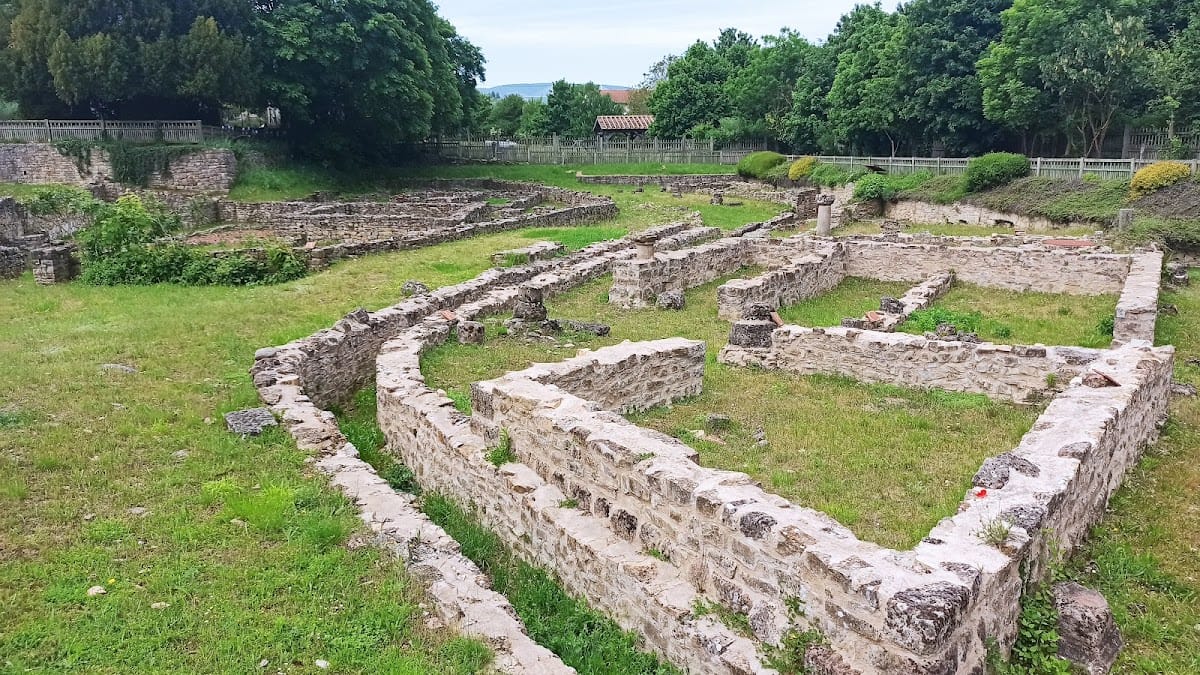
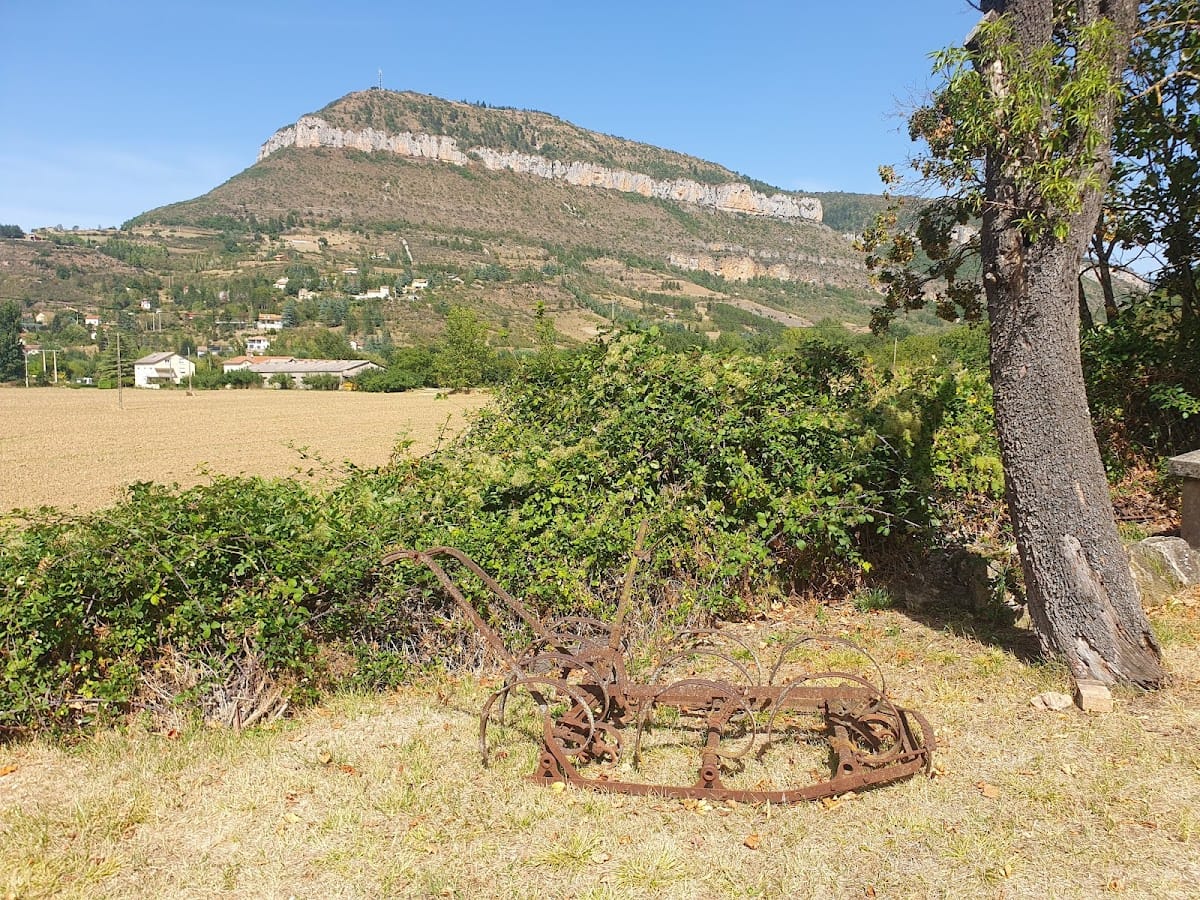
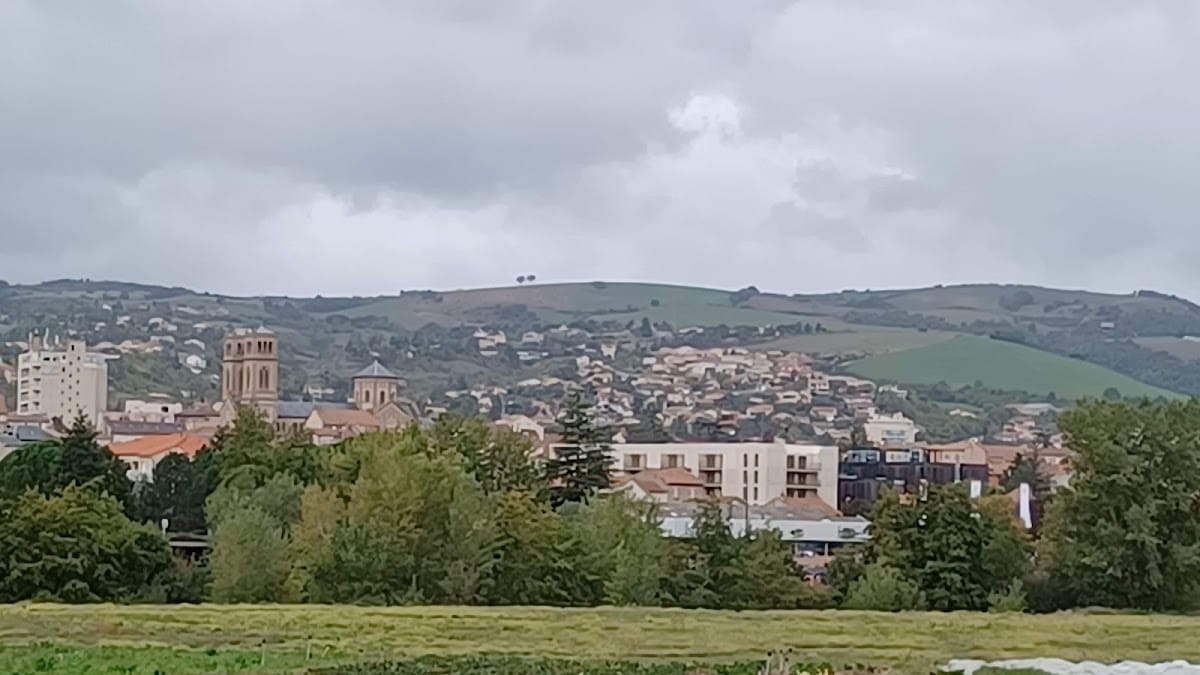
La Graufesenque lies on the left bank of the Tarn, about one kilometer west of Millau and near the river’s confluence with the Dourbie. The archaeological area stands at approximately 370 meters above sea level, on the edge of a small alluvial plain below the slope leading southeast toward La Granède. The settlement occupies a short, narrow strip of scree bordered by recent alluvium and gravel to the northwest and by Domerian marls to the southeast. Triassic marly limestone and bituminous shale formations occur farther southeast, with the nearest exposed deposits about 15 kilometers away.
The excavated area combines an industrial quarter, a sacred area, and residential buildings separated by narrow streets. Pottery kilns and storage facilities formed the industrial zone, while aerial surveys identified a nymphaeum, a monumental fountain or water installation, and a large building. The settlement also contained mosaics, columned porticoes, and bathing installations, although its buildings were largely juxtaposed rather than arranged on a regular Roman urban plan.
Industrial quarter and pottery manufacture
Large kiln and clay storage
A very large wood-fired kiln could fire approximately 40,000 vessels at about 1,050 degrees Celsius over three to four days. A clay-storage area stood near this kiln. The clay body used for the vessels came from highly homogeneous clay derived from the nearby Domerian marls, while the non-calcareous slip came from Triassic geological layers whose nearest exposed deposits lay about 15 kilometers away. Firing temperatures were closely controlled, generally between approximately 1,050 and 1,060 degrees Celsius.
Vessel preparation and firing took place from April to October. During the remaining months, wood was collected for the kilns and clay was prepared. Large enterprises could manage every stage of manufacture, while smaller artisans specialized in particular tasks and relied on one another. Production was strongly standardized, and temporary associations could be formed to meet demand.
Workshops, vessels, and inscriptions
Some former potters’ houses were converted into workshops, and these buildings also provided accommodation for numerous enslaved people. Nearly 200 accounts associated with pottery masters were found. Impressed marks on vessel bases identify about 650 workshops active between approximately 10 BC and AD 120, although only a few dozen seem to have been major establishments.
The workshops made fine tableware covered in a brick-red slip, either decorated in moulds or left plain. Their range included cups, calyx-shaped vessels, beakers, plates, bowls, flasks, and related forms. Earlier production included a broader selection of closed and handled vessels, but increasing standardization led to the partial elimination of these types. Decorated and undecorated examples are preserved in the municipal museum of Millau.
Millions of ceramic fragments lie in stratified deposits across the site, alongside tens of thousands of stamped decorative elements, about 3,000 decorative motifs, hundreds of complete moulds, and roughly a dozen waste dumps. Two dumps contained between approximately 7,000 and 10,000 pieces each. About 270 graffiti written on terracotta fragments were also recovered. Artisans incised firing records, or loading lists, onto pieces of terracotta to record the contents of kiln loads. These inscriptions reveal the organization and economics of the pottery industry.
Sacred area
Fanum-type temples
The sacred area contains two fanum-type Gallo-Roman temples. A fanum was a temple with a central sacred chamber, or cella, surrounded by a gallery. One temple precinct was enclosed by a wall, and its entrance faced the rising sun. The temple had a covered gallery with a wooden roof supported by a wall fitted with balusters. A tall masonry element at the center formed the cella, which has since been lost.
Residential buildings
Houses and heating installations
Residential buildings included a house with a hypocaust, an underfloor heating system in which hot air circulated beneath the floor. The arrangement was comparable to systems used in Gallo-Roman bathhouses. More modest accommodation had beaten-earth floors and may have housed enslaved workers.
The earliest settlement phase, in the first century BC, included houses with dry-stone walls and thatched roofs. Finds from this period include locally made coarse pottery, Italian wine amphorae, black-gloss pottery from Campania, Catalan pottery, and coins from Massalia, Nîmes, and Emporiae.
From approximately 10 BC, houses were built with stones bonded by lime and wooden roofs covered with terracotta tiles. Their interiors were plastered and painted, and some floors were made of brick. These changes accompanied the Roman-period development of Condatomagus and the expansion of the pottery settlement.