Château de Roanne: A Medieval Fortified Castle in France
Site at a Glance
- Popularity
- Medium
- Country
- France
- Primary era
- Medieval
- Eras represented
- Medieval, Modern
- Civilizations
- French
- Site type
- Military
- Remains
- Castle
On this page11 sections
History
Château de Roanne is a medieval fortified castle in Roanne, France. Its precise construction date is unknown, but its building is attributed to Bérard de Roanne, lord of Roanne and Crozet and of the lands of Cordelle and Vernay. Regarded as Roanne’s oldest building, the castle stood amid a town whose control was divided among several landholders.
Medieval lordship
Jean, Count of Forez, acquired half of Roanne from Guichard de Châtelperron and his wife, Isabeau. In 1273, Guichard de Montagny transferred an undivided quarter of the town and its dependencies to Guy, Count of Forez, as part of an exchange. On 27 January 1294, Jean, Count of Dreux, and his wife Jeanne sold the castle, town, and dependencies to Jean, Count of Forez, for 1,400 livres tournois, a form of French currency. They also promised to return records of a donation made by Guiot, the count’s father, to Humbert de Beaujeu, a constable, or senior royal military officer.
In 1346, Hugues de Couzan held half of Roanne. His wife, Alix de la Perrière, had brought that share as her dowry, having inherited it through her mother’s connection to Saint-Haon and her grandmother’s connection to Roanne. In 1516, Anne of France and Charles III, Constable of Bourbon, transferred to Artus Gouffier the half of Roanne they had retained since the 1294 purchase.
Creation and expansion of the Duchy of Roannais
In May 1564, King Charles IX (who ruled from 1560 to 1574) made Claude Gouffier’s lordships of Boisy, La Motte, and Roanne a marquisate, a territory held under a marquis’s title. In November 1566, he elevated them to the Duchy of Roannais, a territory or title held by a duke, for Claude and his male successors. The grant required the redemption, within three months, of the castellanies of Saint-Haon, Saint-Maurice, and Crozet. These were territorial jurisdictions organized around castles. Charles IX redeemed them himself.
A judgment by the Parlement of Paris on 23 December 1567 allowed the duchy to stand with the lands then included, while requiring Claude Gouffier to provide lands of equal value to complete it. He also had to give the Crown land producing 60 livres parisis, a form of French currency, in annual income. Claude’s grandson, Louis Gouffier, later obtained royal letters in September 1612 and April 1620 raising the duchy to a peerage, the rank of a peer within the French nobility.
Artus Gouffier, Louis’s grandson, sold the duchy to his brother-in-law François d’Aubusson, Count of La Feuillade, who was married to Charlotte Gouffier. In April 1667, Louis XIV (who ruled from 1643 to 1715) confirmed the duchy under the terms set at its creation. La Feuillade acquired the castellanies of Saint-Haon, Saint-Maurice, and Crozet on 16 December 1677, then acquired Cervière in an exchange on 14 June 1686. Royal letters issued that November approved combining the lands into one duchy and jurisdiction. Officials from the Montbrison administrative and judicial district objected to registering the decision; compensation resolved the dispute.
Prison use and family inheritance
From about 1674, the castle housed a tribunal and departmental prisons. Its prison use ended in 1810, when a new prison was built on Rue Jean Macé. On 13 June 1752, Françoise-Scholastique-Catherine d’Aubusson de la Feuillade, daughter of Hubert and Catherine-Scholastique Bazin de Bezons, brought the duchy through her marriage to François-Henri, Duke of Harcourt. Their daughter Anne-Gabrielle, born on 8 March 1753, married Victurnien-Jean-Baptiste-Marie de Rochechouart, Prince of Tonnay-Charente and Duke and Peer of France, on 11 June 1772.
Private ownership and city acquisition
In 1845, Jean-Étienne de Saint-Thomas, a former senior officer and Loire inspector of Historic Monuments from 1843, bought the former departmental prison buildings. After several years of work, he used the property to house his collections of antiquities and paintings and to express his attachment to the monarchy. He died in 1875, and his daughter Clémentine, Madame Veuve Andrieu de Vaulx, inherited the castle. It remained with her descendants until they sold it to the city.
The keep received classification as a historic monument on 11 October 1930, a French legal heritage-protection status. The heraldic room was also included in the supplementary inventory of historic monuments. The city of Roanne acquired the castle in 1997, and restoration of the façade and roof framework followed in 2009.
Remains
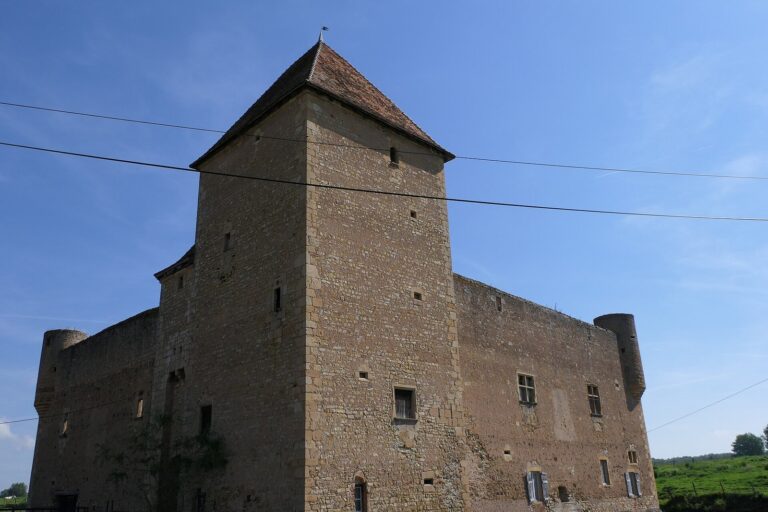
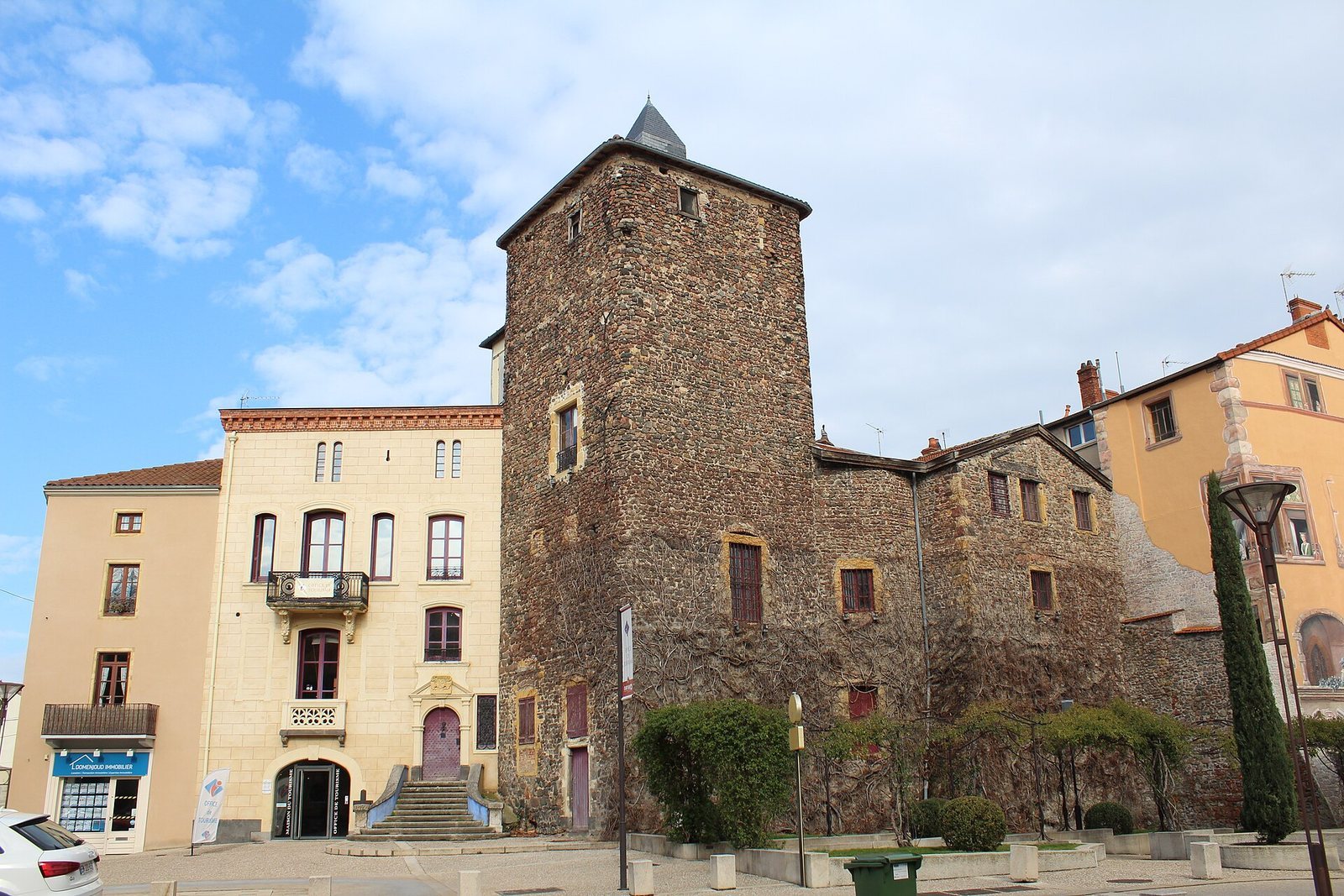
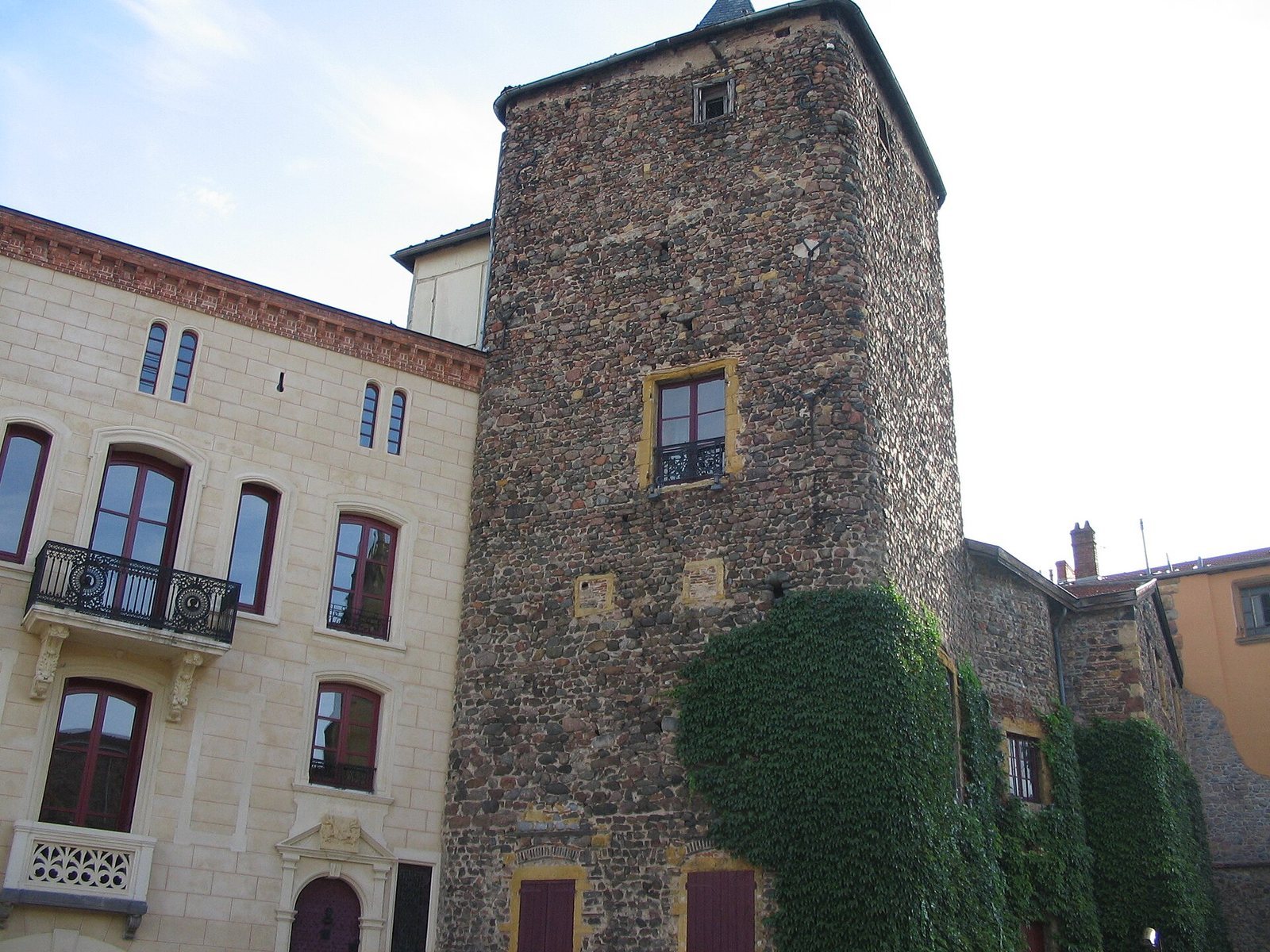
The medieval enclosure has disappeared, leaving the square keep, the castle’s main tower, as its principal surviving structure. The surviving features include the keep and watch turret, the heraldic room and later decorative work, and a passage from the old fortifications.
The keep and its upper works
Masonry and roofline
The keep rises about 20 metres and is built from rough stone, pebbles, and small granite blocks from Villerest. Its corners are rounded. A flat roof finished with hollow tiles supports a watch turret covered in slate. The turret was already depicted in a drawing of Roanne by Guillaume Revel by the mid-15th century.
Heraldic room
Inside the keep, the heraldic room has a vaulted ceiling bearing about one hundred coats of arms. They were painted in the 19th century at the direction of Jean-Étienne de Saint-Thomas. The interior walls also carry fleurs-de-lis, stylized lily emblems associated with French royalty.
Façade and decorative features
The building has a Renaissance-inspired façade with a wrought-iron balcony. A balustrade carries portraits of Saint-Thomas and his wife, Athénaïs de Cuzieu.
Former defenses and passage
A drawbridge once crossed the water-filled ditches around the castle. Water reached them from the ponds of Château de Boisy by way of the Oudan, then continued toward the Loire. A passage from the former fortifications also survives: the Golden Gate, which led toward the Bourgneuf district.