Château de Penne: A Medieval Fortified Castle in France


Site at a Glance
- Rating
- 4.5
- Popularity
- Medium
- Country
- France
- Primary era
- Medieval
- External website
- Open
- Eras represented
- Medieval
- Civilizations
- County of Toulouse, French
- Site type
- Military
- Remains
- Castle
On this page12 sections
History
Château de Penne is a medieval fortified castle in Penne, France, whose presence reaches back at least to the Merovingian period, the era of the dynasty that ruled much of the Frankish realm from the fifth to the eighth century. A castle at Penne is mentioned in 825, when Pepin of Aquitaine visited the valley. Its position above the Aveyron gave the site a lasting role in the control and defense of the surrounding landscape.
Early lords and feudal control
Geoffroi, the earliest known lord of Penne, joined the Crusade under Raymond of Saint-Gilles, Count of Toulouse, in 1096. In 1109, the Viscount of Albi established Penne as a fief, meaning a holding granted in return for service and allegiance. The lords of Albi then rendered homage for it.
By about 1140, the Knights Templar, a medieval military-religious order, held property within the châtellenie of Penne, a territorial jurisdiction administered from a castle. Several Templars lived in the parish of Sainte-Marie-Madeleine des Albis on the right bank of the Aveyron. The castle itself is not identified as Templar property, although its lords had connections with the order, which protected the valley route to Montricoux.
Around 1176, the Counts of Toulouse conquered the castrum of Penne, a fortified settlement or castle complex, from the Trencavel family. This brought the stronghold into the political orbit of Toulouse after a period of competition among powerful regional dynasties.
The Albigensian Crusade
During the Albigensian Crusade, a thirteenth-century campaign against Cathar communities and their supporters in southern France, Penne became contested between its lord and the forces of Simon de Montfort. The lord supported the Cathar cause, a medieval Christian movement considered heretical by the Catholic Church.
In 1223, Amaury de Montfort captured the castle after its defenders, short of water and reinforcements, surrendered. Amaury, Simon de Montfort’s son and successor in the campaign, did not retain it for long. The opposing side soon retook the stronghold, keeping Penne within the wider struggle over Toulouse and its territories.
Royal authority and later warfare
The Treaty of Meaux in 1229 required the Count of Toulouse to surrender Penne to the French Crown. A further treaty in 1243 again required Raymond VII to relinquish it. Olivier and Bernard de Penne resisted at first, but eventually submitted to Alphonse of Poitiers, Count of Toulouse. Alphonse confirmed the privileges of Penne’s inhabitants, strengthened the castle, and moved his county archives there. After his death in 1271, Penne entered the Crown’s domain.
Penne was drawn into the Hundred Years’ War, the prolonged series of conflicts between the English and French crowns conventionally dated from 1337 to 1453. In 1365, a Gascon captain named Mongat captured the site for the English. French forces recovered it in 1374, but the English took the village again in 1384 and held it until 1451.
Abandonment and restoration
The castle was dismantled in 1586 and subsequently abandoned. Its ruins were classified as a French historic monument by an order dated 2 May 1902, placing the remains under the country’s system for protecting historically important buildings and sites.
Breuil, a lawyer, acquired the property in the early 1980s. The architect Axel Letellier became its owner in 2006, and Axel and Sophie Letellier are the current owners. Axel Letellier began a restoration program that was under way from 2009 to 2011, giving continued attention to the surviving medieval fabric.
Remains
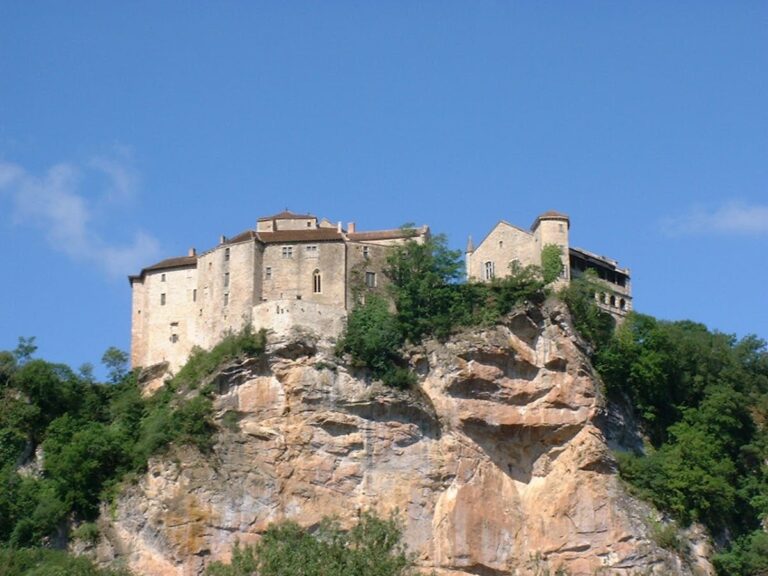
Château de Penne now survives as a ruin built directly onto an irregular rocky promontory more than 120 metres above a meander of the Aveyron. The castle occupies a sharp ridge about 150 metres long and roughly 20 metres wide, narrowing in places to 8 metres. It stands in the northern part of the Grésigne Forest, while the village of Penne lies in a hollow at the foot of the ridge. The built area covers approximately 3,500 square metres.
Approach and entrance defenses
Lower bailey
A lower bailey, or enclosed outer courtyard, occupies lower ground south of the main castle. Simple walls enclose it, and the approach must pass across this area before reaching the entrance gatehouse. The arrangement places the gatehouse at the only possible access to the narrow upper platform.
Entrance gatehouse
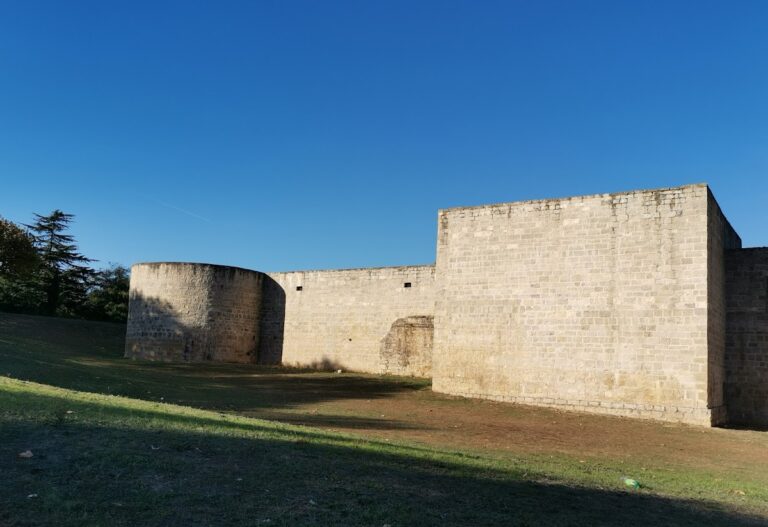
The entrance gatehouse is among the best-preserved parts of the castle and contains two towers. Its circular tower dates from the thirteenth century, while the larger, spur-shaped tower belongs to the fourteenth century. Together they controlled the restricted approach to the fortress.
Inside the gatehouse, a three-by-three-metre murder hole, an opening used to attack people below, defended the passage. On the ground floor of the round tower, an arrow-slit chamber preserves masonry that is almost intact. The chamber’s narrow openings allowed defenders to shoot projectiles while remaining within the tower.
Keep and fortified enclosure
Keep
The keep, the principal fortified tower, dominates the other buildings on the ridge. Its commanding position forms the central architectural focus of the surviving castle complex.
Enclosure and chapel
An irregular enceinte, or enclosing defensive wall, surrounds the keep and is pierced by arrow slits. Only a few fragments of this fortified enclosure remain. A chapel is also associated with the castle complex, adding a religious element to the buildings preserved on the rocky summit.