Monségou Castle: A Fifteenth-Century Fortified Residence


Site at a Glance
- Rating
- 5
- Popularity
- Very Low
- Country
- France
- Primary era
- Medieval
- Eras represented
- Medieval
- Civilizations
- French
- Site type
- Domestic
- Remains
- Castle
On this page9 sections
History
Foundation and the d’Huc de Monségou estate
Monségou Castle is a fifteenth-century fortified residence in Lamontélarié, France, built during the late medieval period. It initially belonged to the Séguy family before passing to the noble d’Huc de Monségou family, whose members held the lordships of Monségou, Besselves, and Naubert. A fortified house combined domestic accommodation with protection, making the castle both a residence and a defensive stronghold.
The d’Huc de Monségou family was a noble Languedoc family established in the Castres region from at least the fifteenth century. During the eighteenth century, one branch held important offices in Montpellier. The family became extinct in 1899 when Philippe d’Huc died. Through the marriage of his daughter to Tristan Delcassé, the family name continued in the form Delcassé d’Huc de Monségou.
Prosperity, hunting, and ironworking
The estate prospered during the sixteenth century. Game from its lands supplied the tables of high-ranking noblemen, while nearby iron-rich soils associated with the Sidobre supported ironworking. The Sidobre is a granite-rich area of the Tarn. Forges had existed on the estate since the Gallo-Roman period, and the modern forges are recorded in a concession dated 21 May 1437.
The forges were destroyed during the Wars of Religion, the sixteenth-century conflicts in France between Catholics and Protestants. Their destruction formed part of the disruption that affected the surrounding region during those conflicts.
Seventeenth- and eighteenth-century changes
The castle was also drawn into the Huguenot rebellions, Protestant uprisings in the early seventeenth century. After his arrest on 25 March 1628, Maroule, an advocate from Béziers who was probably a Protestant, was imprisoned at Monségou Castle.
A major change in ownership followed the marriage of Marie de Monségou to Paul de Pins in 1751. The estate then passed into the powerful de Pins family. The forges were rebuilt under a Council order dated 27 October 1761. Jean-Gaston de Pins, who later became a Catholic bishop, was probably born at the castle on 8 February 1766.
Decline of the forges and later use
After the French Revolution, Jean-Jacques Vieu of Castres was the last recorded master of the forge. The forges closed in 1860 and were apparently razed by a flood in 1876. The castle itself continued as a residence. It is privately owned and serves as a private home.
Monségou Castle also has a place in modern cultural memory. Part of Jacques Studer’s book Le cardinal de Monségou is set there.
Remains
The fortified residence
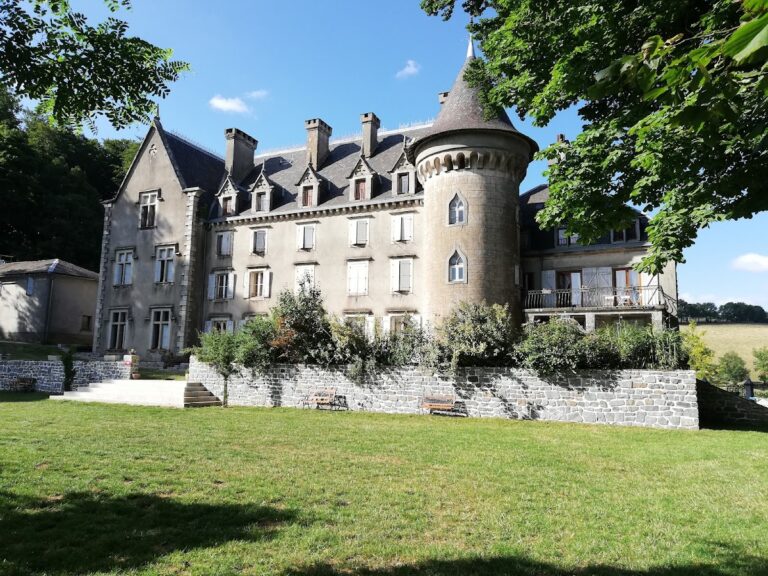
Monségou Castle stands between Brassac and Lake Raviège, beside the Agout River at the confluence of the Falcou stream and the river. Its surviving form is a regular-looking building rising over two storeys. The arrangement reflects its original role as a fortified house, a residence designed to provide both household accommodation and protection.
Keep and turret
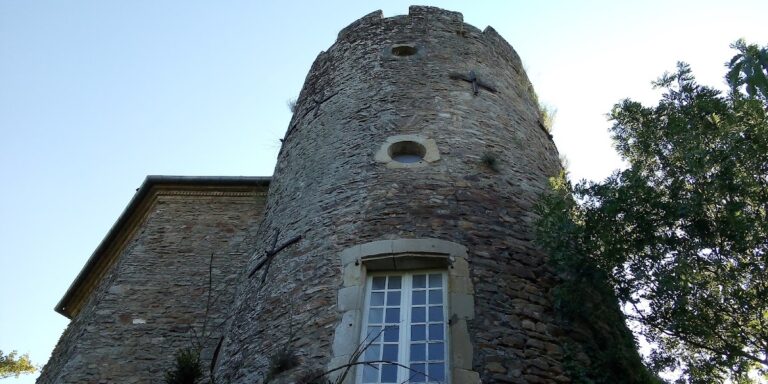
A rectangular keep projects to the north, while a slender turret rises on the western side. Together, these elements distinguish the castle’s otherwise regular outline and preserve its defensive character. The building’s physical form remains associated with its fifteenth-century foundation as a fortified residence.
Façade and coat of arms
The principal ornament on the façade is a sculpted coat of arms belonging to the d’Huc de Monségou family. The arms are blue and show three gold owls, each beaked and spurred in black. The carved emblem links the surviving building to the noble family that held the estate for much of its recorded history.