Château de La Trémolière: A Historic Château and Museum in France


Site at a Glance
- Rating
- 4.5
- Popularity
- Very Low
- Country
- France
- Primary era
- Early Modern
- External website
- Open
- Eras represented
- Early Modern
- Civilizations
- French
- Site type
- Domestic
- Remains
- Castle
On this page8 sections
History
Château de La Trémolière is a historic château and museum in France, in the commune of Anglards-de-Salers. Originally a fief, or landed estate held within a feudal relationship, of the Tournemire family, lords of Leybros, it is documented from the fifteenth century. The building combines medieval and Renaissance characteristics and became associated with several noble families before passing into communal ownership.
From the Tournemires to the Vigiers
Before 1592, Antoine de Vigier, lord of Verdier, bought La Trémolière from a member of the Tournemire family. He apparently intended to establish his son at the estate. La Trémolière was later held by Jacques-Antoine de Vigier, lord of Prades and Loupiac and co-lord of Saint-Christophe-les-Gorges. He served as a man-at-arms under Marshal d’Albret, a senior military commander, in 1597 and again during the levy of 1635. He was probably responsible for commissioning the château that survives today.
The Montclar inheritance
Catherine de Vigier, lady of La Trémolière, transferred the estate through her marriage to Jean de Monclar, lord of Fournols, on 24 September 1640. The Montclar family subsequently held La Trémolière. Jean-Antoine de Montclar, lord of Fournols and La Trémolière, married his cousin Gilberte de Montclar in the same year. Their son Louis later inherited the estate and married Louise Lescurier in 1690.
From private estate to communal museum
Angélique de Montclar, heir to La Trémolière, married Alexis Planchard de Cussac, subprefect of Mauriac, on 28 December 1795. A subprefect was a senior official representing the French state in a subdivision of a department. After Alexis died in 1826, Angélique sold the estate to her niece Anne-Angélique Planchard de Cussac, who was married to Guillaume Rongier, a lawyer in Mauriac.
Their daughter Stéphanie Rongier married Augustin de Courboulès de Montjoly in 1845. In 1855, the couple sold the château to the commune of Anglards-de-Salers, which used it as a presbytery, a residence associated with parish clergy. Laws directed against the Catholic Church ended that use in 1903. An inspection followed, and the tapestries were found in the attic in 1909.
Château de La Trémolière entered the register of historic monuments on 14 October 1963 and was partly classified on 2 March 1981. The classification covers the façades, roofs, stair tower, and four panelled rooms on the first and second floors. The commune now owns the château, which functions as a museum.
Remains
Building and interiors
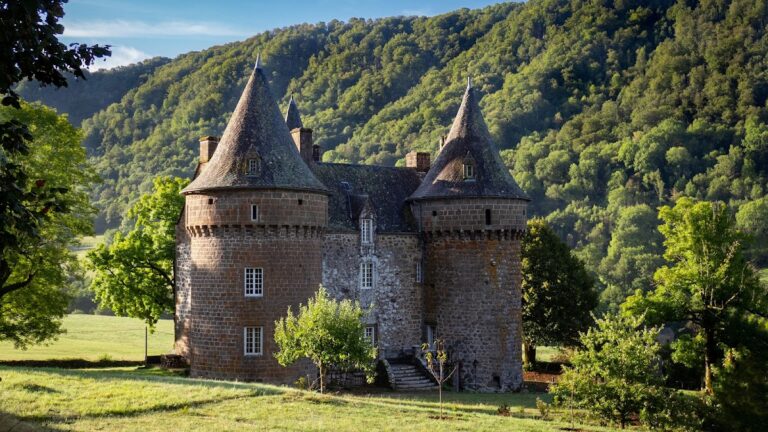
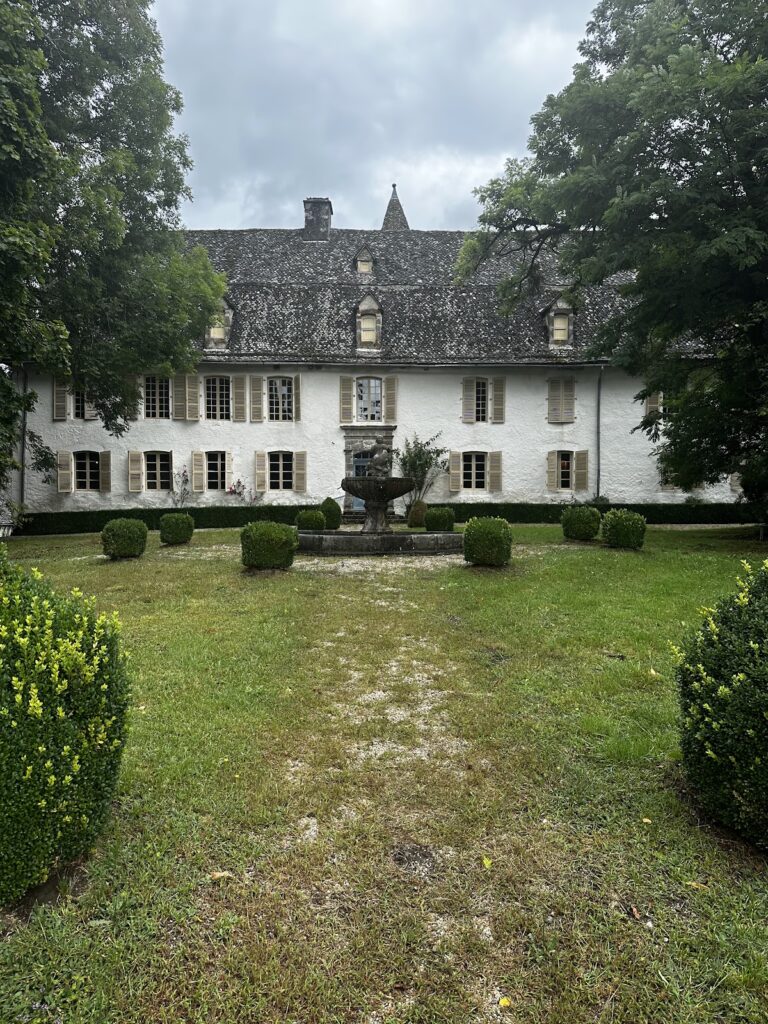
The main residential building is rectangular and rises through three storeys. Its medieval and Renaissance character is combined with a round external stair tower dated 1685. The tower’s entrance door belongs to the latter part of the sixteenth century, creating a visible link between the building’s earlier features and its later form.
The interiors illustrate the decoration of a rural château in Auvergne. The rooms contain eighteenth-century wood panelling and paintings on wall panels placed above fireplaces, doors, or cupboards. These works were probably produced by the Fabry family workshop. Four panelled rooms on the first and second floors form part of the building’s protected historic fabric.
Sixteenth-century tapestries
The château houses a series of ten sixteenth-century tapestries made in the Aubusson region, probably more specifically at Felletin, both important tapestry-making centres in the Limousin region. They show foliage and a fantastic bestiary, with designs based on a full-scale preparatory drawing resembling contemporary Flemish tapestries. The series was probably originally composed of eleven pieces.
Three tapestries bear the arms of Guy de Montclar, lord of Montbrun, and Renée de Chaslus, who married on 8 October 1586. Their heraldry indicates that the series was probably made for Montbrun Castle at Méallet rather than for La Trémolière, which entered the Montclar family only in 1640. The tapestries were found in ruined condition in the attic, then classified as historic monuments and restored. They were exhibited at the Bargoin Museum in Clermont-Ferrand during Verdures, du tissage aux pixels, held from 15 February to 21 May 2017.
Verger de Déduit
The château’s contemporary garden, called the Verger de Déduit, draws its composition from the fantastic bestiary shown on the tapestries and from the Roman de la Rose, a major medieval French allegorical poem using imagery of gardens, love, and symbolic animals. The garden is included in France’s “Remarkable Gardens” inventory, a designation for notable historic or designed gardens.
Nearby sites