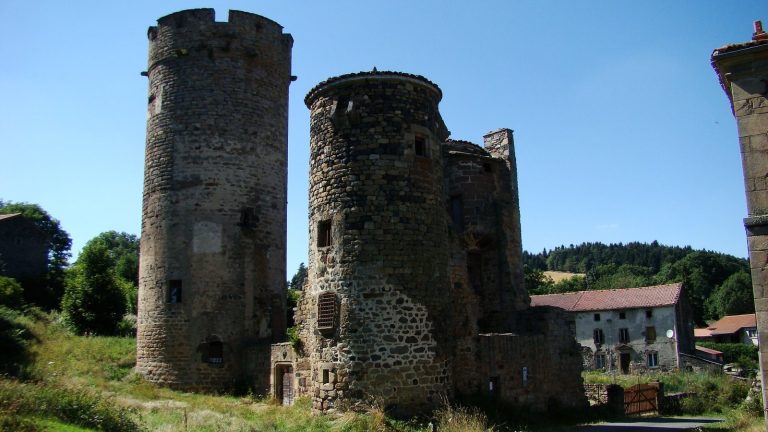
Château de La Rochelambert: A Fortified Residence and Museum in France


Site at a Glance
- Rating
- 4.2
- Popularity
- Low
- Country
- France
- Primary era
- Medieval
- External website
- Open
- Eras represented
- Medieval, Early Modern
- Civilizations
- French
- Site type
- Military
- Remains
- Castle
On this page11 sections
History
Château de La Rochelambert is an eleventh-century fortified residence in France, near Saint-Paulien, built to control a heavily used road across the Borne valley. The site was historically associated with the Velay, and its position probably allowed it to monitor the Via Bolène, an ancient route running from Lyon through Feurs and Saint-Paulien toward Aquitaine. The road was also traditionally identified with the route to Santiago de Compostela, the pilgrimage road leading to the shrine of Saint James in northwestern Spain.
Origins and the La Rochelambert family
The family of La Rochelambert is first mentioned in 1074, in a genealogical tree displayed at the château. Pierre de la Rochelambert, a knight and the first known lord of the site, appears in a transaction from 1164. The documented family lineage begins in 1274, linking the château to a long succession of lords who retained the property through many later changes.
The residence developed as a fortified point beside the route. Its defensive role was tied to the road opposite the château, while the building itself occupied a difficult position against the volcanic rock of the valley.
War, destruction and rebuilding
On 11 August 1562, during the French Wars of Religion, Sieur de Blacons attempted to capture the château. Blacons was lieutenant to Baron des Adrets, a military commander associated with the Protestant side. He had already led about 800 men in the capture of La Chaise-Dieu and Saint-Paulien, as well as in the ravaging and looting of the area around Le Puy. The assault partly destroyed Château de La Rochelambert. A sixteenth-century anonymous chronicle, later found among the château’s papers, preserves an account of the attack.
Hélène de Lestrange, the wife of François, Marquis de La Rochelambert, undertook the rebuilding of the damaged residence. She died in 1614 and was buried in the cemetery of Saint-Paulien. Around 1580, François and Hélène also restored the drawbridge. In 1604, it was filled in when Hélène commissioned the monumental staircase, changing the approach to the château.
Ownership, literature and the museum
The La Rochelambert family retained the château from its origins until 1922, when the daughter of Marie Auguste Aimé de La Rochelambert sold it to a property dealer. Furniture, tableware, arms, paintings and other objects were dispersed through successive sales.
The antiquarian Bresset acquired the property in 1939 and installed a collection of medieval art there. The château remains in the Bresset family, whose present owner is Bresset’s grandson, and it functions as a museum. Château de La Rochelambert was classified as a historic monument on 31 January 1945.
The building also entered nineteenth- and twentieth-century cultural history. The novelist Amantine Lucile Aurore Dupin, who wrote under the name George Sand, visited it on 14 June 1859 while travelling through the Velay. She used the château as the setting for Jean de la Roche, written the following month. Its façade and Grand Staircase were later recreated at the Épinay studios for Jean Cocteau’s 1946 film Beauty and the Beast. Bernard Hecht’s thirteen-part television serial La Belle et son fantôme, made in 1962, was largely filmed at the château.
Remains
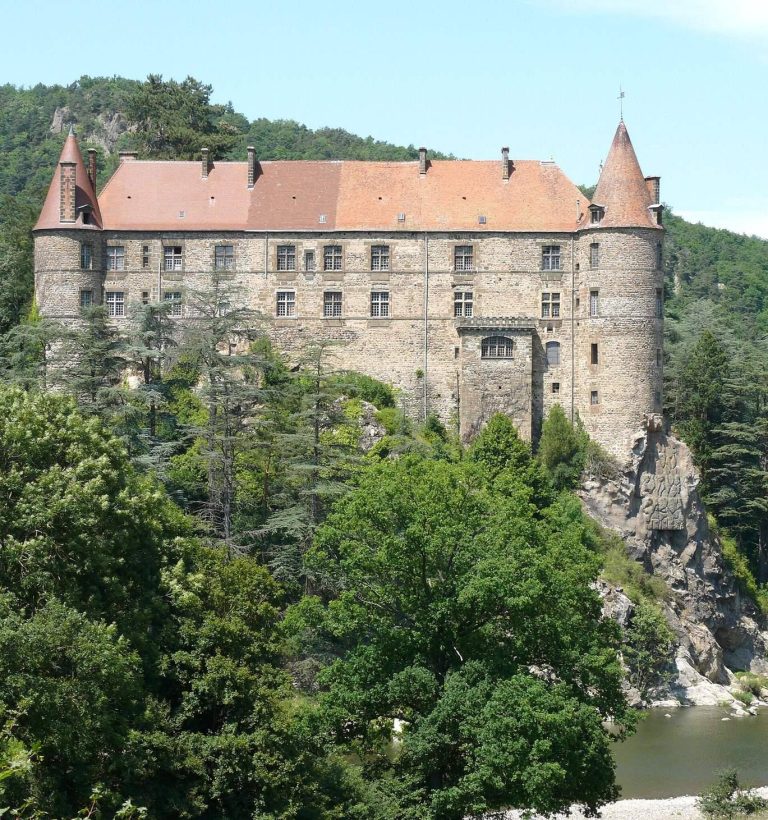
Château de La Rochelambert stands in the Borne valley near the hamlet of Marcilhac, about 2 kilometres southwest of Saint-Paulien. It is built directly against a basalt cliff or flow, the remnant of an ancient volcano. This dark volcanic rock, formed from cooled lava, remains visible in several interior rooms and is integral to the building’s restricted layout.
Cliffside residence
George Sand described the château as a small, broad manor that was unusually shallow, built from the region’s tawny lava. The rock presses closely against both sides of the building, leaving no level ground for a courtyard, garden or adjoining service buildings. The foundations date from the twelfth century, and the surviving structure reflects successive medieval and early modern alterations within this confined setting.
Fortifications and entrance
Southern tower
The southern tower retains barbicans dating from the thirteenth century. A barbican is an outer defensive work protecting an entrance or wall. These features belong to the château’s medieval defensive system and remain part of the surviving fortified fabric.
Octagonal tower
The octagonal tower preserves fourteenth-century machicolations, projecting openings through which defenders could drop or discharge material onto attackers below. The building ranges flanking the tower also date from the fourteenth century, creating the principal surviving medieval group around this defensive element.
Medieval defenses and monumental entrance
The medieval château, now largely disappeared, included several towers, a rampart with a wall-walk, and a drawbridge. A wall-walk is a passage along the top of a defensive rampart. The drawbridge was restored around 1580 and later filled in during 1604, when the monumental staircase was constructed. A doorway from the same period carries the arms of the La Rochelambert family, showing a silver field with a blue chevron and a red chief.
Interior collections
The museum collections occupy the great tower and the principal rooms. They include medieval armour and swords, tools illustrating medieval daily life, Renaissance sculptures, tapestries and paintings. Together, these objects form the material displays assembled by Bresset within the historic residence.