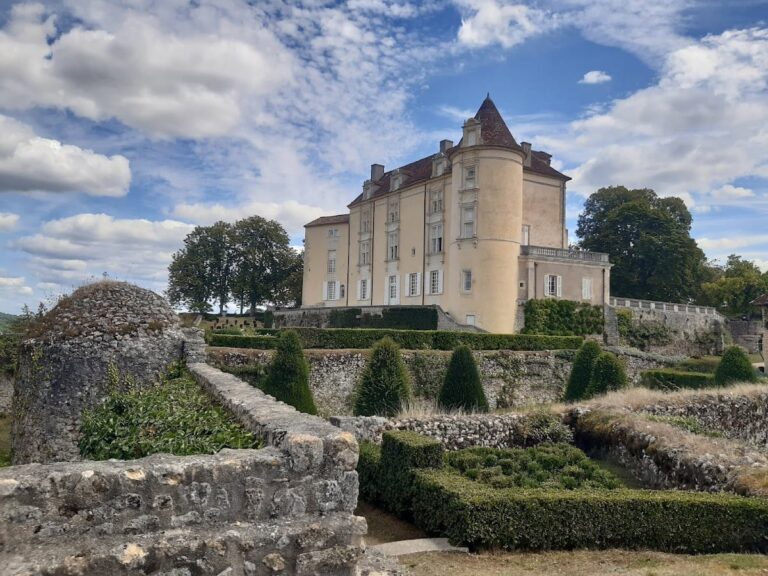
Château de La Force: A Seventeenth-Century French Château


Site at a Glance
- Rating
- 4.9
- Popularity
- Very Low
- Country
- France
- Primary era
- Early Modern
- Eras represented
- Early Modern
- Civilizations
- French
- Site type
- Domestic
- Remains
- Castle
On this page8 sections
History
Château de La Force is a ruined château in La Force, France, built for Jacques Nompar de Caumont in a Florentine-inspired style during the early seventeenth century. Caumont was a Protestant nobleman, governor of Navarre and Béarn, and later marshal of France under Louis XIII, who was king of France at the time.
Construction under Jacques Nompar de Caumont
Construction began in 1604 and had advanced substantially by 1611. Henri IV had promised royal assistance for the project, but his assassination prevented Caumont from receiving it. Despite this setback, work was completed in 1614. An inscription connected with the construction bears the name of Pierre Boisson, who may have been a master mason from Bordeaux and died in 1606. The decoration was carried out by an unidentified Parisian artist, while Jacques Boyceau de la Barauderie designed the formal garden in front of the château.
Siege, destruction, and survival
A siege may have taken place before the fortress in 1622 under Charles de Guise-Lorraine, Duke of Elbeuf, a French aristocratic and military leader. The event is associated with the château’s fortified position, although its occurrence remains uncertain.
In 1793, during the French Revolution, the château was sacked while Lakanal, a representative of the revolutionary government, was on mission at Bergerac. Lakanal was responsible for initiating the action. The château subsequently became a ruin. Its temple, which had served as a dependency of the château, was not demolished.
Later documentation and protection
A small publication by Jules Determes in 1850 documented an eighteenth-century engraving of the palace. The original copper plate had survived the destruction of 1793. The surviving central pavilion of the former stables, locally called the Pavillon des Recettes, was classified as a historic monument on 11 April 1932.
An inscription dated 1604 and associated with the château’s construction, together with funerary plaques linked to the Caumont family, was transferred to the Périgueux Museum. The bequest was accepted in December 1886 by Édouard Galy, the museum’s curator, and Olivier Emmanuel de Caumont, the 12th Duke of La Force.
Remains
Site layout and the former château
Château de La Force was built in Bussac stone as a three-storey building with an attic fitted with dormer windows. The lost château stood at the end of a south-oriented fortified spur overlooking the Dordogne plain. The former parcel is now wooded and built over, in an area known as the Enclos du Château.
The ground behind the surviving façade includes a large lawn that probably occupied the site of a formal French garden, or parterre. A central avenue lined with chestnut trees led from the entrance porch of the Recettes pavilion toward the disappeared château, preserving the main axis of the former grounds.
Pavillon des Recettes
Only the central pavilion of the former stables survives. In 1855, the façade of the Recettes pavilion, facing the present town hall, measured 85 metres in width. Its roofs had long slopes covered with slate.
Three attic window surrounds remain standing on the garden side. The third is incorporated into the building of the former ducal hostelry. A plaque bearing the names of five members of the Caumont family is mounted on the wall to the right of the entrance arch.
Transferred and associated remains
The Périgueux Museum holds two funerary stones connected with the former material heritage of the château. One, dated 1737, commemorates Antoine de Caumont, Marquis of Castelnaut, who died at the age of 17. The other, dated 1764, commemorates Armand Nompar II de Caumont, who died at the age of 86.
The château’s campanile, a small structure designed to hold a bell, may now be identified with a bell at the Church of Saint-Jacques-le-Majeur in Bergerac.
Nearby sites