Château de Gy: A Fortified Episcopal Residence in France


Site at a Glance
- Rating
- 5
- Popularity
- Very Low
- Country
- France
- Primary era
- Early Modern
- Eras represented
- Medieval, Early Modern
- Civilizations
- French, Holy Roman Empire
- Site type
- Religious
- Remains
- Palace
On this page13 sections
History
Château de Gy is a historic fortified residence in Gy, France, built and developed under the archbishops of Besançon over nearly 700 years. Its original construction date is uncertain. The château combined the functions of an episcopal residence with the political and military authority exercised by the archbishops in connection with their ecclesiastical office.
Medieval conflicts and destruction
The château became closely involved in disputes among the archbishops of Besançon, the citizens of Besançon, the lords of Chalon, and the dukes of Burgundy. These conflicts concerned both the archbishop’s authority in Besançon and regalian rights, meaning sovereign or quasi-sovereign powers such as minting money and administering justice.
In 1259, Jean I of Chalon and other lords besieged Gy. The defenders held out for a time, but the château was eventually captured and completely destroyed. Archbishop Guillaume II de la Tour excommunicated those responsible, formally excluding them from participation in the sacraments and communion of the Church. Pope Alexander IV confirmed the excommunication. It was later lifted after an agreement that included an annual rent of five measures of wheat from the mills of Vuillecin.
In 1380, Archbishop Guillaume de Vergy attempted to mint coins at Gy, provoking opposition from Besançon, the lords of Chalon, and Philip the Bold, Duke of Burgundy. After Pope Clement VII intervened, Guillaume agreed to mint elsewhere, while the duke prohibited him from minting in Besançon. Guillaume responded by excommunicating the duke, who then besieged Gy. The dispute ended amicably in 1391.
Renewal under late medieval archbishops
After his election in 1439, Archbishop Quentin Ménard withdrew to Gy following disputes with the citizens of Besançon. When they destroyed the archbishop’s Château de Bregille, claiming that it posed an imminent danger, Ménard demanded its reconstruction. After lengthy negotiations, he surrendered his regalian rights and retired to Gy. From there, he excommunicated those responsible for the destruction of Bregille and strengthened the château with two square towers.
François de Busleyden, tutor and counsellor to Philip the Fair, settled at Gy after receiving a hostile reception in Besançon. Philip the Fair was Philip I of Castile and a ruler of the Burgundian Netherlands. Busleyden rebuilt the château after it was damaged during the attack of 1477 led by the Sire de Craon. Once the work was finished, he ordered the archbishop’s regalian court, the judicial court associated with his authority, to be transferred to Gy. It returned to Besançon only after his death.
A later archbishop, who had served as tutor to Charles V, also moved to Gy after a conflict with Gauthiot d’Ancier. Charles V, also known as Charles Quint, was the Habsburg emperor whose territories included much of western and central Europe. During this period, the château served both as a religious residence and as a fortified house protecting the inhabitants of Gy and nearby villages.
Early modern and eighteenth-century transformation
Claude de La Baume became archbishop in 1545 and inherited the château at the age of nine. Until he reached adulthood, the archbishopric was controlled by François Bonvalot, who had challenged the succession of Claude’s uncle, Archbishop Pierre de La Baume. Claude visited Gy frequently, especially for hunting.
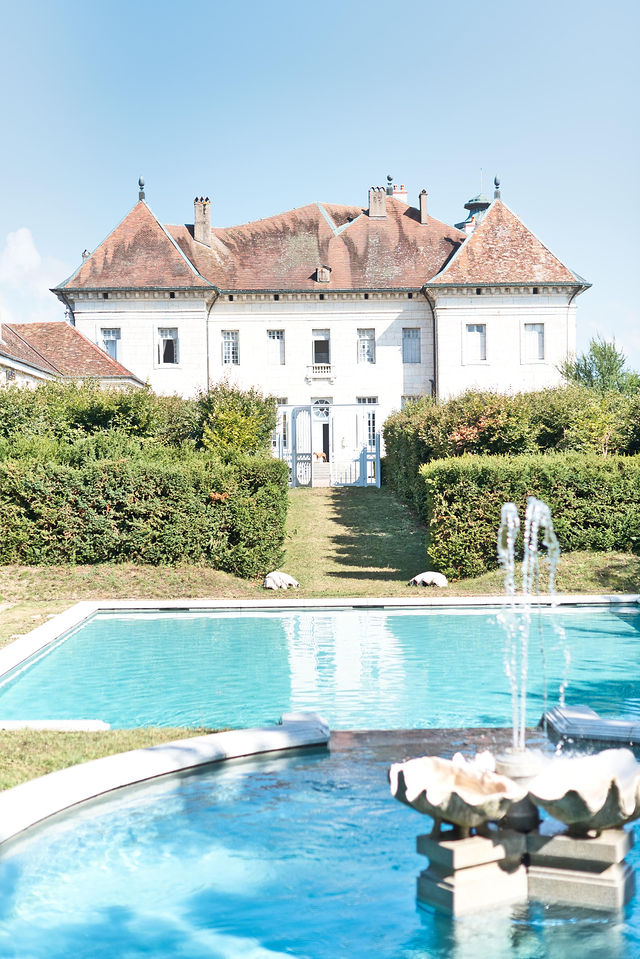
Antoine-Clériade de Choiseul-Beaupré, appointed archbishop of Besançon in 1755, gave Château de Gy much of its present appearance. Having served as chaplain to the king of Poland and seen princely residences across Europe, he undertook an eighteenth-century reconstruction intended to give Gy a similar character. His works extended into the village and included the layout of a new road toward Besançon, although the effect on the village’s development cannot be measured. Choiseul-Beaupré died leaving substantial debts to his successor, Archbishop de Durfort.
Later uses and protection
Château de Gy escaped damage during the French Revolution. Its outbuildings were later sold at auction. From 1854 to 1876, the château was converted into a school, and it subsequently served as a lower secondary school until 1974. For nearly ten years afterward, it hosted cultural events, including celebrations for the bicentenary of the French Revolution.
The château site was designated a classified site by an order of 22 July 1913 because of its artistic character. The château was classified as a historic monument in 1922 and again in 1991, and it was also registered as a historic monument in 1991. The roof of the Marmet Tower was restored in 2012. The château is now privately owned.
Remains
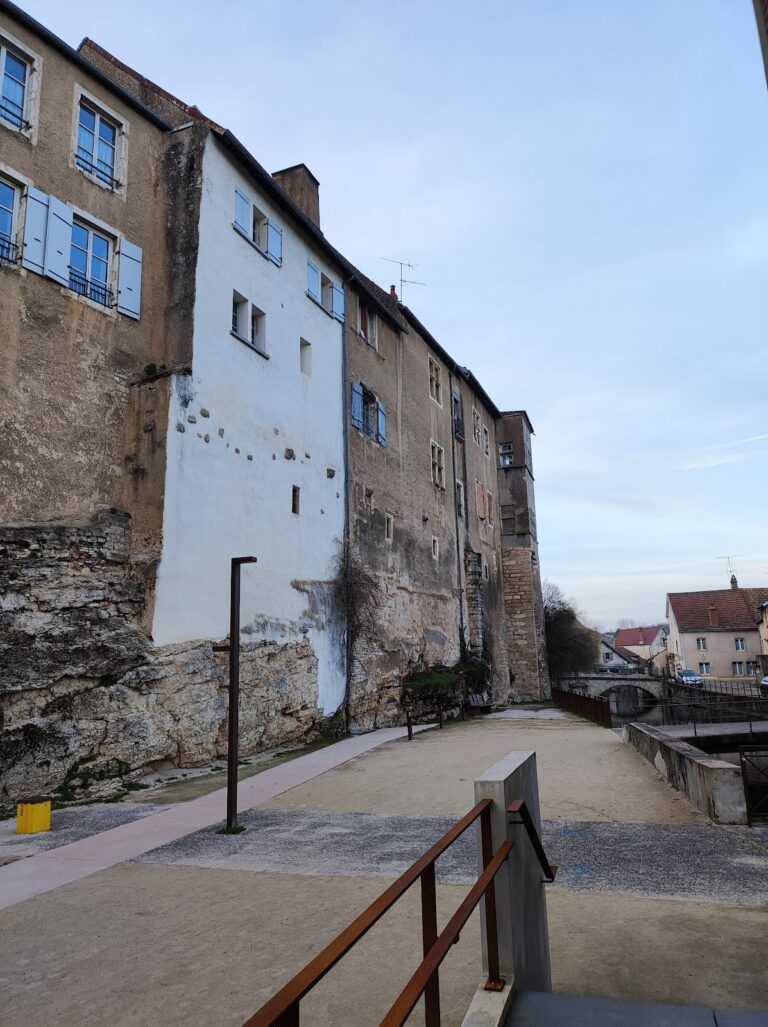
The present complex reflects two principal building campaigns, the first directed by François de Busleyden and the second undertaken during the eighteenth-century reconstruction led by Archbishop Choiseul. Its buildings form a pentagon open toward the south. A central residential range faces the entrance courtyard, while east and west wings extend from it and are each terminated by a square tower dating from the sixteenth century.
Central residential range
Arcaded gallery
The central range contains the main residential building and a gallery of arcades. The gallery survives as part of the work associated with François de Busleyden’s reconstruction, linking the residential character of the château with the late medieval rebuilding campaign.
Stair tower
Opposite the entrance courtyard, a stair tower distributes the central residential range. In the present complex it is a hexagonal tower in the Flamboyant Gothic style, a late Gothic form known for elaborate, flame-like tracery and intricate decoration. The earlier reconstruction is also associated with an octagonal tower containing a spiral staircase.
Wings and towers
East and west wings
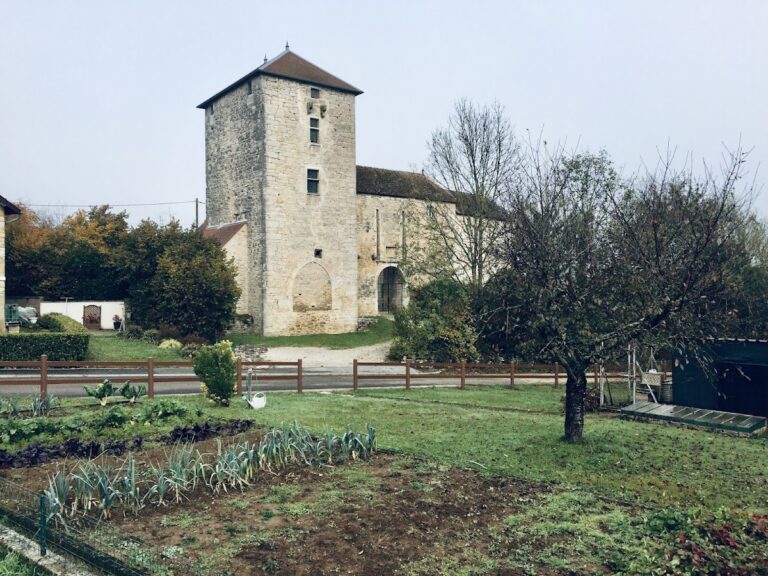
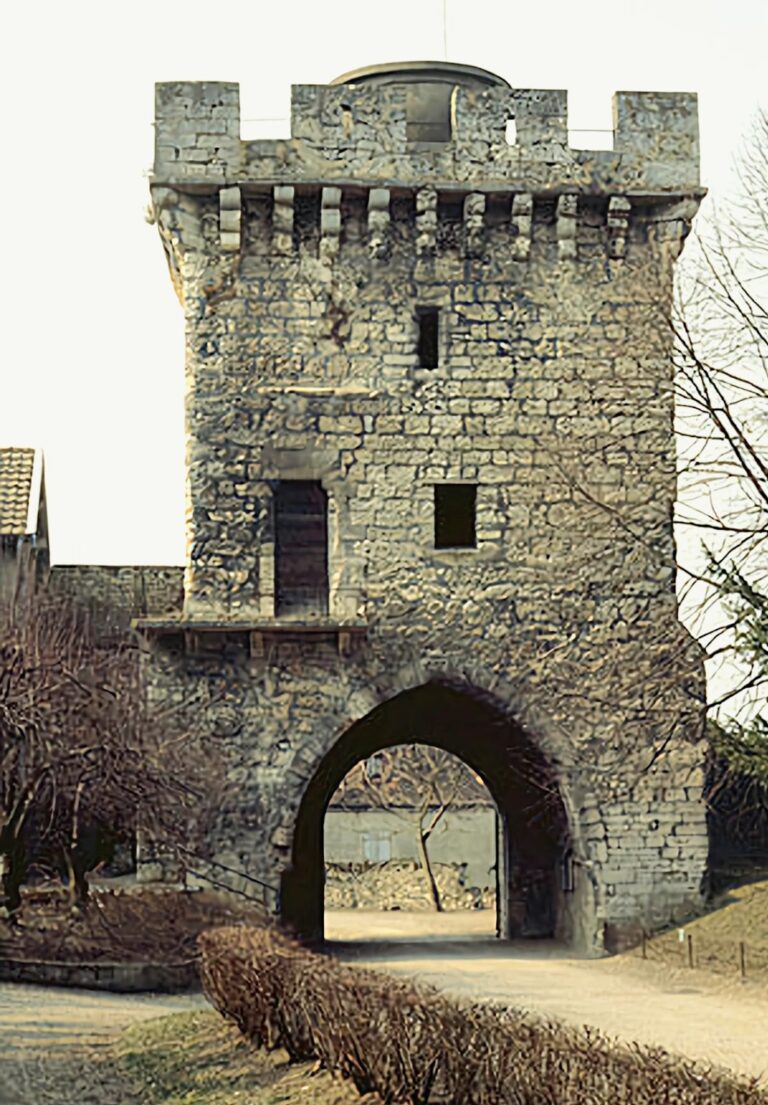
The east and west wings flank the central range. Each ends in a square tower dating from the sixteenth century. These towers belong to the fortified and residential development of the complex, whose defenses were also reinforced when Quentin Ménard added two square towers.
Entrance portal
The entrance portal retains the arms of Antoine-Clériade de Choiseul-Beaupré, connecting the visible entrance to the eighteenth-century transformation that shaped much of the château’s current appearance.
Marmet Tower
The Marmet Tower forms part of the surviving complex, and its roof was restored in 2012.
Nearby sites