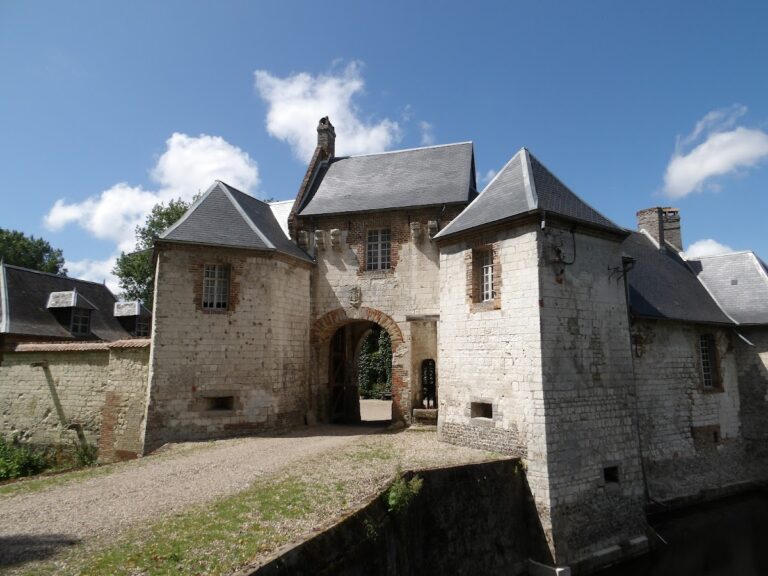
Château d’Hesdin: The Medieval Seat of the Counts of Artois
Site at a Glance
- Rating
- 4.8
- Popularity
- Very Low
- Country
- France
- Primary era
- Medieval
- External website
- Open
- Eras represented
- Medieval
- Civilizations
- Duchy of Burgundy, French
- Site type
- Military
- Remains
- Castle
On this page17 sections
History
Château d’Hesdin is the surviving archaeological site of a medieval fortified residence in Vieil-Hesdin, France, developed by the Counts of Hesdin and later the Counts of Artois from the eleventh century onward. First recorded in 1094, the castle became a principal comital seat, a hunting residence, and a setting for royal and diplomatic occasions. Kings of France, Counts of Flanders, Dukes of Burgundy, and other prominent guests were received there.
The County of Hesdin and its early castle
The County of Hesdin probably emerged in the mid-eleventh century on land belonging to the County of Saint-Pol. Tradition says that Baldwin V of Flanders installed a vassal at Hesdin to counter his rival in Saint-Pol. The Count of Hesdin was traditionally a hereditary peer of Flanders, with responsibilities connected to the defense of the border.
The castle suffered damage during Norman attacks, after which Baldwin VI of Flanders ordered major repairs in 1067. Walter II, the last Count of Hesdin, later rebelled against Flanders. Charles the Good confiscated his domain in 1119, bringing the county under closer control.
In 1180, Philip I of Flanders transferred the county as part of Isabella of Hainault’s dowry to Philip II, king of France. Hesdin passed definitively from Flanders to France in 1191. In 1226, the French Crown granted the county as an apanage, a territorial grant supporting a royal family member, to Prince Robert. In 1237, Robert formally received it from his royal brother as part of the newly established County of Artois, a medieval territorial principality in northern France.
Robert II and the creation of a courtly park
Robert II of Artois transformed Hesdin after taking part in the Eighth Crusade and seeing the park of Palermo. He renovated and rebuilt the Romanesque castle as a summer residence and hunting lodge. He briefly returned from Naples in 1288 to receive the French king and queen, then came back permanently by 1292 with seventeen members of his household from Italy, Sicily, and the Iberian Peninsula.
Robert’s architect and administrator, Rinaldo Crignetti di Barletta, known in French as Renaud Coignet, enlarged the park by purchasing land and designed buildings within it. Robert introduced fallow deer, rabbits, and carp, developed methods for keeping herons through the year, and established an intensive horse-breeding program. Crignetti returned to Italy in 1299 after accusations of extortion and forgery, but work continued. By 1300, a Master of Engines of the Castle was recorded, indicating the organized maintenance of its mechanical entertainments.
Robert II died at the Battle of the Golden Spurs. His daughter Mahaut, Countess of Artois, completed the park by 1306. Under Mahaut and later patrons, Hesdin developed into an elaborate display of comital and ducal power, bringing together gardens, animals, entertainments, and mechanical devices. Mahaut also commissioned heraldic shields and fleurs-de-lis for the walls and ceilings of several rooms, and placed plaster heads of French kings in her chamber.
Damage, rebuilding, and Burgundian patronage
The castle and park were damaged repeatedly, including in 1313, 1350, and 1355. In November 1355, Edward III of England invaded from Calais with Flemish support. His army entered the park and destroyed li Marés, a marsh complex, while the city and castle were spared. Reconstruction began immediately.
By the 1380s, many of Hesdin’s mechanical devices had stopped working because they required constant maintenance. Philip the Bold began remodeling the castle in 1391, and the Burgundian dukes restored its prominence. Around 1410, Hue de Boulogne became painter and governor responsible for the castle’s clock, cages, stained-glass windows, and amusement engines. Pierre Coustain succeeded him around 1450.
Under Philip the Good, the castle received further embellishment. In the 1430s, his chamberlain Colart le Voleur replaced and enlarged the automata, mechanical devices designed to move or perform actions for entertainment and visual marvels. Many were conceived as teasing traps, adding surprise and playful deception to the courtly setting. A spiral staircase was added between 1459 and 1463.
A setting for diplomacy and ceremony
Philip the Good used Hesdin for important political, religious, and diplomatic occasions. The castle chapel hosted the consecration of John of Burgundy as bishop on 5 May 1440. In 1463 and 1464, Philip received Christian I of Denmark and an embassy from Emperor Frederick III, while peace negotiations involving Louis XI of France and Edward IV of England took place there.
In 1483, the three-year-old Margaret of Austria was handed over at Hesdin to the French for her betrothal to the Dauphin Charles at the Château d’Amboise. The castle also hosted the marriage of Philip the Good and Isabella of Portugal. Its reputation extended beyond court records and ceremonies. Guillaume de Machaut’s Remedy of Fortune, written around 1341 to 1349, places its narrator in the “Park of Hedin,” where he composes the lament Tel rit au main. A work from around 1450 invoked Hesdin in an assertion of French superiority over the English, while François de Monceaux’s Heden sive paradisus associated the name Hesdin with Eden and claimed that the site was the original Garden of Eden.
Destruction and archaeological rediscovery
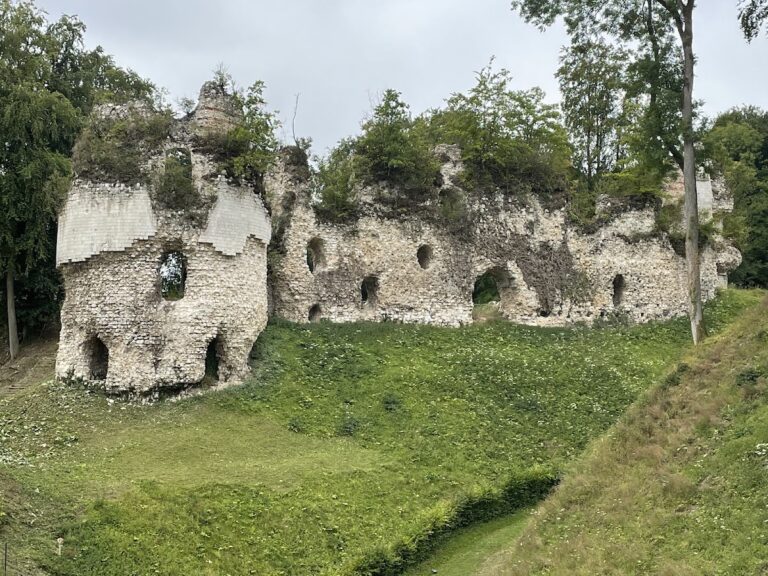
During the sixteenth-century border wars between France and the Habsburg Netherlands, troops of Charles V, a Habsburg emperor, captured the castle on 18 July 1553 after a two-week siege. A battery of sixteen cannons decided the assault. Charles ordered the damaged castle demolished and a stronger citadel built farther away. Demolition lasted from 23 July to 7 August, although the work was incomplete. The city subsequently declined into a village.
Decades later, Charles’s son Philip II of Spain, a later king of Spain, founded Le Parcq on the northern part of the overgrown park. The castle ruins were rediscovered and excavated in 1858 by the local architect Clovis Normand. In 2005, the archaeological remains received protection as an archaeological reserve under French historic-monument legislation.
Hesdin’s mechanical wonders are known through descriptions and other writings rather than surviving machines. Miniatures made by Loyset Liédet for Philip the Good were probably influenced by the automata, especially his illustrations of Christine de Pizan’s Epistle of Othea. The painting known as Garden of Love, preserved in two copies, has also been proposed as a representation of the castle’s marsh complex.
Remains
The surviving remains represent the former castle site and its archaeological context. The castle occupied the northern tip of the triangular old city, with the Canche River separating it from the urban area. Its fortified enclosure was pentagonal, covered approximately five hectares, had a tower at each corner, and contained a central keep. North of the castle, the walled park extended for approximately 940 hectares beyond the Ternoise. Its grounds included wooded hills, vineyards, orchards, ornamental gardens, hunting and animal-keeping areas, and gardens associated with several buildings.
Fortified castle and park layout
The castle enclosure
The castle’s pentagonal fortified building formed the principal defensive and residential core of Hesdin. Towers stood at its five corners, while a central keep occupied the interior. Robert II renovated and rebuilt this Romanesque complex as a summer residence and hunting lodge. Later alterations included the spiral staircase added between 1459 and 1463. The castle was damaged during the sixteenth-century siege and was subsequently subjected to demolition, leaving the excavated ruins preserved as an archaeological reserve.
The extended park
The park stretched northward across approximately 940 hectares, reaching beyond the Ternoise. From the late thirteenth century, it contained a manor beside the river known as the Manage, a pavilion raised on stilts called the Marsh Pavilion or Fountain Pavilion, and two lodges. A menagerie, aviaries, fishponds, tournament fields, and the private enclosed garden called Paradis formed part of the wider estate. The marsh complex known as li Marés was destroyed during Edward III’s invasion in 1355, and later damage and the sixteenth-century demolition caused further losses among the buildings, gardens, and installations.
Entertainments and mechanical features
The banquet pavilion
A banquet pavilion stood on stilts within the park. A bridge led to the structure, with mechanical monkeys covered in badger fur placed along it. One castle wing contained a maze and a mirror palace, adding constructed confusion and optical effects to the entertainments associated with the residence.
The gloriette
The gloriette was a tall, richly illuminated room or gallery containing sculptures, paintings, an interior fountain, and automata. Real and artificial birds were arranged to compete in song. In 1344, Odo IV of Burgundy installed a gilded tree there. The feature formed part of the park’s larger collection of visual, mechanical, and courtly marvels.
Automata and other devices
The castle and park contained numerous amusement devices, including automata, a sundial, a distorting mirror, a menagerie, a labyrinth, and a wagon. The automata were redesigned repeatedly and included mechanical sculptures inspired by French chivalric romances. Their survival is known through written descriptions and artistic representations rather than through preserved machines.
Chapel and interior decoration
The castle chapel
Robert II commissioned a statue of Louis IX for the castle chapel. The chapel later hosted the consecration of John of Burgundy as bishop on 5 May 1440, linking the building’s religious use to the wider ceremonial life of the court.
Painted rooms
Mahaut of Artois ordered heraldic shields and fleurs-de-lis painted on the walls and ceilings of several rooms. She also installed plaster heads of French kings in her chamber. These interior features expressed the identities and political associations of the patrons who developed the residence.