Château de Fougeret: A Historic Château in France


Site at a Glance
- Rating
- 4.2
- Popularity
- Low
- Country
- France
- Primary era
- Medieval
- External website
- Open
- Eras represented
- Medieval, Early Modern, Modern
- Civilizations
- French
- Site type
- Domestic
- Remains
- Castle
On this page9 sections
History
Château de Fougeret is a fifteenth-century château in France, located at Queaux above the Vienne Valley. Its history extends into the sixteenth century, and its origins are associated with the Frotier family. The site was first mentioned in 1337 and served as a defensive stronghold during the opening period of the Hundred Years’ War, the prolonged conflict between England and France conventionally dated from 1337 to 1453.
Medieval origins and feudal authority
The château occupies the top of a cliff overlooking the Vienne, a position that supported its defensive role. The name Fougeret may have derived from the noble Fougères or Fougeré family. The present residence developed from a modest rural feudal dwelling, with construction generally dated to the fifteenth century and continuing into the following century.
Under the Ancien Régime, the French political and social order before the Revolution of 1789, Fougeret was a seat of high justice. This gave its lord authority to hear serious criminal cases and impose severe penalties, adding a judicial function to the château’s residential and defensive roles.
Revolutionary change and nineteenth-century restoration
During the French Revolution, the owner left France. Louis-François Bonaventure, mayor of the commune, then took possession of the château and made it his residence.
During the Second Empire, the regime of Napoleon III from 1852 to 1870, the Robin-Médard family carried out a major restoration campaign. The work gave Fougeret much of its present appearance and reshaped the earlier building with a more elaborate architectural and decorative program.
Twentieth-century use and modern folklore
In the first third of the twentieth century, Paul Robain turned Fougeret into a venue for gatherings and celebrations attended by members of the upper bourgeoisie and aristocracy, especially those connected with Catholic and royalist circles. Robain was a friend of Charles Maurras and sympathized with Action Française, a French royalist and nationalist movement founded in the late nineteenth century.
After the château had stood abandoned for nearly half a century, Véronique Geffroy and her husband, François, purchased it in 2009. They began extensive renovation with the intention of restoring the building and making it their home. The work has continued since then, and Fougeret was listed as a French historic monument in 2010.
Following the owners’ reports of paranormal experiences after the purchase, events involving mediums and overnight stays focused on paranormal themes began in 2010. Television programs, national media, and online creators subsequently helped spread the château’s reputation as one of France’s most haunted places. Skeptics and investigators have challenged the reality of the reported phenomena. These activities also took place while the building was in poor condition, with electrical hazards, weak floors, inadequate fire alarms and safety lighting, and insufficient emergency exits.
Remains
Cliff-top setting and grounds
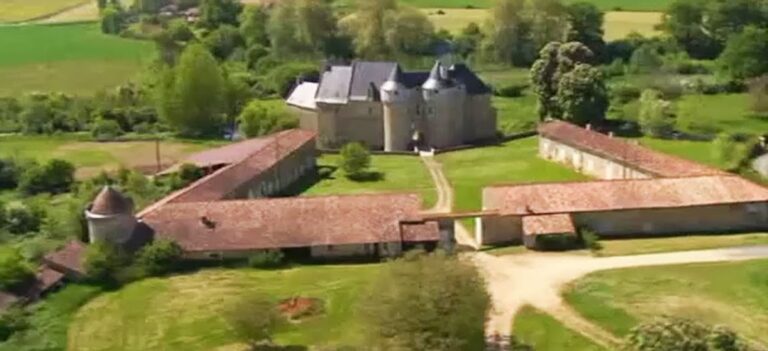
Château de Fougeret stands on a 38-metre cliff above the Vienne Valley. Its park covers 10 hectares and borders the Vienne River. The grounds include star-shaped avenues and an arboretum, a planned collection of trees and woody plants, containing species introduced from the New World, among them American walnuts and giant sequoias.
Medieval fabric and principal buildings
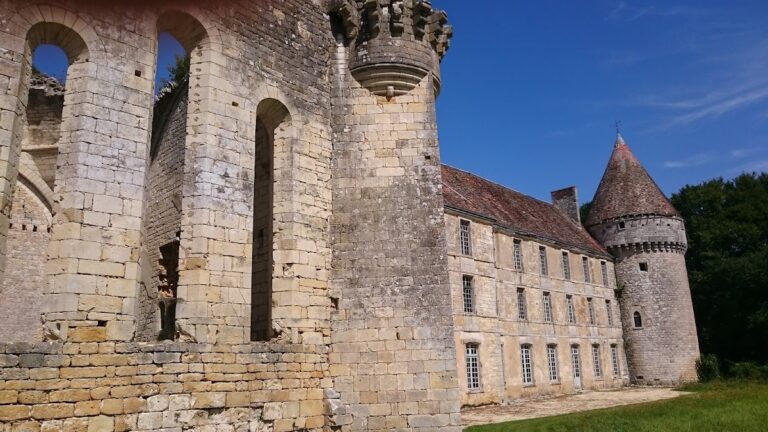
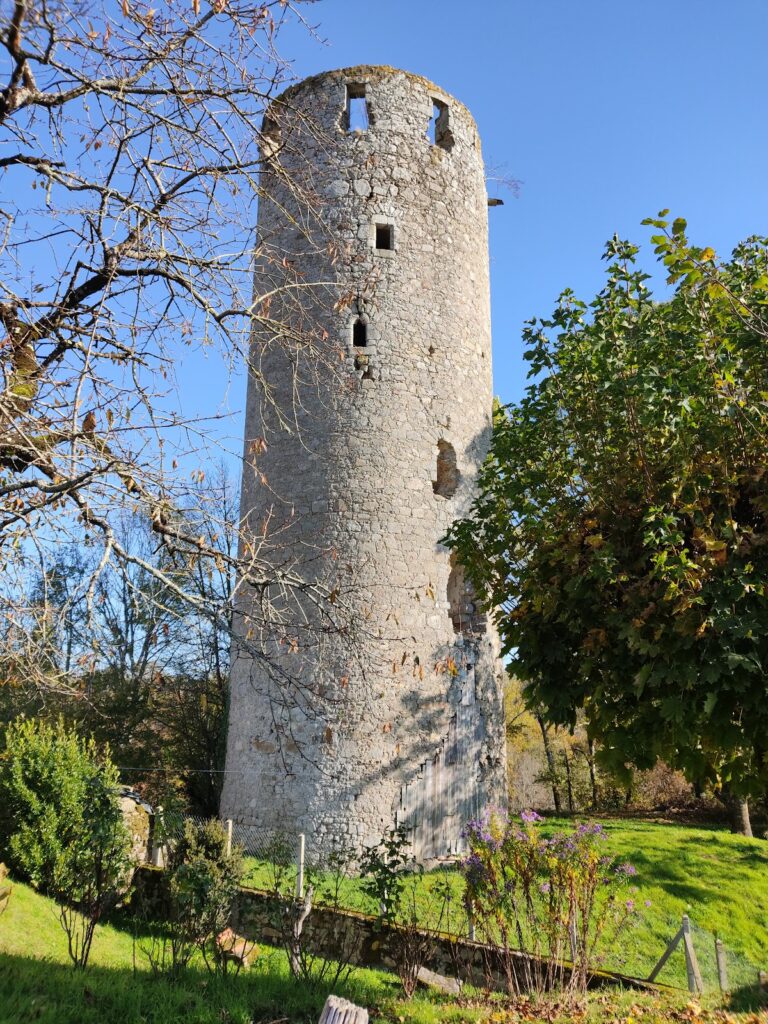
The main residential building, or corps de logis, is flanked by three round towers and a chapel. Two further independent towers stand near the principal building. Medieval elements survive in the form of projecting defensive structures called brattices, cellars, sarcophagi, an icehouse used historically to store ice, and two windows divided by stone mullions.
Nineteenth-century alterations
The nineteenth-century restoration added an upper storey and reorganized the position and arrangement of the windows. It also introduced substantial Neo-Gothic, eclectic, and troubadour-style decoration, creating interiors intended to convey the owners’ wealth and importance.
Interior features
The château contains wall paintings and frescoes, decorated and painted flat ceilings, a mosaic, woodwork, and a monumental Gothic fireplace carved from stone. A Gothic-style stone staircase has a central balustrade with tracery, ornamental stone framework comparable to the staircase at Chambord. Interior and cellar staircases, a first-floor area, and a Ouija table are also among the recorded features and contents of the building.