Crozant Castle: A Medieval Fortress in France


Site at a Glance
- Rating
- 4.5
- Popularity
- Very Low
- Country
- France
- Primary era
- Medieval
- Eras represented
- Medieval
- Civilizations
- Unclassified
- Site type
- Military
- Remains
- Castle
On this page11 sections
History
Crozant Castle is a medieval fortress in France, occupying a rocky spur between the Creuse and Sédelle rivers. The surviving stronghold dates chiefly from the late twelfth century and was remodelled during the thirteenth and fifteenth centuries. Its position and successive fortifications made it an important comital castle, meaning a fortress controlled by a count, within the County of La Marche.
Early occupation and medieval origins
The rocky ridge was occupied during the protohistoric period before being abandoned in antiquity. A primitive fortress appears to have been built between 997 and 1018. The castle is first mentioned in a charter dating from approximately 1200 to 1210, in a context associated with the development of the town of Crozant.
During the twelfth century, the castle’s captains included members of the Foucault family of Saint-Germain-Beaupré. The site later became the comital fortress of the Counts of La Marche, the medieval rulers of the County of La Marche in central-western France. They developed its fortifications during the thirteenth century and renewed them again in the middle of the fifteenth century.
The succession of lords included Géraud de Crosenc in 1019, the Bridiers family until 1136, Géraud de Brosse from 1136 to 1168, and Audebert IV of Montgommery from 1168 to about 1177. The Plantagenets, the royal dynasty that ruled England while holding extensive territories in France, controlled the site from about 1177 to 1199. The Lusignans followed from 1199 to 1308, the Capetians from 1308 to 1327, and the Bourbon family from 1327 to 1356.
Later holders included the Bourbon-La Marche line from 1356 to 1438, the Armagnacs from 1438 to 1477, the Bourbon-Beaujeu family from 1477 to 1521, and the Bourbon-Montpensier line from 1521 to 1523. This succession is not exhaustive. A surviving tower from the first half of the thirteenth century is traditionally associated with Isabelle of Angoulême, widow of John Lackland, king of England, and wife of Hugh X of Lusignan, Count of La Marche.
Crozant during the Hundred Years’ War
In 1347, the Count of La Marche ordered Crozant’s captain to equip the fortress with men and supplies because an English attack was feared. The Hundred Years’ War was a prolonged series of conflicts between the English and French crowns from the fourteenth to the fifteenth century.
During the Black Prince’s campaign of 1356, Anglo-Gascon forces attacked the region. The Black Prince was Edward of Woodstock, the English military leader whose campaign reached Crozant. The castle resisted the assaults, and the attackers moved on on 22 August after sacking the village.
Decline, ownership, and conservation
The fortress belonged to the Crown after the confiscation of the Constable of Bourbon’s properties in 1527. It was acquired in 1646 by Gabriel Foucault de Saint-Germain-Beaupré, governor of La Marche. After the death of his son Henri Foucault in 1678, ownership passed through Gabriel-François Foucault, Louis Foucault, Armand-Louis-François, and Anne-Françoise Foucault, who was married to Alexandre Auguste de Grivel de Grossouvre, Marquis of Ourouer.
The castle was allegedly captured by Catholic extremists in 1588, an event that may have contributed to the collapse of one of its towers. From 1606, local inhabitants appear to have taken building stone from the ruins. A royal assessment in February 1640 found the fortress in very poor condition, while an inspection that year by Le Voyer d’Argenson, the king’s intendant at Moulins, described the entire feudal complex as dilapidated.
After lengthy negotiations, the commune acquired the ruins. Their conservation and enhancement are being carried out by the Mixed Syndicate for the Safeguarding and Enhancement of the Crozant Fortress, which brings together the Creuse department, the Community of Communes of Pays Dunois, and the commune of Crozant. State, regional, and other funding has supported major conservation campaigns. The castle and the land within its parcels have been protected as historical monuments since 3 October 1997.
Literary and artistic associations
Crozant is described as a foundation of the Painters’ Valley between Berry and Limousin, an interregional landscape associated with colonies of landscape, Impressionist, and Post-Impressionist artists. The art historian Christophe Rameix has highlighted this artistic history.
The ruins influenced the writing of George Sand, the pen name of the French novelist Amantine Lucile Aurore Dupin. After visiting Crozant with Frédéric Chopin, the Polish composer and pianist, she described the fortress in Le Péché de monsieur Antoine and drew inspiration from it for Mauprat. The painter Armand Guillaumin, identified as a co-founder of Impressionism, also expressed great admiration for Crozant’s landscape and ruins.
Local traditions add a legendary dimension to the surrounding landscape. At the Rock of the Spinners, young village women were said to have competed each year to spin wool so that their thread reached the water, 80 metres below, first. Another legend says that the Devil built the Charraud Bridge in a single night after making a pact with a man. The man avoided becoming the first bundle of sticks tied in the morning by appearing naked at their meeting.
Remains
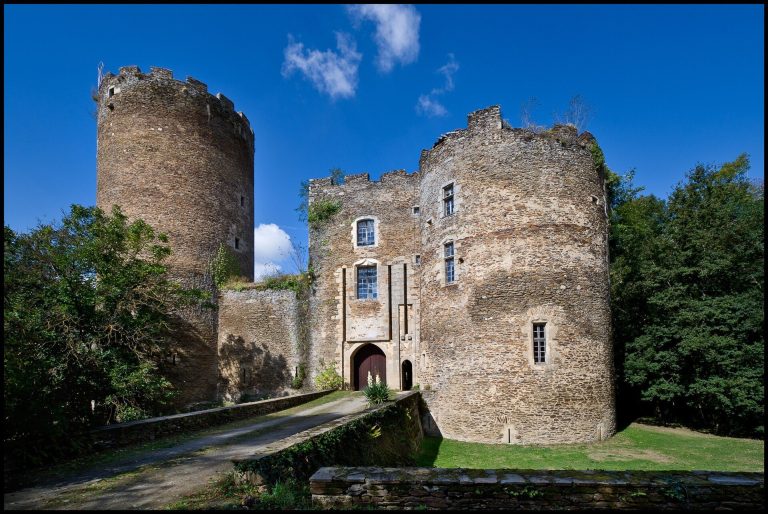
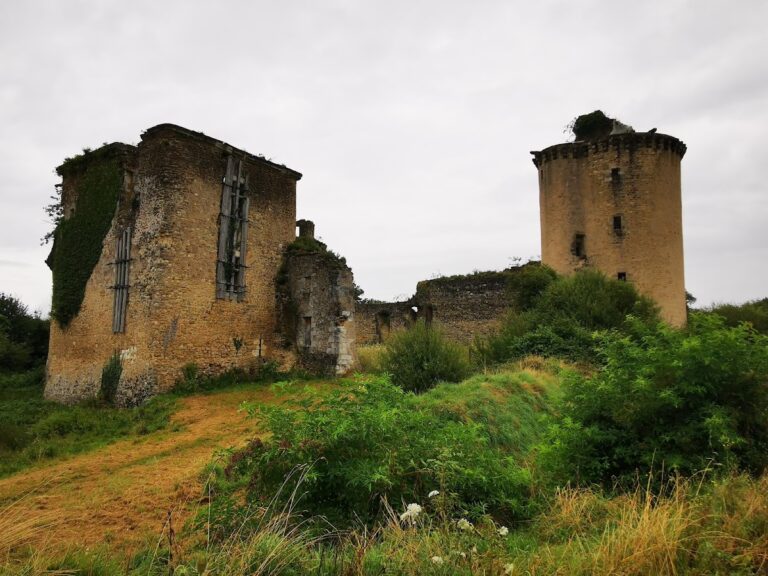
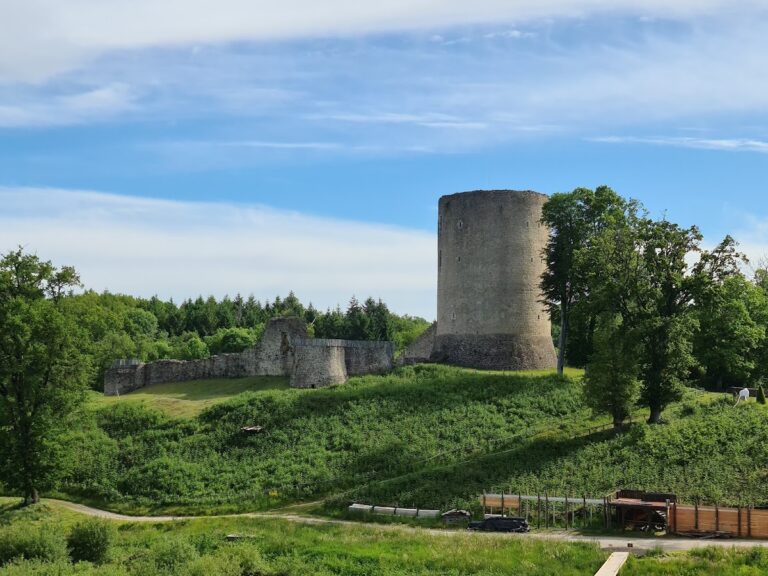
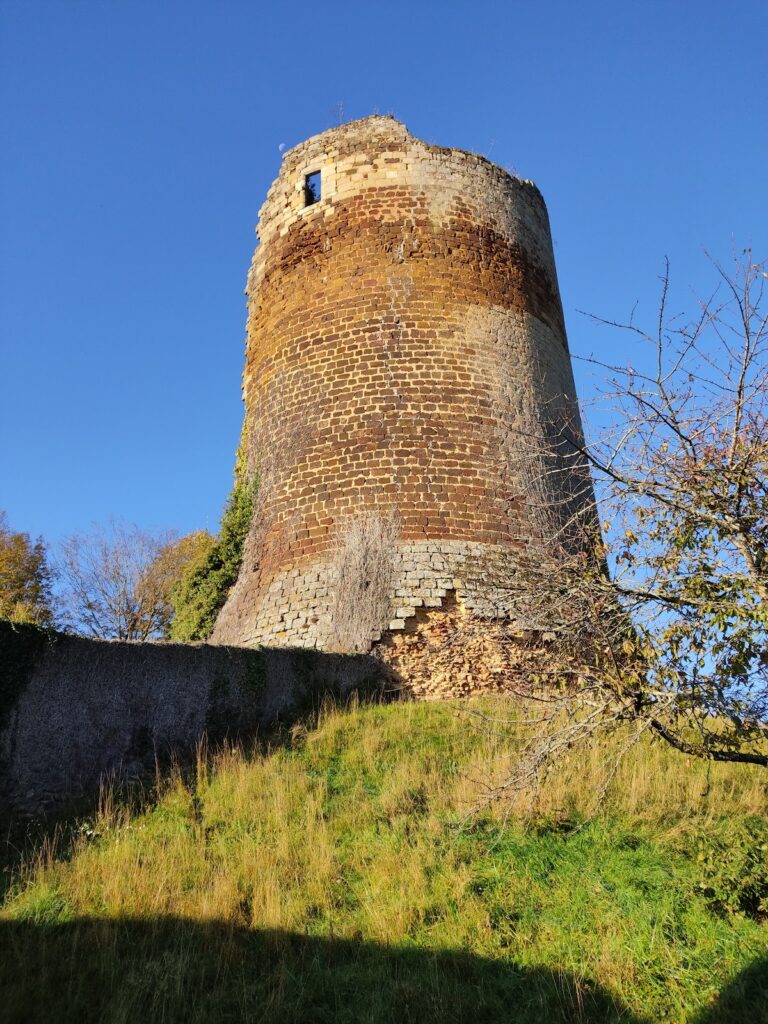
The ruins occupy a rocky ridge with steep slopes between the Creuse and its tributary, the Sédelle. The citadel covers a substantial part of the spur and is arranged in several successive enclosures. Its masonry visually echoes the exposed rock faces of the surrounding valley, while the surviving structures preserve the outline of a fortress expanded and remodelled over several medieval phases.
Fortifications and principal structures
Fifteenth-century keep
The principal surviving structures include a square-plan keep dating from the fifteenth century. A keep is the main fortified tower of a castle, generally combining strong defensive and residential functions. The tower forms part of the later rebuilding of the fortress and remains within the wider system of successive enclosures.
Thirteenth-century towers
Two towers date from the thirteenth century. One is known as Isabelle of Angoulême’s Tower, linking the surviving masonry with the traditional association between the tower and the noblewoman who was widow of John Lackland and wife of Hugh X of Lusignan. Together with the fifteenth-century keep, these towers represent the principal surviving vertical elements of the fortress.
Chapel and water tower
The ruins also include a chapel and a water tower. The water tower incorporated a covered route to the river, allowing occupants to obtain water while remaining protected. This arrangement connected the fortified structures on the ridge with the river below and formed part of the castle’s defensive organization.
Reconstruction and interpretation
The first volume of the comic series Les Aigles décapitées includes a plausible reconstruction drawing of the castle. The drawing reverses the left and right sides of the site, but it provides a visual interpretation of the fortress as a developed medieval complex rather than as the fragmentary ruins that survive today.