Château de Chazelet: A Sixteenth-Century Fortified Castle in France


Site at a Glance
- Rating
- 4.5
- Popularity
- Very Low
- Country
- France
- Primary era
- Early Modern
- External website
- Open
- Eras represented
- Medieval, Early Modern, Modern
- Civilizations
- French
- Site type
- Military
- Remains
- Castle
On this page13 sections
History
Château de Chazelet is a fortified castle in France, built on an artificial island in the valley of the Abloux River. Fortifications were established there in the thirteenth century, and the present complex took shape during a rebuilding completed in 1544. Its medieval-style reconstruction, carried out when such fortresses were becoming less common, preserved parts of the earlier stronghold and gave the castle the form that has largely survived.
From the thirteenth century to the Hundred Years’ War
The first known lord of the estate was Imbert de Gueret, whose name appears in a document dated 1285. Because the surrounding land was flat, the original fortress stood on a man-made island. In the fourteenth century, shortly before the Hundred Years’ War, a prolonged series of conflicts between the English and French crowns conventionally dated from 1337 to 1453, Chazelet passed to the powerful Counts of Brosse.
During the conflict between England and France, the estate came to Guillaume de Lage in 1369. He was captain of the royal cavalry at Vincennes in Paris and had won royal favour through military actions in Limousin and Périgord. The Lage family retained Chazelet until 1540.
The Pot rebuilding
In 1540, François Pot, lord of Chassingrimont, acquired the estate through his marriage to a daughter of Regnier de Lage. With permission from the Count of Châteauroux, the overlord of the estate, he rebuilt Chazelet as a fortified castle with moats and a drawbridge. The work was completed in 1544. It retained foundations and the lower parts of walls and towers from the earlier fortress while creating the castle’s later appearance.
François Pot’s son, François Pot II, married Gabrielle de Rochechouart, a relative of Catherine de’ Medici, the Italian-born queen consort of France and an influential royal figure. Catherine visited Chazelet during the French Wars of Religion, the sixteenth-century civil and religious conflicts fought principally between Catholic and Protestant factions.
La Trémoille and Aubusson ownership
In 1555, Suzanne Pot, the daughter of François Pot II, married François de La Trémoille, bringing Chazelet into the La Trémoille family. Because François de La Trémoille had no sons, his younger daughter Louise inherited the estate through her marriage in 1595 to Guillaume d’Aubusson.
Louise and Guillaume had eight children, including Robert, William, and Charles, who later became Knights of Malta. The Order of Malta, also known as the Knights Hospitaller, was a Catholic religious and military order. Guillaume d’Aubusson was buried in the family crypt beneath the castle chapel on 17 May 1638. Charles later left the order and married Anne Doux on 11 June 1641, thereby becoming owner of the castle. He was buried in the chapel crypt on 16 July 1664.
Charles’s two daughters, Anne-Thérèse-Gabrielle and Catherine-Hyacinthe, jointly administered the estate until Catherine married François Verthamon in September 1693. After Catherine-Hyacinthe’s death, Chazelet passed to the Verthamon family. François Verthamon left a library of valuable rare books at the castle.
Douhault, de Tilière, and later history
The estate was sold at auction on 23 August 1729 to Louis-Magdelon II, Count of Turpin-Crissé, who was married to Françoise de Douhault. As the couple had no children, Chazelet passed around 1760 to Françoise’s brother, Louis-Joseph Douhault. After the death of Louis-Joseph’s wife, Marie-Adélaïde de Rogres de Lusignan de Champignelles, known as the Marquise de Douhault, the castle passed to her nephew. In 1825, the nephew’s daughter sold the estate and its buildings to members of the de Tilière family.
Under the de Tilière family, effective management and advanced agricultural methods made the estate highly profitable. The adjoining village had about 500 inhabitants in the middle of the nineteenth century. The castle was not damaged by fighting during either the First or Second World War and remained inhabited throughout. The Counts de Tilière owned the estate until 1992, when it was sold to a French entrepreneur.
Legends, literature, and protection
Chazelet became associated with the legal affair of the Marquise de Douhault, remembered as the “False Marquise.” The trial began during the French Revolution and continued for nearly forty years. The affair inspired literary works including Wilkie Collins’s The Woman in White and Georges Lenôtre’s The Woman Without a Name.
Alexandre Dumas the Elder also connected the castle with his fiction. He published The Mysterious Doctor and The Marquis’s Daughter, novels set at or around Chazelet, and visited Count de Tilière several times. The count gave Dumas a silk-and-silver tapestry showing a woman with a unicorn, which Dumas later presented to Victor Hugo.
Château de Chazelet was listed as a historic monument in France in 1927. The designation reflects the importance of a complex whose medieval foundations, sixteenth-century rebuilding, later family history, and nineteenth-century engineering work remain closely connected.
Remains
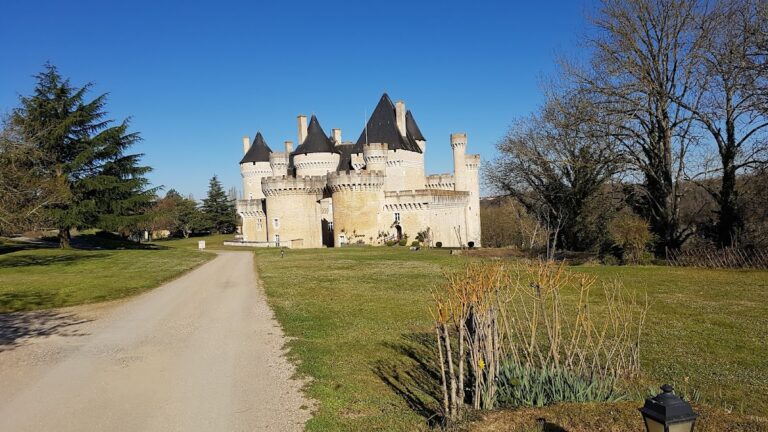
The present castle occupies almost the entire surface of a square artificial island. A square moat filled with water surrounds the island, while the castle itself is formed from stone and brick. Five round towers with narrow loopholes are joined by tall curtain walls, creating a compact fortified enclosure. A square entrance tower contains the gateway and originally provided the only crossing over the moat, reached by a drawbridge.
Fortifications and entrance
Towers and curtain walls
The round towers and connecting walls preserve the defensive character established in the sixteenth-century rebuilding. Their bases incorporate elements of the earlier fortress, while the surviving upper works belong to the reconstruction that was completed in 1544. Machicolations, projecting structures with openings for dropping or discharging materials onto attackers, and breteches, smaller projecting defensive galleries or boxes, reinforce the walls and entrance. A Pot family coat of arms remains visible at the gateway.
Moat and bridges
The water-filled moat defines the artificial island on all four sides. During modernization in the 1860s, architect Alfred Dauvergne designed an additional bridge across it. He initially proposed a metal structure, but Count Taupinart de Tilière commissioned a reinforced-concrete bridge instead. Reinforced concrete combines concrete with embedded metal reinforcement, enabling a structure to withstand tensile forces more effectively than ordinary concrete. Joseph Monier came to Chazelet in 1875 to construct the bridge, which is described as the first reinforced-concrete bridge in the world.
Chapel and later fabric
Castle chapel and family crypt
The castle chapel contains the family crypt of the estate’s later lords. Guillaume d’Aubusson was buried there in 1638, and Charles d’Aubusson followed in 1664. Their burials preserve the chapel’s role as a dynastic space within the fortified complex.
Preservation of the complex
The sixteenth-century rebuilding changed little during subsequent repairs and reconstructions. The towers and walls are exceptionally well preserved, partly because repair work was carried out in time, and the complex has also undergone restoration. The survival of the earlier foundations beneath the later castle allows the site’s thirteenth-century origins and sixteenth-century transformation to be read together in the existing fabric.