Château de Bridiers: A Medieval Fortified Castle in France


Site at a Glance
- Rating
- 4.5
- Popularity
- Low
- Country
- France
- Primary era
- Medieval
- External website
- Open
- Eras represented
- Medieval
- Civilizations
- Duchy of Aquitaine
- Site type
- Military
- Remains
- Castle
On this page8 sections
History
Château de Bridiers is a medieval fortified castle ruin at Bridiers in La Souterraine, France, constructed from the late twelfth century by the Viscounts of Aubusson. Built during the medieval period, it stood in the eastern part of the commune of La Souterraine, in the Creuse, near the historic boundaries of Berry and Poitou. Its position near the junction of a Gallic road linking Lyon and Saintes with a Roman road between Bordeaux and Bourges helped draw the castle into repeated military operations.
Early lords and the Aubusson foundation
Bridiers was the seat of a viscountcy, a lordship governed by a viscount, a rank below a count in the medieval and early-modern hierarchy. The succession of its lords was complex, with several families holding or claiming the lordship at overlapping times.
The earliest documented lords belonged to the Crozant lineage. Géraud I of Crozant, identified as the first lord of Bridiers by Geoffroy of Vigeois, offered La Souterraine to the Abbey of Saint-Martial in Limoges around 1017, during the reign of Robert II of France. The abbey was a major medieval religious institution associated with Saint Martial, traditionally regarded as the first bishop of Limoges. Géraud I was followed by Béraud I, Géraud II, and Béraud II of Crozant-Bridiers. Their line ended around 1137.
The Brosse family succeeded the Crozant line around 1137 to 1139. Géraud I of Brosse, related by marriage to the Crozant lords, inherited Bridiers and Crozant. His sons Bernard II and Foulques of Brosse later held the viscountcy. The castle itself was constructed from the late twelfth century by the Viscounts of Aubusson, placing its principal medieval fortification within a period of changing lordship and regional rivalry.
Military conflict and changing lordships
Bridiers’ position on important routes contributed to its military importance. In 1177, Henry II of England, who ruled from 1154 to 1189, besieged and captured the castle. In 1356, a force commanded by the Captal de Buch and allied with the English seized it again.
The lordship later passed to the Lusignan family, possibly as early as Hugues IX, Count of La Marche from 1199 to 1219. Hugues X of Lusignan, Count of La Marche from 1219 to 1249 and husband of Isabella of Angoulême, controlled both Crozant and Bridiers. Members of the Thouars family were recorded as viscounts from 1265 until about 1350. This succession followed the marriage of Marguerite of Lusignan to Aimery IX of Thouars. The later use of the title may have derived from the earlier Brosse viscountcy or from the transfer of the Thouars title through Marguerite, with the latter interpretation placing its formal adoption around 1375.
The Naillac family also held the viscountcy in parallel, from 1275 or, under an alternative chronology, from a later date in the fourteenth century. The recorded succession included Pierre I of Naillac, Pierre II, Perrichon or Pierre III, Philibert, and Guillaume of Naillac. Guillaume served as seneschal of Saintonge and Beaucaire. Philibert became grand master of the Order of Saint John of Jerusalem, a medieval religious and military order that operated hospitals and defended Christian territories and routes in the eastern Mediterranean.
From the fifteenth century to the Revolution-era inheritance
Jeanne of Naillac, the family heiress, married the marshal Jean de Brosse of Boussac in 1419. Jean de Brosse lived from 1375 to 1433 and was killed at the Battle of the Herrings in 1429. In the second half of the fifteenth century, Bertrand III of Maulmont-Fromental held part of the viscountcy. He is recorded between 1449 and 1476 and was associated with Jacques II and Jacques III, Counts of La Marche.
The Brosse family of Boussac and Sainte-Sévère held Bridiers until 1522. The viscountcy then passed to their relative Philiberte of Savoy, daughter of Duke Philippe II and Claudine of Brosse-Boussac, and wife of Julien de Medici, Duke of Nemours. In 1526, Jean II de La Barre received the County of Étampes and the Viscountcy of Bridiers as a reward for his loyalty to Francis I. Through the marriages of his daughters, the title subsequently passed during the sixteenth century among the families of Estouteville, Courtenay, Lignières, Varye, Couhé, and Couhé de Lusignan.
In 1623, Marguerite d’Aubray became Viscountess of Bridiers. She was the wife of François Pot of Rhodes, grand master of ceremonies, and the mother of Henri Pot, who also held the title. Henri Pot was followed by his son Charles Pot and then by Charles’s daughter, Marie-Louise-Charlotte Pot of Rhodes, who was also Marchioness of Rhodes and Lady of Menetou and La Maisonfort.
The Pot inheritance passed to members of the Mesgrigny family, including Charles-Hubert and his sister Louise-Françoise. The Bouthillier family of Beaujeu later held the viscountcy and sold it in 1756 to Marguerite-Henriette de La Roche, widow of Jean-Baptiste-Jacques Boucher, treasurer of the French colonies in America. Her daughter Marie-Victorine, also known as Victoire, married Louis-François-Marie-Honorine de Rochechouart-Pontville in 1757. Their children included Armand-Constant de Rochechouart-Pontville, the last viscount of Rochechouart, and Michelle-Marie-Constance de Rochechouart-Pontville.
Dispersal, preservation, and public use
In 1820, Michelle-Marie-Constance and her husband, Antoine-Joseph Flotard de Montagu-Lomagne, gave the castle estate to their son, Armand-Jean Flotard de Montagu-Lomagne. He sold the land in parcels, including the great tower. The tower and the surviving castle remains were designated as French historic monuments by an order dated 24 September 1968.
After a long period of abandonment, the keep underwent safeguarding and archaeological work. Excavation and restoration were still in progress in 2019. The former fortified-castle function has since given way to use as a public park and garden. The site also hosts a recurring large-scale historical pageant that presents Bridiers’ history through staged scenes, lighting, projected images, music, and pyrotechnics.
Remains
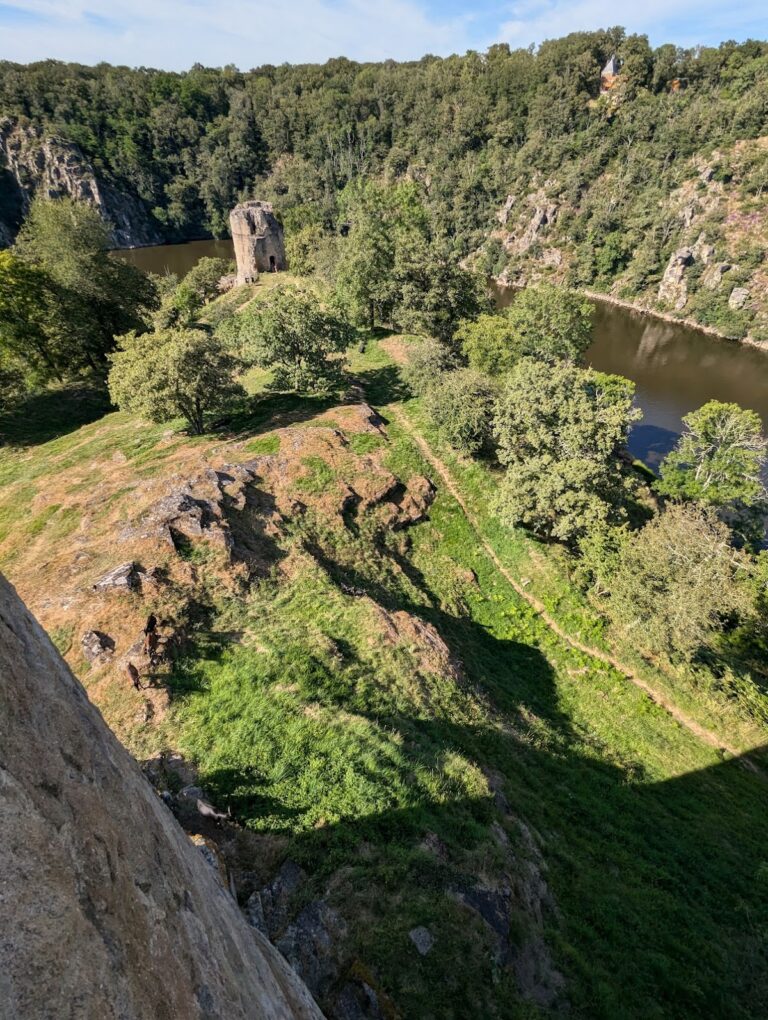
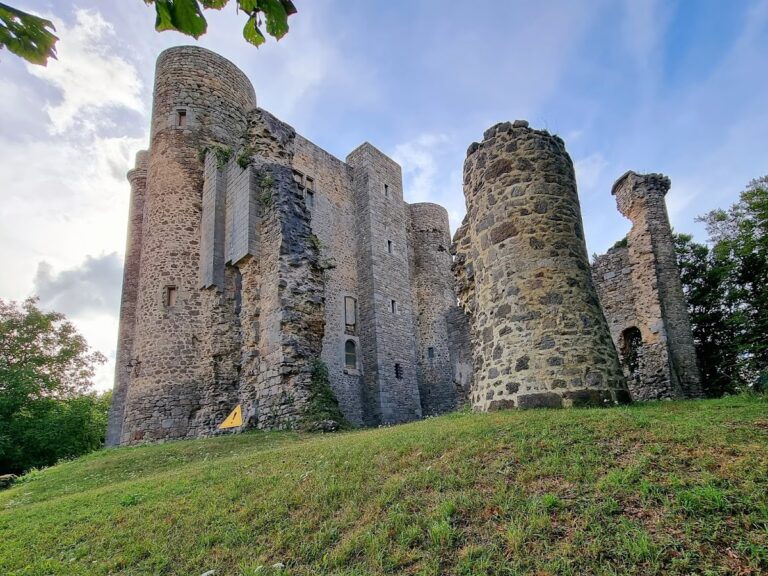
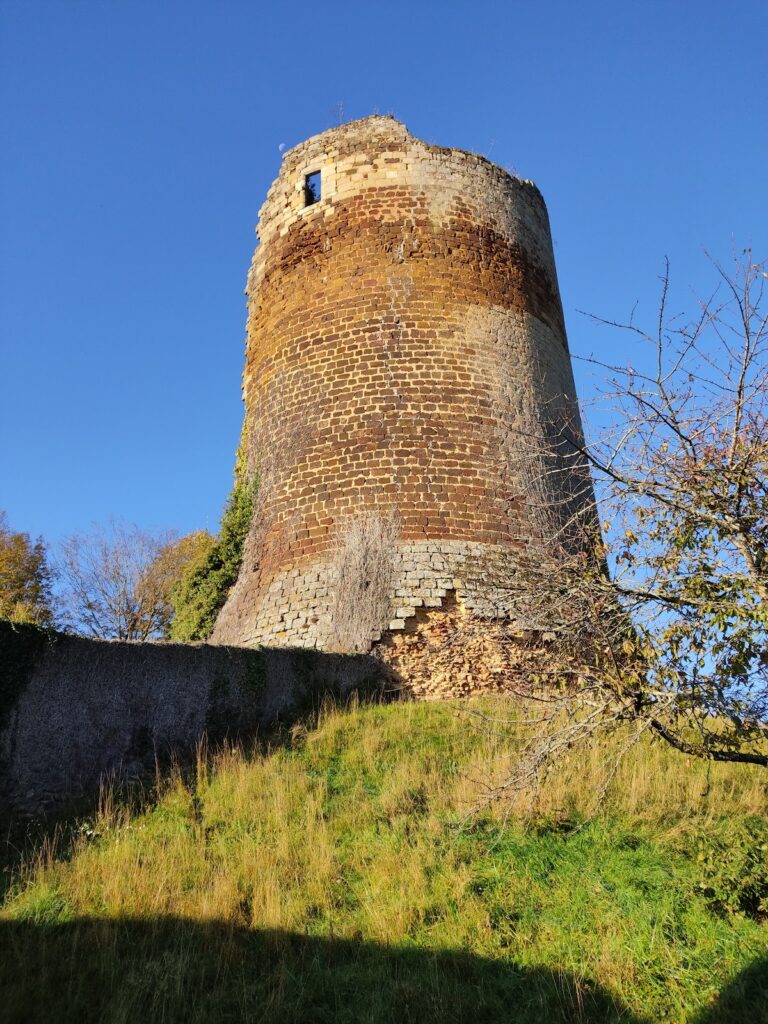
Château de Bridiers survives primarily as a medieval castle ruin organized around its tower or keep. Archaeological excavation has exposed the pentagonal structures of the principal fortified building. The surviving remains now form part of a park and garden setting, where restoration and archaeological work have helped reveal the physical form of the former fortress.
The keep and excavated fortress
The keep is the principal surviving feature of Château de Bridiers. A keep was the main fortified tower of a medieval castle, serving as a strong defensive position and often as a residence or visible expression of lordship. At Bridiers, the tower had been abandoned for a long period before safeguarding and restoration began. Archaeological investigation exposed the building’s pentagonal structures, making the tower the central surviving element through which the form of the former fortress can be understood.
Medieval garden and park setting
A medieval garden lies a few metres from the tower and forms part of the present park. Its design was initiated by Jean-Philippe Béguin together with members of the town’s employment-integration project. Since 2008, municipal services have been responsible for its design and maintenance. A herd of Rove goats has helped maintain the site since 1999.
Nearby sites