Château de Bannegon: A Medieval Fortified Residence in France


Site at a Glance
- Rating
- 4.4
- Popularity
- Low
- Country
- France
- Primary era
- Medieval
- External website
- Open
- Eras represented
- Medieval, Early Modern
- Civilizations
- French
- Site type
- Military
- Remains
- Castle
On this page9 sections
History
Château de Bannegon is a medieval fortified residence in France, on the historical boundary between Berry and Bourbonnais. It began as a defensive work probably in the eleventh century, while the first château developed in the twelfth century as a seigneurial residence surrounded by moats and defensive towers.
Medieval frontier stronghold
The château was associated with the La Porte family around the year 1000 and passed to the des Barres family from 1383. Its position between the historic provinces of Berry and Bourbonnais gave it a frontier role during a period of repeated political and military conflict.
Château de Bannegon survived the Hundred Years’ War, the prolonged series of conflicts between the English and French crowns conventionally dated from 1337 to 1453. King Charles VII, who ruled France from 1422 to 1461, stayed at the château in 1431 and again in 1454.
Siege and Renaissance transformation
In 1568, during the Reformation, a religious movement that challenged the authority and practices of the Roman Catholic Church and led to the formation of Protestant churches, the château was besieged for fifteen days. The attacking force numbered 2,000 men and was led by Montaré, governor of Bourbonnais, because the owners sympathized with the reform movement. Marie de Brabançois, then Lady of Bannegon, directed the defence.
The château was partly destroyed during the sixteenth century. Its rebuilding included a new structure in the early Renaissance style, adding a later architectural phase to the medieval complex. In 1652, Roger de Bussy-Rabutin, a French nobleman, military officer, and writer, occupied Bannegon for the king.
Revolution, inheritance, and conservation
During the French Revolution, the château became national property and was sold. The de Bengy family inherited it in 1807. A restoration campaign at the end of the nineteenth century renewed the complex while preserving much of its medieval appearance.
In the late twentieth century, a preservation association was created to support conservation of the neglected château. The annual Bannegon Medieval Festival began in 1996, and its proceeds are devoted to restoration and preservation work. The château remains privately owned, with Antoine de Bengy Puyvallé identified as its current owner. It has been classified as a French monument historique, a protected historic monument or site, since 1965. The classification covers the façades, roof structures, and roof coverings.
Remains
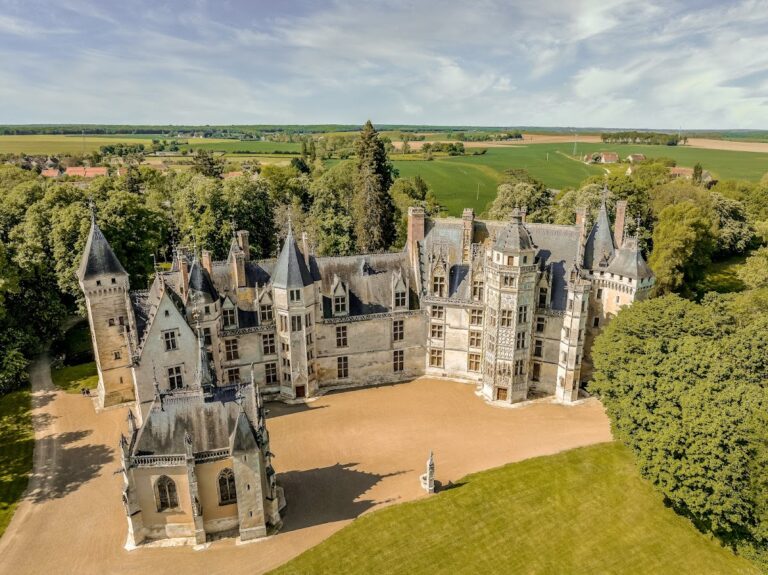
Château de Bannegon stands in the commune of Bannegon in the Cher department, beside the Auron River and the former boundary between Berry and Bourbonnais. The surviving complex is organized around an imposing keep, a trapezoidal fortified enclosure, a drawbridge, moats, and defensive towers. Its buildings and later additions preserve the relationship between the medieval stronghold and the Renaissance phase of rebuilding.
Fortifications and towers
Keep and fortified enclosure
The keep forms the dominant defensive element of the château and is reached by a drawbridge. Around it lies a trapezoidal fortified enclosure bordering the Auron. Moats and defensive towers surrounded the buildings, reinforcing the complex’s role as a protected seigneurial residence.
Barres Tower
The large tower known as the Barres Tower dates from the thirteenth century or the beginning of the fourteenth century. It contains a chimney measuring 9.5 metres in height, an interior feature that forms part of the surviving medieval fabric.
Renaissance building and restoration
After the partial destruction of the medieval château in the sixteenth century, a building in the early Renaissance style was added to the complex. The restoration undertaken at the end of the nineteenth century preserved much of the château’s medieval character, allowing the defensive enclosure, towers, and later building to remain legible as parts of a long architectural sequence.