Castel Nanno: A Renaissance Castle in Trentino, Italy


Site at a Glance
- Rating
- 4.3
- Popularity
- Low
- Country
- Italy
- Primary era
- Early Modern
- External website
- Open
- Eras represented
- Medieval, Early Modern
- Civilizations
- Holy Roman Empire
- Site type
- Domestic
- Remains
- Castle
On this page7 sections
History
Castel Nanno is a castle in Italy, in the municipality of Ville d’Anaunia in Trentino. It originated in the thirteenth century, with the earliest recorded references dating to 1264. Its present character largely comes from a sixteenth-century Renaissance rebuilding, and it was the ancestral seat of the lords of Denno-Nanno.
The Lords of Nanno
The Denno-Nanno family was a medieval ministerial lineage, a noble service family that held land or offices for a higher lord. It was first associated with the counts of Eppan and later with the bishops of Trento, whose bishopric also exercised territorial authority. In 1274, Niccolò and Giordano, sons of Ropreto da Denno, acquired the castle and adopted the surname da Nanno.
In 1350, Bishop Johann of Pistoia declared the Nanno-Madruzzo family under a ban and withdrew its fiefs because of disloyalty. Peter of Spaur then received Castel Nanno as a fief, meaning land or jurisdiction granted in return for service. He renounced it in 1391 but later reconquered it. In 1420, the bishop of Trento returned the fief to the Nanno family.
The hostility between the Nanno and Spaur families survives in a local legend concerning Melisenda of Nanno and Ludovico of Sporo. According to the story, Melisenda’s father discovered their forbidden relationship and had both lovers walled up alive at Nanno.
The Rise of the Madruzzo Dynasty
Family inheritance disputes shaped the castle’s later ownership. In 1447, Riprando da Nanno received the fief of Castel Madruzzo and adopted the Madruzzo surname through his connection with that family. This marked the rise of the Madruzzo dynasty, a prominent noble house whose members included several prince-bishops of Trento. An arbitration ruling awarded Castel Nanno to Nikolaus von Nanno in 1452.
On 24 October 1523, Anton von Nanno transferred all his Trento fiefs to his distant relative Gratiadeo Madruzzo, captain of Thun and cousin of the prince-bishop of Trento. During the first half of the sixteenth century, the castle was extensively rebuilt. Giovanni Gaudenzio Madruzzo ordered a complete renovation between 1520 and 1530, while Cristoforo Madruzzo commissioned a Renaissance residential building around the medieval keep, the castle’s principal fortified tower, and used the complex as a summer residence.
Later Ownership
In 1610, during the tenure of Gaudenz von Madruzzo, a witch trial took place at the castle. Three women were sentenced to death by burning. Castel Nanno later belonged to Prince-Bishop Carlo Emanuele Madruzzo, a prince-bishop being a bishop who also held secular territorial authority. The Madruzzo family became extinct in the male line during his tenure. Following an inheritance division, the castle passed to the bishopric of Trento in 1661.
In the late nineteenth century, Carlo Ritter von Giuliani, a librarian and museum director in Trento, owned Castel Nanno and placed it in better condition. The castle is now privately owned, is only exceptionally accessible, and is recognized as Italian national heritage.
Remains
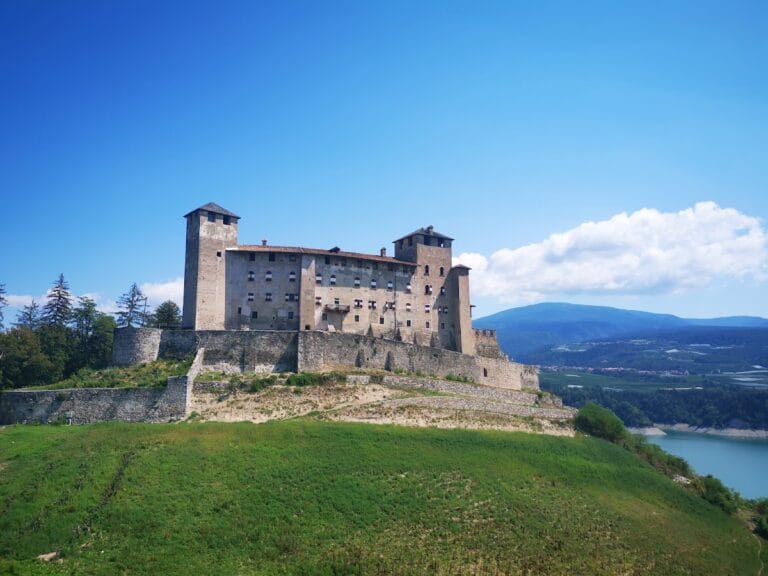
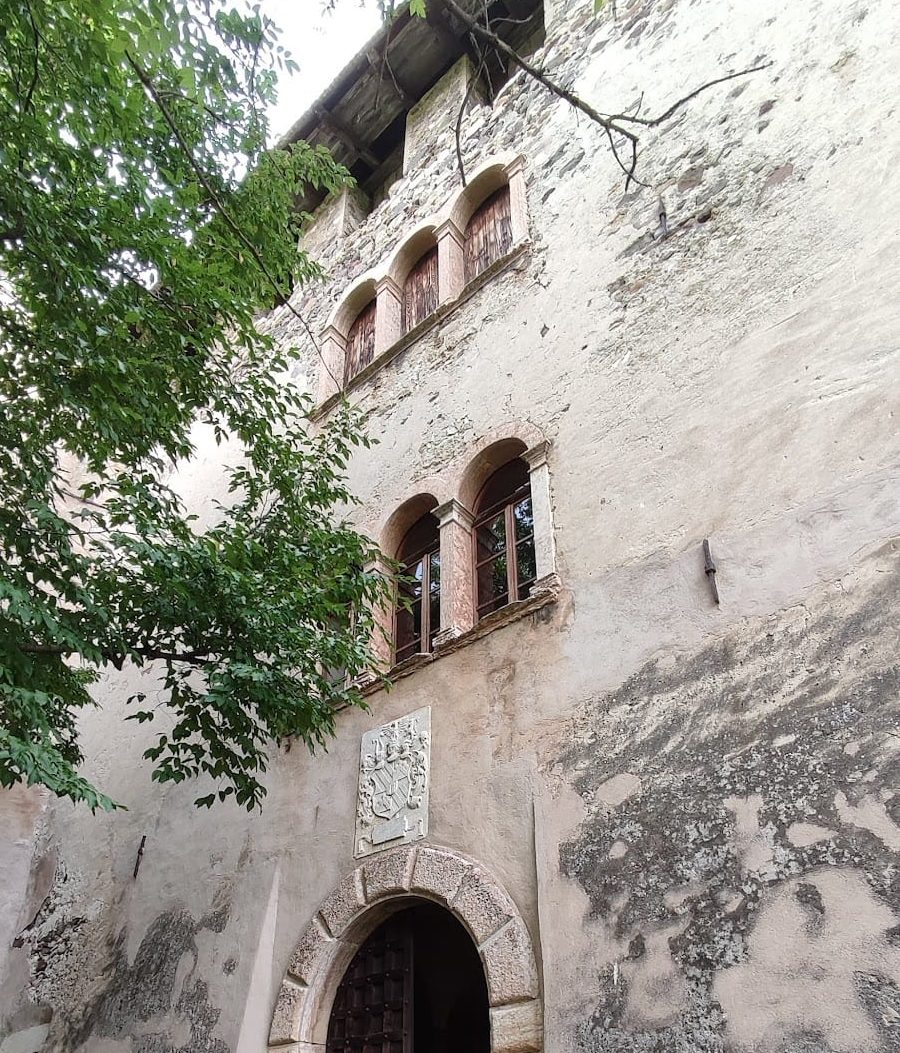
Castel Nanno stands on a hill and has the appearance of a sixteenth-century Renaissance residence. The residential building is enclosed by a quadrangular curtain wall, the defensive wall connecting fortified structures, with four corner turrets. The complex is partially preserved, and the Renaissance residence incorporates the principal surviving element of the earlier medieval castle.
Renaissance Residence
The residential building was commissioned as part of the sixteenth-century transformation of the castle. It surrounds the medieval keep and is enclosed by the quadrangular curtain wall. Four corner turrets define the outer perimeter, while the surviving arrangement expresses the change from a medieval fortified complex to a Renaissance residence.
Medieval Keep
The medieval keep is incorporated into the Renaissance residence and remains the chief surviving feature of the earlier castle. Part of it collapsed in 1873. Its surviving fabric preserves the connection between Castel Nanno’s thirteenth-century origins and the later residential rebuilding, although the complex as a whole is only partially preserved.