Château de Bonnais: A Late Fifteenth-Century Castle in France


Site at a Glance
- Rating
- 4.5
- Popularity
- Very Low
- Country
- France
- Primary era
- Medieval
- External website
- Open
- Eras represented
- Medieval, Early Modern
- Civilizations
- French
- Site type
- Military
- Remains
- Castle
On this page8 sections
History
From Bonayo to Bonnais
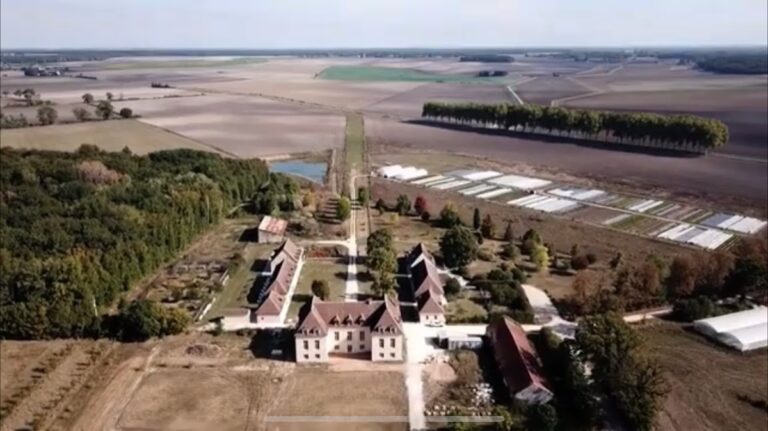
The Château de Bonnais is a historic château in France, east of Coust in the Cher department. Its principal construction dates from the end of the fifteenth century, while the fief itself is recorded earlier under the name Bonayo. The place appears as Bonnay around 1435, Bonay in 1454 and 1569, and in its present spelling from 1774 onward.
The Bonnais family were the earliest known proprietors. Amisius de Bonayo is recorded in 1274, when he married Benvenuta, and Renulphus de Boneyo was lord in 1283. Arnoul de Bonay, who was also marshal of Berry, a senior military officer, and lord of Précy and Quantilly, married Ysabeau de Sancerre around 1384. Pierre de Bonnay, lord of Précy and Bonnay, married Jeanne de Grassay in 1445, while Gilbert de Bonay married Marguerite de Bar in 1550. Paul, described as lord of Bonnais in 1613, was the last known lord of that family.
The d’Aubigny estate
The d’Aubigny family held Bonnais after the Bonnais line. An old family associated with chivalry in 1550, the d’Aubignys also possessed lands in Bourbonnais, one of the historical provinces of central France. Jean d’Aubigny was lord of Bonnais and Alligny in 1669, and Antoine-François d’Aubigny was a knight and lord of Bonnais in 1768. The family retained the estate until the French Revolution.
Jean-Claude-Gilbert d’Aubigny was born at Bonnais in 1736. He served as vicar at Saint-Amand-Montrond, parish priest at Saint-Pierre-les-Bois and Notre-Dame-du-Fourchaud in Bourges, and titular canon of Bourges Cathedral, a cathedral chapter member holding a canonry. After refusing the Civil Constitution of the Clergy, the revolutionary measure that reorganized the Catholic Church in France and required clerical allegiance to the state, he hid at the nearby Château de Madeau. He was arrested on 26 April 1793, imprisoned at the Saint Francis convent in Bourges, and deported on 6 March 1794. He later died on the Rochefort prison hulks, decommissioned ships used as floating prisons during the revolutionary period.
Nineteenth-century ownership and restoration
Bernard Rey, a member of the council, owned the château during the nineteenth century. The building has since been substantially restored, and one wing has been arranged as a gîte, a furnished rural lodging.
Remains
Layout and water defences
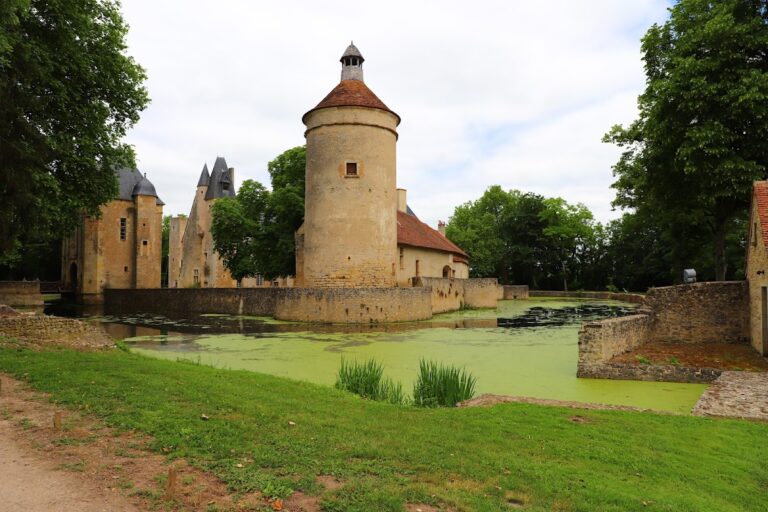
The château follows a square plan and has six towers, including four positioned at the corners. One corner tower contains a pigeon loft, a purpose-built space for keeping pigeons. The Chignon stream, a tributary of the Marmande, supplies the surrounding moats. The same stream also feeds the moats of the old Castel of Saint-Amand-Montrond.
Entrance stair tower
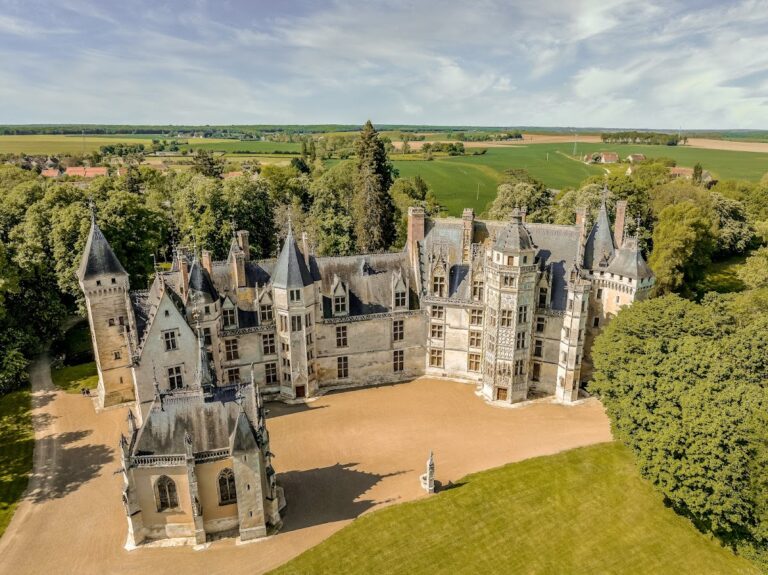
On the courtyard-facing side of the main façade, the entrance stair is enclosed within an octagonal tower. Its upper section changes from octagonal to square through the use of corbels, projecting structural supports that carry weight above them. A round turret, supported by curved corbels, provides access to the upper floors. This arrangement has parallels at the châteaux of Gien and Jallanges.
Western entrance
A western portal has an arch in the Louis XIV style, the architectural and decorative forms associated with the reign of Louis XIV, especially during the seventeenth century. The portal is attributed to that period and represents a later addition or alteration to the principal late fifteenth-century construction.
Nearby sites