Chapelle Saint-Martin-de-Fenollar: A Pre-Romanesque Chapel in France


Site at a Glance
- Rating
- 4.6
- Popularity
- Very Low
- Country
- France
- Primary era
- Medieval
- Eras represented
- Medieval
- Civilizations
- Unclassified
- Site type
- Religious
- Remains
- Chapel
On this page8 sections
History
Chapelle Saint-Martin-de-Fenollar is a pre-Romanesque Roman Catholic chapel in France, near Maureillas-las-Illas, associated with the cultural landscape of Roussillon. Dedicated to Martin of Tours, a fourth-century bishop widely venerated for charitable conduct and the spread of Christianity in Gaul, it preserves architecture linked to suspected Visigothic traditions and a major cycle of Romanesque frescoes.
Early religious foundation
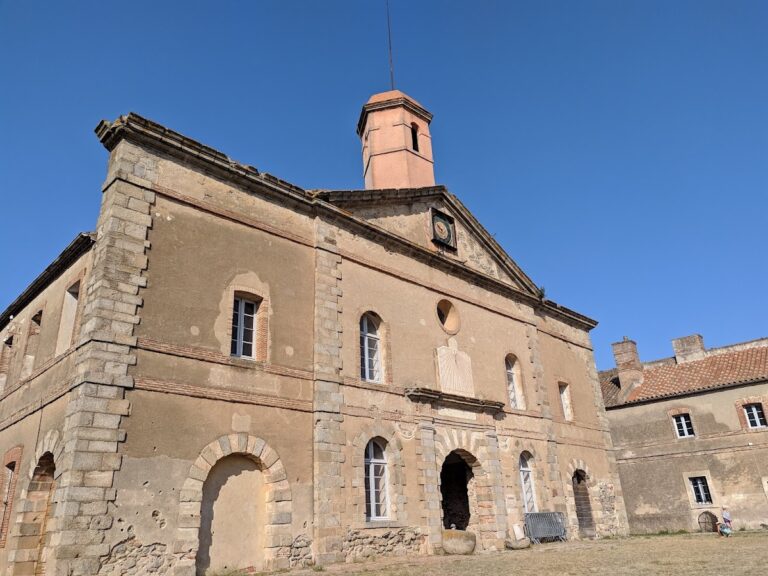
A church or religious property at the site appears in an 844 confirmation by Charles the Bald, the Carolingian king of West Francia. The ruler confirmed it as the possession of the Benedictine Abbey of Arles-sur-Tech. The building was described as a cella, a small dependent religious establishment occupied by only a few members of a larger monastic community. A vaulted room set at right angles to the chapel, now incorporated into the adjacent building, may have accommodated the monks.
The church mentioned in 844 was probably not the structure that survives today. The chapel’s construction date remains uncertain, although it is generally placed between the ninth century and the beginning of the eleventh century. A tenth-century date has also been proposed, while the date and identity of its original patron or commissioner remain unknown. Its form belongs to the pre-Romanesque traditions of Septimania, a historical region broadly corresponding to present-day Roussillon and Languedoc.
Medieval and modern transformations
A will dated 1187 records a bequest to Saint Martin of Fenollar involving bread and wine. This provides evidence of a medieval benefaction connected with the chapel. The Romanesque frescoes are generally dated to the twelfth century. Their anonymous painter is conventionally known as the Master of Fenollar, and the same artist is considered responsible for frescoes preserved in part of the main apse of Sainte-Marie at La Cluse-Haute.
In the modern period, the chapel was converted into an agricultural storehouse. A doorway opened through the eastern chancel wall destroyed part of the Romanesque decoration before the opening was later blocked. Restoration in the 1950s and 1960s completely exposed the frescoes and repaired the eastern wall, bringing much of the surviving medieval decoration back into view. The chapel has been protected as a French historic monument since 5 December 1908, with that protection extended by a further classification order on 1 August 1967. The colours of its frescoes later influenced artists including Pablo Picasso and Georges Braque, twentieth-century modernist painters associated with Cubism.
Remains
Chapel layout and construction
The chapel is a small plastered building near the Roman Via Domitia, the road that crossed southern Gaul toward the Iberian Peninsula. It stands about 500 metres northeast of the centre of Maureillas-las-Illas and a few kilometres from the Spanish border. The plan consists of a single nave followed by a narrower, lower eastern chancel and a smaller rectangular apse, the eastern end of the church where the altar is placed.
The nave contains three bays and measures approximately 9.50 metres long by 3.40 metres wide. Its stone barrel vault is strengthened by two transverse arches with a slightly horseshoe-shaped curve. The chancel is trapezoidal, raised above the nave, and separated from it by a similar triumphal arch, the arch dividing the nave from the sanctuary. Its barrel vault covers an area ending in a rectangular apse about 3.20 metres deep and 2.40 metres wide on average. A small altar stands against the rear wall, while stone benches run along the nave walls.
The vaulting’s date and original form are uncertain. It may have replaced an earlier timber roof around the twelfth century, although the existing vault has also been assigned to the eleventh or possibly the twelfth century. A small opening above the altar was formerly unglazed, and two further openings illuminate the chapel above the triumphal arch and high in the west wall. The otherwise undecorated west facade carries a small bell gable. The entrance is centrally placed on the south side and is reached by several steps descending into the interior. A medieval stone cross is also associated with the chapel.
Romanesque frescoes
The interior was probably covered throughout with painted decoration, and fragments remain on the nave walls. Most of the fresco cycle is concentrated in the chancel. The eastern part was damaged when the former agricultural doorway was cut through the chancel wall, but the later blocking of the opening and restoration of the wall helped preserve the remaining decoration.
Lower and middle registers
The paintings are arranged in four superimposed registers. The lowest imitates a hanging textile or curtain. Above it, the Nativity cycle includes the Annunciation, the Nativity, the Announcement to the Shepherds, the Adoration of the Magi, and the Return of the Magi. In the Annunciation, Mary listens to the angel Gabriel. In the Nativity, Mary rests on one bed while the infant Jesus lies on another, with Joseph seated nearby. Only an angel remains from the scene of the shepherds, while the Virgin is shown carrying the child in the Adoration of the Magi.
Apocalyptic figures and the vault
The upper register shows the twenty-four Elders of the Apocalypse lifting their cups and making music in homage to Christ. Above the axial window, the praying Virgin appears inside a diamond-shaped mandorla, an almond- or lozenge-shaped enclosure around a sacred figure, framed by two angels.
The vault presents Christ in Majesty within a mandorla. He blesses with his right hand and holds a book in the other. Around him are the symbols of Matthew, Mark, Luke, and John, the four Evangelists traditionally associated with the canonical Gospels. Inscriptions identify the symbols, which are accompanied by some of the twenty-four Elders.