Chapel of St. Blas: Pedro Tenorio’s Funerary Chapel in Toledo Cathedral
Site at a Glance
- Popularity
- Medium
- Country
- Spain
- Primary era
- Medieval
- Eras represented
- Medieval, Early Modern
- Civilizations
- Crown of Castile, Habsburg, Habsburg Spain, Spanish
- Site type
- Religious
- Remains
- Chapel
On this page12 sections
History
The Chapel of St. Blas is a funerary chapel dedicated to Saint Blaise of Sebaste, a Christian saint traditionally regarded as a bishop and martyr, within Toledo Cathedral in Spain. Founded for Archbishop Pedro Tenorio in the late fourteenth century, it was intended as his burial place and a setting for continuing memorial worship.
Foundation and completion
The date when construction began is uncertain. One proposal links its start to work on the cloister in 1389; another places it around late 1397, when Tenorio issued the chapel’s foundation deed. Cathedral accounts record work on the vault in autumn 1398 and on the roof framework before the end of that year. The enclosing walls were probably finished shortly before Tenorio died at Alcalá de Henares in 1399. The chapel was completed on 10 May that year, ten days before his burial.
A deed dated 9 November 1397 and Tenorio’s will, made shortly before his death, set out the chapel’s purpose and support. Revenues were assigned to its upkeep, while the cathedral chapter was charged with its management and the appointment of six chaplains. They were to celebrate masses and memorial services, and Tenorio’s burial in the chapel was stipulated.
Repairs and changing decoration
Dampness prompted the first recorded restoration in 1403. Painters renewed the murals during the fifteenth and sixteenth centuries. In the late sixteenth century, three altarpieces were made for the east wall to cover areas where the paintings had deteriorated. The successive interventions, together with inadequate funds, led to the chapel’s closure on 3 September 1685. Cardinal Luis Manuel Fernández Portocarrero later ordered it reopened.
In 1720, painter Francisco Rodríguez de Toledo was commissioned to whitewash the walls and extensively chip their surfaces up to the cornice, while repainting the paintings above it. A cleaning in 1924 removed whitewash from the lower walls and revealed remnants of earlier murals. In the early twenty-first century, a major restoration consolidated the paintings and recovered much of their color.
Artistic attribution
The murals’ authorship remains unresolved. In 1624, Eugenio Narbona attributed them to an Italian master he called Ioto Griego. Gherardo Starnina, a Florentine painter in Toledo in 1393, may have been brought by Tenorio to work on the cathedral’s original main altarpiece. Parts of its paintings survive in the altarpiece of the Chapel of Saint Eugene, where Juan de Borgoña repainted them in 1516 to suit changing tastes. Starnina is not considered the author of the Chapel of St. Blas murals: their creation could not have begun before 1399, by which time he had been established in Valencia for some time.
A painter who came to the Iberian Peninsula with Starnina, possibly Niccolò d’Antonio, has been suggested instead. The proposed attribution to Antonio Veneziano also faces chronological and stylistic difficulties. At least four artists took part in the work, and art historian Joan Molina Figueras proposed the designation Master of the Chapel of Saint Blaise for its principal painter.
Remains
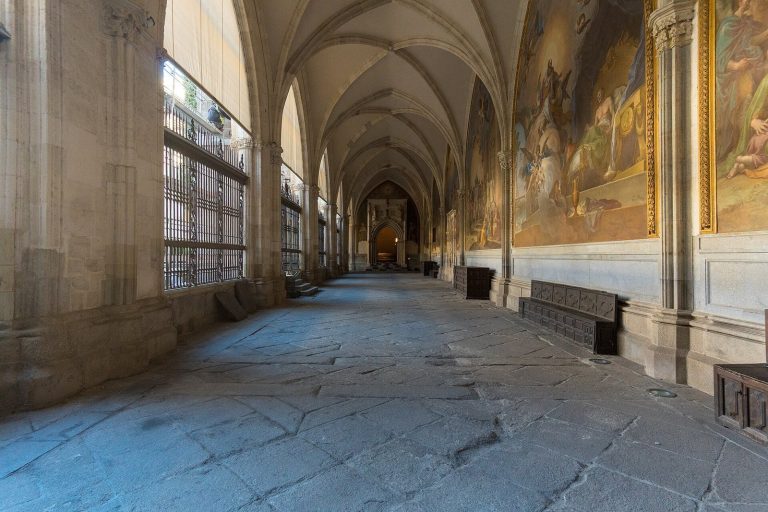
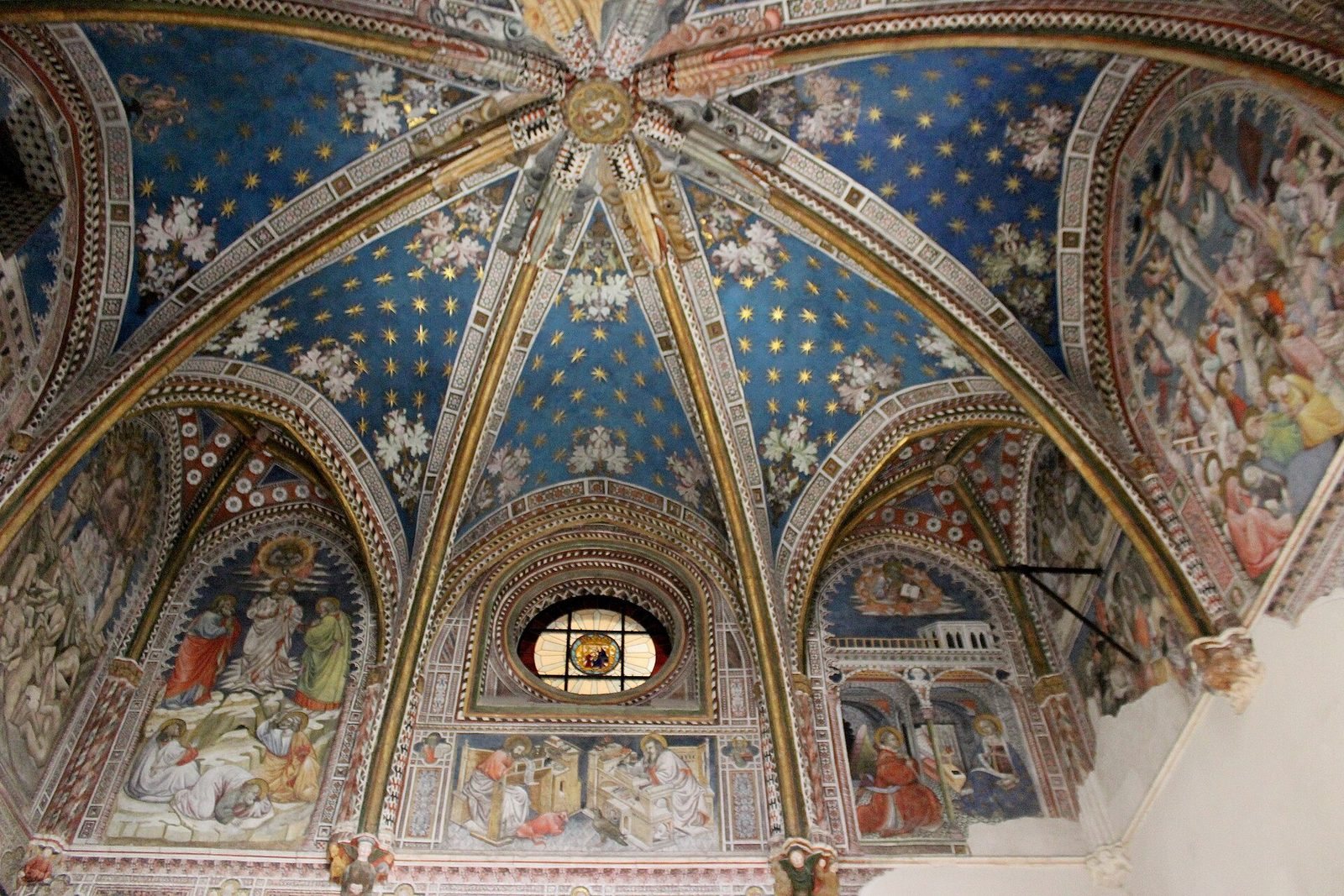
The chapel occupies a square space on the ground floor of Toledo Cathedral’s cloister. Its chamber lies below street level, beneath an octagonal vault, and its entrance is reached from within the cathedral complex.
Layout and entrance
Chapel chamber
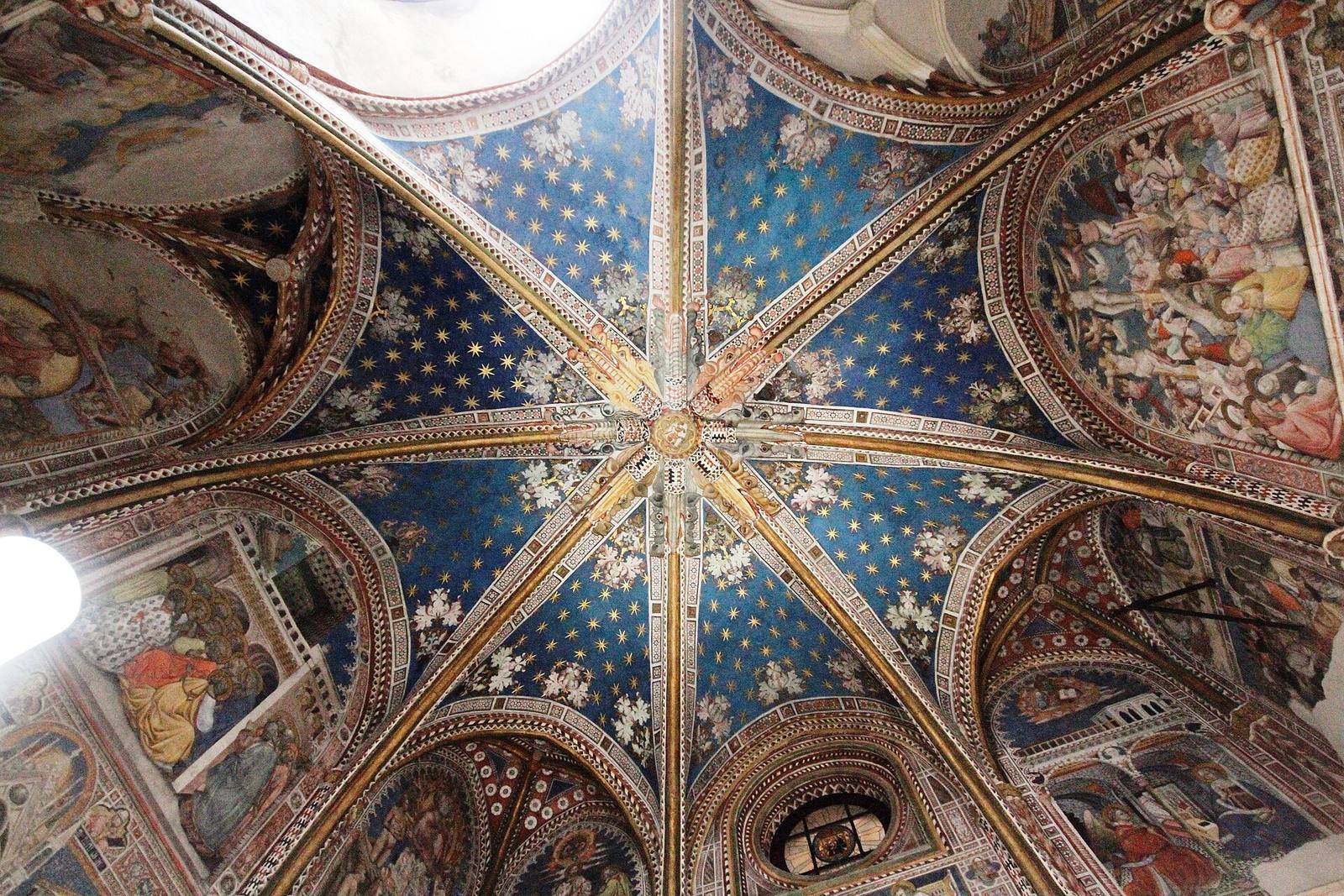
The square-plan chapel lies seven metres below street level and is covered by an eleven-metre-high octagonal vault. Although it can appear separate, it forms an integral part of the cloister and has no direct entrance from outside. As construction neared completion, Tenorio ordered the floor lowered because the building’s mass seemed too heavy in appearance. The change also increased the chapel’s interior height. Persistent damp was addressed by paving the adjacent courtyard and directing water through the cloister towards the street.
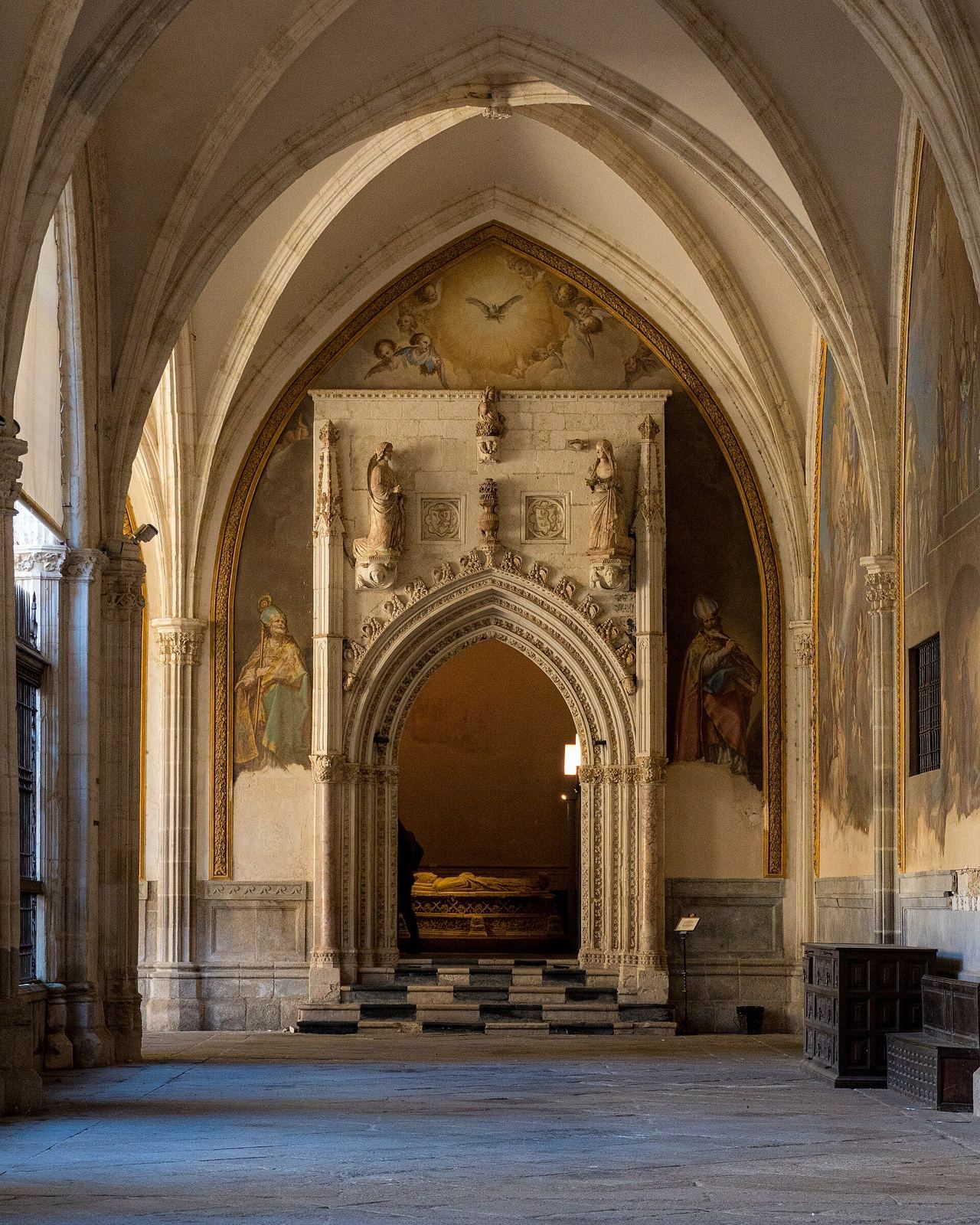
Entrance portal
The Gothic portal is ornamented with foliage and a decorative crest, with a vase set above the arch’s central stone. A sculpted Annunciation above it shows figures close to life size: the angel Gabriel announces to Mary that she will bear Jesus. God the Father appears with them, and the Holy Spirit, understood in Christian belief as part of the Trinity, is represented in paint. A walnut-wood door opens onto steps descending into the chapel.
Burial monuments
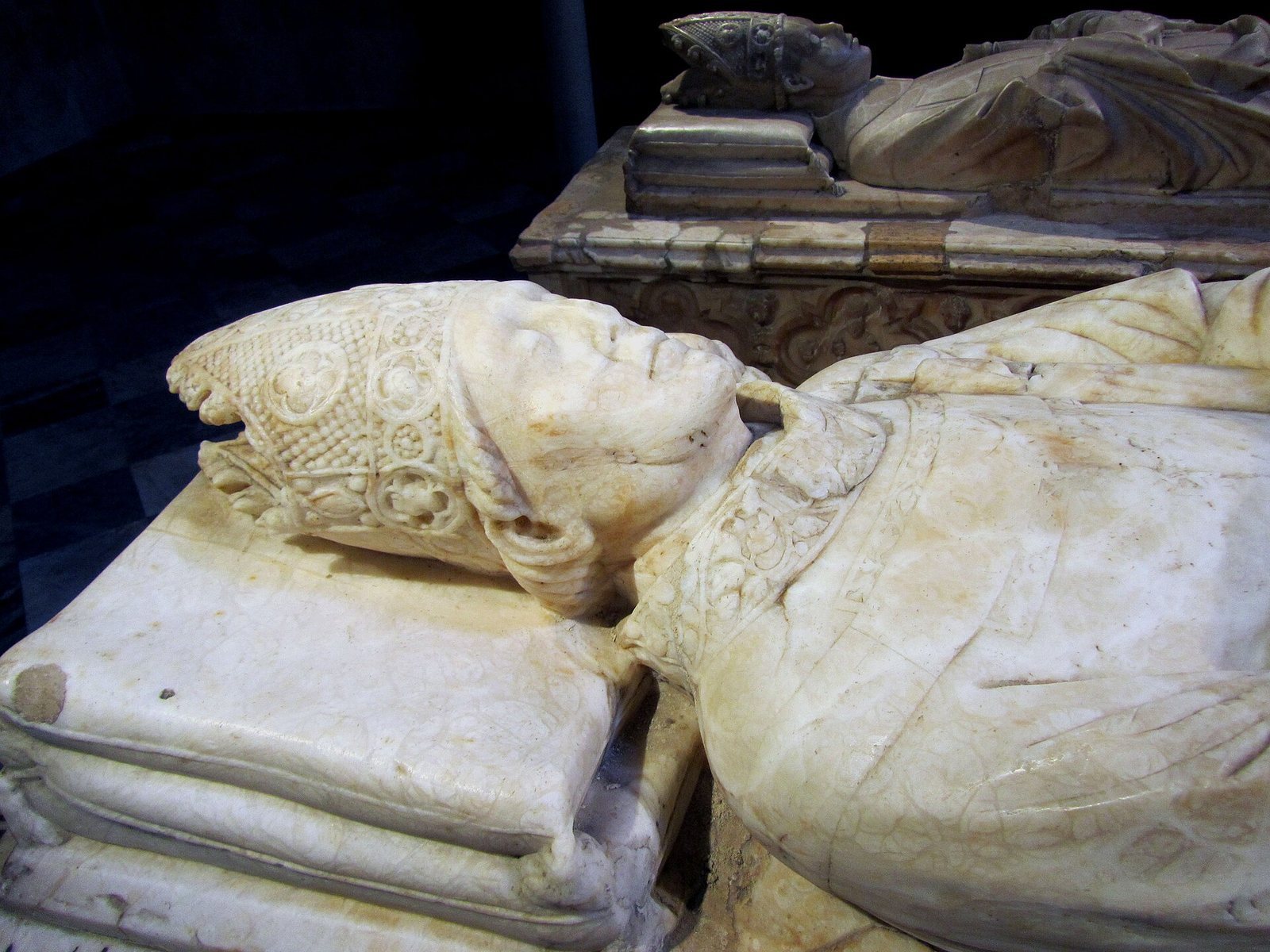
Two white-marble tombs stand inside the chapel, one for Tenorio and the other for his nephew and secretary Vicente Arias Balboa, Bishop of Plasencia. Both date to about 1399 and are attributed to sculptor Fernando González. Each sarcophagus rests on carved lions and bears figures of saints beneath arches with lobed outlines. The tombs carry recumbent effigies, carved figures shown lying down, and Tenorio’s monument stands slightly higher than his nephew’s.
Painted decoration
Scenes of the Creed
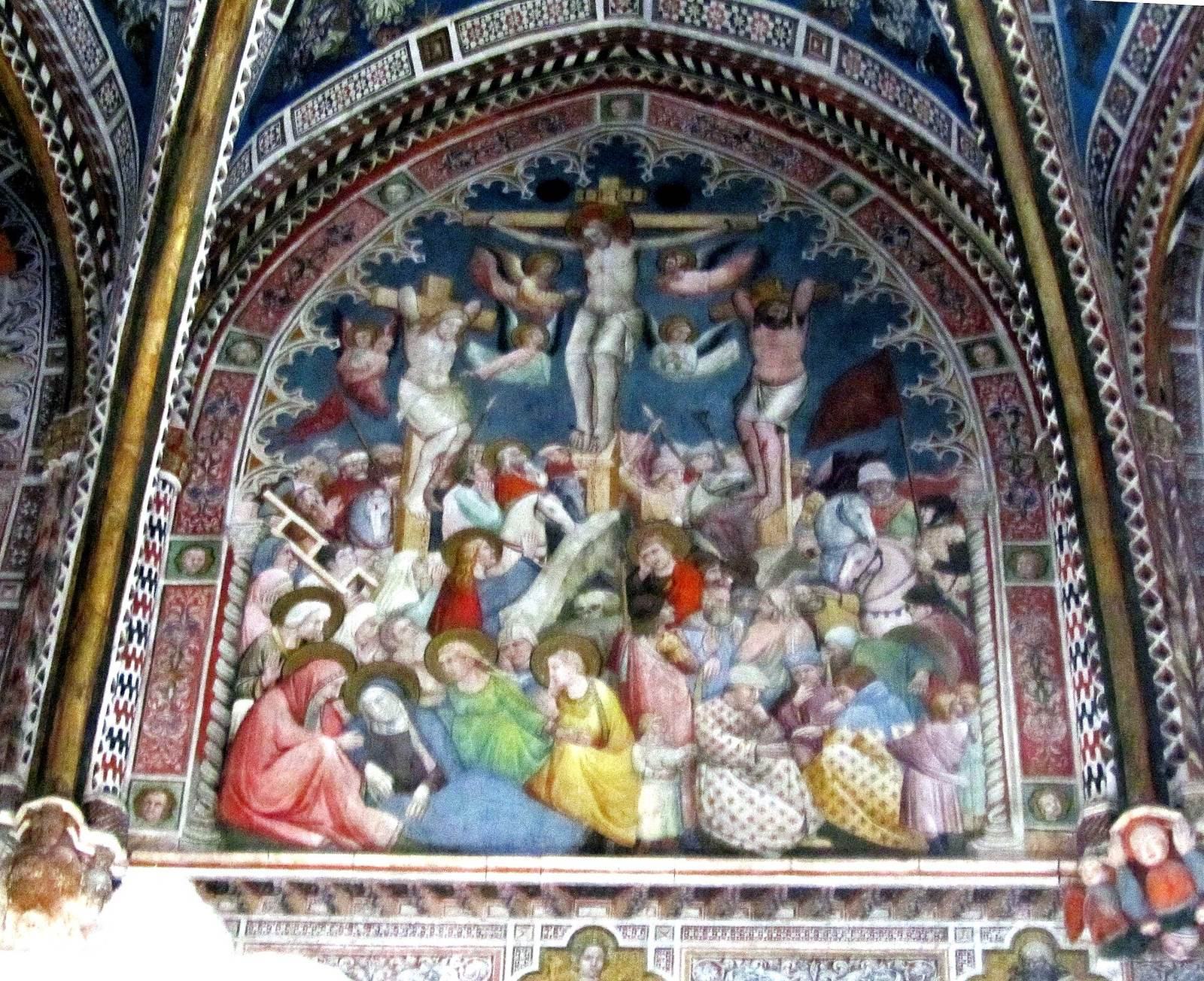
Above the cornice, fourteen scenes illustrate the Creed, a concise statement of Christian beliefs, in a sequence to be followed clockwise. On the west wall, Saints John and Luke read and write the Gospels; an inscription there translates as “In the beginning was the Word.” The cycle also includes the Annunciation, with God the Father, Mary in her chamber, and Gabriel. Opposite the entrance is the Crucifixion, probably based on a work by Antonio Veneziano preserved in the National Museum of San Matteo in Pisa.
On the north wall, the Adoration and Jesus before Caiaphas, the high priest associated with the proceedings against Jesus, lie to the left of the Crucifixion. The Entombment and the Descent from the Cross are to its right. The east wall preserves a fragment of the Ascension, whose complete composition included Saints Mark and Matthew, two of the four Evangelists traditionally associated with the canonical Gospels. On the south wall are Jesus seated at the right hand of God the Father, the Last Judgment, Pentecost, and the Resurrection of the dead. The cycle concludes on the west wall with the Transfiguration on Mount Tabor.
Paintings below the cornice
A separate Last Judgment is painted on the west wall between the cornice and the floor. The north wall shows saints, including a fairly complete image of Saint Anthony Abbot, an early Christian monk associated with the beginnings of monasticism, and images of Saint Blaise. On the south wall, Saint Peter heals the sick in a scene that may occupy a papal throne. Other paintings depict the Conversion of Saint Paul and the martyrdoms of Peter and Paul, with Peter crucified and Paul beheaded.
The chapel’s low position exposed its painted walls to persistent damp. The upper paintings retain more of their original freshness, while the lower paintings are more heavily damaged.