Cembalo: A Genoese Fortress in Crimea, Ukraine




Site at a Glance
- Rating
- 4.8
- Popularity
- Medium
- Country
- Ukraine
- Primary era
- Medieval
- Eras represented
- Medieval
- Civilizations
- Genoese
- Site type
- Military
- Remains
- Fort
On this page14 sections
History
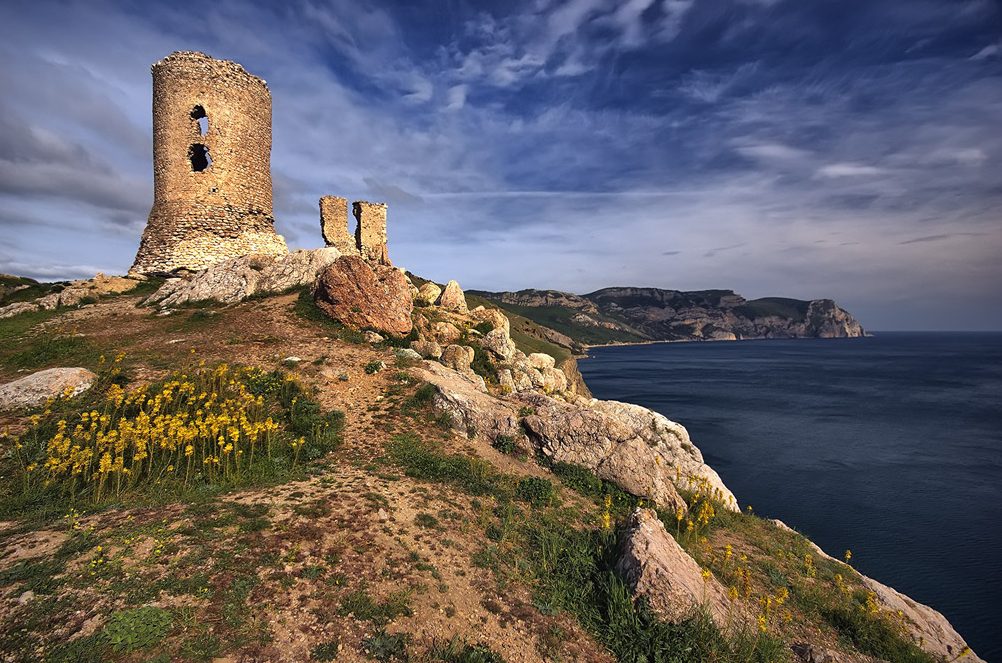
Cembalo is a Genoese fortified trading post and administrative center in Ukraine, overlooking the eastern entrance to Balaklava Bay. The Genoese established it around 1343 after taking control of an earlier Greek or Byzantine settlement, creating one of their fortified colonies in the Black Sea region known as Gazaria. The bay was associated in antiquity with Symbolon Limen, a settlement and harbor whose name was understood as “Harbor of Prophecies” or “Harbor of Symbols.” The Genoese rendered that name in Italian form as Cembalo.
Before the Genoese
The site’s earlier history included a settlement associated with the Taurians, possession by Chersonesus Taurica in the second century BC, and Byzantine control in the fifth century AD. A small Byzantine fortress stood here in the sixth century. Later, a Greek fishing settlement became part of the Orthodox principality of Theodoro, a medieval Christian state in the Crimean mountains with a Greek administrative and cultural tradition. The earlier buildings were not preserved when the Genoese developed their own stronghold.
The Genoese consulate
The first Genoese defenses appeared around the middle of the fourteenth century. By the 1340s, the trading settlement was substantially built up, and a notarial act of 1344 records Genoese activity in the quarter of the Virgin Mary. In 1354, Janibeg, khan of the Golden Horde, captured and burned the existing fortifications and buildings. After a peace agreement, the Genoese recovered the mountain and rebuilt the fortress.
The rebuilt settlement had an Upper City, Saint Nicholas, which served as the administrative citadel, and a Lower or Outer City, Saint George, where artisans, merchants, and fishermen lived and worked. A port and market operated below the mountain beside the bay. The administration included two treasurers, a judicial vicar, a bishop, elders, a messenger, and trumpeters. Elected in Genoa for a one-year term, the consul held the principal executive and judicial authority and shared command of the garrison with the castellan of Saint Nicholas.
By the fifteenth century, the garrison included about forty crossbowmen. Its members included a barber, two trumpeters, and a police officer. Seven men under a commander maintained the permanent guard of the Upper City, while the consul apparently also had several Tatar cavalrymen as a personal guard. The Cembalo consulate probably extended across several nearby settlements and included the remains of Chersonesus Taurica.
Conflict with Theodoro
Cembalo was drawn into repeated conflicts with Theodoro in the early fifteenth century. Theodorite forces captured the fortress in 1423, but the Genoese soon retook it. They strengthened Cembalo in 1424 and 1425, while Theodoro restored and fortified nearby Kalamita.
A local revolt enabled Theodoro to recover Cembalo in 1433 or 1434. In June 1434, a Genoese expedition of about 6,000 mercenaries, commanded by the knight Carlo Lomellino, stormed the fortress. The assault has been described as the first use of artillery in Crimea. The city was looted, almost all the besieged Theodorites were killed, and their commander Olou-bey was captured.
Reconstruction and Ottoman conquest
In 1453, Genoa’s Senate transferred Cembalo, Kaffa, other Crimean castles, and their surrounding estates to the Bank of Saint George, a Genoese financial institution that administered property pledged against debts. Support from the bank helped finance a major rebuilding campaign between 1464 and 1467. The work strengthened the outer defenses, rebuilt the citadel, and produced the great donjon, the principal fortified tower of a castle or fortress.
The Genoese abandoned the fortress without a battle several years before the Ottoman conquest, faced with the Ottoman army’s numerical and technical superiority. Ottoman forces captured Cembalo in 1475, installed a garrison, and incorporated it first into an Ottoman sanjak, an administrative district, and later into an eyalet, a larger Ottoman province. Under Ottoman rule, the fortress received a name meaning “Fish’s Nest,” later rendered as Balaklava.
The fortress gradually lost strategic importance and declined during the eighteenth century. Crimean khans who opposed the Ottoman sultan were sometimes imprisoned there, and Zaporozhian and Don Cossacks attacked it repeatedly. After Russia annexed Crimea in 1783, soldiers were quartered within the fortress grounds. This military use did not prevent the continuing deterioration of the site.
War, archaeology, and conservation
During the Crimean War, the donjon was partly destroyed and never fully rebuilt. Terraces on the eastern slope still mark the camp occupied by Italian troops during the 1854 Battle of Balaklava. After the 1917 Revolution and the Civil War, the site’s infrastructure was nationalized under Soviet rule.
During the Second World War, Cembalo and Balaklava stood at the southern end of the Soviet-German front after the German and Romanian occupation of Crimea in October 1941. The area remained occupied for eight months. The garrison defended Cembalo from 5 to 6 May 1944 during the fighting to liberate Sevastopol. The donjon suffered major damage in summer 1942 and spring 1944, while the fortress sustained further wartime destruction and later losses through stone extraction.
Systematic archaeological study of the fortifications and residential areas began in 2002 under the Southern Crimean Archaeological Expedition of the State Hermitage, led by Svetlana Adaksina. Restoration work on a tower took place from 2004 to 2007, and scientific restoration of the donjon was also undertaken before the 2014 occupation of Crimea. On 18 July 2008, heavy rain caused part of the donjon tower to collapse. Cembalo is now a ruin.
The fortress is protected as an architectural and cultural-heritage monument. In 2010, Ukraine placed it on its Tentative List for a World Heritage nomination concerning Genoese trading posts and fortifications from the Mediterranean to the Black Sea. The nomination work, prepared with Italy and later joined by Turkey and Greece, was suspended after the 2014 occupation of Crimea. Cembalo’s later cultural history also includes Adam Mickiewicz’s sonnet 17, devoted to its ruins in his Crimean cycle published in 1826.
Remains
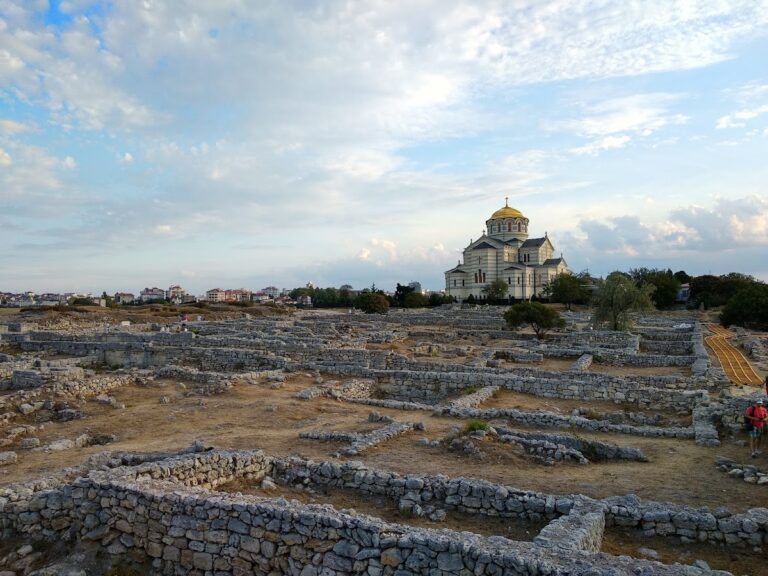
Cembalo occupies the summit and slopes of Fortress Mountain, formerly called Castron, above the eastern entrance to Balaklava Bay. The surviving complex consists of defensive and retaining walls, the remains of four towers, and the ruins of a church. Its layout follows the mountain’s steep form, with the Upper City on the summit, the Lower City on the slopes, and the port and market below beside the bay.
Early defenses and the two cities
The earliest Genoese defenses crossed the northern slope. A ditch and bank were reinforced with a wooden palisade, while a stone tower and gateway protected the northeastern side. Traces of these early works remain on the northern slope.
The Upper City of Saint Nicholas formed the citadel. A cliff protected one side, while strong walls with eight towers defended the other. Two of those towers stood separately rather than being joined to the walls. The Upper City contained the consul’s castle-tower, probably about 15 metres high, a massaria, or customs house, a church that probably served as a burial place for prominent residents, and a town hall.
The Lower City of Saint George extended down the mountain slope. Three lines of walls enclosed it on the northeastern, western, and southern sides, with six towers and additional protection from a southern cliff. Its artisans, merchants, and fishermen were based above the port and market, which occupied the shore beside the bay.
Citadel towers and water systems
The great donjon
During the reconstruction of the 1460s, the defenses of Saint George were rebuilt and a citadel with a powerful donjon was erected at a high point of the fortress. The tower survives to its full stated height of about 20 metres. Its four levels served different purposes: the lowest held a water cistern, the second an arsenal, the third a residential room with remains of a fireplace, and the upper level a lookout. The tower may also have functioned as a lighthouse.
The consular water supply
Clay piping carried water to the donjon’s cistern from the Képhalo-Vrissi spring at the head of a ravine of the same name on Mount Spilia. A similar water-collecting cistern probably occupied the lower level of the consular tower. The spring remains associated with Balaklava’s water supply. Its name means “head” or “beginning of the spring,” while Spilia refers to a cave.
Religious remains and the Virgin fresco
Churches of the fortress
At least five religious buildings have been excavated or identified within the fortress. Their presence reflects the changing religious and political history of the city. The church from which a recovered fresco of the Virgin came has not been securely identified.
The Hodegetria fresco
In 2004, archaeologists recovered a cache of wall-painting fragments from a small pit in the eastern corner of the courtyard of the barbican of Tower 2. The fragments had been wrapped in cloth and concealed there, probably after the Ottoman conquest in 1475 to protect the image from destruction.
The restored fresco shows the Virgin Hodegetria, a Christian image type in which the Virgin presents or directs attention toward the Christ Child. The half-length composition is set beneath a pointed arch measuring 0.97 by 1.10 metres. The figures stand against a dark background framed by red fields with white edging. The Virgin turns and leans toward the Child, whose pose differs from the usual strictly frontal arrangement.
Greek-letter abbreviations for Jesus Christ and the Mother of God appear above the figures. The Virgin wears an ochre-gold halo outlined in dark red and white, a purple-brown maphorion decorated with three symbolic stars and yellow-gold fringe, a blue head covering, and a gray-blue tunic. Much of the Child’s dark-red mantle and light-green chiton has been lost, while a broad sleeve and folds of the himation survive with a bright ochre ornamental border.
The painting was probably made using a mixed fresco-and-tempera technique. Natural pigments mixed with limewater were applied to wet plaster, and upper layers were added to the dry surface with tempera paints, probably using wheat or barley glue as a binder. Its style belongs to the traditional Greek painting of the Palaiologan period, the later Byzantine artistic tradition associated with the Palaiologos dynasty and Constantinople. The fresco is described as unique, with no direct parallels among medieval monumental paintings in Crimea or beyond. It was restored in the field in 2004 and under permanent conditions in spring 2005 at the Chersonesus Taurica National Reserve, then exhibited there from 25 August to 15 September 2017.