Caves of Valerón: Indigenous Collective Granary on Gran Canaria
Site at a Glance
- Popularity
- Medium
- Country
- Spain
- Primary era
- Medieval
- Eras represented
- Medieval
- Civilizations
- Unclassified
- Site type
- Economic
- Remains
- Warehouse
On this page9 sections
History
The Caves of Valerón are a cliffside collective granary on Gran Canaria, Spain, used by the island’s Indigenous inhabitants from the thirteenth through the fifteenth centuries. Use may have continued after the European conquest of Gran Canaria in the late fifteenth century.
Agriculture and Granary Use
The complex’s scale reflects the importance of agriculture to Gran Canaria’s food supply and social and political organization, including the influence of its governing elite. Granaries across the island point to an economy that combined livestock raising with farming, especially cereal cultivation. Gran Canaria relied more heavily on agriculture than other Canary Islands, where livestock raising was the stronger emphasis, and grain was among its main crops.
Changing Interpretation and Conservation
The name “monastery” arose from a romantic theory that the caves housed celibate priestesses called harimaguadas, alongside young women of noble status who lived with them until marriage. This explanation persisted into the twentieth century. French archaeologist Guy Marcy is credited with first identifying the caves as a granary, drawing comparisons with the agadir, a North African communal granary with shared storage and individually maintained chambers, and with chronicles describing food silos on hard-to-reach cliffs. Many archaeological materials from the site are incomplete, and many were found in the nineteenth century. Later archaeological study and dating helped establish the period of use.
In 1978 the caves were declared a Historic-Artistic Monument. Under Spain’s 1985 heritage law, they became a Property of Cultural Interest in the archaeological-site category. A major restoration in 2010 rehabilitated the historic San Felipe footpath, formerly used by local people to reach the caves.
Remains
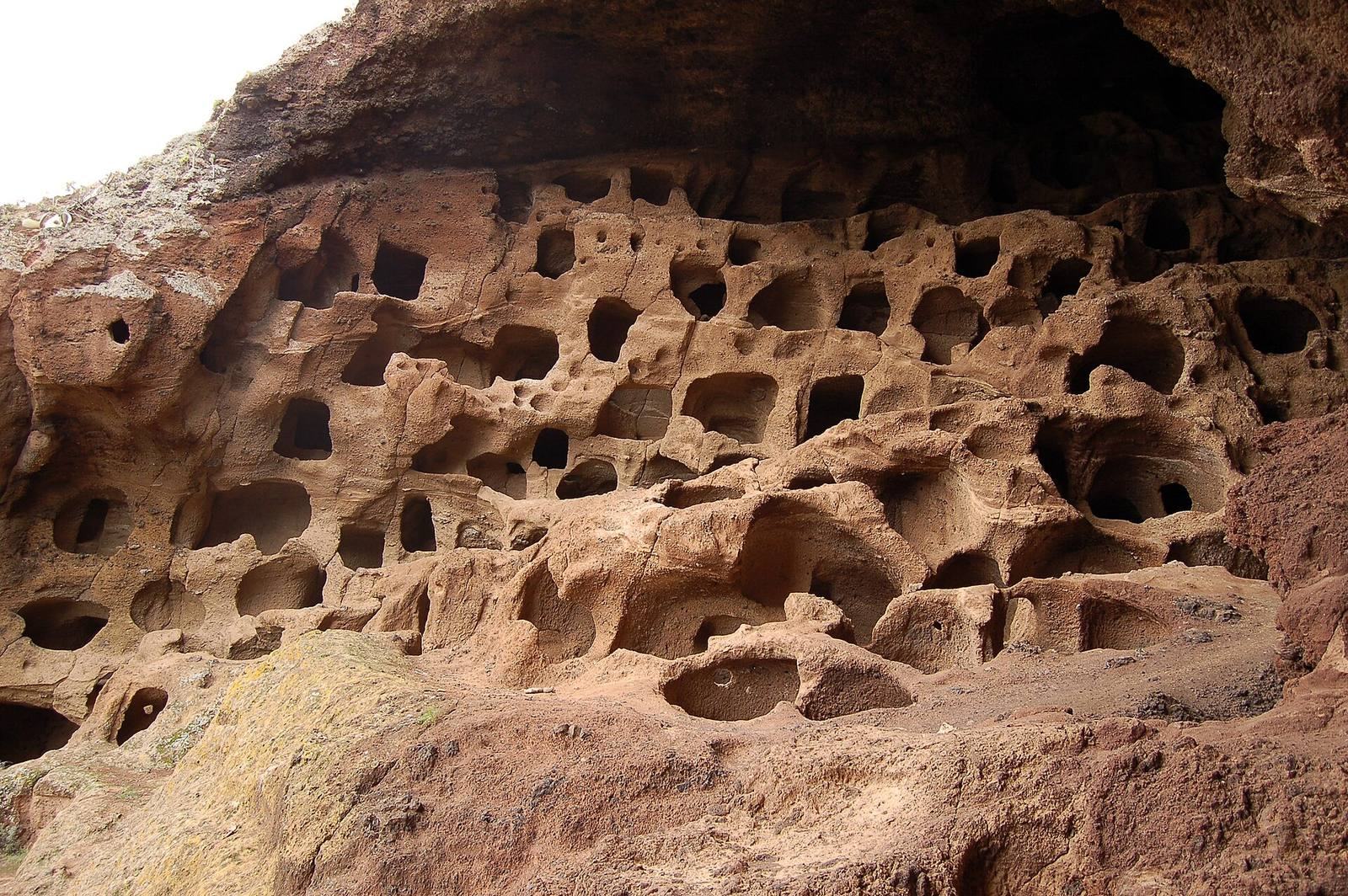
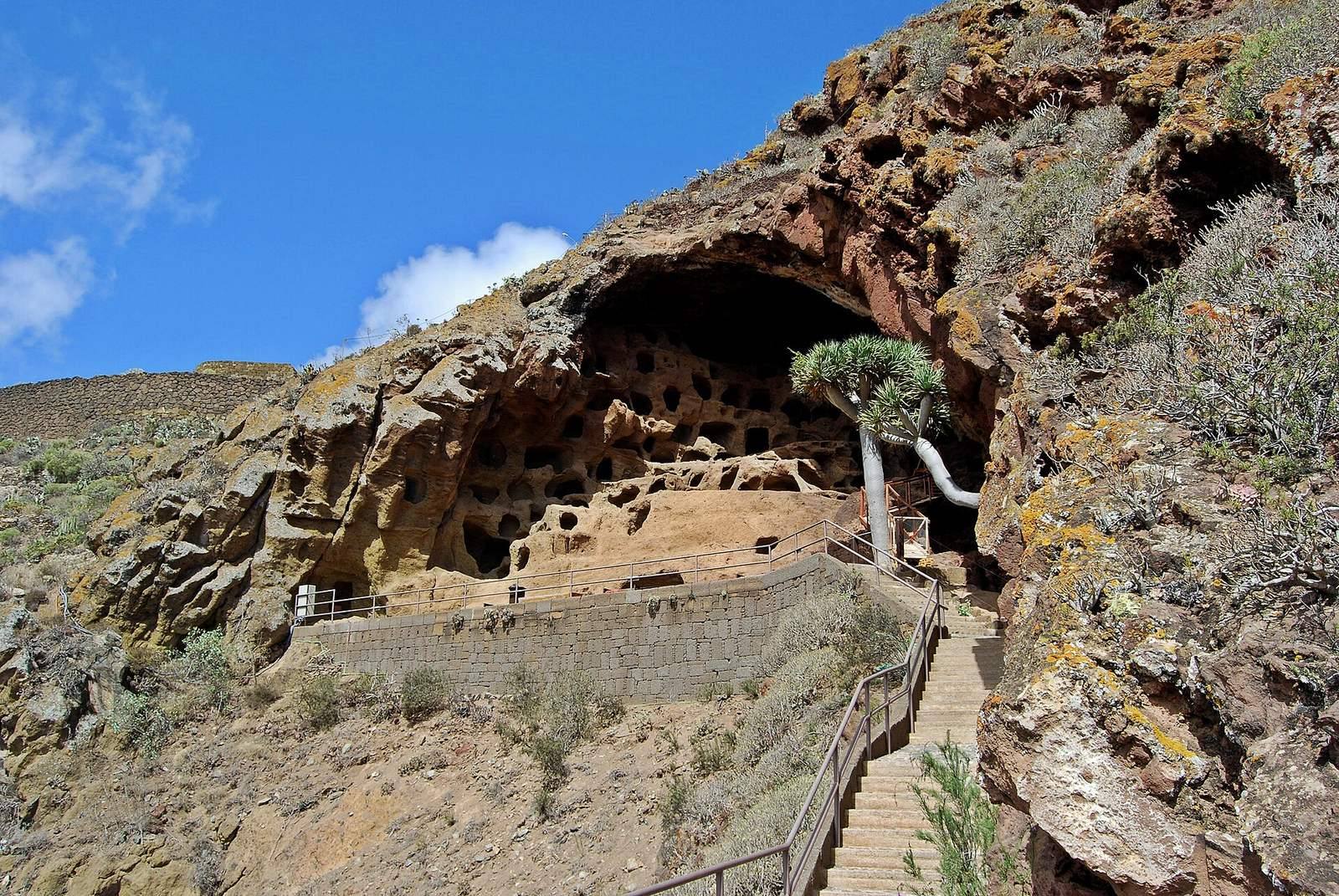
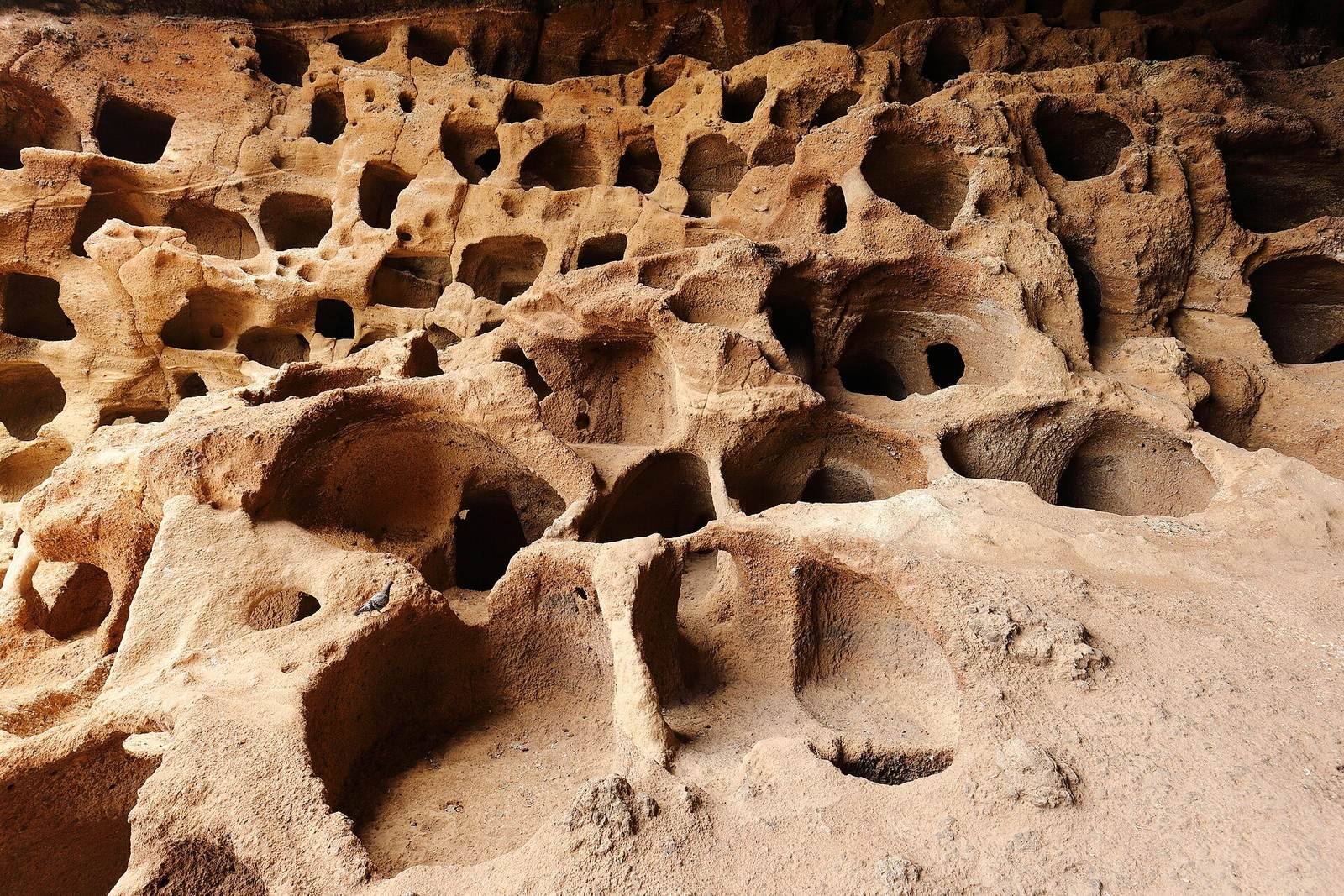
The Caves of Valerón form a network of rock-cut storage spaces on a steep cliff beneath a natural arch. The chambers and cavities were excavated in soft volcanic tuff, consolidated volcanic material that can be cut when soft.
Cliff Setting
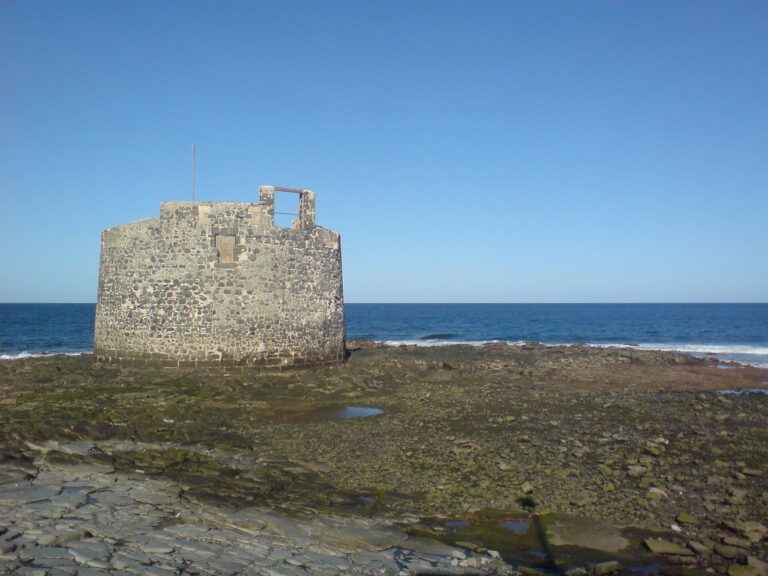
The complex occupies the Valerón ravine on the northwestern face of Montaña del Gallego, overlooking the north-facing, funnel-shaped San Felipe ravine. It lies about 600 metres south of Gran Canaria’s northern coast. The site is concealed from the sea, and its steep approaches provided a defensive setting. The natural rock arch offered shelter, while the location’s temperature and humidity suited storage. Towers reportedly framed the caves at the time of the Spanish conquest.
Chambers and Access
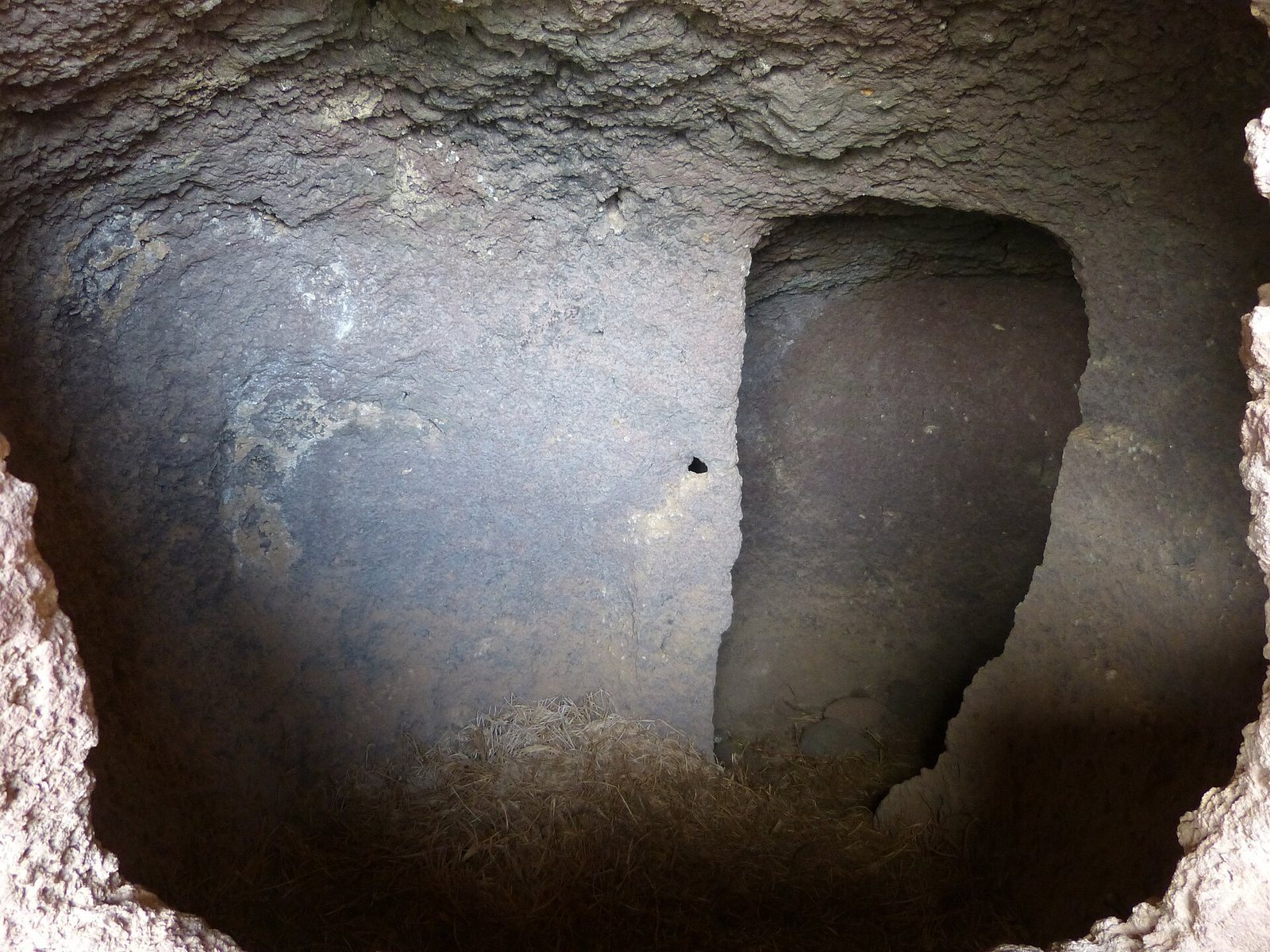
The complex contains 298 compartments, each measuring between one and three square metres, arranged across eight levels. Including silos, rooms, caves and cavities, it has more than 350 storage spaces. Chambers differ in shape and size; some connect, while groups occupy tiers one above another. Stone and wooden tools were used to cut the spaces into the tuff. Rock-cut steps survive, and ladders, scaffolding or ropes may also have helped people reach the chambers.
Doors and Crop Protection
Marks around the openings indicate that doors once closed the chambers, although their material is uncertain. A few stone slabs survive; doors may also have been made from wood, textiles or leather. If wooden doors were used, a pintadera, a small patterned stamp or seal, may have been applied to show ownership. Ash mortar was also used to seal openings and grooves, apparently to protect the stored crops.
Finds and Stored Crops
Finds from the caves include idols, ceramics, human bones and ashes. The bones and ashes are thought to have belonged to people who guarded the granary. Barley and wheat fragments, including whole grains with cut marks, indicate that cereals were stored as ears. Taphonomic analysis, the study of changes to biological remains after deposition, and the good preservation of material in the silos have helped identify plant species and families also found in other collective granaries on Gran Canaria.
Tools and Pintaderas
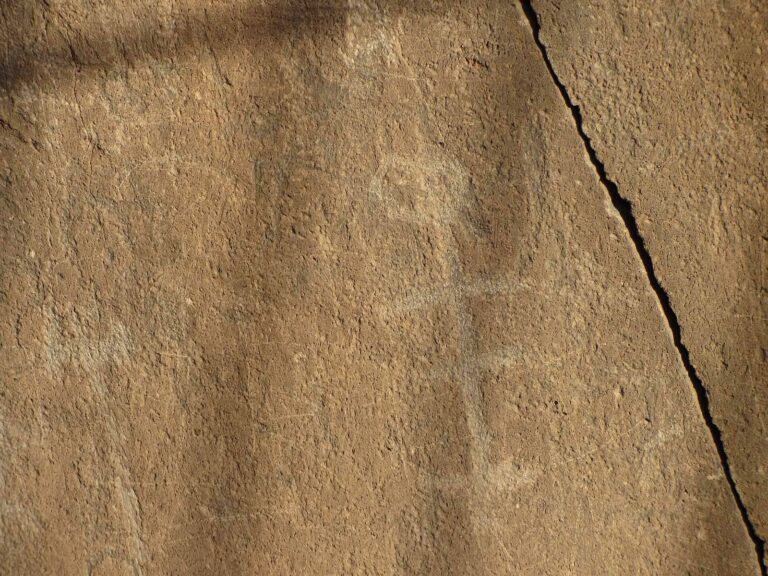
Stone tools may have been used to work wood, gather plant resources or carve the tuff. Stone grinding tools may have served to process domestic plants such as wheat and barley. Small geometric pintaderas have also been found. They may have marked granaries or ownership; another interpretation is that they encoded language and supplemented Libyco-Berber inscriptions, an ancient North African writing system.